When writing about caste based reservation, it’s important to understand how it supports certain social groups to get equal chances in education and jobs. This essay on caste based reservation explains its meaning, purpose, benefits, challenges, and effects on society. It’s written in 500 words to help students with school assignments or exams. You can download this caste based reservation essay as a free PDF or image to read, study, or print.
10 Lines Caste Based Reservation Essay for Class 2 to Class 5
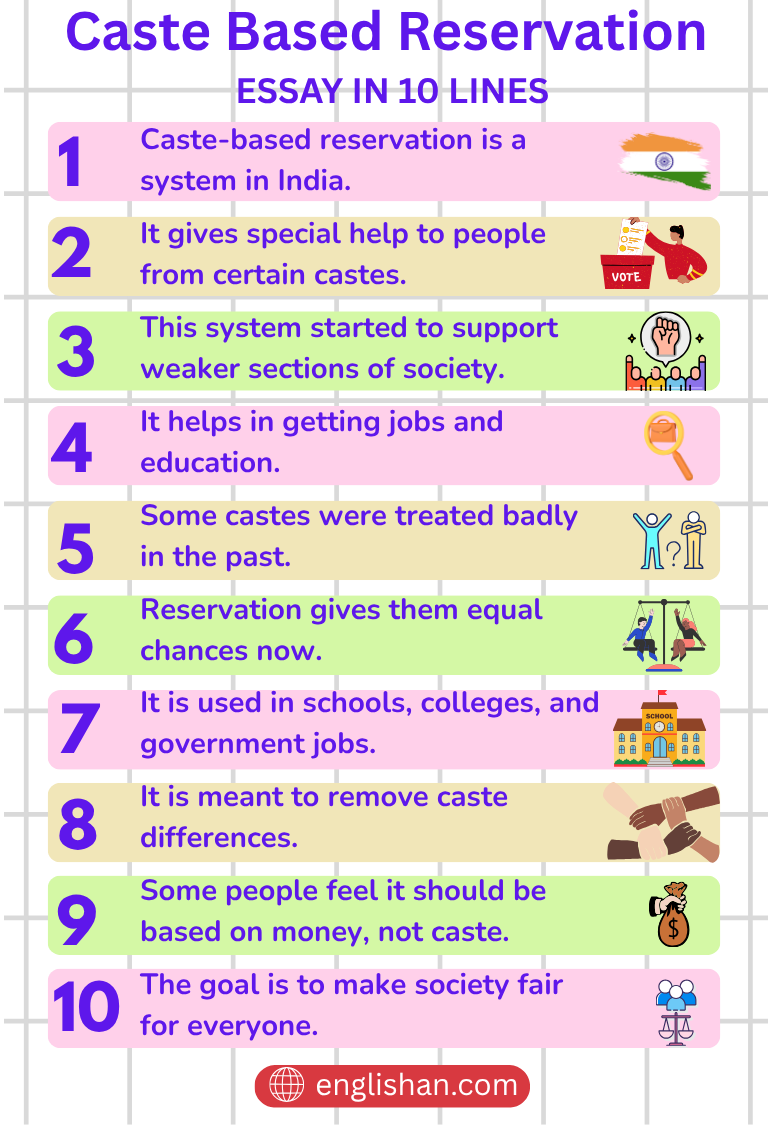
- Caste-based reservation is a system in India.
- It gives special help to people from certain castes.
- This system started to support weaker sections of society.
- It helps in getting jobs and education.
- Some castes were treated badly in the past.
- Reservation gives them equal chances now.
- It is used in schools, colleges, and government jobs.
- It is meant to remove caste differences.
- Some people feel it should be based on money, not caste.
- The goal is to make society fair for everyone.
250 Words Essay on Caste Based Reservation for Middle School
Caste-based reservation is a policy in India that helps people from backward or disadvantaged castes. It was started to correct the injustice and unfair treatment that certain castes faced for many years. People from Scheduled Castes (SC), Scheduled Tribes (ST), and Other Backward Classes (OBC) are given reserved seats in schools, colleges, and government jobs.
The main goal of this system is to provide equality and justice. In the past, many people from lower castes were not allowed to go to school or work in good jobs. Reservation helps them to grow and improve their life.
This system gives more opportunities to those who were left behind. It tries to bring everyone to the same level. For example, if two students apply for college, one from a reserved category might get selected even with lower marks to support equal chances.
However, some people feel that reservation should be given based on income and not caste. They believe that poor people from all castes also need support. Others believe that the caste system is still strong in many places, so reservation is still needed.
In conclusion, caste-based reservation is an important step to reduce social inequality. But it should be used wisely to make sure it helps those who truly need it.
500 Words Caste Based Reservation Essay for Upper Primary and Lower Secondary
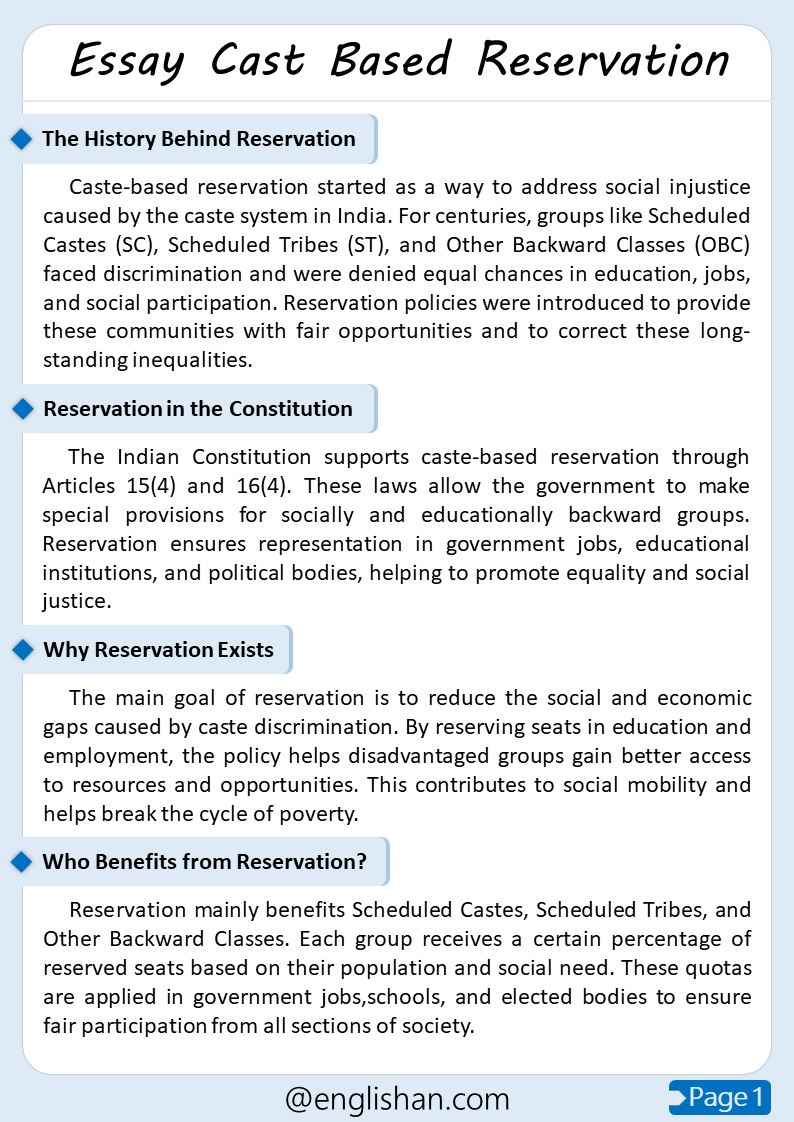
The History Behind Reservation
Caste-based reservation started as a way to address social injustice caused by the caste system in India. For centuries, groups like Scheduled Castes (SC), Scheduled Tribes (ST), and Other Backward Classes (OBC) faced discrimination and were denied equal chances in education, jobs, and social participation. Reservation policies were introduced to provide these communities with fair opportunities and to correct these long-standing inequalities.
Reservation in the Constitution
The Indian Constitution supports caste-based reservation through Articles 15(4) and 16(4). These laws allow the government to make special provisions for socially and educationally backward groups. Reservation ensures representation in government jobs, educational institutions, and political bodies, helping to promote equality and social justice.
Why Reservation Exists
The main goal of reservation is to reduce the social and economic gaps caused by caste discrimination. By reserving seats in education and employment, the policy helps disadvantaged groups gain better access to resources and opportunities. This contributes to social mobility and helps break the cycle of poverty.
Who Benefits from Reservation?
Reservation mainly benefits Scheduled Castes, Scheduled Tribes, and Other Backward Classes. Each group receives a certain percentage of reserved seats based on their population and social need. These quotas are applied in government jobs, schools, and elected bodies to ensure fair participation from all sections of society.
The Debate Around Reservation
Reservation policies have sparked debates. Critics say reservation may prioritize caste over merit, potentially affecting standards in education and employment. Some believe it leads to unfair treatment of candidates outside reserved categories. However, supporters argue that reservation is necessary to correct deep-rooted social inequalities and provide a level playing field for marginalized groups.
Positive Effects of Reservation
Reservation has helped improve literacy rates and economic conditions among disadvantaged communities. It has increased their presence in government services and educational institutions, fostering greater social inclusion. Many individuals and families have benefited from the opportunities created by reservation, though progress is uneven across different regions and groups.
Problems in Applying Reservation
Reservation faces several challenges. Sometimes, quotas are misused by those who do not belong to disadvantaged groups. Social stigma and lack of awareness prevent some from using their reserved opportunities. Monitoring and transparent implementation are needed to ensure the policy benefits the intended groups.
Suggestions to Improve Reservation
Experts suggest reforms such as including economic criteria to select beneficiaries, regularly reviewing reservation quotas, and providing support to economically weaker sections regardless of caste. These changes aim to make the system more fair and effective while addressing current social realities.
Reservation’s Role in Unity
Some people fear that caste-based reservation divides society along caste lines. However, many believe it promotes unity by ensuring all groups have representation and equal opportunities. Reservation helps build a more balanced society by addressing historic discrimination and encouraging social cohesion.
The Future of Reservation
The future of reservation depends on adapting to changing social conditions. Combining affirmative action with merit-based opportunities is essential. The ultimate goal is to reduce reliance on reservation by eliminating the root causes of inequality and discrimination.
Conclusion of Caste Based Reservation Essay
Caste-based reservation remains a vital tool for social justice in India. It has provided many marginalized groups with opportunities to improve their lives. However, continuous review and reforms are necessary to maintain fairness and efficiency. Balancing equality with merit will help build an inclusive society where everyone can succeed.
Difficult Words used in 500 Caste Based Reservation Essay
| Word | Meaning |
|---|---|
| Marginalized | Treated as unimportant or excluded |
| Systemic | Related to a whole system or structure |
| Hierarchy | A ranked order of power or status |
| Quotas | Fixed shares set aside for certain groups |
| Disparities | Differences or inequalities |
| Reverse discrimination | Unfair treatment of majority groups to benefit minorities |
| Meritocracy | System where people advance based on skill or ability |
| Implementation | Putting a plan or law into effect |
| Empower | To give power or confidence |
| Inclusive | Including everyone fairly |
| Allocation | Distribution of resources |
| Cohesion | Unity or sticking together |
| Affirmative action | Policies supporting disadvantaged groups |
| Demographic | Characteristics of a population |
Caste Based Reservation Essay PDF
You May Also Like