A car wheel does more than roll; it combines several parts of a car wheel that carry weight, absorb road impact, and transfer motion from the axle to the ground. When you talk about rotation, alignment, or tire fitting, the explanation loses precision if names like rim, hub, or lug nuts are used loosely.
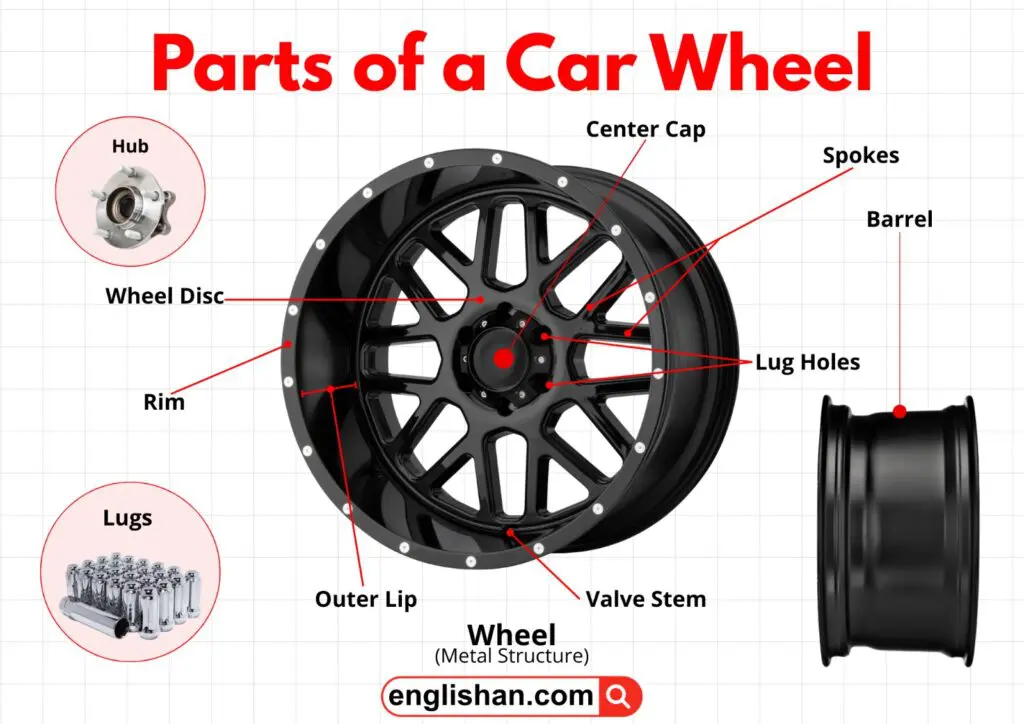
This guide covers the parts of a passenger car wheel with a focus on standard vehicles. You will find the tire, rim, hub, spokes, valve stem, lug nuts, wheel bearing, and brake rotor where visible through the wheel design. The labeled diagram below connects each name to its exact position.
List Of Car Wheel Parts With Names
A car wheel assembly includes the metal wheel structure and the tire built around it. Below is a complete, well-ordered list arranged from the central mounting area outward to the road contact surface. This order follows how force moves from the vehicle to the road.
- Hub
- Lug
- Lug Holes
- Wheel Disc
- Center Cap
- Spokes
- Barrel
- Rim
- Outer Lip
- Valve Stem
- Tire
- Beads
- Bead Filler
- Inner Liner
- Radial Cord Body (Body Plies)
- Belt Plies
- Sidewall
- Tread
Car Wheel Parts Diagram With Names
A car wheel assembly is a rotating load-bearing system built from two major structures: the metal wheel and the tire. The wheel provides rigid support and mounting strength, while the tire delivers traction and cushioning. Rotational force moves from the axle through the hub, into the wheel, and finally through the tire into the road surface. Every part contributes to balance, structural durability, and stable road contact.
Wheel And Rim Parts
The wheel is the rigid component that connects directly to the vehicle’s hub and supports the tire under continuous stress. It must tolerate vertical load, lateral cornering force, and braking heat without deforming.
Wheel
The wheel is the complete metal assembly that mounts onto the hub and carries the tire. It provides:
- Structural strength
- Rotational stability
- Load distribution
- Brake heat dissipation
It fastens to the hub using lug hardware at its center mounting section.
Rim
The rim is the outer circular edge of the wheel that secures the tire. It forms the mounting surface that locks the tire bead and maintains air pressure integrity.
Barrel
The barrel is the cylindrical inner section that supports the tire’s internal structure. It maintains rigidity under load and helps preserve rotational balance.
Outer Lip
The outer lip reinforces the rim edge and protects the tire bead from impact damage. It forms the visible outer edge of the wheel.
Spokes
Spokes connect the central mounting area to the rim. Their design balances strength and weight reduction while improving airflow around braking components.
They extend outward from the center hub area toward the rim.
Wheel Disc
The wheel disc forms the central mounting plate. It distributes clamping force from the lug fasteners and ensures secure hub alignment.
Center Cap
The center cap covers the exposed hub opening and shields internal components from dust and moisture while completing the wheel’s exterior finish.
Hub
The hub serves as the mechanical interface between the wheel and axle. It contains bearings that allow smooth rotation and proper alignment.
It occupies the central position within the wheel assembly.
Lug
Lugs clamp the wheel firmly against the hub surface. Proper torque ensures stable attachment during acceleration and braking.
Lug Holes
Lug holes are precision-drilled openings in the wheel disc. They align with hub studs for secure fastening.
Valve Stem
The valve stem allows air inflation and pressure regulation inside the tire. It maintains internal pressure and supports monitoring systems.
It passes through an opening in the rim wall.
Tire Parts
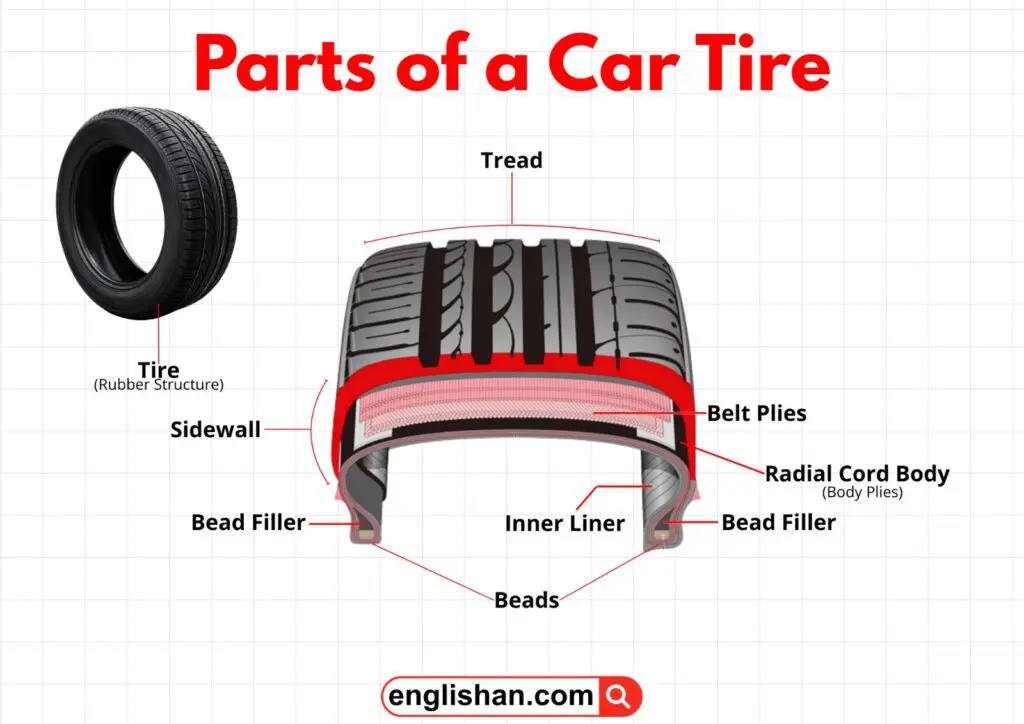
The tire is a flexible composite structure designed to grip the road while absorbing impact. It combines rubber compounds with reinforced layers to balance traction, durability, and structural strength.
Tire
The tire surrounds the rim and forms the contact surface with the road. It supports:
- Road traction
- Impact absorption
- Load cushioning
- Stability under braking
It seals against the rim at the bead area.
Tread
The tread is the patterned outer layer that directly contacts the road. Its design improves:
- Grip on dry surfaces
- Water evacuation in wet conditions
- Braking performance
It forms the outer rolling surface of the tire.
Sidewall
The sidewall connects the tread to the bead and allows controlled flex. It absorbs lateral forces and displays tire specifications.
It spans the section between tread and bead.
Belt Plies
Belt plies are reinforced layers beneath the tread. They stabilize the tire at high speeds and reduce tread distortion.
They sit directly under the tread layer.
Inner Liner
The inner liner is an airtight rubber layer inside the tire. It prevents air leakage and maintains pressure without a separate tube.
Beads
The beads are steel-reinforced rings that secure the tire to the rim. They ensure:
- Airtight sealing
- Stable mounting
- Resistance to slippage
They rest against the rim flanges at the tire’s inner edge.
Bead Filler
The bead filler strengthens the lower sidewall area and improves steering response by increasing stiffness near the bead region.
Radial Cord Body (Body Plies)
The radial cord body forms the internal structural framework of the tire. These fabric layers provide:
- Flexibility under load
- Strength against internal pressure
- Impact resistance
They extend from bead to bead beneath the tread and sidewall.
Key Takeaway
A car wheel assembly functions as a combined structural and traction system. The wheel structure supports mounting and rotation, while the tire structure delivers grip and cushioning. The hub and lugs secure the assembly to the axle, spokes and rim maintain balance, and reinforced tire layers manage load and pressure. Though materials and designs vary, all components work together to support rotation, braking force, and stable road contact.
You May Also Like
- Parts of a Car
- Parts Of A Car Interior
- Parts of a Car Door
- Parts of a Door Knob
- Bicycle Parts Names
- Parts of a Bike