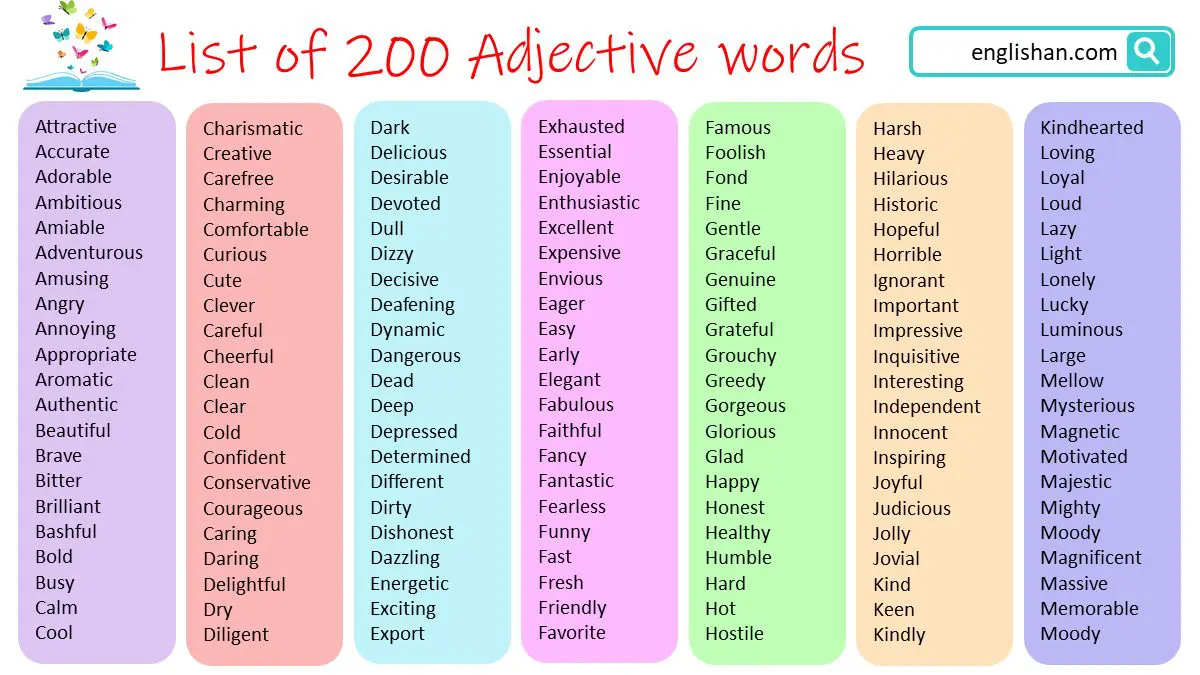
An adjective names a quality, quantity, or character of a noun or pronoun: tall building, kind teacher, seven files, ancient temple. Learn this list of adjectives with their meanings, say the core words with their IPA pronunciation, and read each example sentence to see the word in use. To describe a person, choose adjectives of personality and feeling; to describe a place, choose words of size, age, and atmosphere. Positive adjectives praise, negative adjectives criticise, and every letter from A to Z has its own set of adjectives.
List Of Adjectives With Meanings
These are the adjectives that carry most of everyday English, from feelings and size to quality and character. Each one comes with its pronunciation and a sentence.
Able /ˈeɪ.bəl/: Having the skill or means to do something.
- She is able to solve the problem in seconds.
Ancient /ˈeɪn.ʃənt/: Extremely old, belonging to a distant past.
- The museum holds an ancient stone carving.
Angry /ˈæŋ.ɡri/: Filled with strong displeasure.
- He gave her an angry look.
Bold /boʊld/: Showing courage or strong confidence.
- The reporter asked a bold question.
Bright /braɪt/: Giving off strong light, or intelligent and quick-thinking.
- The child has a bright mind.
Busy /ˈbɪz.i/: Occupied with work or activity.
- The station stays busy through the evening.
Calm /kɑːm/: Quiet and free from disturbance.
- She spoke in a calm voice.
Careful /ˈkeər.fəl/: Paying close attention to avoid mistakes.
- He is careful with figures.
Cheap /tʃiːp/: Costing little money, or of low quality.
- They bought a cheap ticket.
Clever /ˈklev.ər/: Quick to understand and reason.
- Her clever reply ended the debate.
Cold /koʊld/: Having a low temperature.
- The coffee has gone cold.
Confident /ˈkɒn.fɪ.dənt/: Sure of oneself or of a fact.
- He gave a confident answer.
Cruel /ˈkruː.əl/: Causing pain without regret.
- The winter turned cruel by December.
Curious /ˈkjʊə.ri.əs/: Eager to learn or know.
- She asked a curious question about the painting.
Dark /dɑːrk/: Without light, or deep in colour.
- The room felt dark even at noon.
Deep /diːp/: Extending far down, or serious in nature.
- The lake is deep near the centre.
Delicious /dɪˈlɪʃ.əs/: Highly pleasant to taste.
- The soup was delicious.
Dry /draɪ/: Without moisture.
- The soil is dry after two weeks of heat.
Eager /ˈiː.ɡər/: Keen and enthusiastic about doing something.
- The students are eager to begin.
Elegant /ˈel.ɪ.ɡənt/: Graceful and refined in style.
- She wore an elegant black dress.
Empty /ˈemp.ti/: Containing nothing.
- The bus was empty by ten.
Excited /ɪkˈsaɪ.tɪd/: Filled with lively feeling.
- The crowd grew excited during the final minute.
Expensive /ɪkˈspen.sɪv/: Costing a large amount.
- That watch is too expensive for a student.
Famous /ˈfeɪ.məs/: Known by many people.
- She interviewed a famous novelist.
Fast /fɑːst/: Moving or acting at high speed.
- He drives a fast motorbike.
Fresh /freʃ/: Newly made or newly arrived.
- The bread is fresh from the oven.
Friendly /ˈfrend.li/: Kind and pleasant toward others.
- Our neighbour is friendly and always waves.
Full /fʊl/: Holding as much as possible.
- The jar is full of honey.
Generous /ˈdʒen.ər.əs/: Willing to give freely.
- He is generous with his time.
Gentle /ˈdʒen.təl/: Mild and kind in nature or touch.
- She has a gentle way with children.
Happy /ˈhæp.i/: Feeling or showing pleasure.
- They looked happy in the photograph.
Hard /hɑːrd/: Firm and solid, or difficult.
- The exam was hard for most of the class.
Heavy /ˈhev.i/: Weighing a great deal.
- The suitcase is too heavy for one hand.
Honest /ˈɒn.ɪst/: Truthful and sincere.
- She gave an honest review of the film.
Hot /hɒt/: At a high temperature.
- The tea is still hot.
Humble /ˈhʌm.bəl/: Modest about one’s abilities.
- The champion remains humble after every win.
Hungry /ˈhʌŋ.ɡri/: Needing food.
- The children came home hungry after the match.
Kind /kaɪnd/: Caring and considerate.
- A kind stranger returned the wallet.
Large /lɑːrdʒ/: Of great size.
- They live in a large house near the park.
Late /leɪt/: After the expected time.
- She arrived late for the interview.
Light /laɪt/: Not heavy, or bright with light.
- The bag feels light in one hand.
Loud /laʊd/: Making a great deal of sound.
- The music was too loud for the room.
Loyal /ˈlɔɪ.əl/: Firm in support of a person or cause.
- He has always been a loyal friend.
Modern /ˈmɒd.ən/: Belonging to the present time.
- The office has a modern design.
Narrow /ˈnær.oʊ/: Small in width.
- The lane is narrow and quiet.
Nervous /ˈnɜːr.vəs/: Worried or tense.
- She felt nervous before the first speech.
New /njuː/: Made or arrived recently.
- He bought a new bicycle last week.
Noisy /ˈnɔɪ.zi/: Making unwanted sound.
- The market is noisy on Saturdays.
Old /oʊld/: Having existed for a long time.
- An old radio sits on the shelf.
Peaceful /ˈpiːs.fəl/: Quiet and untroubled.
- The village is peaceful in the evenings.
Polite /pəˈlaɪt/: Showing respect through manners.
- He gave a polite refusal.
Popular /ˈpɒp.jə.lər/: Liked by many people.
- That song is popular this year.
Powerful /ˈpaʊ.ər.fəl/: Strong in effect or force.
- The engine is powerful for its size.
Proud /praʊd/: Pleased with one’s achievement.
- Her parents are proud of her results.
Quick /kwɪk/: Acting or moving in little time.
- He gave a quick reply.
Quiet /ˈkwaɪ.ət/: With little sound.
- The library was quiet by six.
Rich /rɪtʃ/: Holding much wealth.
- The soil is rich in this valley.
Round /raʊnd/: Shaped like a circle.
- The table is round and wooden.
Safe /seɪf/: Free from harm.
- The road is safe for cyclists.
Sharp /ʃɑːrp/: Having a fine edge or point.
- The knife is sharp enough for tomatoes.
Short /ʃɔːrt/: Of small length or height.
- The story is short but memorable.
Silent /ˈsaɪ.lənt/: Without any sound.
- The room was silent after the news.
Slow /sloʊ/: Acting at low speed.
- The train is slow this morning.
Small /smɔːl/: Of little size.
- A small dog followed us to the gate.
Smart /smɑːrt/: Intelligent, or well-dressed.
- She looks smart in her interview suit.
Soft /sɒft/: Pleasant to touch, not hard.
- The blanket is soft and warm.
Strong /strɒŋ/: Powerful in body or effect.
- He has strong hands from years of climbing.
Tall /tɔːl/: Greater than average in height.
- The tall runner won the final.
Warm /wɔːrm/: Pleasantly heated.
- The kitchen is warm on winter mornings.
Wet /wet/: Covered in liquid.
- The floor is wet near the door.
Wise /waɪz/: Having good judgement from experience.
- Grandfather gave wise advice about money.
List Of Adjectives From A To Z
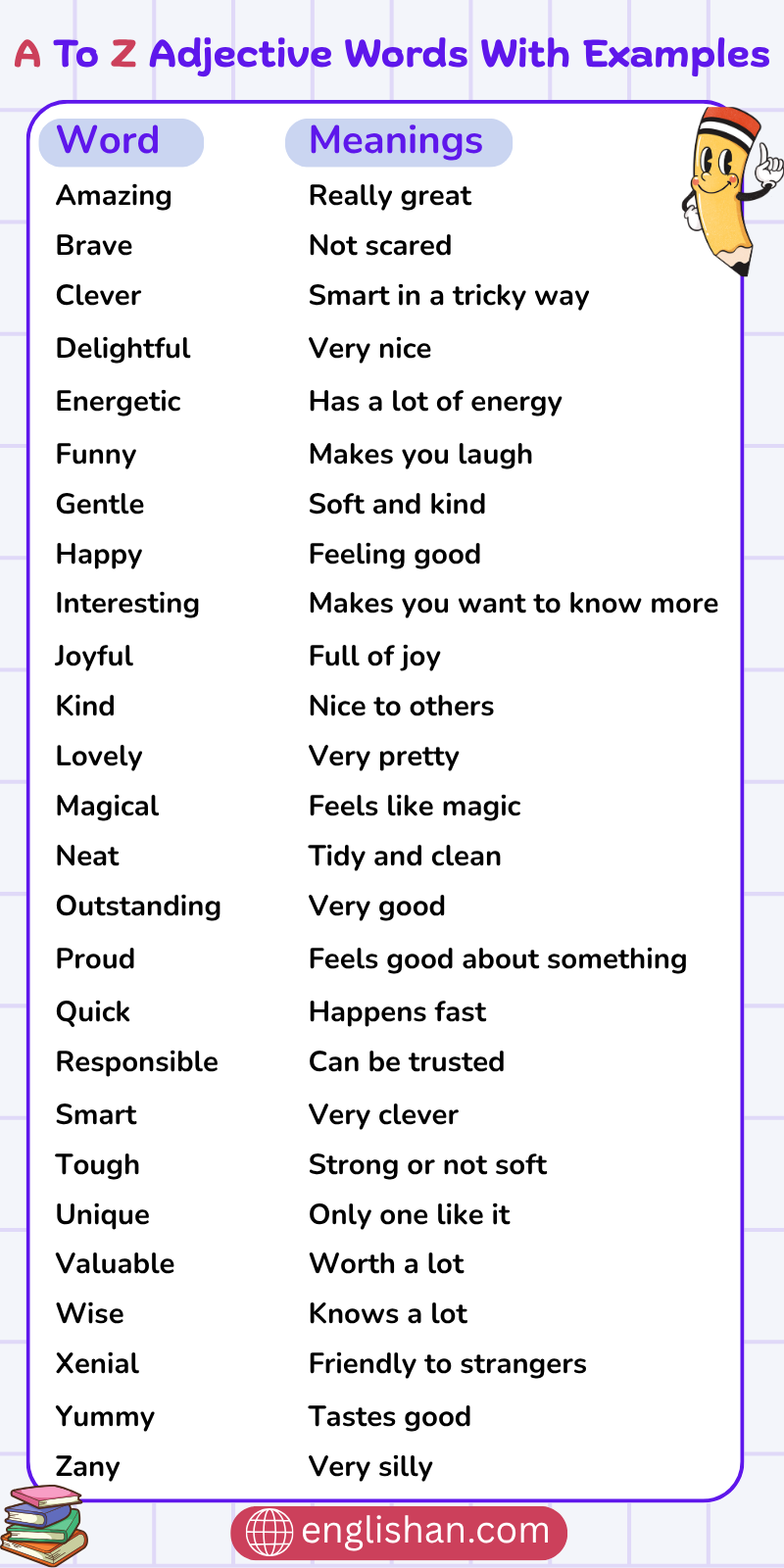
Common English adjectives fall under each first letter from A to Z.
Choose the first letter to open the complete list for that letter:
A · B · C · D · E · F · G · H · I · J · K · L · M · N · O · P · Q · R · S · T · U · V · W · X · Y · Z
Adjectives From A To F
List Of Adjectives Starting With A
| Adjective | Adjective | Adjective | Adjective |
|---|---|---|---|
| Able | Alert | Ancient | Awkward |
| Active | Amazing | Angry | |
| Adorable | Ambitious | Awake |
List Of Adjectives Starting With B
| Adjective | Adjective | Adjective | Adjective |
|---|---|---|---|
| Beautiful | Black | Brave | Broad |
| Big | Blue | Brief | Brown |
| Bitter | Bold | Bright | Busy |
List Of Adjectives Starting With C
| Adjective | Adjective | Adjective | Adjective |
|---|---|---|---|
| Calm | Certain | Chilly | Comfortable |
| Careful | Charming | Clever | Confident |
| Caring | Cheerful | Cold | Curious |
List Of Adjectives Starting With D
| Adjective | Adjective | Adjective | Adjective |
|---|---|---|---|
| Damp | Deep | Dense | Diligent |
| Dangerous | Delicate | Different | Dry |
| Dark | Delicious | Difficult | Dusty |
List Of Adjectives Starting With E
| Adjective | Adjective | Adjective | Adjective |
|---|---|---|---|
| Eager | Elegant | Enormous | Excellent |
| Early | Empty | Entire | Exciting |
| Efficient | Energetic | Equal | Expensive |
List Of Adjectives Starting With F
| Adjective | Adjective | Adjective | Adjective |
|---|---|---|---|
| Faint | Famous | Fearless | Firm |
| Fair | Fancy | Fierce | Foreign |
| Faithful | Fast | Fine | Fresh |
Adjectives From G To L
List Of Adjectives Starting With G
| Adjective | Adjective | Adjective | Adjective |
|---|---|---|---|
| Gentle | Glad | Graceful | Great |
| Genuine | Glorious | Grand | Green |
| Giant | Good | Grateful | Grumpy |
List Of Adjectives Starting With H
| Adjective | Adjective | Adjective | Adjective |
|---|---|---|---|
| Handsome | Healthy | Honest | Huge |
| Happy | Heavy | Hopeful | Humble |
| Harmless | High | Hot |
List Of Adjectives Starting With I
| Adjective | Adjective | Adjective | Adjective |
|---|---|---|---|
| Icy | Immediate | Innocent | Internal |
| Ideal | Impressive | Intelligent | Itchy |
| Idle | Independent | Interesting |
List Of Adjectives Starting With J
| Adjective | Adjective | Adjective | Adjective |
|---|---|---|---|
| Jealous | Joyful | Just | |
| Jolly | Junior | Juicy |
List Of Adjectives Starting With K
| Adjective | Adjective | Adjective | Adjective |
|---|---|---|---|
| Keen | Kind | Knowing | Knowledgeable |
List Of Adjectives Starting With L
| Adjective | Adjective | Adjective | Adjective |
|---|---|---|---|
| Large | Leading | Local | Lovely |
| Last | Light | Lonely | Loyal |
| Late | Little | Long | |
| Lazy | Live | Loud |
Adjectives From M To R
List Of Adjectives Starting With M
| Adjective | Adjective | Adjective | Adjective |
|---|---|---|---|
| Magnificent | Mature | Merry | Modern |
| Main | Mean | Mighty | Modest |
| Major | Medium | Mild | Muddy |
List Of Adjectives Starting With N
| Adjective | Adjective | Adjective | Adjective |
|---|---|---|---|
| Narrow | Naughty | New | Nutritious |
| Nasty | Near | Nice | |
| Native | Neat | Noisy | |
| Natural | Necessary | Normal |
List Of Adjectives Starting With O
| Adjective | Adjective | Adjective | Adjective |
|---|---|---|---|
| Obedient | Old | Optimistic | Original |
| Odd | Only | Ordinary | Outstanding |
| Official | Open | Organised |
List Of Adjectives Starting With P
| Adjective | Adjective | Adjective | Adjective |
|---|---|---|---|
| Painful | Personal | Poor | Precious |
| Patient | Plain | Popular | Proud |
| Peaceful | Pleasant | Positive | |
| Perfect | Polite | Powerful |
List Of Adjectives Starting With Q
| Adjective | Adjective | Adjective | Adjective |
|---|---|---|---|
| Quaint | Quiet | Quotable | |
| Quick | Quirky |
List Of Adjectives Starting With R
| Adjective | Adjective | Adjective | Adjective |
|---|---|---|---|
| Radiant | Ready | Reliable | Round |
| Rapid | Real | Remote | Rude |
| Rare | Recent | Rich | |
| Raw | Red | Rough |
Adjectives From S To Z
List Of Adjectives Starting With S
| Adjective | Adjective | Adjective | Adjective |
|---|---|---|---|
| Sacred | Sharp | Small | Strong |
| Sad | Shiny | Smart | Sudden |
| Safe | Short | Smooth | Sweet |
| Salty | Silent | Soft | |
| Scared | Silly | Special | |
| Serious | Slow | Strange |
List Of Adjectives Starting With T
| Adjective | Adjective | Adjective | Adjective |
|---|---|---|---|
| Talented | Terrible | Tidy | Tough |
| Tall | Thick | Tight | True |
| Tasty | Thin | Tiny | |
| Tender | Thoughtful | Tired |
List Of Adjectives Starting With U
| Adjective | Adjective | Adjective | Adjective |
|---|---|---|---|
| Ugly | Upset | Urgent | |
| Unique | Urban | Utter |
List Of Adjectives Starting With V
| Adjective | Adjective | Adjective | Adjective |
|---|---|---|---|
| Vacant | Valuable | Vibrant | Vivid |
| Vague | Various | Vicious | |
| Valid | Vast | Victorious |
List Of Adjectives Starting With W
| Adjective | Adjective | Adjective | Adjective |
|---|---|---|---|
| Warm | White | Windy | Worthy |
| Weak | Whole | Wise | |
| Wealthy | Wide | Wonderful | |
| Wet | Wild | Wooden |
List Of Adjectives Starting With X
| Adjective | Adjective | Adjective | Adjective |
|---|---|---|---|
| Xenial | Xenophobic | Xeric |
List Of Adjectives Starting With Y
| Adjective | Adjective | Adjective | Adjective |
|---|---|---|---|
| Yearly | Young | Yummy | |
| Yellow | Youthful |
List Of Adjectives Starting With Z
| Adjective | Adjective | Adjective | Adjective |
|---|---|---|---|
| Zany | Zealous | Zestful | Zigzag |
List of Types of Adjectives
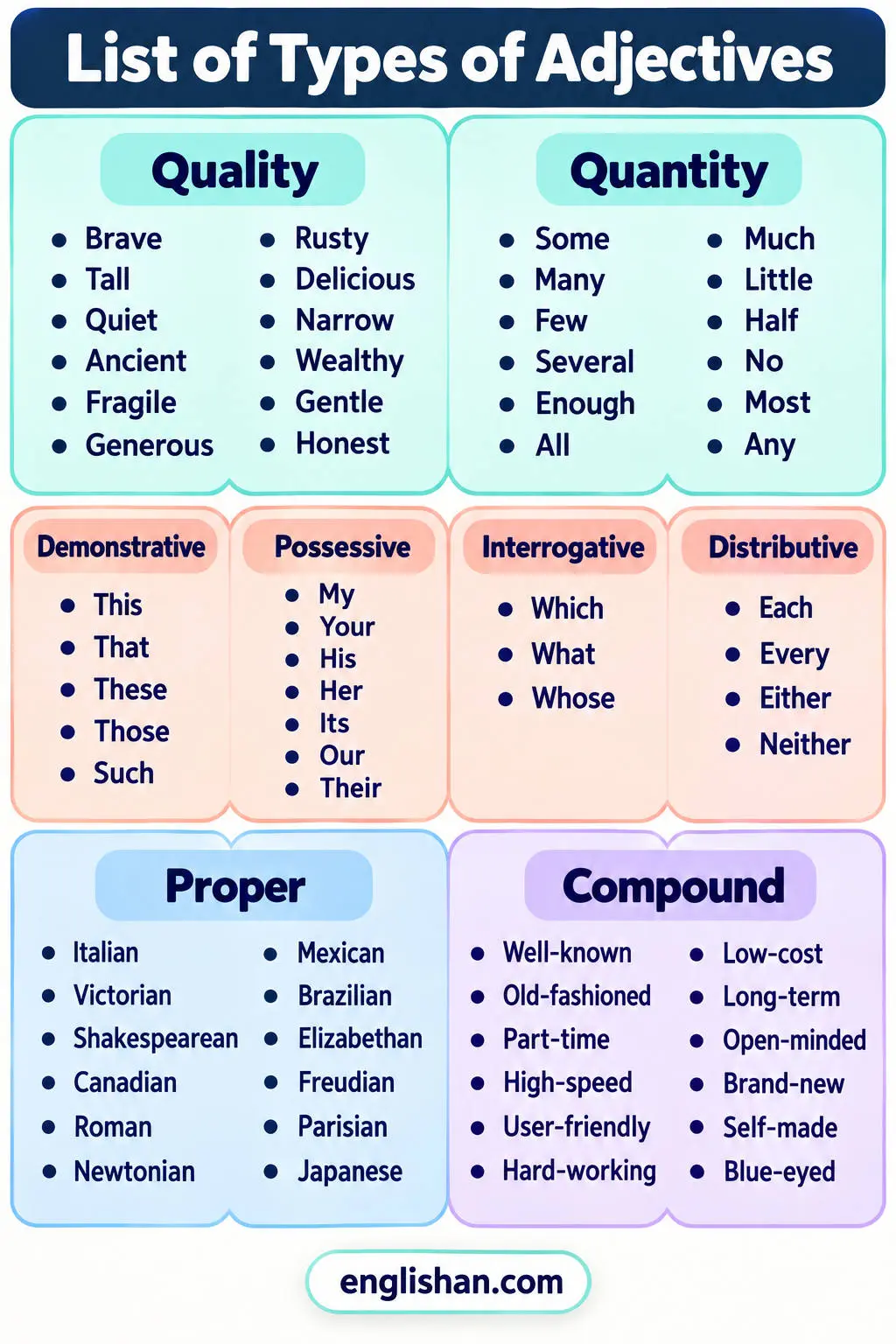
English groups adjectives by their grammatical role. Each type describes a noun in a specific way: some measure quantity, some point out which noun, some belong to a person, and some change form to compare. The nine types below appear across written and spoken English.
| Type | What it does | Example |
|---|---|---|
| Quality (descriptive) | Names a quality of the noun | A brave officer |
| Quantitative | States how much or how many | Several guests |
| Demonstrative | Points out which noun | This book |
| Possessive | Shows who owns the noun | Her garden |
| Interrogative | Asks about the noun | Which road? |
| Distributive | Refers to members one at a time | Each player |
| Proper | Comes from a proper noun | Italian marble |
| Compound | Joins two words into one describer | A well-known singer |
Related: Types of Adjectives with Examples
List of Descriptive Adjectives
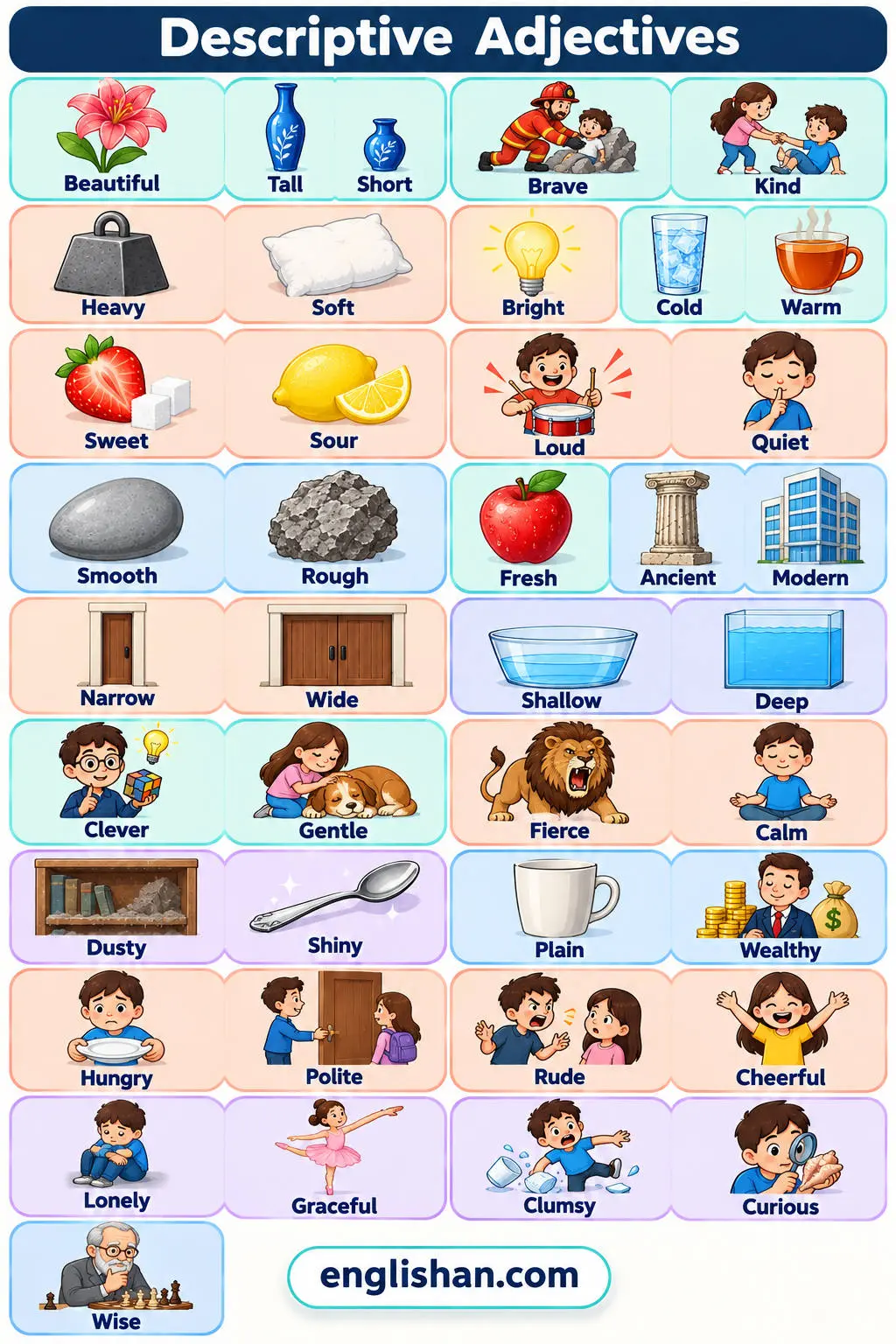
Descriptive adjectives name a quality of a noun such as colour, size, shape, sound, taste, or feeling. This group carries most of the sensory detail in English writing.
Beautiful: Pleasing to the senses.
- She wore a beautiful silver ring.
Brave: Showing courage in danger.
- The brave officer entered the burning shop.
Cheerful: Full of good spirits.
- Our teacher has a cheerful voice.
Colourful: Showing many colours.
- The market has a colourful display of fruit.
Delicate: Fine and easy to break.
- The vase has a delicate pattern.
Enormous: Extremely large.
- An enormous crowd filled the stadium.
Fragile: Easily broken.
- The parcel holds fragile glassware.
Graceful: Moving with beauty and control.
- The dancer is graceful on stage.
Handsome: Attractive in appearance, mainly of men.
- Her uncle is a handsome older gentleman.
Icy: Extremely cold, covered in ice.
- The road is icy near the bridge.
Juicy: Full of natural liquid.
- The mango is juicy and ripe.
Lively: Full of energy.
- The village square is lively on Sundays.
Massive: Very large or heavy.
- A massive stone blocks the path.
Muddy: Covered in mud.
- His boots are muddy from the field.
Shiny: Reflecting light.
- She drove a shiny black car.
Silky: Smooth like silk.
- Her hair is silky after the wash.
Sour: Sharp in taste like lemon.
- The tamarind gave the sauce a sour edge.
Sweet: Pleasant to taste like sugar.
- The apple is sweet and crisp.
Tiny: Extremely small.
- A tiny bird sat on the fence.
Vivid: Bright and lifelike.
- A vivid painting caught every eye.
Related: Colors with Names in English
List of Compound Adjectives
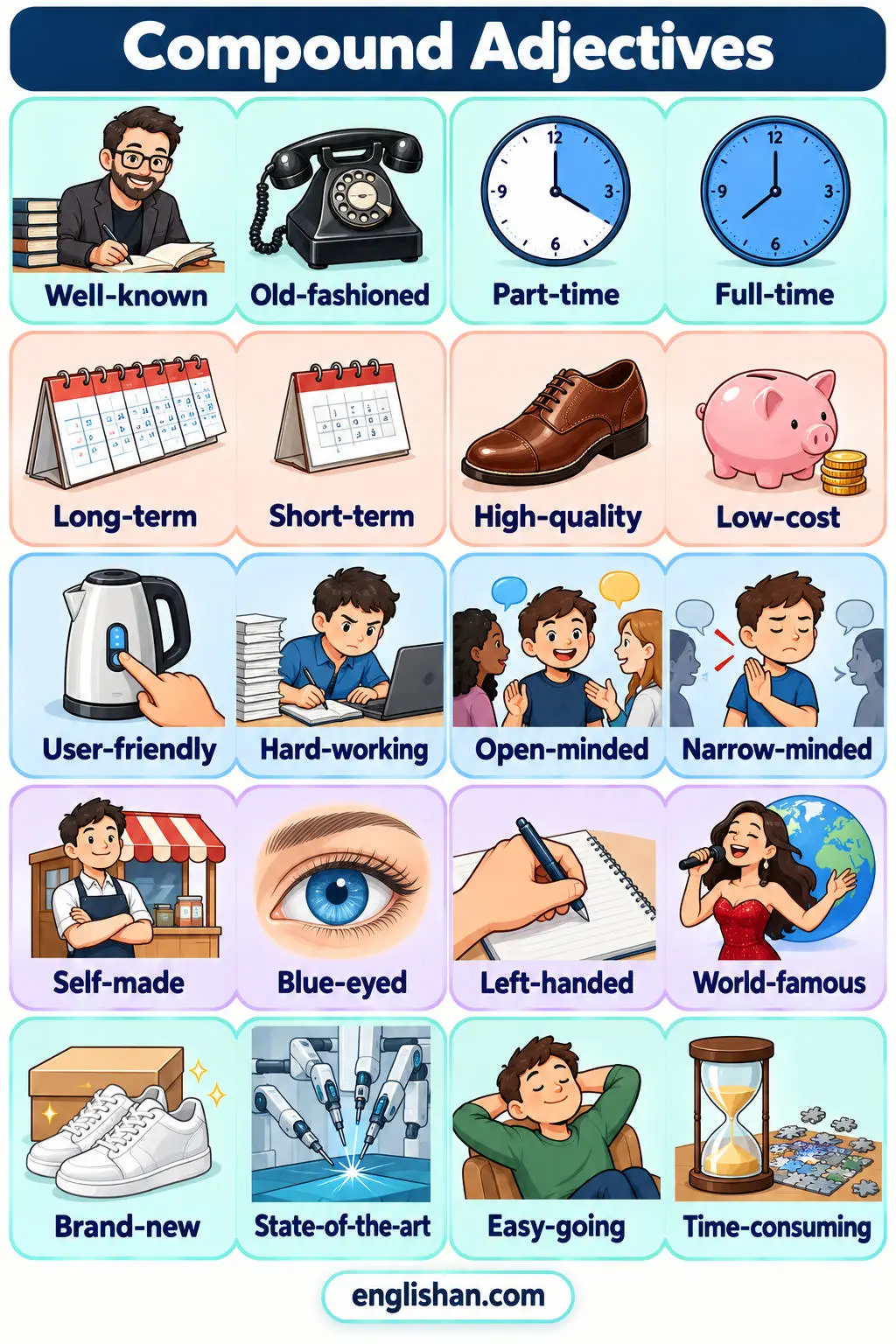
Compound adjectives join two or more words into a single describer, hyphenated when they sit before a noun.
Well-known: Recognised by many people.
- She is a well-known historian.
Old-fashioned: From an earlier style.
- The café has an old-fashioned charm.
Kind-hearted: Naturally caring.
- Our aunt is a kind-hearted woman.
Absent-minded: Forgetful.
- The professor is absent-minded before lunch.
Middle-aged: In the middle years of life.
- A middle-aged runner won the local race.
Long-lasting: Enduring for a long time.
- The battery gives long-lasting service.
Short-tempered: Quick to anger.
- His short-tempered response ended the meeting.
High-quality: Of a high standard.
- They sell high-quality leather goods.
Low-cost: Inexpensive.
- The clinic offers low-cost check-ups.
Sun-dried: Dried by sunlight.
- The recipe calls for sun-dried tomatoes.
World-famous: Known across the world.
- She is a world-famous violinist.
Time-consuming: Taking up much time.
- The paperwork is time-consuming.
List of Proper Adjectives
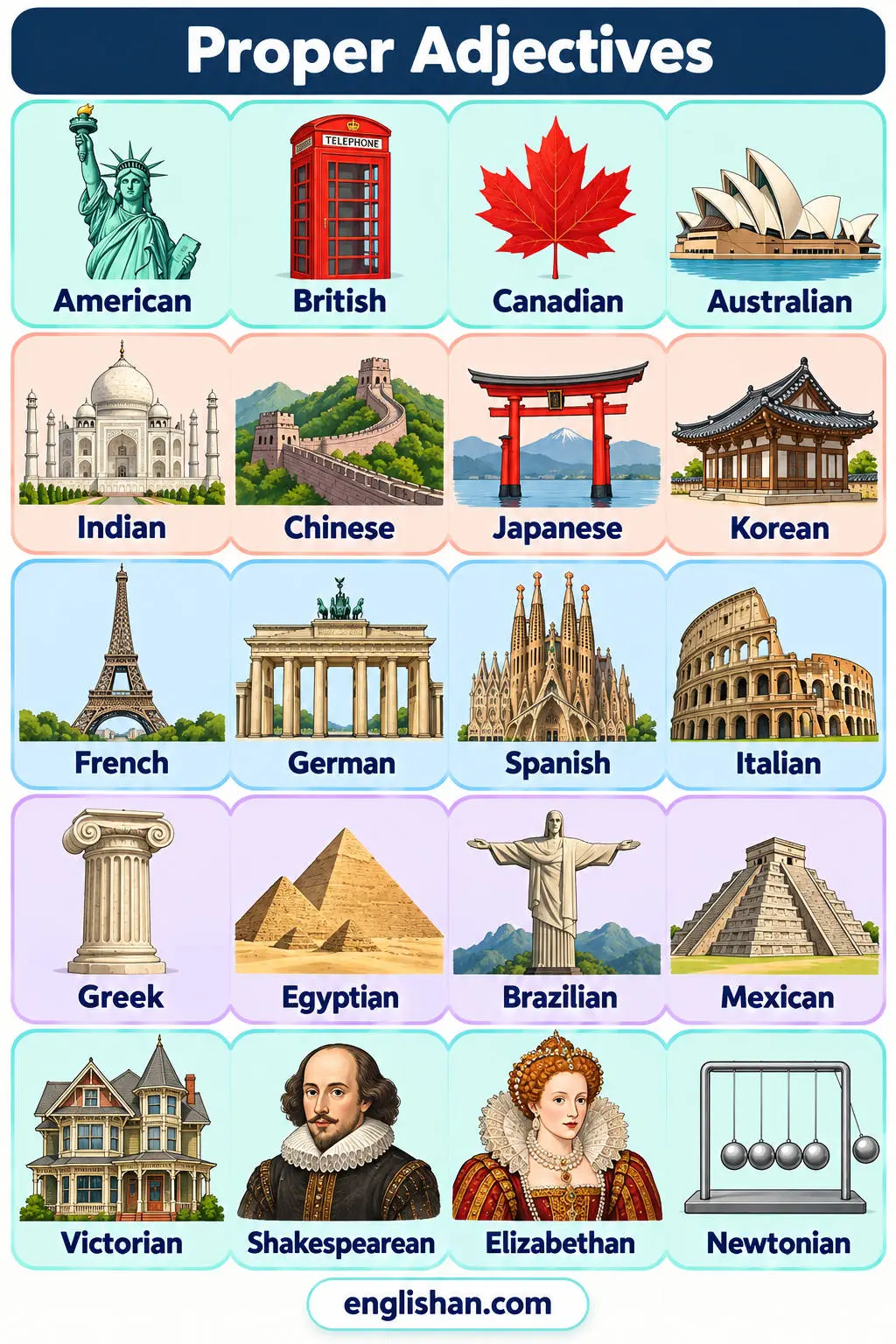
Proper adjectives come from proper nouns such as place names and personal names. They begin with a capital letter.
American: Relating to the United States.
- She enjoys American literature.
British: Relating to Britain.
- The British Museum sits in central London.
Chinese: Relating to China.
- Chinese porcelain has a long tradition.
French: Relating to France.
- We ordered French bread with the soup.
German: Relating to Germany.
- The engineer drives a German saloon.
Indian: Relating to India.
- Indian tea is served across the region.
Italian: Relating to Italy.
- Italian marble covers the floor.
Japanese: Relating to Japan.
- He collects Japanese prints.
Mexican: Relating to Mexico.
- The Mexican restaurant opened last month.
Pakistani: Relating to Pakistan.
- Pakistani mangoes reach Europe in July.
Shakespearean: In the style of Shakespeare.
- The play has a Shakespearean tone.
Victorian: From the reign of Queen Victoria.
- The house has a Victorian facade.
List of Possessive Adjectives
Possessive adjectives mark ownership. They stand before a noun and show whose noun it is. English uses seven of them.
- My: Belonging to the speaker.
- Your: Belonging to the person addressed.
- His: Belonging to a male.
- Her: Belonging to a female.
- Its: Belonging to a thing or animal.
- Our: Belonging to the speaker and others.
- Their: Belonging to more than one other person.
Related: Possessive Adjectives in English with Examples
List of Demonstrative Adjectives
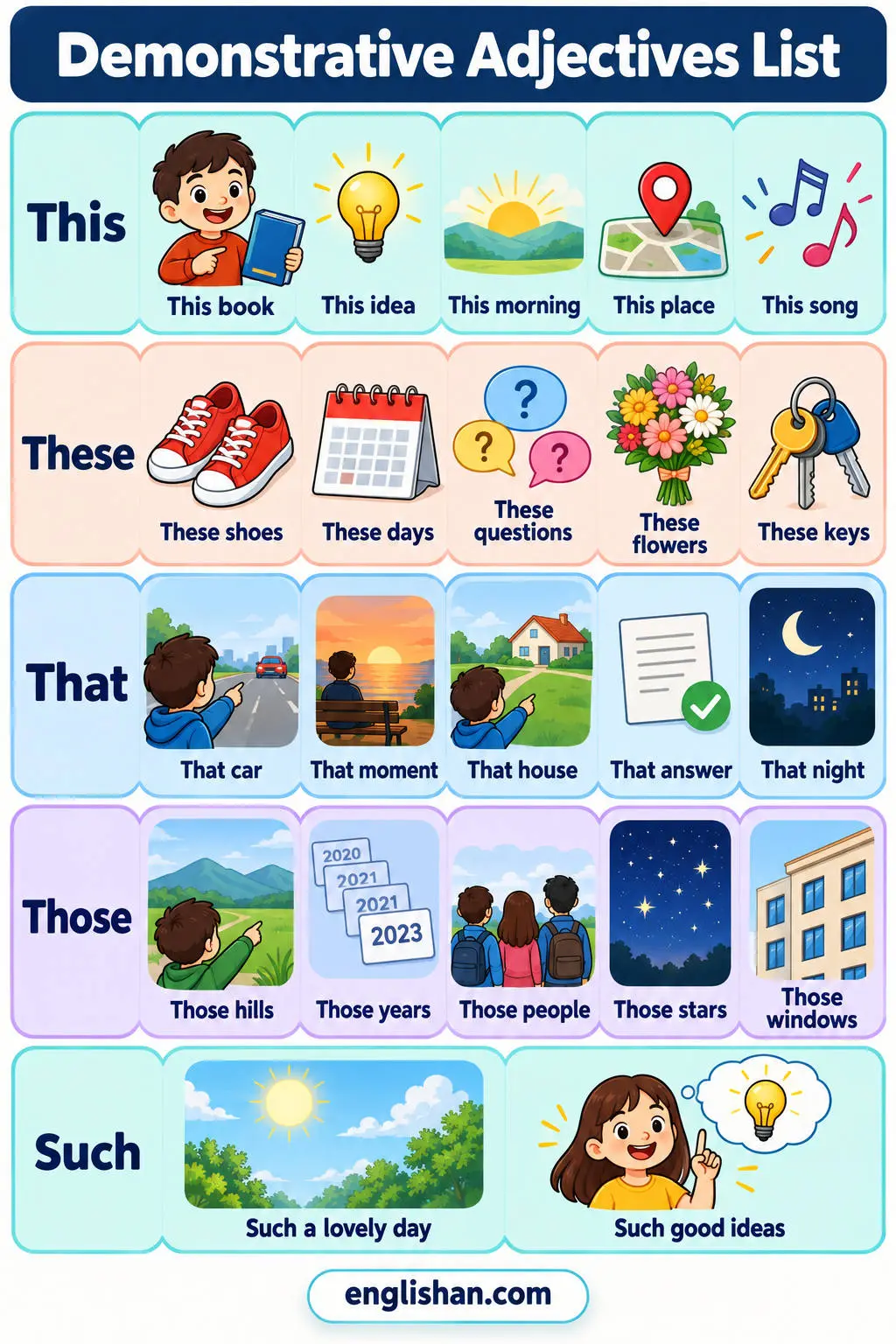
Demonstrative adjectives point out a specific noun and mark distance from the speaker.
- This: Singular noun near the speaker.
- That: Singular noun far from the speaker.
- These: Plural nouns near the speaker.
- Those: Plural nouns far from the speaker.
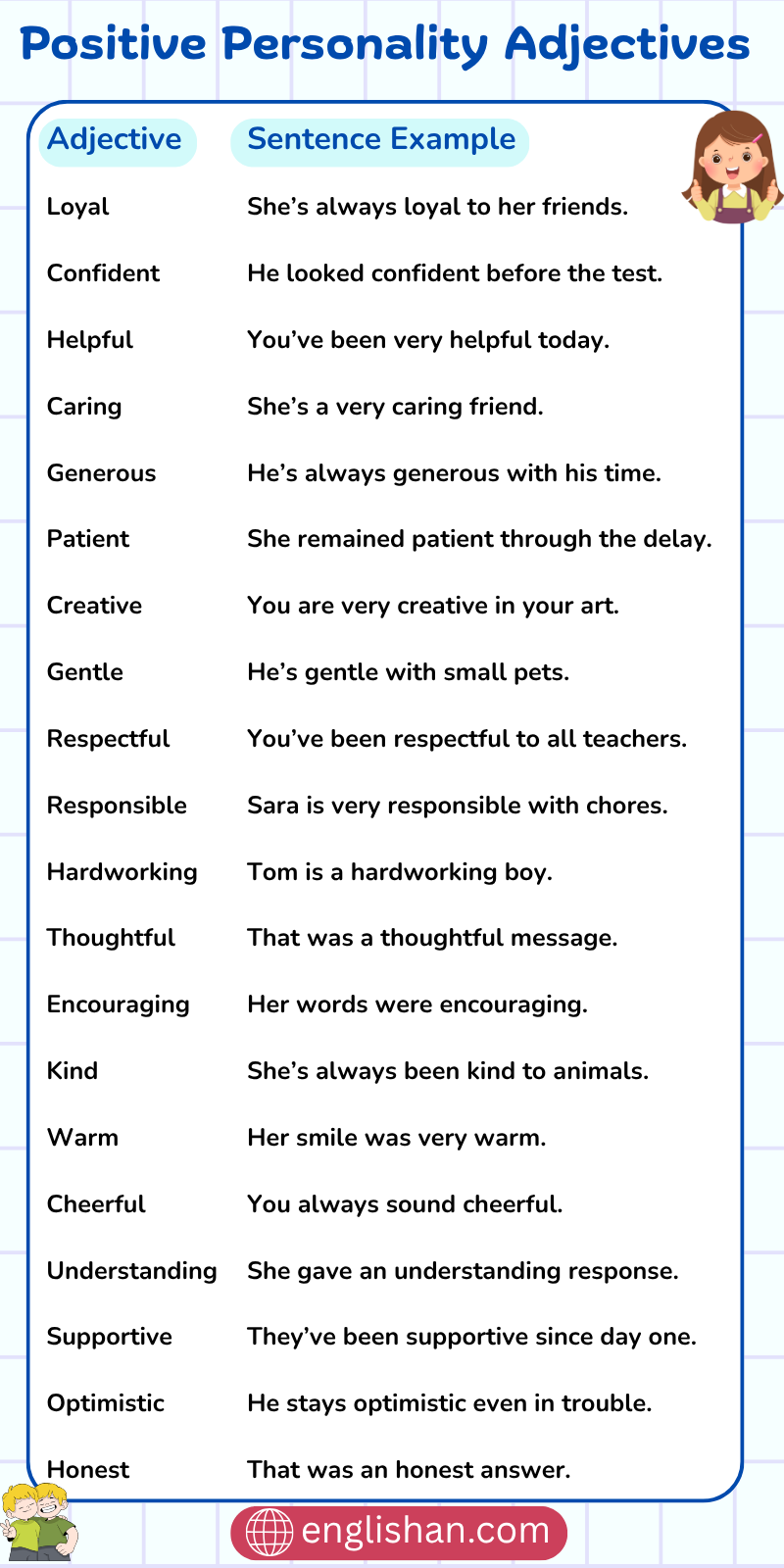
List Of Positive Adjectives With Meanings
- Admirable /ˈæd.mər.ə.bəl/: Worthy of respect.
- Adventurous /ədˈven.tʃər.əs/: Willing to take risks.
- Ambitious /æmˈbɪʃ.əs/: Strongly driven toward a goal.
- Charming /ˈtʃɑːr.mɪŋ/: Pleasing in personality.
- Compassionate /kəmˈpæʃ.ən.ət/: Showing sympathy for suffering.
- Considerate /kənˈsɪd.ər.ət/: Thoughtful of others.
- Creative /kriˈeɪ.tɪv/: Producing new ideas.
- Dedicated /ˈded.ɪ.keɪ.tɪd/: Strongly committed.
- Diligent /ˈdɪl.ɪ.dʒənt/: Careful and steady in work.
- Enthusiastic /ɪnˌθjuː.ziˈæs.tɪk/: Full of interest.
- Fair /feər/: Treating everyone equally.
- Faithful /ˈfeɪθ.fəl/: Loyal over time.
- Grateful /ˈɡreɪt.fəl/: Showing thanks.
- Hardworking /ˌhɑːrdˈwɜːr.kɪŋ/: Giving strong effort.
- Intelligent /ɪnˈtel.ɪ.dʒənt/: Quick to learn.
- Joyful /ˈdʒɔɪ.fəl/: Full of joy.
- Loving /ˈlʌv.ɪŋ/: Showing deep affection.
- Modest /ˈmɒd.ɪst/: Not boasting.
- Optimistic /ˌɒp.tɪˈmɪs.tɪk/: Expecting good outcomes.
- Patient /ˈpeɪ.ʃənt/: Bearing waiting well.
- Reliable /rɪˈlaɪ.ə.bəl/: Worthy of trust.
- Respectful /rɪˈspekt.fəl/: Showing regard.
- Sincere /sɪnˈsɪər/: Genuine in feeling.
- Skilful /ˈskɪl.fəl/: Showing high skill.
- Talented /ˈtæl.ən.tɪd/: Naturally able.
- Thoughtful /ˈθɔːt.fəl/: Showing careful thought.
- Trustworthy /ˈtrʌstˌwɜːr.ði/: Worthy of trust.
- Wonderful /ˈwʌn.dər.fəl/: Extremely pleasing.
Related: Positive Adjectives
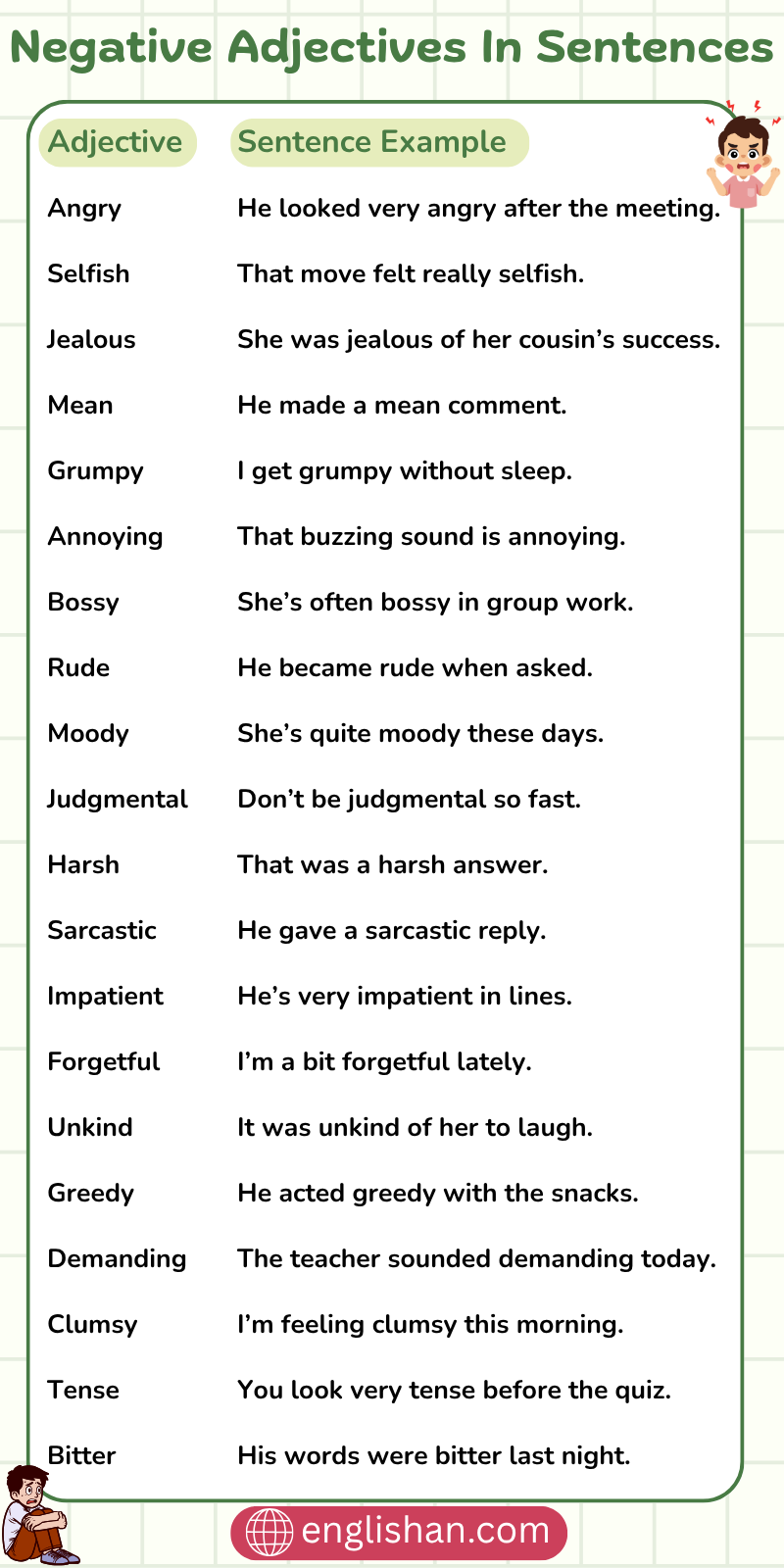
List Of Negative Adjectives With Meanings
- Aggressive /əˈɡres.ɪv/: Ready to attack or confront.
- Arrogant /ˈær.ə.ɡənt/: Falsely proud.
- Awful /ˈɔː.fəl/: Extremely bad.
- Bitter /ˈbɪt.ər/: Sharp in taste, or resentful.
- Boring /ˈbɔːr.ɪŋ/: Without interest.
- Bossy /ˈbɒs.i/: Giving orders often.
- Careless /ˈkeər.ləs/: Lacking care.
- Clumsy /ˈklʌm.zi/: Lacking coordination.
- Corrupt /kəˈrʌpt/: Dishonest for gain.
- Cowardly /ˈkaʊ.ərd.li/: Without courage.
- Deceitful /dɪˈsiːt.fəl/: Given to lying.
- Dishonest /dɪsˈɒn.ɪst/: Not truthful.
- Dull /dʌl/: Uninteresting.
- Foolish /ˈfuː.lɪʃ/: Lacking sense.
- Greedy /ˈɡriː.di/: Wanting too much.
- Grumpy /ˈɡrʌm.pi/: Often cross.
- Harsh /hɑːrʃ/: Severe in manner.
- Hateful /ˈheɪt.fəl/: Full of hate.
- Ignorant /ˈɪɡ.nər.ənt/: Lacking knowledge.
- Impatient /ɪmˈpeɪ.ʃənt/: Unable to wait calmly.
- Jealous /ˈdʒel.əs/: Envious of another.
- Lazy /ˈleɪ.zi/: Unwilling to work.
- Mean /miːn/: Unkind or petty.
- Nasty /ˈnɑːs.ti/: Unpleasant.
- Rude /ruːd/: Without manners.
- Selfish /ˈsel.fɪʃ/: Caring only for oneself.
- Silly /ˈsɪl.i/: Lacking sense.
- Stubborn /ˈstʌb.ərn/: Refusing to change.
- Terrible /ˈter.ə.bəl/: Extremely bad.
- Ugly /ˈʌɡ.li/: Unpleasant in appearance.
- Unfair /ʌnˈfeər/: Not just.
- Violent /ˈvaɪ.ə.lənt/: Using force.
- Weak /wiːk/: Lacking strength.
- Wicked /ˈwɪk.ɪd/: Morally bad.
List Of Neutral Adjectives
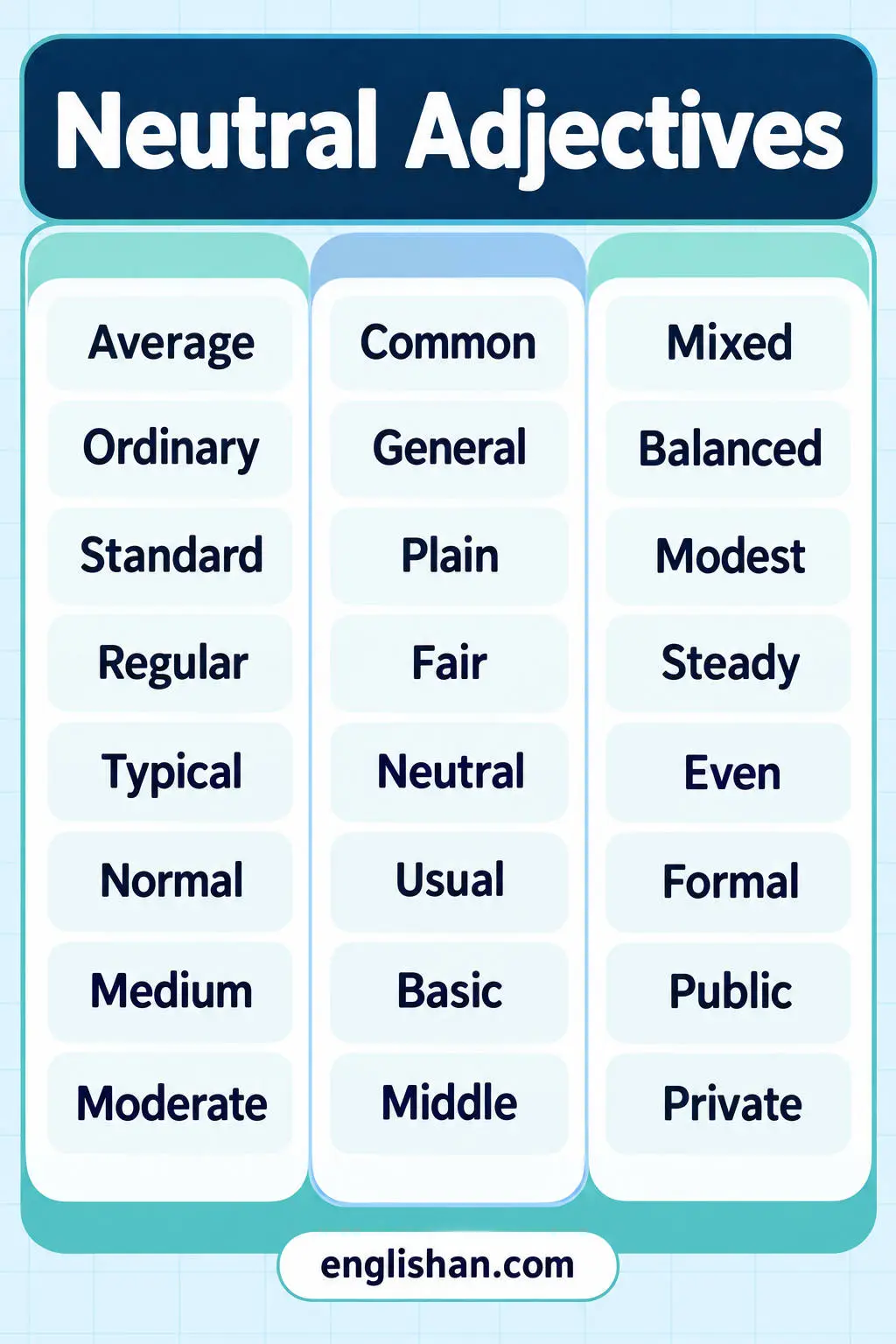
Neutral adjectives describe a noun without a positive or negative charge.
| Adjective | Adjective | Adjective | Adjective |
|---|---|---|---|
| Round | Digital | Domestic | Circular |
| Square | Manual | International | Rectangular |
| Wooden | Public | Vertical | Solid |
| Metal | Private | Horizontal |
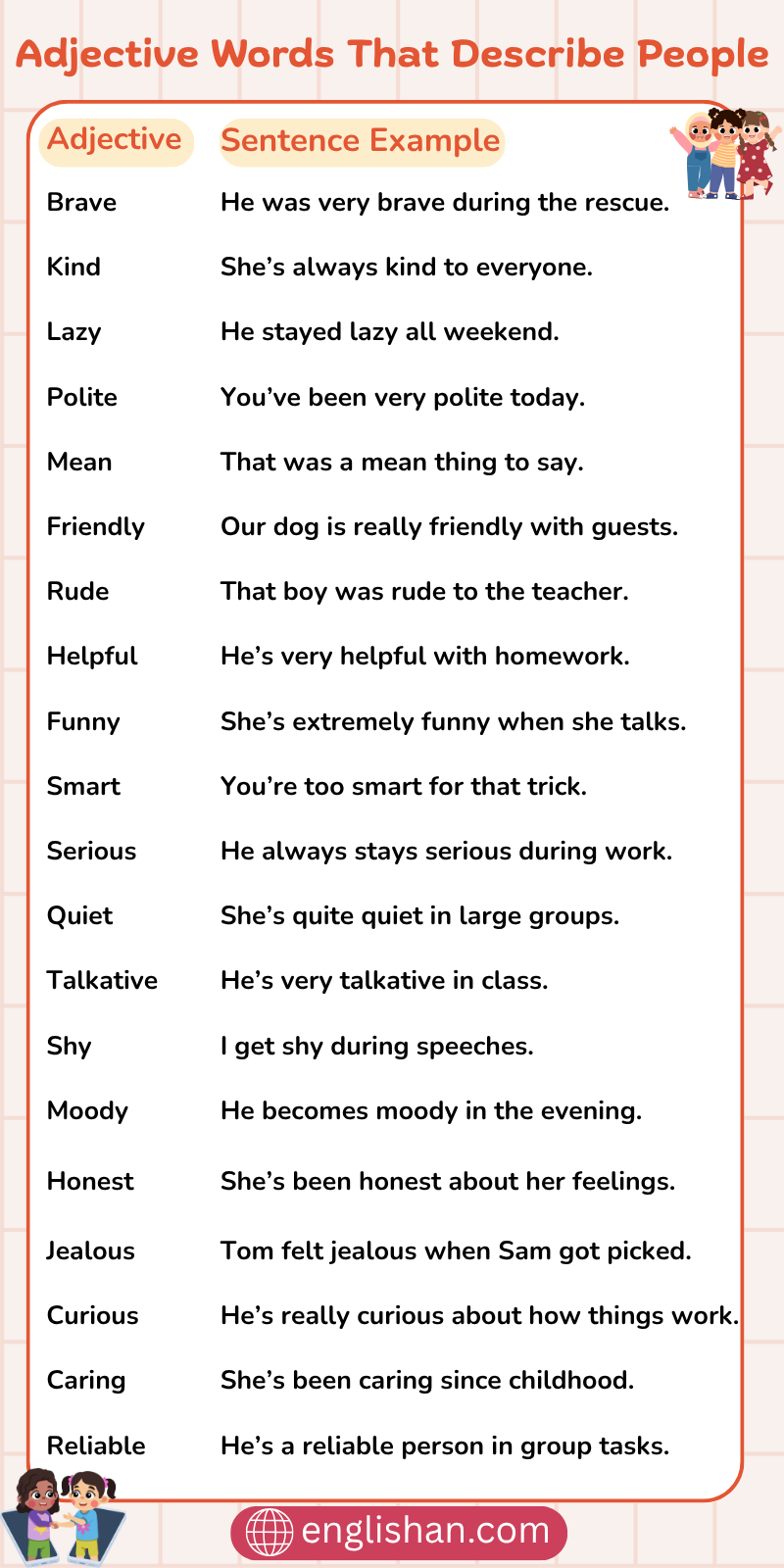
List Of Adjectives To Describe People
- Ambitious /æmˈbɪʃ.əs/: Driven by strong goals.
- Athletic /æθˈlet.ɪk/: Strong and physically active.
- Confident /ˈkɒn.fɪ.dənt/: Sure of oneself.
- Cultured /ˈkʌl.tʃərd/: Broad in knowledge of the arts.
- Devoted /dɪˈvoʊ.tɪd/: Strongly committed to another.
- Disciplined /ˈdɪs.ə.plɪnd/: Showing self-control.
- Focused /ˈfoʊ.kəst/: Giving strong attention.
- Frank /fræŋk/: Open in speech.
- Generous /ˈdʒen.ər.əs/: Giving freely.
- Hardworking /ˌhɑːrdˈwɜːr.kɪŋ/: Putting in strong effort.
- Honest /ˈɒn.ɪst/: Truthful.
- Humble /ˈhʌm.bəl/: Modest.
- Independent /ˌɪn.dɪˈpen.dənt/: Standing on one’s own.
- Intelligent /ɪnˈtel.ɪ.dʒənt/: Quick to learn.
- Kind /kaɪnd/: Warm-hearted.
- Loyal /ˈlɔɪ.əl/: Firm in support.
- Optimistic /ˌɒp.tɪˈmɪs.tɪk/: Expecting good.
- Patient /ˈpeɪ.ʃənt/: Bearing waiting well.
- Polite /pəˈlaɪt/: Showing respect.
- Reliable /rɪˈlaɪ.ə.bəl/: Worthy of trust.
- Sensible /ˈsen.sə.bəl/: Showing good sense.
- Sincere /sɪnˈsɪər/: Genuine.
- Thoughtful /ˈθɔːt.fəl/: Showing care.
- Warm /wɔːrm/: Friendly.
- Wise /waɪz/: With sound judgement.
- Witty /ˈwɪt.i/: Quick with humour.
List Of Adjectives To Describe Personality
- Adventurous: Keen on risk and new experiences.
- Analytical: Given to reasoning through problems.
- Calm: Steady under pressure.
- Cheerful: Brightly good-humoured.
- Competitive: Driven to win.
- Creative: Producing new ideas.
- Curious: Eager to learn.
- Determined: Firmly set on a goal.
- Easygoing: Relaxed in manner.
- Empathetic: Sensing others’ feelings.
- Energetic: Full of activity.
- Extroverted: Outward and sociable.
- Introverted: Inward and reflective.
- Meticulous: Extremely careful.
- Passionate: Full of strong feeling.
- Practical: Given to workable solutions.
- Resilient: Recovering quickly from setbacks.
- Sarcastic: Given to sharp irony.
- Sociable: Fond of company.
- Spontaneous: Acting on the moment.
List Of Adjectives To Describe Appearance
- Attractive: Pleasing to look at.
- Chubby: Slightly plump.
- Cute: Charming and appealing.
- Fair: Light in skin tone.
- Fit: In good physical shape.
- Lean: Slim and muscular.
- Muscular: With well-developed muscles.
- Petite: Small and slight, mainly of women.
- Plump: Pleasantly rounded.
- Radiant: Glowing with good feeling.
- Slim: Gracefully thin.
- Slender: Gracefully thin and tall.
- Stocky: Solidly built.
- Stout: Solidly built and slightly heavy.
- Well-dressed: Dressed with care.
List Of Adjectives To Describe Feelings
- Afraid /əˈfreɪd/: Filled with fear.
- Amused /əˈmjuːzd/: Mildly entertained.
- Angry /ˈæŋ.ɡri/: Strongly displeased.
- Anxious /ˈæŋk.ʃəs/: Worried about the future.
- Ashamed /əˈʃeɪmd/: Filled with shame.
- Bored /bɔːrd/: Without interest.
- Confused /kənˈfjuːzd/: Unable to think plainly.
- Content /kənˈtent/: Quietly satisfied.
- Delighted /dɪˈlaɪ.tɪd/: Highly pleased.
- Depressed /dɪˈprest/: Low in spirit.
- Disappointed /ˌdɪs.əˈpɔɪn.tɪd/: Let down by an outcome.
- Ecstatic /ekˈstæt.ɪk/: Extremely joyful.
- Embarrassed /ɪmˈbær.əst/: Awkwardly self-conscious.
- Excited /ɪkˈsaɪ.tɪd/: Filled with lively feeling.
- Frightened /ˈfraɪ.tənd/: Filled with sudden fear.
- Frustrated /frʌsˈtreɪ.tɪd/: Prevented from progress.
- Grateful /ˈɡreɪt.fəl/: Showing thanks.
- Guilty /ˈɡɪl.ti/: Feeling responsible for a wrong.
- Hopeful /ˈhoʊp.fəl/: Feeling positive about the future.
- Jealous /ˈdʒel.əs/: Envious of another.
- Lonely /ˈloʊn.li/: Without company.
- Miserable /ˈmɪz.ər.ə.bəl/: Extremely unhappy.
- Nostalgic /nɒsˈtæl.dʒɪk/: Fondly recalling the past.
- Overwhelmed /ˌoʊ.vərˈwelmd/: Unable to handle everything at once.
- Relieved /rɪˈliːvd/: Freed from worry.
- Sad /sæd/: Unhappy.
- Surprised /sərˈpraɪzd/: Struck by the unexpected.
Related: 100 Important Antonyms in English
Adjective Words To Describe Places And Things
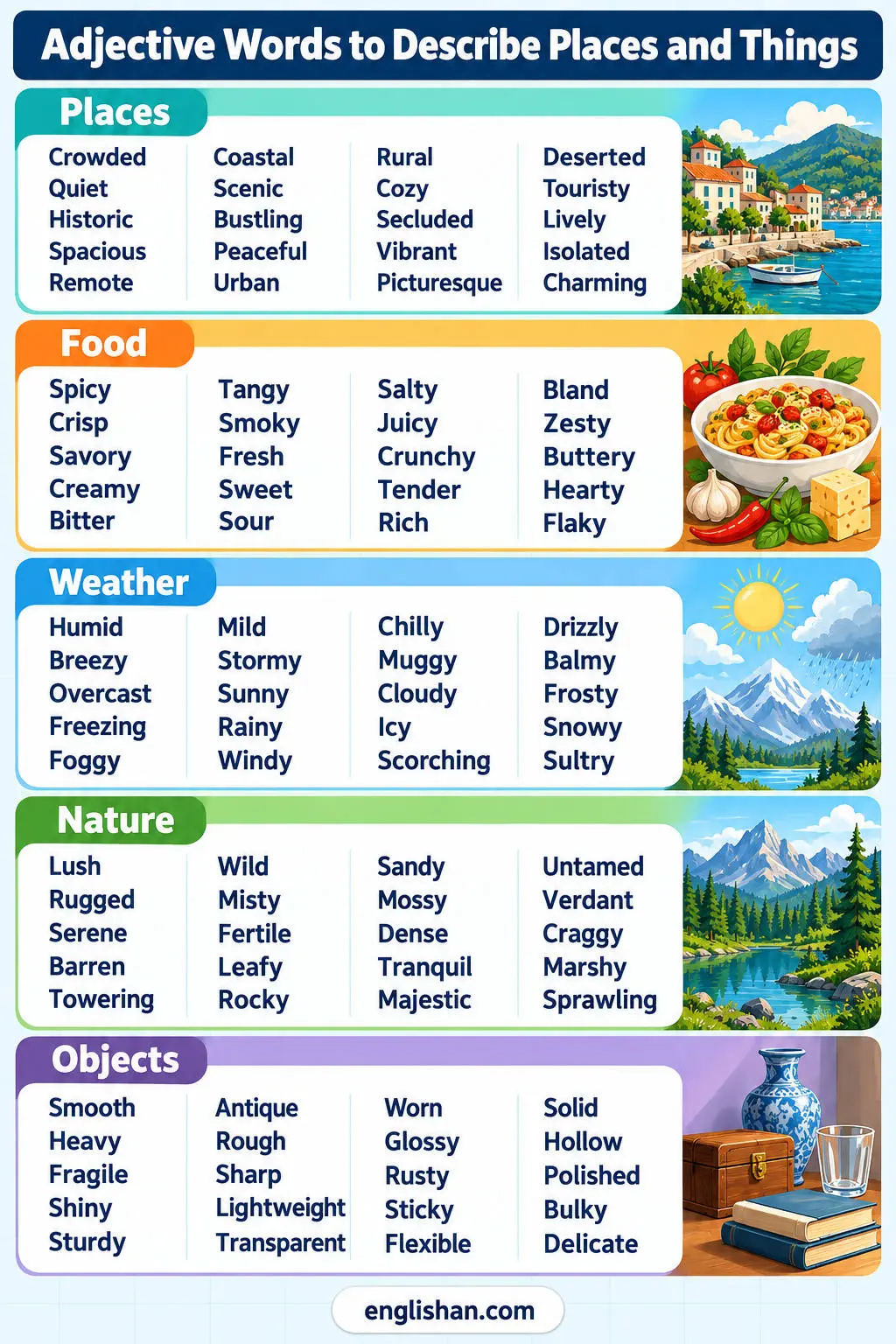
Places, food, weather, and nature each take their own adjective words, most of them tied to sight, taste, sound, and touch.
Adjective Words For Places
| Adjective | Adjective | Adjective | Adjective |
|---|---|---|---|
| Ancient | Dusty | Modern | Scenic |
| Bustling | Foggy | Peaceful | Spacious |
| Cosy | Historic | Picturesque | Tropical |
| Crowded | Isolated | Remote | Urban |
| Deserted | Lively | Sacred | Vast |
Adjective Words For Food
| Adjective | Adjective | Adjective | Adjective |
|---|---|---|---|
| Aromatic | Creamy | Greasy | Sour |
| Bitter | Crispy | Juicy | Spicy |
| Bland | Crunchy | Rich | Sweet |
| Buttery | Delicious | Salty | Tangy |
| Chewy | Fresh | Savoury | Tender |
Related: Adjectives for Smell A to Z
Adjective Words For Weather
| Adjective | Adjective | Adjective | Adjective |
|---|---|---|---|
| Breezy | Dry | Humid | Snowy |
| Chilly | Foggy | Icy | Stormy |
| Cloudy | Freezing | Mild | Sunny |
| Cold | Frosty | Muggy | Windy |
| Damp | Hot | Rainy |
Adjective Words For Nature
| Adjective | Adjective | Adjective | Adjective |
|---|---|---|---|
| Breathtaking | Green | Peaceful | Serene |
| Calm | Lush | Pristine | Vast |
| Colourful | Majestic | Rugged | Wild |
List Of Comparative And Superlative Adjectives
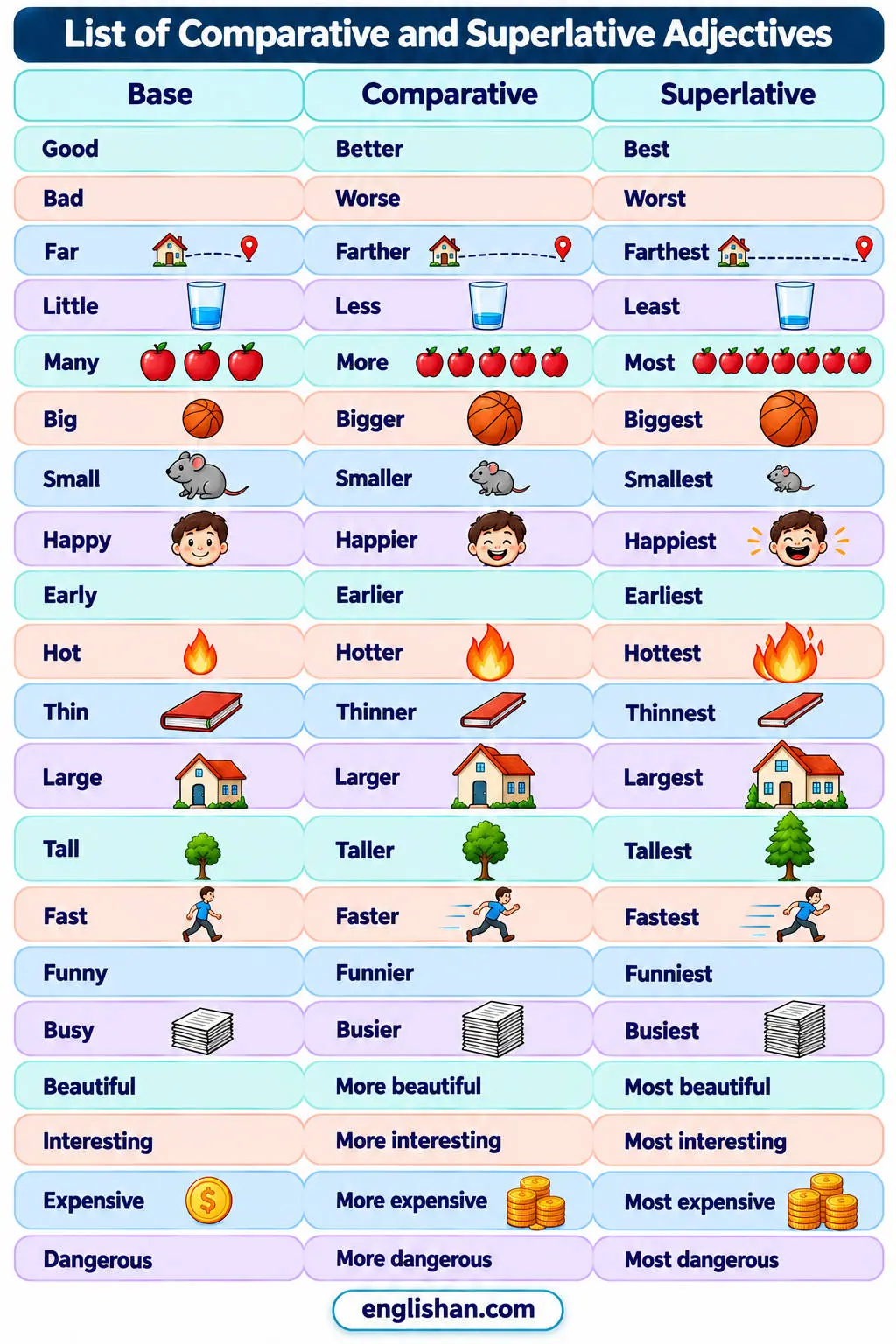
Comparative adjectives compare two people, places, or things. Superlative adjectives compare three or more. English grammar calls the three forms the degrees of comparison: the positive degree (tall), the comparative degree (taller), and the superlative degree (tallest).
| Base adjective | Comparative | Superlative |
|---|---|---|
| Tall | Taller | Tallest |
| Small | Smaller | Smallest |
| Big | Bigger | Biggest |
| Hot | Hotter | Hottest |
| Thin | Thinner | Thinnest |
| Fast | Faster | Fastest |
| Long | Longer | Longest |
| Strong | Stronger | Strongest |
| Young | Younger | Youngest |
| Happy | Happier | Happiest |
| Busy | Busier | Busiest |
| Early | Earlier | Earliest |
| Pretty | Prettier | Prettiest |
| Brave | Braver | Bravest |
| Careful | More careful | Most careful |
| Expensive | More expensive | Most expensive |
| Beautiful | More beautiful | Most beautiful |
| Dangerous | More dangerous | Most dangerous |
| Comfortable | More comfortable | Most comfortable |
| Interesting | More interesting | Most interesting |
| Good | Better | Best |
| Bad | Worse | Worst |
| Far | Farther / Further | Farthest / Furthest |
| Little | Less | Least |
| Many | More | Most |
Related:
Adjective Words For Writing
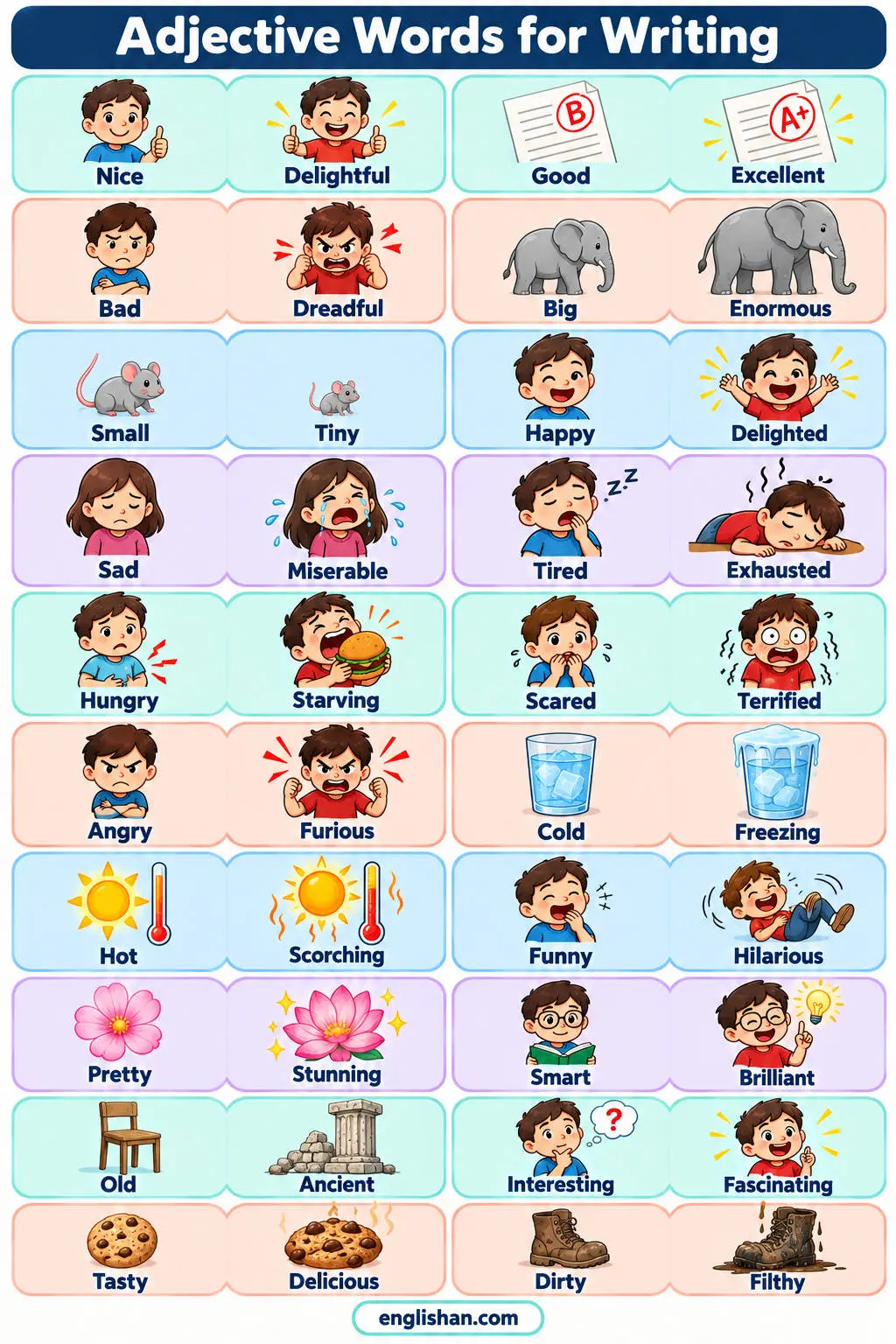
Writers use nice, strong, and unusual adjective words to make letters, reviews, essays, and stories more exact.
Nice Adjective Words To Describe People
- Delightful: Very pleasant and enjoyable.
- Gracious: Polite, kind, and generous in manner.
- Approachable: Friendly and open to conversation.
- Good-natured: Kind and not easily annoyed.
- Warm-hearted: Kind and full of sympathy.
- Supportive: Giving help and encouragement.
Good Adjective Words For Writing
Precise adjectives give writing sharper images than general words such as nice or good.
- Luminous: Giving off or reflecting light.
- Crisp: Firm and fresh, or cool and dry.
- Brisk: Quick and energetic.
- Fragrant: Having a sweet, pleasant smell.
- Relentless: Continuing without stopping.
- Towering: Very tall.
Strong Adjective Words
Strong adjectives, also called extreme or non-gradable adjectives, express the top degree of an ordinary adjective. They take absolutely or really, not very.
- Enormous: the strong form of big.
- Tiny: the strong form of small.
- Freezing: the strong form of cold.
- Boiling: the strong form of hot.
- Exhausted: the strong form of tired.
- Starving: the strong form of hungry.
- Excellent: the strong form of good.
- Awful: the strong form of bad.
- Furious: the strong form of angry.
- Terrified: the strong form of scared.
- Astonished: the strong form of surprised.
- Fascinating: the strong form of interesting.
- Stunning: the strong form of beautiful.
- Hilarious: the strong form of funny.
- ✅ The lake was absolutely freezing.
- ❌ The lake was very freezing.
Related: Words to Use Instead of Very
Fun And Silly Adjective Words
- Wacky: Funny in an odd, surprising way.
- Goofy: Silly in a harmless way.
- Cheeky: Rude in a funny or charming way.
- Whimsical: Playful and unusual.
- Bouncy: Full of lively energy.
List Of Adjectives For Kids
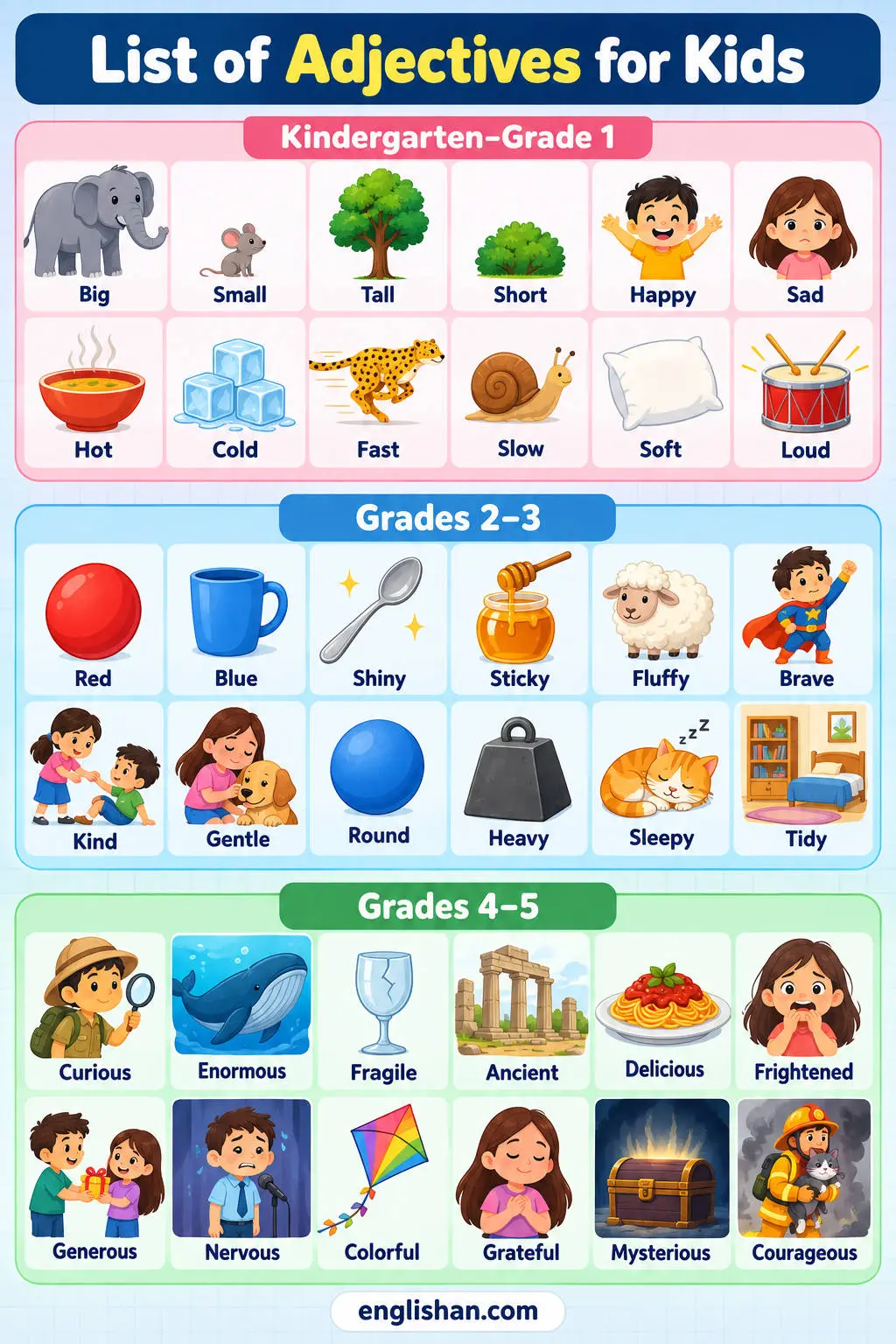
Young learners start with adjectives they hear every day, then move to words for feelings, senses, and character, grouped here by grade.
Adjectives For Kindergarten And 1st Grade
Big: Larger in size.
- A big dog ran in the park.
Small: Little in size.
- A small ant crossed the path.
Happy: Feeling glad.
- A happy child clapped her hands.
Sad: Feeling unhappy.
- The sad boy lost his balloon.
Hot: High in heat.
- The soup is hot today.
Cold: Low in heat.
- The ice is cold in her hand.
Fast: Moving quickly.
- A fast car passed the bus.
Soft: Gentle to touch.
- The soft toy sat on the bed.
Loud: Making much sound.
- A loud drum woke the baby.
Red: The colour of an apple.
- A red kite flew high.
Adjectives For 2nd And 3rd Grade
Brave: Showing courage.
- A brave girl climbed the tall slide.
Shiny: Reflecting light.
- A shiny coin lay on the floor.
Gentle: Mild and kind.
- A gentle breeze cooled the yard.
Sleepy: Needing rest.
- The sleepy cat curled up.
Friendly: Kind to others.
- A friendly boy shared his lunch.
Tiny: Very small.
- A tiny bug sat on the leaf.
Huge: Very large.
- A huge whale swam past the boat.
Scary: Causing fear.
- A scary mask hung on the wall.
Bumpy: Uneven to touch.
- The bumpy road shook the cart.
Noisy: Full of sound.
- A noisy class waited for the bell.
Adjectives For 4th And 5th Grade
Curious: Eager to learn.
- A curious student asked ten questions.
Generous: Willing to share.
- A generous friend gave away her prize.
Enormous: Extremely large.
- An enormous tree shaded the whole yard.
Fragile: Easily broken.
- A fragile vase stood on the shelf.
Cautious: Careful about danger.
- A cautious cyclist slowed at the corner.
Delicious: Very tasty.
- A delicious meal ended the trip.
Furious: Very angry.
- A furious wind bent the young trees.
Graceful: Moving with beauty.
- A graceful swan crossed the pond.
Stubborn: Unwilling to change.
- A stubborn stain stayed on the shirt.
Peaceful: Calm and quiet.
- A peaceful lake mirrored the hills.
Related:
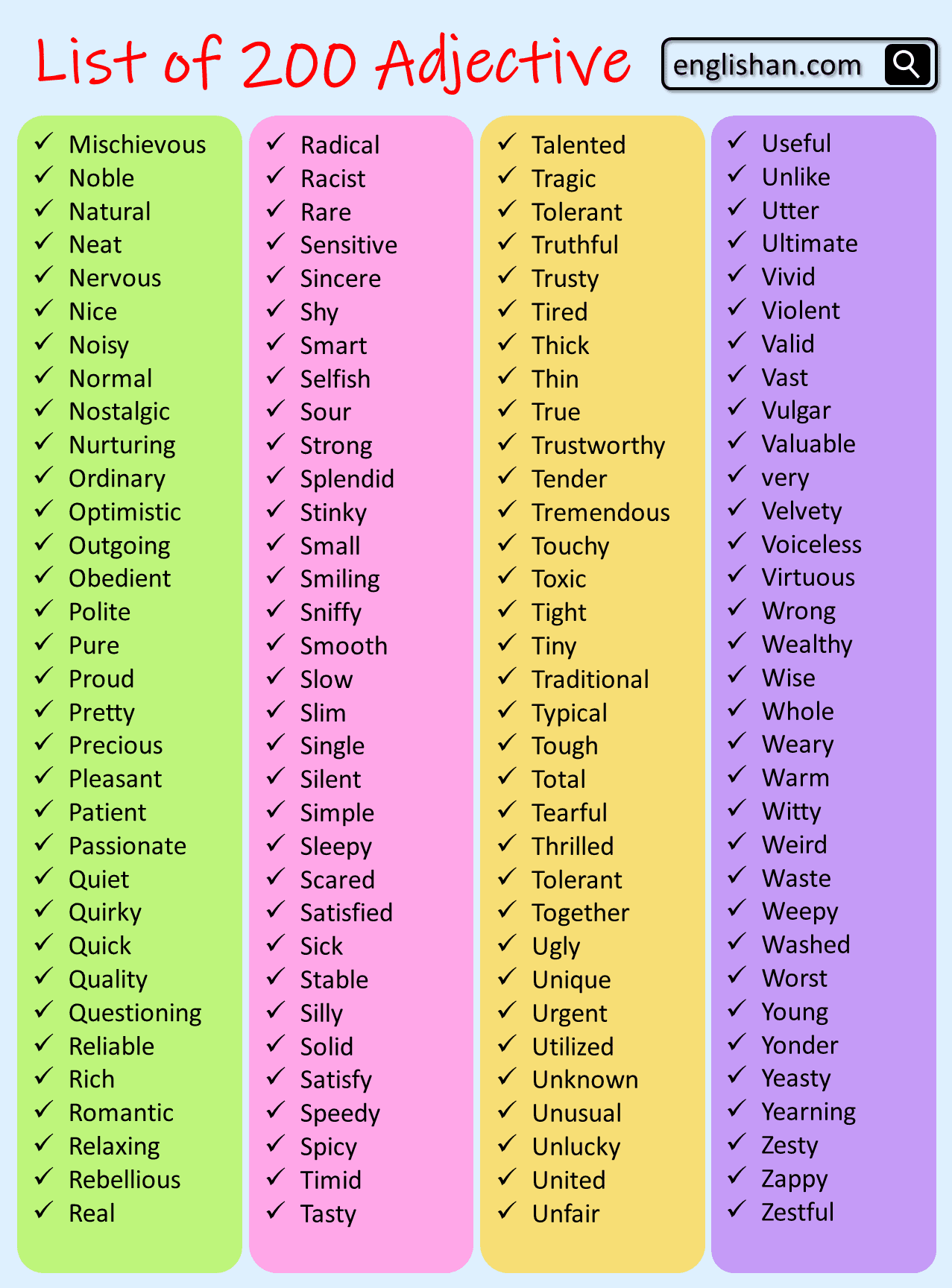
Common Adjectives List In English
| Adjective | Adjective | Adjective | Adjective |
|---|---|---|---|
| Able | Final | Little | Real |
| Available | Fine | Local | Recent |
| Bad | First | Long | Red |
| Beautiful | Foreign | Low | Right |
| Big | Free | Main | Safe |
| Black | Full | Major | Same |
| Blue | General | National | Serious |
| Busy | Good | Natural | Short |
| Central | Great | New | Similar |
| Certain | Green | Next | Simple |
| Clean | Happy | Nice | Single |
| Clear | Hard | Old | Small |
| Close | Heavy | Open | Social |
| Cold | High | Other | Special |
| Common | Hot | Own | Strong |
| Current | Huge | Past | Sure |
| Dark | Human | Personal | Traditional |
| Dead | Important | Physical | True |
| Different | Large | Poor | Various |
| Difficult | Last | Popular | Warm |
| Early | Late | Possible | White |
| Easy | Left | Private | Whole |
| Entire | Legal | Public | Wide |
| Fast | Light | Quick | Wrong |
| Few | Likely | Ready | Young |
List Of Adjectives By Ending And Syllable
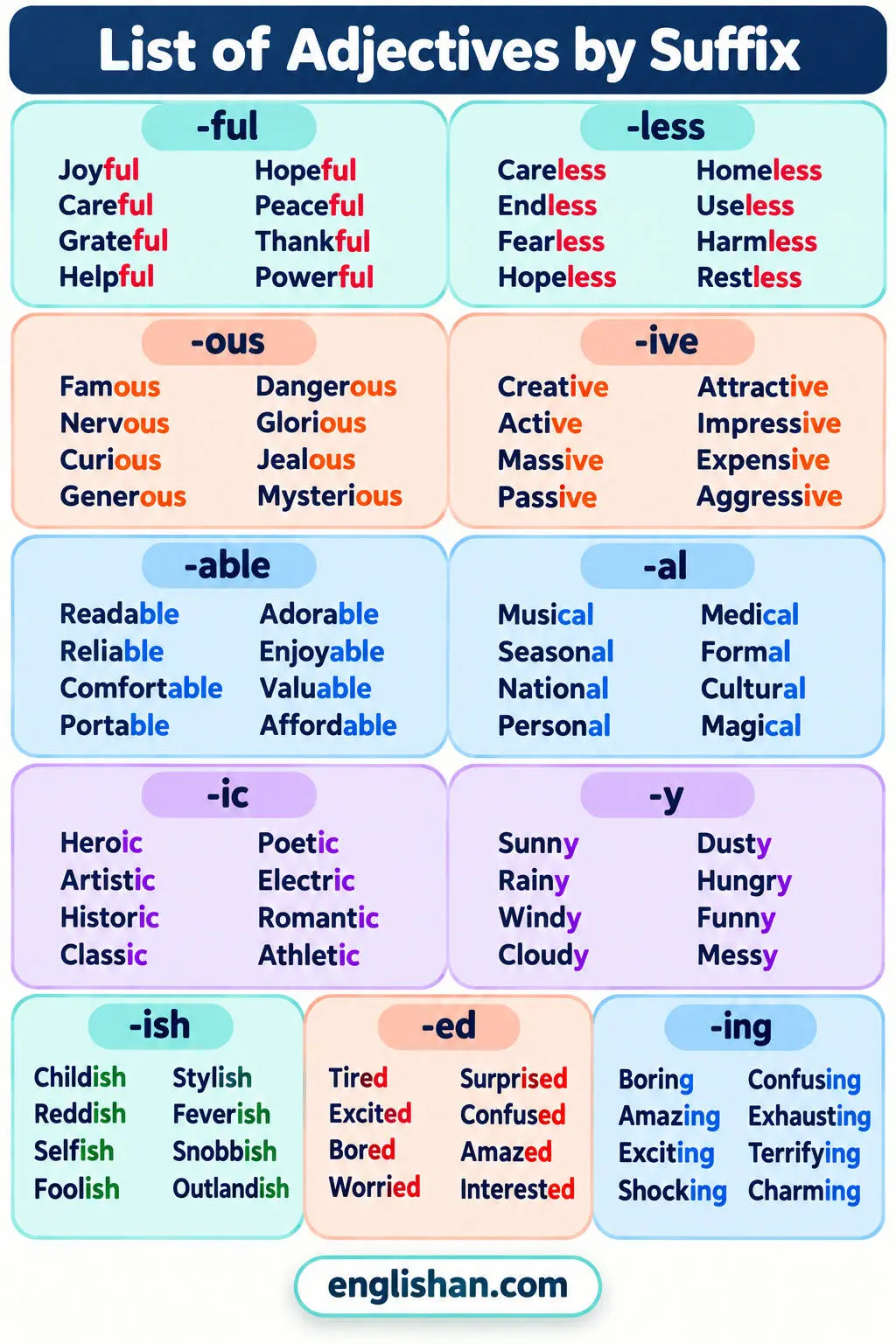
Many English adjectives end in one of a small group of suffixes. These endings mark a word as an adjective and turn nouns and verbs into new adjectives.
List Of Adjectives By Suffix
| Suffix | Meaning | Adjectives |
|---|---|---|
| -ful | Full of | Careful, hopeful, peaceful, colourful |
| -less | Without | Careless, fearless, endless, harmless |
| -ous | Having the quality of | Famous, dangerous, curious, generous |
| -ive | Tending to | Active, creative, expensive, attractive |
| -able | Able to be | Comfortable, reliable, enjoyable, valuable |
| -al | Related to | Natural, musical, national, personal |
| -ic | Related to | Artistic, historic, scientific, heroic |
| -y | Full of or like | Sunny, windy, sleepy, noisy |
| -ish | Somewhat or like | Childish, reddish, foolish, selfish |
| -ed | Describes how someone feels | Bored, excited, tired, worried |
| -ing | Describes what causes the feeling | Boring, exciting, tiring, worrying |
The -ed form names a feeling, and the -ing form names its cause.
- ✅ The film was boring, so the audience felt bored.
- ❌ I am boring in this class. (The speaker means bored.)
List Of Adjectives By Syllable
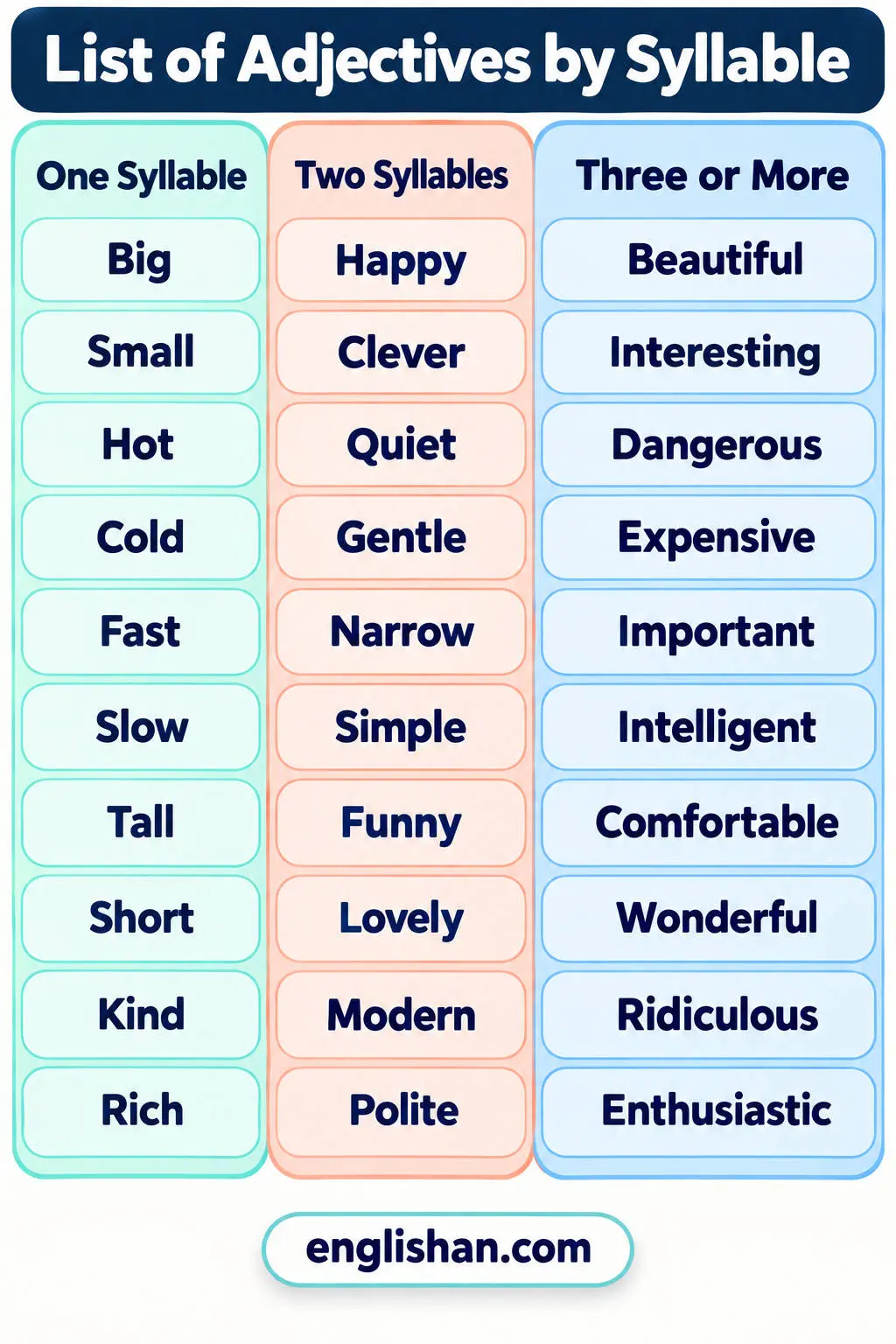
Syllable count decides the comparative form. One-syllable adjectives add -er and -est, and most adjectives of three or more syllables take more and most.
- One syllable: big, bright, cold, fast, kind, loud, soft, tall.
- Two syllables: happy, gentle, quiet, clever, honest, careful, polite, narrow.
- Three syllables: beautiful, dangerous, excellent, curious, wonderful, delicious.
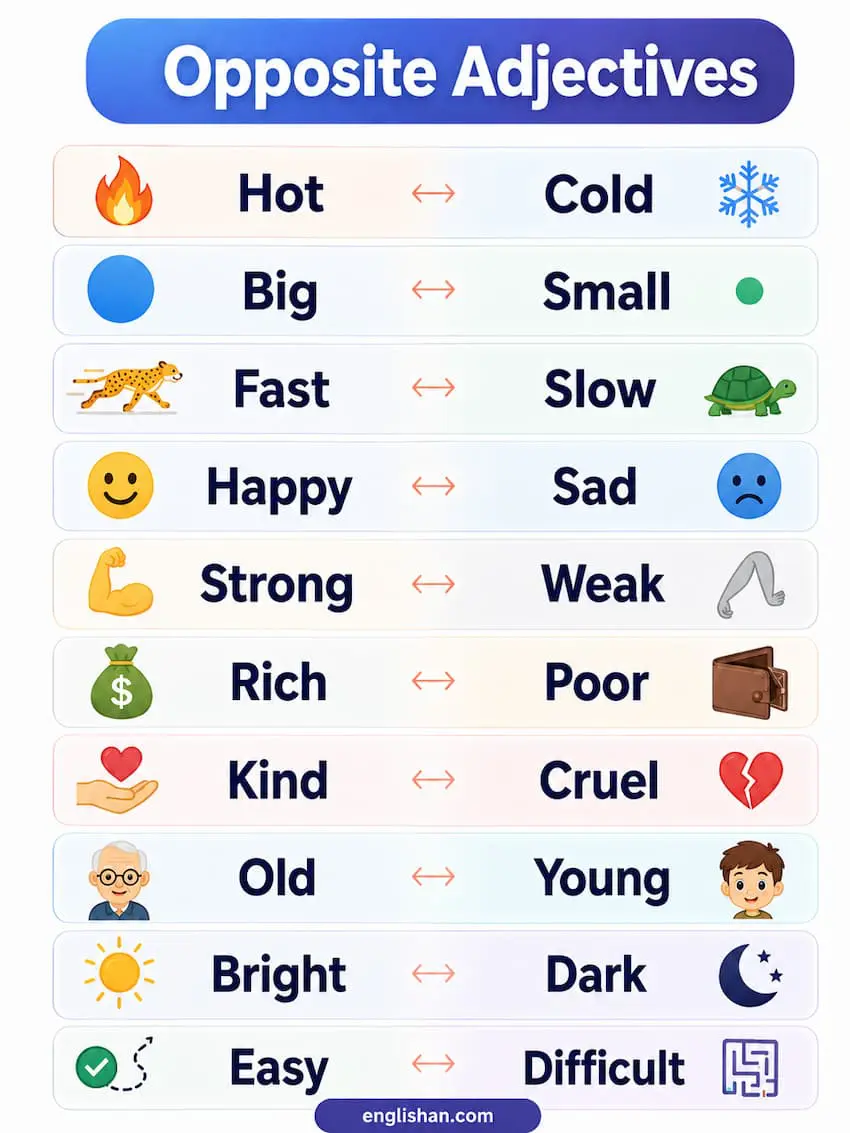
List Of Opposite Adjectives (Antonym Pairs)
FAQs
An adjective is a word that modifies a noun or pronoun by naming a quality, quantity, or characteristic. It answers what kind, which one, how many, or how much. In a bright room, bright is the adjective describing room.
Ten common adjectives are happy, sad, big, small, bright, dark, clean, dirty, kind, and brave. In sentences, they read like this: a happy child smiled at the door, a dark cloud covered the sun, and a brave firefighter carried the woman out.
Positive adjectives name good qualities, praise, strength, kindness, beauty, or skill. Common examples include kind, brave, honest, generous, patient, brilliant, cheerful, loyal, humble, and thoughtful. Use them in references, cover letters, birthday cards, and any writing meant to leave the reader thinking well of the subject.
Negative adjectives name poor behaviour, unpleasant qualities, weakness, or danger. Common examples include lazy, rude, cruel, dishonest, jealous, arrogant, hostile, and selfish. Use them precisely in complaints, warnings, and honest reviews, and avoid them in writing that requires professional distance.
Adjectives that describe a person fall into four groups: appearance (tall, slim, elegant), character (kind, honest, loyal), mood (happy, sad, calm), and ability (skilled, capable, gifted). Pick the group that matches your purpose. A reference letter needs character adjectives, while a novel needs appearance and mood.
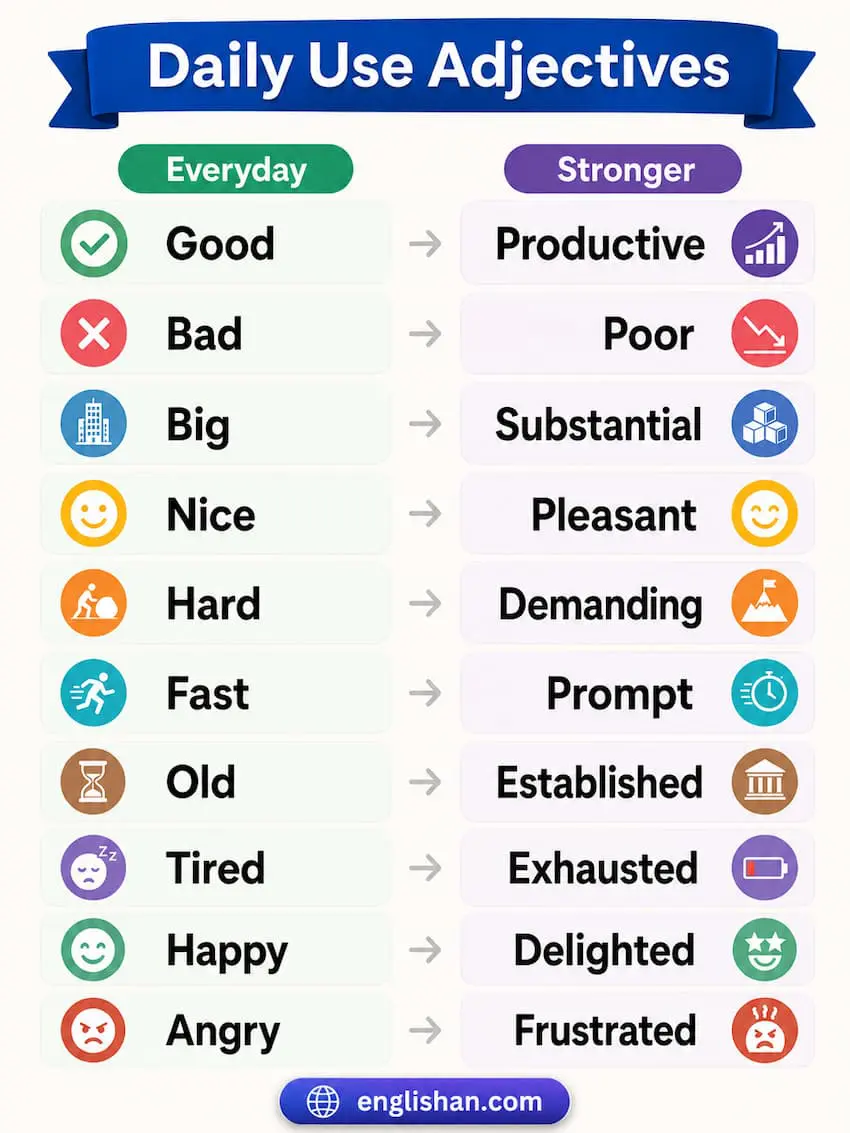
Daily use adjectives are the common describing words of everyday English, such as busy, cold, easy, fast, good, heavy, late, new, old, quiet, small, strong, tired, and warm. In formal writing, upgrade them to sharper words: busy to demanding, cold to chilly, fast to prompt, old to established, and tired to weary.
Yes, a short list of adjectives includes happy, sad, brave, kind, tall, short, fast, slow, bright, dark, strong, weak, old, young, rich, poor, clean, dirty, warm, and cold. The complete list of adjectives from A to Z on this page runs to 600+ words, with meanings and pronunciation for the core entries.
A list of adjectives for kids uses words children already know and say every day: big, small, happy, sad, fast, slow, kind, brave, funny, tall, short, loud, quiet, cold, and hot. The kids’ lists on this page group these words by grade, from kindergarten to fifth grade, each with a short sentence a child can read and repeat.
The main types of adjectives are descriptive, quantitative, demonstrative, possessive, interrogative, distributive, proper, and compound adjectives. Descriptive adjectives form the largest group because they name what a noun is like. The other types show amount, position, ownership, or origin, or ask a question about the noun.
English places adjectives in this order before a noun: opinion, size, age, shape, colour, origin, material, and purpose. A lovely small old round red French wooden dining table follows that order in full. Skipping a category is fine, but swapping two categories sounds wrong to a native speaker.
Use a comma between adjectives only when they describe the noun in the same way, as in a long, tiring journey. To test a pair, switch the two words or put and between them. If both versions read naturally, keep the comma. Adjectives from different categories take no comma, as in three big brown dogs.
Strong adjectives are extreme forms of ordinary adjectives, such as freezing for very cold and exhausted for very tired. They take absolutely or really instead of very. Native speakers say absolutely freezing, never very freezing.
You May Also Like
- 60 Examples of Adjectives in Sentences
- Superlative Degree Examples With Usage In Sentences
- Worksheets on Adjectives
- Degrees of Adjectives with their Rules