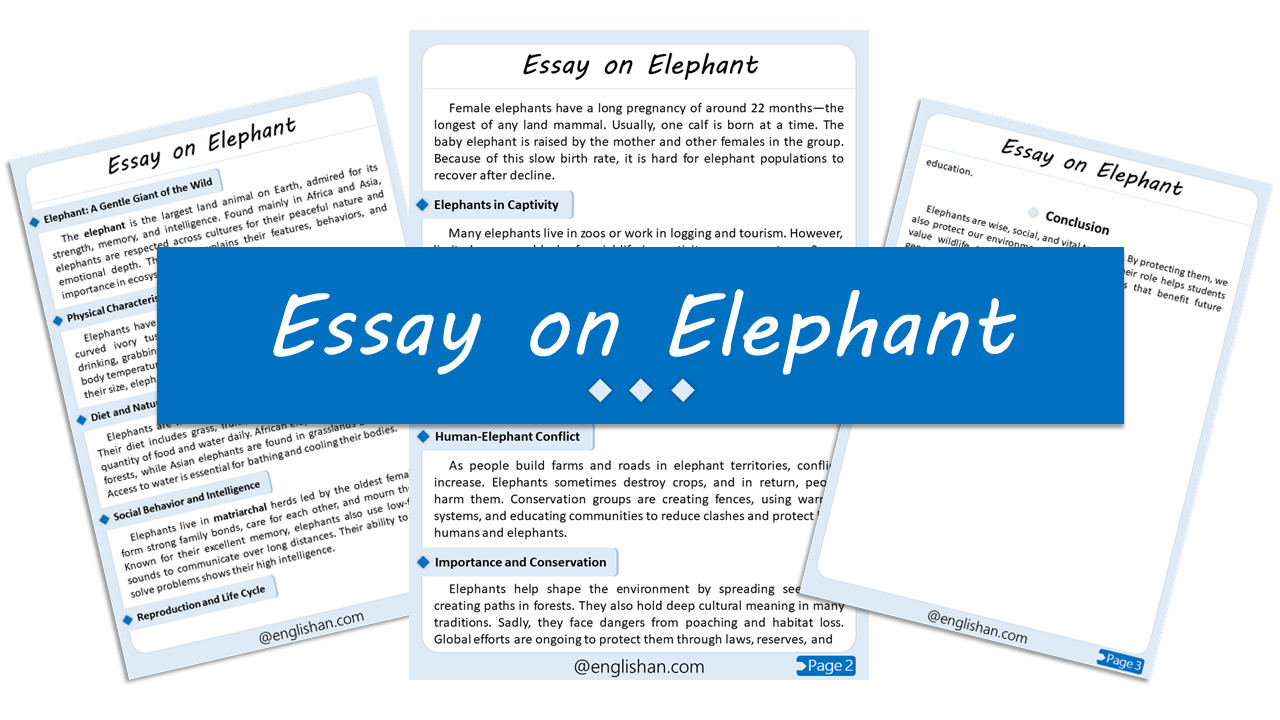
When writing about the elephant, it’s important to understand how this giant land animal lives, behaves, and helps nature. This essay on the elephant explains its body features, food habits, social behavior, and the reasons why it is respected in many cultures. It’s written in 500 words to help students with homework or exams. You can download this elephant essay as a free PDF or image to study or print.
10 Lines Elephant Essay for Class 2 to Class 5
- The elephant is the largest land animal on Earth.
- It has a long trunk, big ears, and strong tusks.
- Elephants are usually grey in color.
- They eat grass, leaves, fruits, and bark.
- Elephants live in forests and jungles.
- They are very strong and intelligent animals.
- Elephants use their trunks to drink water and pick things up.
- Some elephants are trained to work or perform in shows.
- Baby elephants are called calves.
- Elephants are kind and social animals.

250 Words Essay on Elephant for Middle School
The elephant is the biggest land animal in the world. It is known for its large body, long trunk, and big ears. Elephants usually live in forests and grasslands in Africa and Asia. They are herbivores and eat leaves, grass, fruit, and tree bark. Their long trunk helps them smell, drink water, and pick up food.
Elephants have thick grey skin and small eyes. Male elephants often have tusks, which are long teeth made of ivory. They use these tusks for digging, lifting objects, and protecting themselves. Elephants are also known for their strong memory and social behavior. They live in groups called herds and take care of each other.
These animals are very intelligent and emotional. They can feel happiness, sadness, and grief. Elephants are also known to help their young ones and protect weaker members of their group. In many cultures, elephants are respected and seen as symbols of wisdom and strength.
In some places, elephants are trained to carry loads, perform in parades, or take part in cultural events. However, many elephants are now in danger because of hunting and loss of habitat. Wildlife groups are working to protect them through national parks and sanctuaries.
In conclusion, elephants are amazing animals that play a key role in nature. They are not only strong and smart but also gentle and caring. We should protect and respect elephants for future generations.
500 Words Elephant Essay for Upper Primary and Lower Secondary
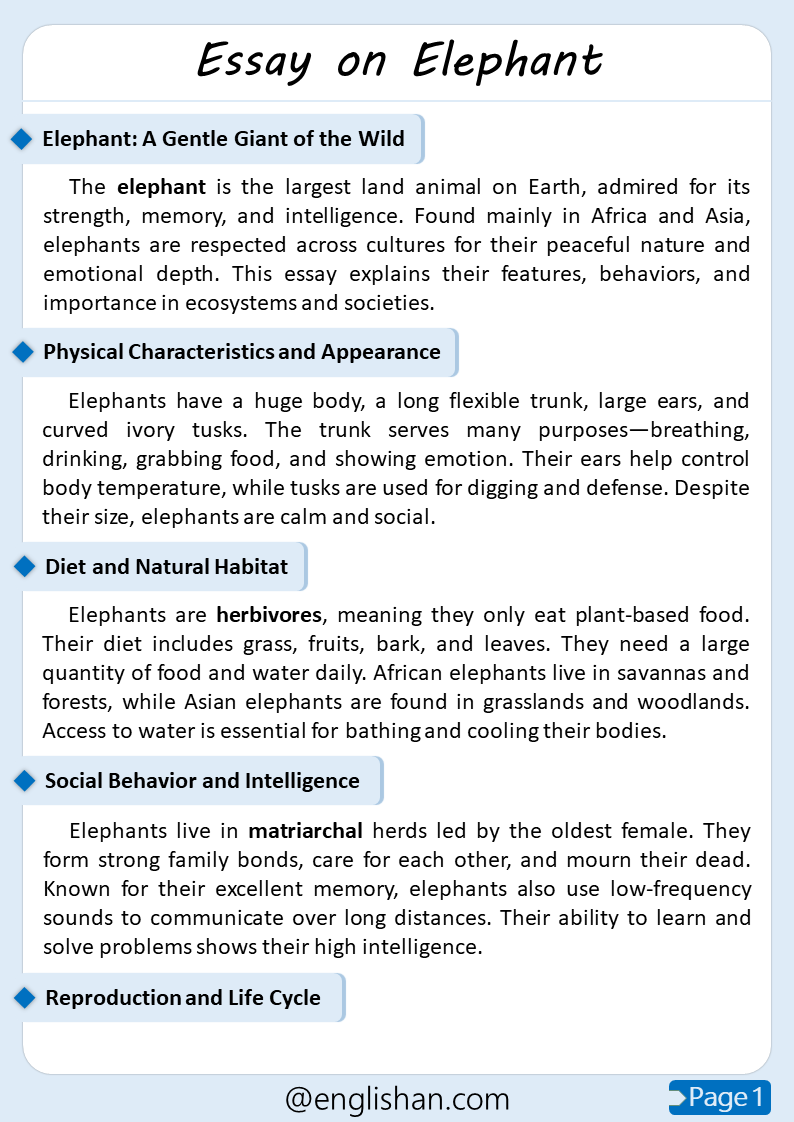
Elephant: A Gentle Giant of the Wild
The elephant is the largest land animal on Earth, admired for its strength, memory, and intelligence. Found mainly in Africa and Asia, elephants are respected across cultures for their peaceful nature and emotional depth. This essay explains their features, behaviors, and importance in ecosystems and societies.
Physical Characteristics and Appearance
Elephants have a huge body, a long flexible trunk, large ears, and curved ivory tusks. The trunk serves many purposes—breathing, drinking, grabbing food, and showing emotion. Their ears help control body temperature, while tusks are used for digging and defense. Despite their size, elephants are calm and social.
Diet and Natural Habitat
Elephants are herbivores, meaning they only eat plant-based food. Their diet includes grass, fruits, bark, and leaves. They need a large quantity of food and water daily. African elephants live in savannas and forests, while Asian elephants are found in grasslands and woodlands. Access to water is essential for bathing and cooling their bodies.
Social Behavior and Intelligence
Elephants live in matriarchal herds led by the oldest female. They form strong family bonds, care for each other, and mourn their dead. Known for their excellent memory, elephants also use low-frequency sounds to communicate over long distances. Their ability to learn and solve problems shows their high intelligence.
Reproduction and Life Cycle
Female elephants have a long pregnancy of around 22 months—the longest of any land mammal. Usually, one calf is born at a time. The baby elephant is raised by the mother and other females in the group. Because of this slow birth rate, it is hard for elephant populations to recover after decline.
Elephants in Captivity
Many elephants live in zoos or work in logging and tourism. However, limited space and lack of social life in captivity can cause stress. Some countries are now building sanctuaries where elephants can live in better conditions, with space to roam and socialize naturally.
African vs. Asian Elephants
There are two main elephant species. African elephants are larger, with big ears shaped like Africa, while Asian elephants are smaller, with rounded ears. Most African elephants have tusks, but in Asian elephants, only some males grow tusks. Their behaviors and habitats also differ.
Human-Elephant Conflict
As people build farms and roads in elephant territories, conflicts increase. Elephants sometimes destroy crops, and in return, people harm them. Conservation groups are creating fences, using warning systems, and educating communities to reduce clashes and protect both humans and elephants.
Importance and Conservation
Elephants help shape the environment by spreading seeds and creating paths in forests. They also hold deep cultural meaning in many traditions. Sadly, they face dangers from poaching and habitat loss. Global efforts are ongoing to protect them through laws, reserves, and education.
Conclusion
Elephants are wise, social, and vital to nature. By protecting them, we also protect our environment. Understanding their role helps students value wildlife and support conservation efforts that benefit future generations.
Difficult Words Used in 500 Elephant Essay
| Word | Meaning |
|---|---|
| Matriarchal | Led by a female leader |
| Herbivore | An animal that eats only plants |
| Conservation | The act of protecting animals, plants, and nature |
| Reproduction | The process of producing young animals |
| Poaching | Illegal hunting of wild animals |
| Captivity | The state of being kept in a confined space |
| Conflict | A serious disagreement or struggle |
Elephant Essay PDF
You May Also Like