When writing about social justice, it’s important to understand how fairness and equal rights help build a better society. This essay on social justice explains what it means, why it matters, common challenges, and ways to support equality. It’s written in 500 words to help students with homework or exams. You can download this social justice essay as a free PDF or image to study or print.
10 Lines Social Justice Essay for Class 2 to Class 5
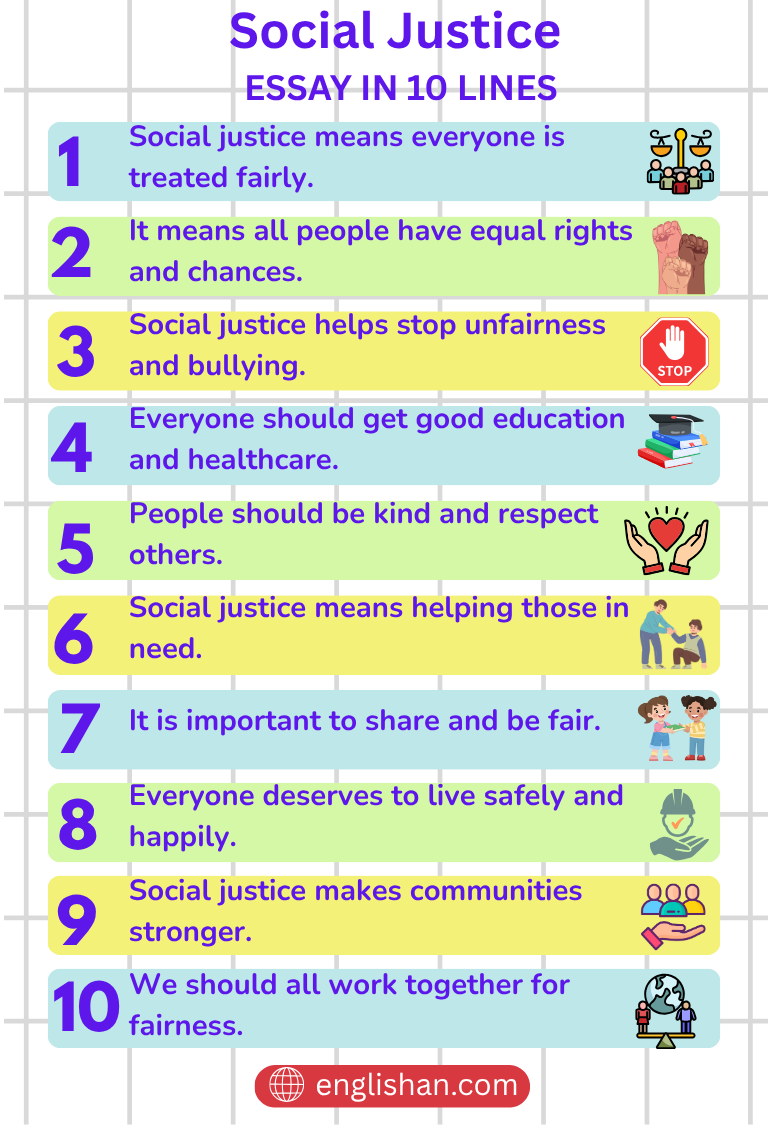
- Social justice means everyone is treated fairly.
- It means all people have equal rights and chances.
- Social justice helps stop unfairness and bullying.
- Everyone should get good education and healthcare.
- People should be kind and respect others.
- Social justice means helping those in need.
- It is important to share and be fair.
- Everyone deserves to live safely and happily.
- Social justice makes communities stronger.
- We should all work together for fairness.
250 Words Essay on Social Justice for Middle School
Social justice means fairness for all people in society. It means everyone should have equal rights, chances, and respect regardless of their background, race, or status. Social justice is about making sure no one is treated unfairly or left out.
In many places, some people do not get the same opportunities as others. They might not have access to good education, healthcare, or jobs. This creates problems like poverty and inequality. Social justice works to fix these problems by promoting fairness and equality.
One way to support social justice is by standing against discrimination and helping those who are less fortunate. This can include volunteering, speaking up for others, or supporting laws that protect everyone’s rights.
Social justice is important because it helps build a peaceful and strong community. When everyone is treated fairly, people can live happily and work together. It also teaches us to respect differences and care for one another.
In conclusion, social justice means fairness, equality, and respect for all. We all have a role in making the world a better place by supporting social justice every day.
500 Words Social Justice Essay for Upper Primary and Lower Secondary
Defining Social Justice in Society
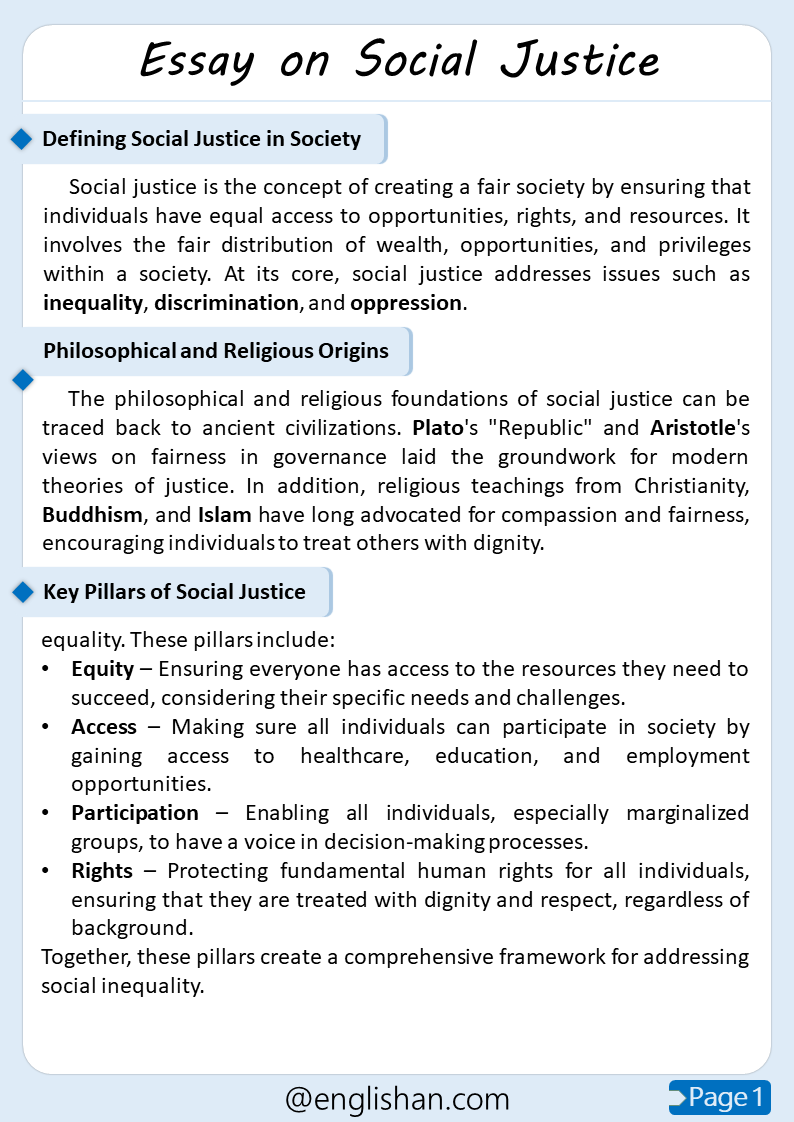
Social justice is the concept of creating a fair society by ensuring that individuals have equal access to opportunities, rights, and resources. It involves the fair distribution of wealth, opportunities, and privileges within a society. At its core, social justice addresses issues such as inequality, discrimination, and oppression.
Philosophical and Religious Origins
The philosophical and religious foundations of social justice can be traced back to ancient civilizations. Plato‘s “Republic” and Aristotle‘s views on fairness in governance laid the groundwork for modern theories of justice. In addition, religious teachings from Christianity, Buddhism, and Islam have long advocated for compassion and fairness, encouraging individuals to treat others with dignity.
Key Pillars of Social Justice
Social justice is built upon four key pillars that guide society toward fairness and equality. These pillars include:
- Equity – Ensuring everyone has access to the resources they need to succeed, considering their specific needs and challenges.
- Access – Making sure all individuals can participate in society by gaining access to healthcare, education, and employment opportunities.
- Participation – Enabling all individuals, especially marginalized groups, to have a voice in decision-making processes.
- Rights – Protecting fundamental human rights for all individuals, ensuring that they are treated with dignity and respect, regardless of background.
Together, these pillars create a comprehensive framework for addressing social inequality.
Historical Movements and Civil Rights
Throughout history, several social justice movements have reshaped society. The abolition of slavery in the 19th century and the women’s suffrage movement in the early 20th century were pivotal in challenging the social and legal inequalities of their times. In the 1960s, the Civil Rights Movement in the United States aimed to end segregation and discrimination based on race. These movements highlighted the struggles of oppressed groups and led to critical reforms in laws, policies, and social norms.
Modern-Day Issues of Injustice
While significant progress has been made, modern-day injustices persist in many aspects of society. Issues such as racial inequality, gender discrimination, economic disparity, and access to education continue to affect millions. For instance, the gender pay gap remains a pressing issue, with women, especially women of color, earning less than their male counterparts in similar positions.
Educational Institutions as Change Agents
Educational institutions play a crucial role in the fight for social justice. By fostering critical thinking and raising awareness of social issues, schools can encourage young people to become agents of change. Civic education can empower students to understand the complexities of social justice and actively participate in improving their communities.
Legal Frameworks and Policy Reforms
The legal framework is essential in the pursuit of social justice. Laws that promote equal rights and prevent discrimination are fundamental to achieving justice in society. Anti-discrimination laws, such as the Civil Rights Act of 1964 in the U.S., were pivotal in ending racial segregation and discrimination in various public sectors.
Economic Equality and Labor Rights
Social justice also includes economic fairness, which is often achieved through labor rights and policies aimed at reducing poverty. Laws that guarantee fair wages, provide for safe working conditions, and protect workers’ rights are essential to ensuring that people can support themselves and their families. Labor unions have historically played a significant role in advocating for workers’ rights, leading to reforms such as minimum wage laws and the right to collective bargaining.
Technology’s Role in Promoting Awareness
In today’s digital age, technology plays an important role in amplifying voices and spreading awareness of social justice issues. Social media platforms like Twitter, Instagram, and Facebook have allowed activists to mobilize communities and raise awareness about racial injustice, police brutality, climate change, and more. Campaigns such as #MeToo and #BlackLivesMatter have shown the power of digital platforms to create social change by connecting people worldwide and calling attention to critical issues.
Conclusion
In conclusion, social justice is an ongoing endeavor that requires the commitment of both individuals and institutions. It involves addressing systemic inequalities and creating systems that offer fairness and equality to all. Whether through policy changes, education, or grassroots movements, everyone has a role to play in the pursuit of social justice. Achieving a fair society where all individuals are treated with dignity requires continuous effort and action. Only through collective commitment can we build a world that truly reflects the principles of justice for all.
Difficult Words Used in 500 Social Justice Essay
| Word | Meaning |
|---|---|
| Equity | Fairness in providing what people need to succeed |
| Discrimination | Unjust treatment based on characteristics like race, gender, or religion |
| Marginalized | Treated as insignificant or less important |
| Empowerment | Granting individuals the power or confidence to act in their own interests |
| Civic Education | Education that encourages active participation in societal and political issues |
| Progressivism | Political philosophy favoring change and reform to improve society |
| Activism | Efforts to bring about social or political change |
| Echo Chamber | An environment where a person only encounters information that reinforces their beliefs |
| Oppression | Prolonged cruel or unjust treatment of individuals or groups |
| Systemic | Something that affects an entire system rather than just isolated parts |
Social Justice Essay PDF
You May Also Like