When writing about untouchability, it’s important to understand how some people were unfairly treated because of their caste. This essay on untouchability explains what it means, its effects on society, and how laws and leaders have worked to end it. It’s written to help students with homework or exams. You can download this untouchability essay as a free PDF or image to study or print.
10 Lines Untouchability Essay for Class 2 to Class 5
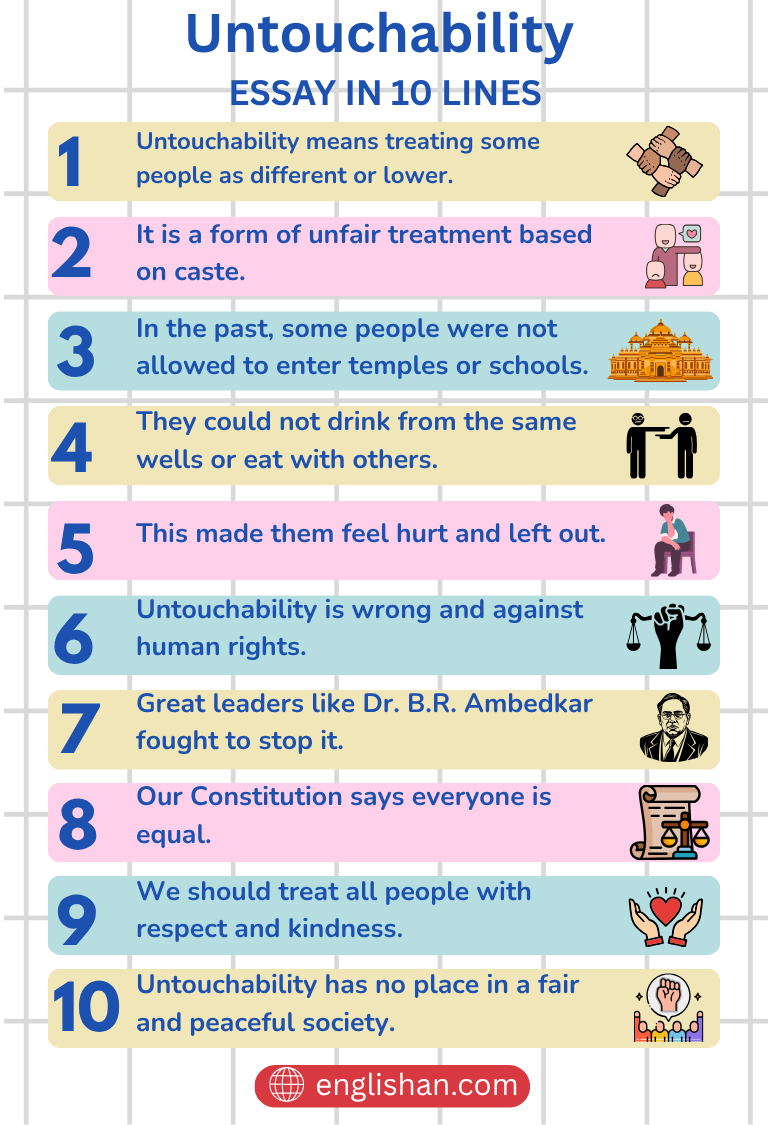
- Untouchability means treating some people as different or lower.
- It is a form of unfair treatment based on caste.
- In the past, some people were not allowed to enter temples or schools.
- They could not drink from the same wells or eat with others.
- This made them feel hurt and left out.
- Untouchability is wrong and against human rights.
- Great leaders like Dr. B.R. Ambedkar fought to stop it.
- Our Constitution says everyone is equal.
- We should treat all people with respect and kindness.
- Untouchability has no place in a fair and peaceful society.
250 Words Essay on Untouchability for Middle School
Untouchability is a form of social discrimination where some people are treated as less important or impure because of their caste. This practice has been seen in some parts of India for many years, especially against those known as Dalits or lower castes.
In the past, people affected by untouchability were not allowed to enter temples, use public wells, or even attend the same schools as others. They had to live in separate areas and were often given only the hardest and lowest-paying jobs. This caused great pain, sadness, and inequality in society.
Untouchability is not only unfair but also against basic human rights. It divides people and creates hatred and fear. To fight this, leaders like Mahatma Gandhi and Dr. B.R. Ambedkar worked hard to promote equality and justice. Dr. Ambedkar, who also faced untouchability himself, helped write the Indian Constitution, which says that every person is equal and untouchability is illegal.
Even though untouchability is banned by law, it still exists in some areas. We must teach children that everyone should be treated the same, no matter their caste, religion, or background.
In conclusion, untouchability is a wrong practice that should never happen. Respecting each other, learning about equality, and spreading kindness can help build a better and fairer society for all.
500 Words Untouchability Essay for Upper Primary and Lower Secondary
Understanding Untouchability
Untouchability refers to the unfair practice of isolating individuals based on caste. Traditionally, this has involved treating some people as “polluted” or “lesser” simply because of their birth into certain communities, especially the Dalits in India. This system goes beyond social exclusion—it is a violation of human rights and an obstacle to unity and equality.
Historical Roots of Discrimination
The caste system, deeply embedded in ancient Indian society, placed Dalits at the bottom of the hierarchy. Over centuries, they were denied basic rights and forced into degrading occupations. These beliefs were reinforced through cultural and religious customs, making untouchability a social norm. Reformers and philosophers throughout history challenged these views, but the practice persisted in many regions.
Social and Psychological Effects
Untouchability has caused emotional trauma, loss of self-respect, and a sense of inferiority among victims. It limits access to education, jobs, healthcare, and public spaces. Entire communities were made to feel unwanted and unsafe, fostering anger, rebellion, and mistrust in society. This deeply harmed the social fabric of the nation.
Legal Measures and Constitutional Support
The Indian Constitution clearly bans untouchability under Article 17, declaring it a punishable offense. Laws such as the Protection of Civil Rights Act (1955) and the SC/ST (Prevention of Atrocities) Act (1989) were enacted to prevent discrimination and ensure equal treatment. However, laws alone cannot change centuries-old mindsets.
Role of Mahatma Gandhi and Other Reformers
Mahatma Gandhi played a key role in fighting untouchability. He called Dalits “Harijans,” meaning children of God, and encouraged their social inclusion. Reformers like B.R. Ambedkar, Jyotiba Phule, and Swami Vivekananda also stood against caste oppression and worked to uplift marginalized communities through education and awareness.
The Power of Education and Awareness
Education has become a powerful tool to fight untouchability. Schools now teach values of equality, dignity, and human rights. Awareness campaigns on social media, in films, and in literature have challenged deep-seated prejudices. Education shapes young minds to think critically and reject inherited discrimination.
Rural vs Urban Realities
While urban areas have seen progress due to education and employment, untouchability still exists in rural regions. Social customs in villages are often more rigid. In many places, Dalits still face barriers to entering temples or drawing water from wells. Focused rural development programs and community efforts are needed to bring true equality.
Government and NGO Involvement
Various government schemes now aim to support Dalits through scholarships, job reservations, and legal assistance. NGOs also provide support by offering education, legal aid, and public campaigns. These efforts have helped improve the condition of marginalized communities, though much work remains.
Importance of Social Unity and Respect
Eliminating untouchability is not just a legal issue but a moral responsibility. Every citizen must promote mutual respect, dignity, and equality. A nation can only progress when all its people are treated fairly, regardless of caste or background. True social development comes from inclusive thinking and ethical living.
Conclusion
Untouchability is a social evil that must be fully eradicated through education, awareness, and social reform. Although progress has been made, the journey toward equality is not over. By rejecting discrimination and embracing unity, we move closer to building a just and humane society.

Difficult Words Used in 500 Untouchability Essay
| Word | Meaning |
|---|---|
| Violation | The act of breaking a rule or law |
| Marginalized | Treated as insignificant or unimportant |
| Atrocities | Extremely cruel acts, often involving violence or injustice |
| Inferiority | A feeling of being less worthy or capable than others |
| Discrimination | Treating someone unfairly based on category like race, caste, or gender |
| Inclusive | Open to all; not limited by social group or caste |
| Fabric (of society) | The basic structure or system that holds a society together |
Untouchability Essay PDF
You May Also Like