A ship carries movement, balance, and direction across open water, and its structure shapes how every part fits into that motion. When you talk about ships, study them, or follow explanations about sea travel, having the right words keeps ideas precise, from the outer body below the waterline to the working areas above.
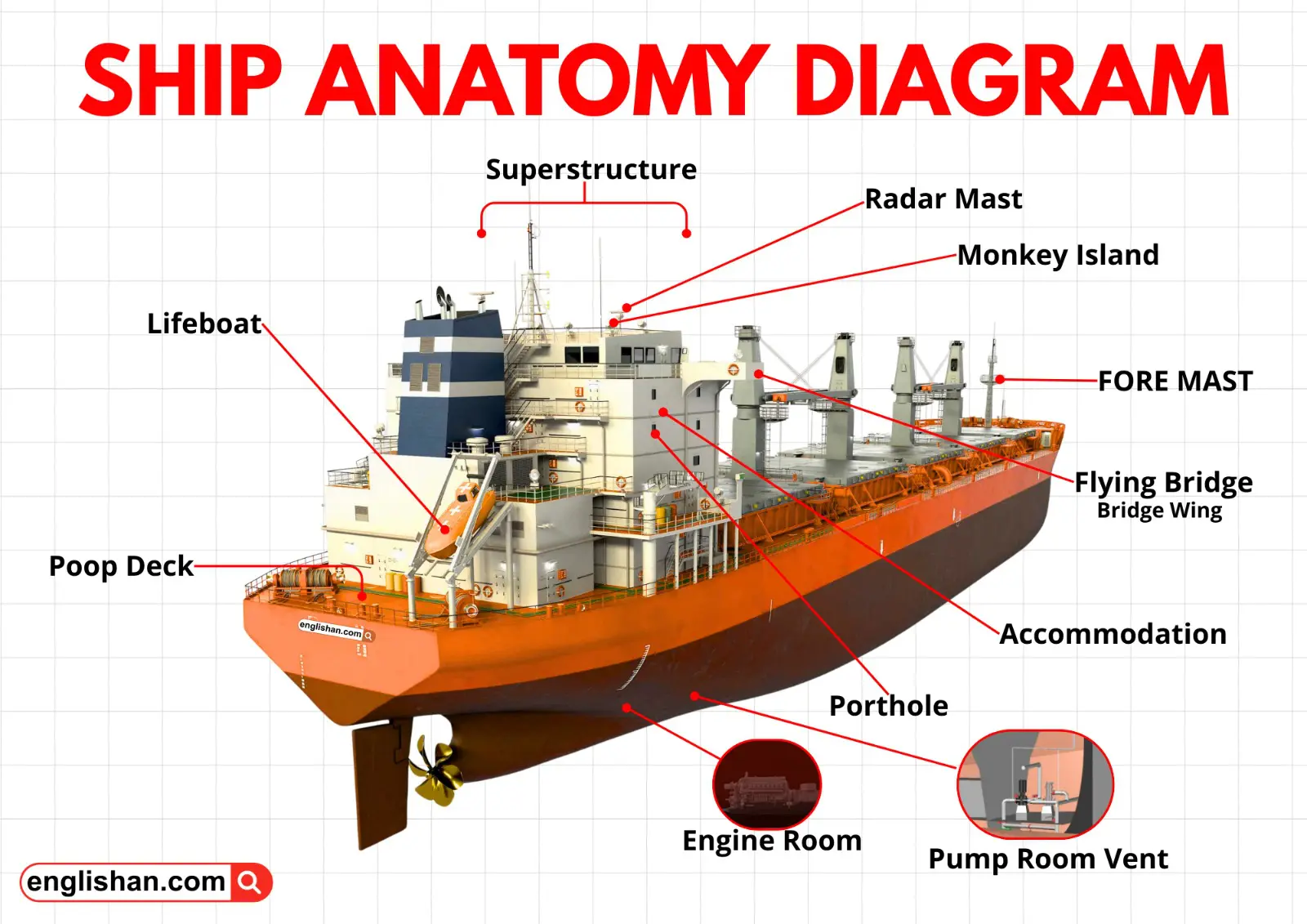
In this blog post, we explain the parts of a ship, starting with the hull and moving through the deck, bow, stern, bridge, mast, anchor, funnel, and propeller. We begin with common passenger and cargo ships, since names can change by type. The labeled diagram that follows helps connect each word to its exact place.
List of Parts of a Ship
- Hull
- Bow
- Stern
- Keel
- Gunwale
- Main Deck
- Fore Deck
- Aft Deck
- Poop Deck
- Funnel Deck
- Hatch
- Hatch Cover
- Bridge
- Wheelhouse
- Flying Bridge
- Bridge Wing
- Monkey Island
- Superstructure
- Accommodation
- Cabin
- Porthole
- Window
- Bridge Ladder
- Ladder
- Stairway
- Handrails
- View Screen
- Mast
- Mainmast
- Radar Mast
- Yardarm
- Masthead Light
- Navigation Lights
- Anchor Light
- Antenna
- Flag
- Flagstaff
- Siren
- Ship Horn
- Morse Lamp
- Lifeboat
- Lifeboat Davit
- Life Buoy
- Life Raft
- Winch
- Windlass
- Hawser
- Mooring Rope
- Capstan
- Bollard
- H-Bitt
- Anchor
- Anchor Chain
- Fairlead
- Chock
- Propeller
- Propeller Shaft
- Tail Shaft
- Rudder
- Rudder Blade
- Steering Gear
- Kort Nozzle
- Engine Room
- Main Engine
- Auxiliary Engine
- Generator
- Exhaust Funnel
- Ventilator
- Air Intake
- Pump Room
- Pump Room Vent
- Sea Chest
- Bilge
- Bilge Pump
- Old Tyre Fender
- Rubber Fender
- Side Fender
- Bulwark
- Freeboard Mark
- Draft Mark
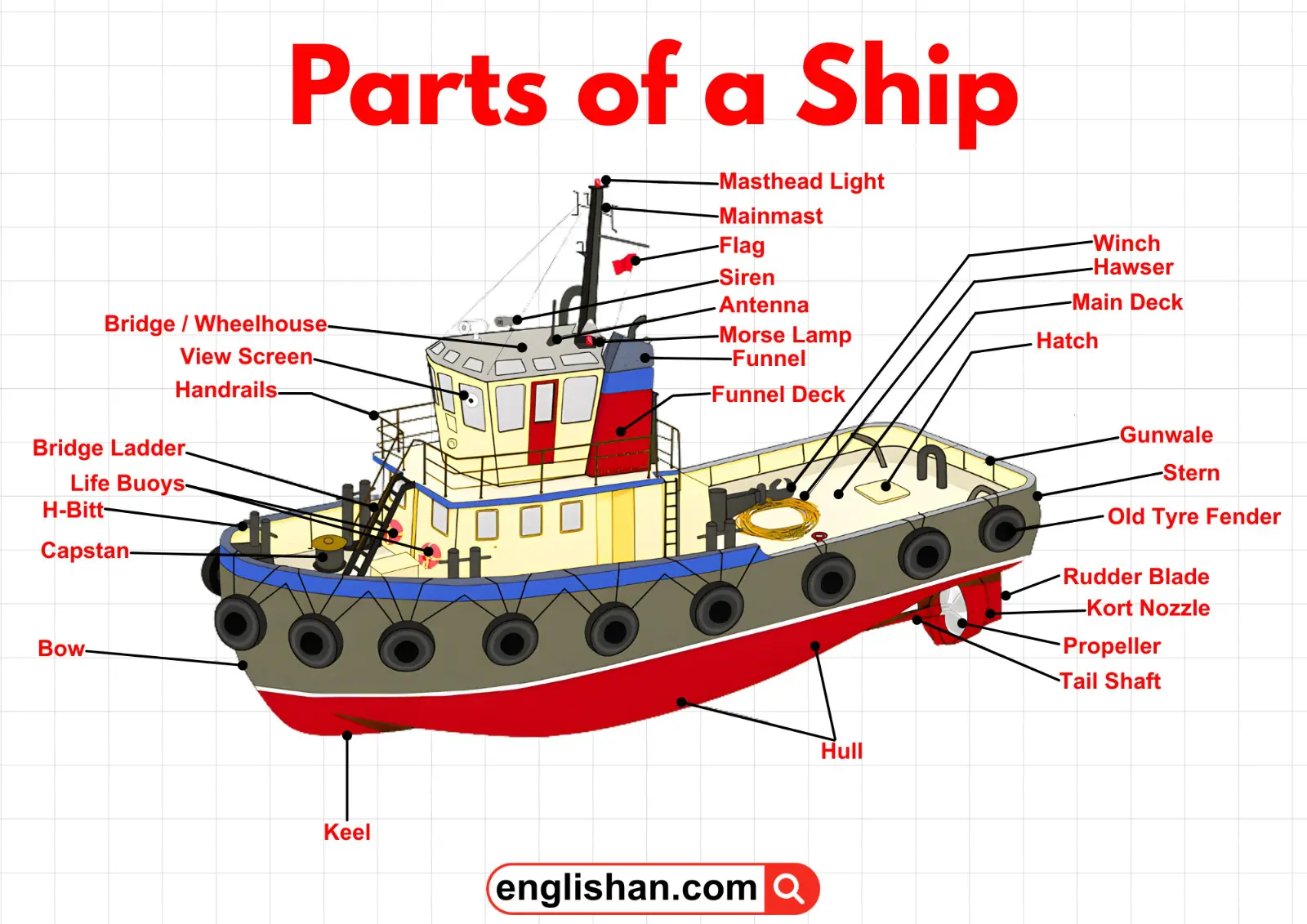
Ship Parts Diagram With Names
A ship operates as a floating system where structure, movement, navigation, and safety work together. Each named part supports a visible or functional role, allowing the vessel to float, move through water, and remain controlled at sea.
Hull And Ends
The hull and its ends form the floating body of the ship. Shape and strength here affect stability, balance, and movement through water.
Hull
The hull is the main outer body that keeps the ship afloat. Its structure provides:
- Buoyancy for floating
- Enclosed space for cargo and machinery
- Support for decks and superstructure
Bow
The bow forms the forward end of the hull. Its design:
- Cuts through water
- Reduces resistance
- Improves forward motion
Stern
The stern forms the rear end of the hull. This area:
- Supports propulsion parts
- Influences water flow
- Affects steering response
Keel
The keel runs along the bottom centerline. It provides:
- Structural strength
- Directional stability
- Balance against rolling
Gunwale
The gunwale is the upper edge of the hull sides. It:
- Strengthens hull edges
- Supports railings and fittings
Deck And Openings
Decks create working surfaces, while openings allow access and ventilation.
Main Deck
The main deck is the primary open surface. It supports:
- Crew movement
- Deck operations
- Equipment placement
Poop Deck
The poop deck sits at the aft upper level. It offers:
- Additional working space
- Access to rear equipment
Funnel Deck
The funnel deck supports exhaust structures. It allows:
- Exhaust passage
- Maintenance access
Hatch
A hatch is a deck opening that:
- Provides access to lower spaces
- Allows cargo handling
Bridge And Accommodation
This section supports navigation and living spaces on board.
Bridge Or Wheelhouse
The bridge controls navigation and movement. It contains:
- Steering controls
- Navigation equipment
- Communication systems
Flying Bridge
The flying bridge is an open control area. It provides:
- Higher visibility
- Open navigation access
Bridge Wing
Bridge wings extend outward from the bridge. They allow:
- Side visibility
- Safer docking maneuvers
Monkey Island
Monkey island sits above the bridge. It supports:
- Observation points
- Navigation equipment
Accommodation
Accommodation includes living areas. These spaces provide:
- Crew cabins
- Rest areas
- Mess facilities
Superstructure
The superstructure is built above the main deck. It houses:
- Bridge spaces
- Accommodation areas
Porthole
A porthole is a circular window. It allows:
- Natural light
- Limited ventilation
Bridge Ladder
The bridge ladder connects deck levels. It enables:
- Vertical movement
- Access between decks
Handrails
Handrails run along decks and ladders. They provide:
- Support while moving
- Safety against slipping
View Screen
A view screen shields the bridge. It:
- Reduces wind exposure
- Improves visibility
Masts And Signals
These parts support navigation, communication, and signaling.
Mainmast
The mainmast is the primary vertical support. It holds:
- Lights
- Antennas
- Signal equipment
Radar Mast
The radar mast supports radar units. It allows:
- Object detection
- Navigation awareness
Masthead Light
The masthead light signals vessel presence. It:
- Shows direction
- Indicates movement
Antenna
Antennas handle communication. They support:
- Radio signals
- Satellite links
Flag
Flags provide visual signals. They indicate:
- Vessel identity
- Communication status
Siren
The siren produces loud warning sound. It is used for:
- Fog signaling
- Emergency alerts
Morse Lamp
A Morse lamp sends light signals. It allows:
- Visual communication
- Silent signaling
Safety Gear
Safety gear supports emergency response.
Lifeboat
A lifeboat is carried for evacuation. It provides:
- Emergency transport
- Survival support
Life Buoys
Life buoys float on water. They are used for:
- Rescue support
- Man overboard response
Mooring And Deck Gear
These parts secure the ship during docking.
Winch
A winch controls heavy ropes. It provides:
- Line pulling
- Tension control
Hawser
A hawser is a thick rope. It is used for:
- Mooring
- Towing
Capstan
A capstan assists with rope handling. It allows:
- Controlled line movement
- Heavy load handling
H-Bitt
An H-bitt is a fixed metal post. It:
- Holds mooring lines
- Resists heavy force
Propulsion And Steering
These parts move and guide the ship.
Propeller
The propeller rotates in water. It:
- Pushes water backward
- Drives the ship forward
Tail Shaft
The tail shaft connects engine to propeller. It transfers:
- Rotational power
- Engine motion
Rudder Blade
The rudder blade turns in water. It:
- Redirects water flow
- Changes direction
Rudder
The rudder assembly controls steering. It:
- Guides the vessel
- Maintains course
Kort Nozzle
A Kort nozzle surrounds the propeller. It improves:
- Thrust efficiency
- Low speed control
Machinery Spaces And Vents
These areas support power systems and airflow.
Engine Room
The engine room houses engines and systems. It supports:
- Power generation
- Mechanical operation
Pump Room Vent
A pump room vent allows airflow. It:
- Releases heat
- Prevents gas buildup
Protection And Fenders
These parts reduce impact damage.
Old Tyre Fender
An old tyre fender cushions contact. It:
- Absorbs impact
- Protects hull surfaces
Ship Key Takeaways
A ship operates as a marine system built around structure, movement, navigation, and safety. The hull provides flotation, decks and superstructure support operations, propulsion parts create movement, steering controls direction, and safety equipment supports emergencies. Power flows from engines to propellers, steering alters water flow, and protective parts absorb contact. Some variation exists in deck layout and equipment, and we summarize the parts of a ship as a connected structure that enables controlled travel across water.