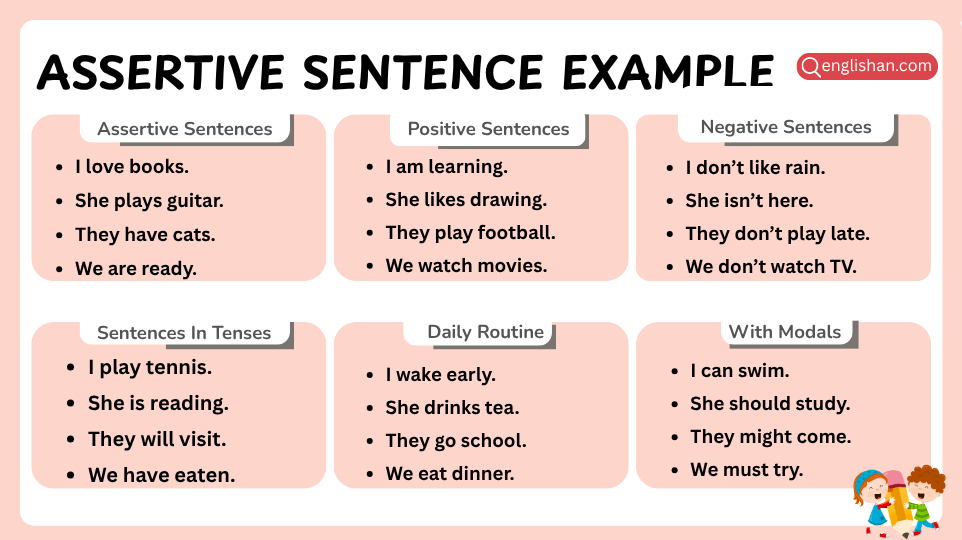
An assertive sentence is a statement that tells a fact, gives information, or says what someone thinks. It does not ask a question or give an order. For example, “The sun is bright” and “I like apples” are assertive sentences.
Learning an assertive sentence example helps you write better sentences and understand English grammar more easily.

What is an Assertive Sentence?
An assertive sentence is a simple statement that declares information, thoughts, or feelings in a direct way. It does not ask a question or give an order but instead tells something clearly. For example, “The sky is blue” and “I like apples” are assertive sentences because they state facts or opinions.
Assertive Sentence Examples
Below is a list of assertive sentences showing how clear statements are formed for practice and recognition of grammar patterns in daily learning.
- I love reading books.
- Sara plays the guitar well.
- They have two cats at home.
- The bus arrives on time every day.
- We are ready for the test.
- My father drives to work every morning.
- It rains a lot in this city.
- I enjoy listening to music.
- You look happy today.
- He always drinks coffee in the morning.
- They study together after school.
- She cooks delicious food.
- We travel during summer vacations.
- The teacher explains the lesson clearly.
- I walk to school every day.
Positive Assertive Sentences
Below is a list of positive assertive sentences for building clear statement structure.
- She likes to draw.
- I am learning English.
- They have a small garden.
- The baby sleeps peacefully.
- He visits his grandmother often.
- We enjoy the weather today.
- Sara writes stories in her notebook.
- The dog runs fast in the park.
- You help your friends.
- I read a new book yesterday.
- They play football every weekend.
- He sings beautifully.
- My mother makes tea in the evening.
- We like to watch movies.
- The students answer the questions quickly.
Negative Assertive Sentences
Below is a list of negative assertive sentences to practice denying or negating statements confidently.
- I don’t like spicy food.
- She isn’t going to the market today.
- They don’t play outside after dark.
- He hasn’t finished his homework yet.
- We don’t watch TV in the morning.
- The car doesn’t start easily in winter.
- You aren’t late for the meeting.
- Sara doesn’t eat meat.
- They aren’t ready for the trip yet.
- He doesn’t live far from here.
- I don’t understand this topic well.
- She hasn’t called me yet.
- We don’t have enough time today.
- The shop doesn’t open on Sundays.
- You don’t need to worry about it.
Assertive Sentences For Beginners
Below is a list of simple assertive sentences using basic vocabulary for beginner-level practice.
- I like apples.
- You are my friend.
- He has a bike.
- She is happy.
- We play in the park.
- They are at home.
- It is a sunny day.
- The cat sleeps on the bed.
- Sara reads books.
- The dog barks loudly.
- I am ten years old.
- He goes to school.
- We like ice cream.
- You can draw well.
- She sings a song.
Assertive Sentences With Simple Vocabulary
Below is a list of assertive sentences with easy words to help new learners build comfort with clear statements.
- I drink water.
- You see the moon.
- He wears a blue shirt.
- She has a red bag.
- We eat lunch together.
- They like playing games.
- It is a big tree.
- The baby smiles often.
- Sara loves her dog.
- The teacher is kind.
- I have a pencil.
- You look smart.
- He has a pet cat.
- We are friends.
- They are students.
Assertive Sentences In Different Tenses
Below is a list of assertive sentences using different tenses for grammar pattern awareness.
- I play tennis every Sunday.
- She is reading a book now.
- They will visit us tomorrow.
- We have eaten breakfast already.
- He was watching TV last night.
- The cat sleeps during the day.
- They were playing outside when it rained.
- I will call you later.
- She has finished her homework.
- You are studying English grammar.
- They have been waiting for an hour.
- We had gone before you arrived.
- He will be joining us soon.
- She had finished the project on time.
- They will have arrived by now.
Assertive Sentences About Daily Routines
Below is a list of assertive sentences showing daily activities for context-based grammar learning.
- I wake up early in the morning.
- She drinks tea at breakfast.
- They go to school by bus.
- We eat dinner together.
- He reads the newspaper daily.
- The baby takes a nap in the afternoon.
- Sara writes in her diary every night.
- You brush your teeth before bed.
- They play outside after school.
- We watch a movie on weekends.
- She studies for her exams.
- He walks his dog every evening.
- I clean my room every day.
- They do their homework after dinner.
- We cook dinner at 7 pm.
Assertive Sentences With Modals
Below is a list of assertive sentences using modal verbs to express possibilities and abilities.
- I can swim well.
- She should study more.
- They might come tomorrow.
- We must follow the rules.
- He could help us with this.
- You may leave now.
- Sara can speak three languages.
- They must reach on time.
- He should call his parents.
- We can visit the museum.
- She might join us later.
- I must complete my work today.
- They could play football in the evening.
- He may come to the party.
- You should eat healthy food.
Assertive Sentences For Speaking Practice
Below is a list of assertive sentences to help learners practice speaking with clear sentence structures.
- I like chocolate ice cream.
- You are a good friend.
- She has a beautiful smile.
- They are playing in the garden.
- We love reading books.
- He is very tall.
- It looks like rain.
- Sara is learning to dance.
- The teacher gives us homework.
- You can sing well.
- They live near the park.
- We are having fun today.
- She wears a blue dress.
- I want to go to the zoo.
- He makes delicious food.
Assertive Sentences In Short Paragraphs
Below is a list of assertive sentences combined in short, simple paragraphs for reading flow.
- I wake up early. I brush my teeth. I eat breakfast. I go to school.
- Sara has a cat. The cat is white. It likes to sleep. It plays with toys.
- They live in a big house. The house has a garden. They play there. They love their home.
- He goes to the market. He buys fruits. He brings them home. He eats an apple.
- We have a holiday. We visit our grandma. She makes tea. We enjoy the day.
FAQs
Use assertive sentences by stating facts like “I go to school” or “We eat lunch.” They help you speak clearly in English.
Yes, assertive sentences are statements. They state facts or opinions directly, using clear sentence structure in English.
You May Also Like