Many English words begin with a small unit added before the root that changes meaning. Many learners ask about dis vs un, two prefixes often used for negative or opposite meaning in words such as disagree, dishonest, unhappy, and unknown. Because both prefixes can make a word negative, many learners wonder why English uses one in some words and the other in others.
These prefixes are common in everyday English. For example, disagree expresses opposition, while unhappy describes a lack of happiness. Looking at how each prefix attaches to different words explains why some forms sound natural in English and others do not.
This article explains dis vs un by covering their meanings, the words they commonly attach to, and common everyday examples. By the end, you will understand how each prefix changes meaning and how to recognize them quickly while reading or writing.
What Are Prefixes in English?
A prefix is a group of letters placed at the beginning of a word to change its meaning.
For example:
- happy → unhappy
- agree → disagree
Prefixes do not stand alone. They attach to a root word and modify its meaning. In many cases, they create a negative or opposite sense.
Two of the most common negative prefixes in English are dis and un.
Meaning of the Prefix Dis
The prefix dis often carries meanings such as:
- not
- opposite of
- lack of
- separation
- reversal of an action
Examples:
| Word | Meaning |
|---|---|
| disagree | to have a different opinion |
| dishonest | not honest |
| dislike | not like |
| disconnect | separate a connection |
| disapprove | not approve |
In verbs, dis often suggests that something is being reversed or taken apart.
Examples:
- disassemble – take apart
- disarm – remove weapons
- disconnect – break a connection
Meaning of the Prefix Un
The prefix un most often means not.
It commonly appears before adjectives.
Examples:
| Word | Meaning |
|---|---|
| unhappy | not happy |
| unfair | not fair |
| unknown | not known |
| unclear | not clear |
| unable | not able |
In some verbs, un shows that an action is reversed or removed.
Examples:
- untie – remove a knot
- unlock – open a lock
- unpack – remove from a package
- unfasten – loosen or open
Dis vs Un: Key Differences
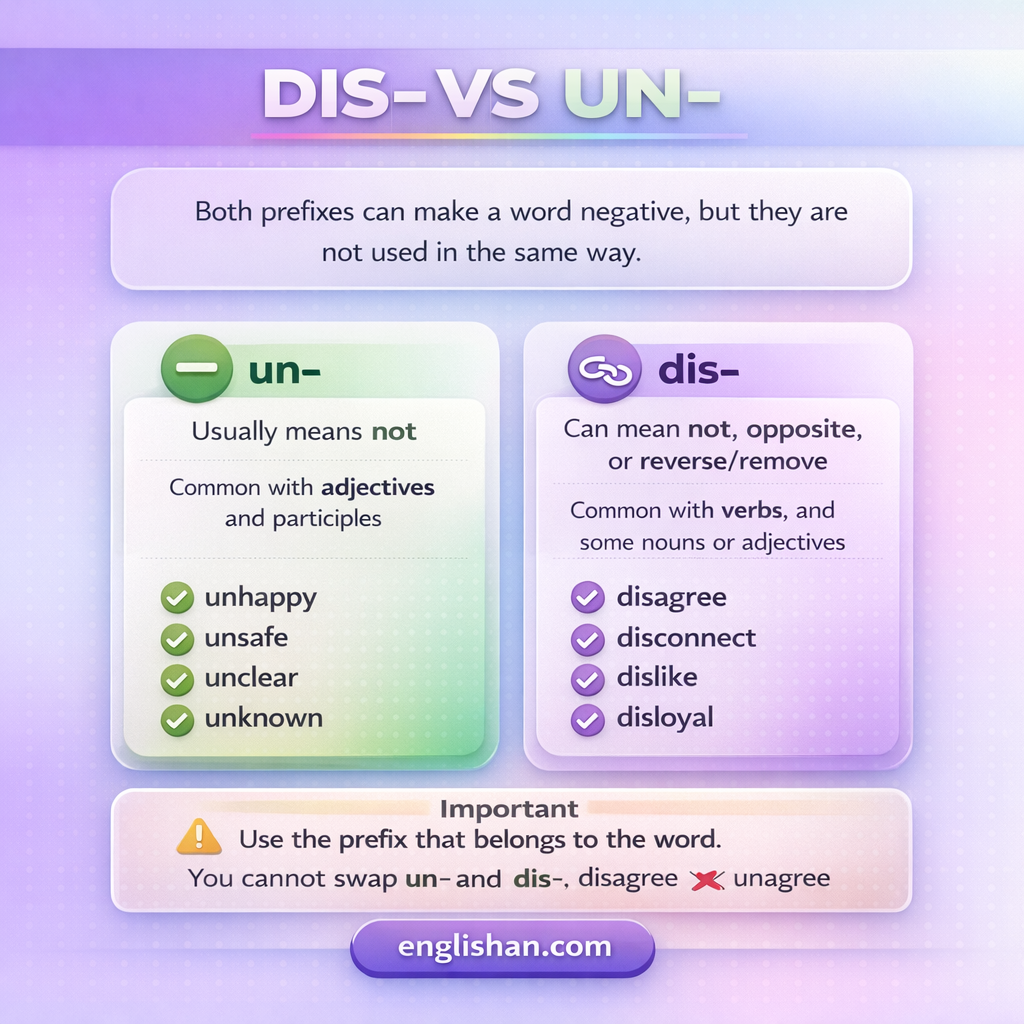
Although both prefixes can make a word negative, they are not used in the same way.
| Prefix | Typical Use | Common Meaning | Examples |
|---|---|---|---|
| un | often with adjectives | not | unhappy, unfair, unknown |
| dis | often with verbs and nouns | not, opposite, reverse | disagree, disconnect, disapprove |
This comparison helps explain why English uses unhappy but disagree, or unkind but dishonest.
English vocabulary developed over time, so the correct form depends on standard usage rather than a strict rule.
Common Words With the Prefix Dis
Here are common everyday words with dis:
- disagree
- disappear
- disappoint
- dislike
- dishonest
- disobey
- disorder
- disrespect
- disconnect
- disapprove
- disarm
- disassemble
- displace
- discomfort
- distrust
- dismiss
- dislike
- disallow
- discredit
- disbelieve
These words appear frequently in spoken and written English.
Common Words With the Prefix Un
Here are widely used words beginning with un:
- unable
- unfair
- unhappy
- unknown
- unclear
- unkind
- unusual
- unsafe
- untie
- unlock
- unpack
- unpaid
- untrue
- unwanted
- uncertain
- uneasy
- unfairly
- unfriendly
- unlucky
- unfinished
Words Often Confused With Dis and Un
Some word pairs exist with both prefixes but have slightly different meanings.
Uninterested vs Disinterested
- uninterested = not interested
- disinterested = impartial or unbiased
Example:
- She seemed uninterested in the topic.
- A judge should remain disinterested during a case.
Unorganized vs Disorganized
- unorganized = not organized
- disorganized = messy or lacking order
Example:
- The files were still unorganized after the move.
- His desk was so disorganized that he lost important papers.
Unsatisfied vs Dissatisfied
- unsatisfied = not satisfied
- dissatisfied = unhappy or displeased
Example:
- She felt unsatisfied with the incomplete answer.
- Customers were dissatisfied with the slow service.
Why You Cannot Add Dis or Un to Every Word
A common mistake is assuming any positive word can become negative by adding dis or un.
English does not always allow that.
Examples:
Correct forms:
- unhappy
- disagree
- dishonest
- unkind
Incorrect forms:
- dishappy
- unagree
- disgood
Word formation in English developed historically, so many forms must simply be learned as standard vocabulary.
Quick Tip to Remember the Difference
A helpful guideline:
- Un often forms negative adjectives meaning not.
- Dis often appears in verbs showing opposition, separation, or reversal.
Examples:
- unhappy
- unclear
- disagree
- disconnect
Learning these common patterns makes it easier to recognize new words with these prefixes.
Example Sentences Using Dis and Un
Sentences With Dis
- I disagree with that explanation.
- The phone charger became disconnected during the call.
- The teacher disapproved of the careless work.
- His rude comment felt disrespectful.
Sentences With Un
- She felt unhappy about leaving the team.
- The instructions were unclear to many students.
- Please untie the ribbon before opening the box.
- The road looked unsafe after the storm.
Common Mistakes With Dis and Un
Using the wrong prefix
Writers sometimes guess which prefix to use, producing forms like unagree or dishappy.
Treating the prefixes as identical
Although both can make a word negative, their meanings and usage often differ.
Ignoring established vocabulary
Some words simply use one prefix because that is the accepted form in English.
Summary
The prefixes dis and un both create negative meanings in English words, but they are not interchangeable. Un commonly forms adjectives meaning not, while dis often appears in verbs or nouns that suggest opposition, separation, or reversal. Understanding these patterns helps readers recognize unfamiliar vocabulary and choose the correct form in writing.
FAQs
The prefix dis often means not, opposite of, lack of, or sometimes reversal. Examples include disagree, dishonest, and disconnect.
The prefix un usually means not and often appears before adjectives such as unhappy, unfair, and unknown.
No. Some words use dis, while others use un, depending on standard English usage. For example, disagree is correct, but unagree is not.
Examples include:
Dis: disagree, dishonest, disconnect, disapprove
Un: unhappy, unfair, unknown, unclear
You May Also Like