Prefixes and suffixes: Definition, List and Examples

Julian Mercer
5 Min Read
Prefixes and suffixes with the meanings and complete list with downloadable flashcards. See examples of prefixes and example of suffixes.

Prefixes and suffixes are essential for building a strong English vocabulary. These word parts, when added to the beginning or end of a root word, create new words and meanings. Mastering prefixes and suffixes not only enhances your understanding of word formation but also strengthens your overall grasp of the language. Expanding your vocabulary through these word elements allows you to communicate more effectively in both writing and speech.

Prefixes and suffixes

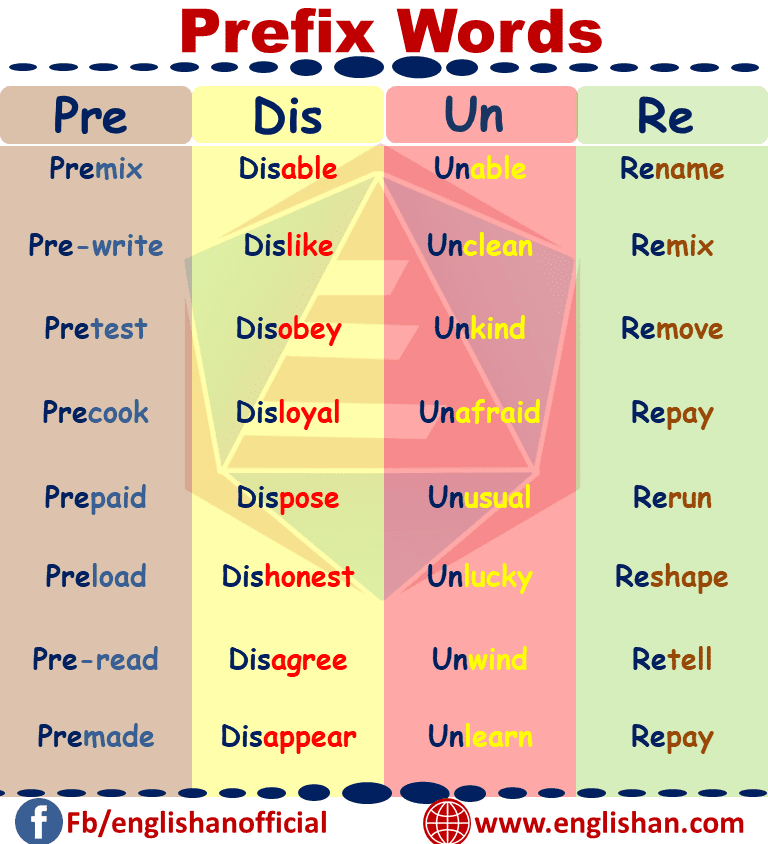
A prefix is a group of letters that is put before a word to form a new word with a new meaning.

PrefixWordNew word
RethinkRethink
MisbehaveMisbehave
SemicircleSemicircle
ImpossibleImpossible
PreviewPreview
DisobeyDisobey
InjusticeInjustice
TricycleTricycle
UnableUnable
irrelevantIrrelevant
Advertisement

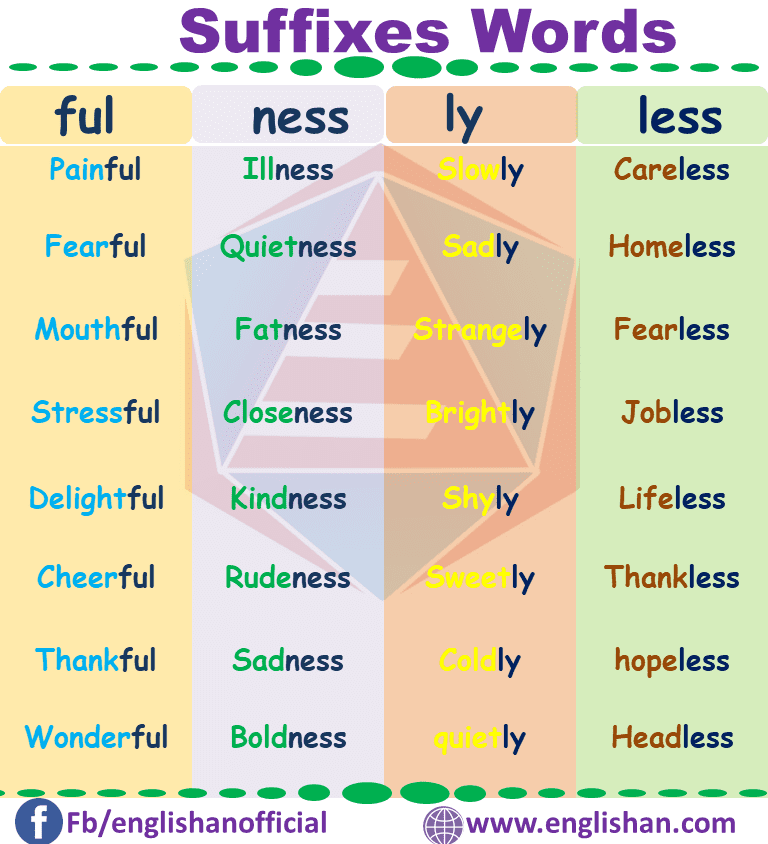
A suffix is a group of letters that is added after a word to form a new word with a new meaning.

WordSuffixNew word
CollectionCollection
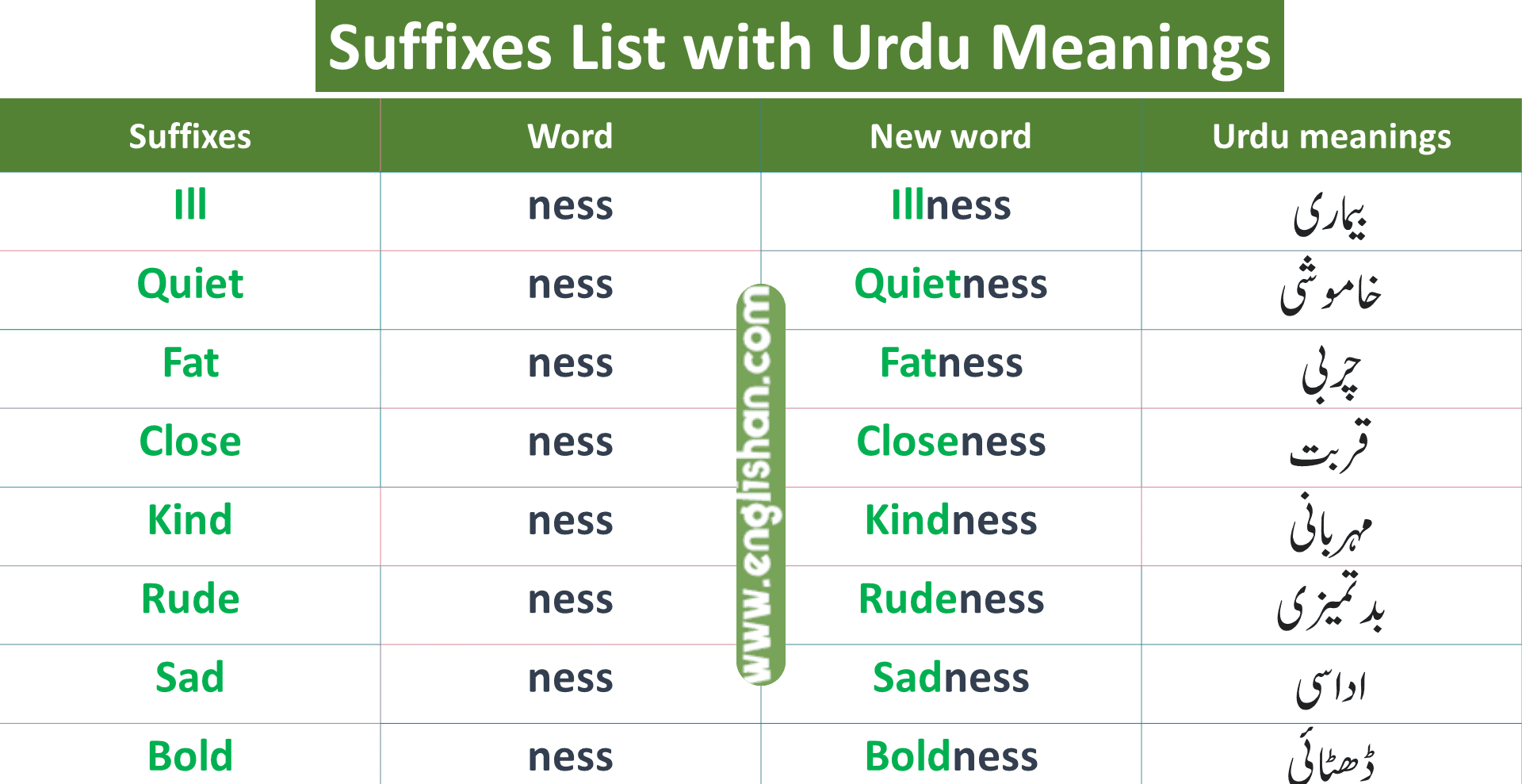
KindnessKindness
HardenHarden
HopefulHopeful
FollowerFollower
ConvertibleConvertible
BadlyBadly
BeakableBreakable
CarelessCareless
EnjoymentEnjoyment

Here are meanings of some common prefixes and suffixes.

PrefixMeaningExample
Anti-againstantinarcotics
Dis-not or removaldisappear, dismount
Inter-betweeninteract
Non-withoutnonfat
Pre-beforepreview
semi-halfsemicircle
Un-oppositeunhappy
Post-afterpostwar
Tri-threetricycle


SuffixMeaningExample 
-ablecapable of beingsolvable
-lesswithoutmotionless
-fulfull ofcheerful
-ento do, made of, becomefasten, woolen, strengthen
-nessstate of beingheaviness
-holicone who is obsessedworkaholic
-tionstate or quality ofattention
-istprofessionartist
-mentaction or process ofmovement
-fythe process of making intoamplify

Some more examples

PrefixesSuffixes 
AntisocialLoudly
DefrostBelievable
MisjudgeStronger
ImpureWooden
DisownJoyous
ExplodeDelightful
ProactiveReversible
PrepaidDirection
IncorrectRestless
UnusualSoftness
Suffixes with Definition, List and Examples Flashcards PDF
Prefixes with Definition, List and Examples Flashcards PDF
50 + Suffixes List with Urdu Meanings

FAQs

1. What is prefix and suffix examples with definition?

A prefix is a group of letters added to the beginning of a word to change its meaning.
Examples:
Un-: means “not” → Unkind (not kind)
Re-: means “again” → Rewrite (write again)
A suffix is a group of letters added to the end of a word to change its form or meaning.
Examples:
-ful: means “full of” → Hopeful (full of hope)
-less: means “without” → Careless (without care)

2. What are prefixes and suffixes in a list?

List of Prefixes
Un-
: means “not” → Unhappy (not happy)
Re-: means “again” → Redo (do again)
Pre-: means “before” → Preheat (heat before)
Dis-: means “not” → Dislike (not like)
Mis-: means “wrong” → Misplace (put in the wrong place)
List of Suffixes
-ful
: means “full of” → Joyful (full of joy)
-less: means “without” → Hopeless (without hope)
-ly: means “in a certain way” → Quickly (in a quick way)
-ness: means “state of being” → Kindness (state of being kind)
-able: means “able to” → Lovable (able to be loved)

3. What is prefix and suffix in name example?

A prefix in a name is a title added before the name. Examples: Mr. John Smith, Dr. Emily Brown, Miss Sarah Johnson.
A suffix in a name is a title added after the name. Examples: Robert King Jr., David Lee Sr., James Carter III.
In short, a prefix comes before the name, and a suffix comes after the name.

4. What are 12 examples of prefixes and suffixes?

12 Examples of Prefixes and Suffixes
Prefixes:
Un-: not → Unhappy (not happy)
Re-: again → Rewrite (write again)
Pre-: before → Preheat (heat before)
Dis-: not → Dislike (not like)
Mis-: wrong → Misunderstand (understand wrongly)
In-: not → Inactive (not active)
Suffixes:
7. -ful: full of → Joyful (full of joy)
8. -less: without → Careless (without care)
9. -ly: in a certain way → Quickly (in a quick way)
10. -ness: state of being → Kindness (being kind)
11. -able: able to → Readable (able to be read)
12. -er: one who → Writer (one who writes)

You May Also Like

Grammar practice

Prefixes and Suffixes

Prefix or suffix?

In 'unhappy', 'un-' is a ___ .

Reasoning

'Un-' attaches to the front of the root, so it is a prefix.

a prefix attaches to the front

unhappy

Prefix or suffix?

In 'kindness', '-ness' is a ___ .

Reasoning

'-ness' attaches to the end of the root, so it is a suffix.

a suffix attaches to the end

kindness

What does the prefix mean?

In 'rewrite', 're-' means ___ .

Reasoning

'Re-' means 'again', so 'rewrite' means write again.

're-' means again

rewrite = write again

What does the prefix mean?

In 'disagree', 'dis-' means ___ .

Reasoning

'Dis-' reverses the root, so 'disagree' means not agree.

'dis-' means not/opposite

disagree = not agree

What class does the suffix create?

Adding '-ly' to 'quick' makes 'quickly', which is a(n) ___ .

Reasoning

'-ly' turns the adjective 'quick' into the adverb 'quickly'.

'-ly' often forms adverbs

quick -> quickly

What does the prefix mean?

In 'preview', 'pre-' means ___ .

Reasoning

'Pre-' means 'before', so 'preview' means view before.

'pre-' means before

preview = view before

What class does the suffix create?

Adding '-ful' to 'care' makes 'careful', which is a(n) ___ .

Reasoning

'-ful' turns the noun 'care' into the adjective 'careful'.

'-ful' often forms adjectives

care -> careful

What does the prefix mean?

In 'misread', 'mis-' means ___ .

Reasoning

'Mis-' means 'wrongly', so 'misread' means read wrongly.

'mis-' means wrongly

misread = read wrongly

True or false?

A prefix is added to the beginning of a word and a suffix to the end.

Reasoning

Prefixes attach to the front and suffixes to the end of a root.

prefix: front; suffix: end

un- + kind + -ness

What class does the suffix create?

Adding '-tion' to 'educate' makes 'education', which is a(n) ___ .

Reasoning

'-tion' turns the verb 'educate' into the noun 'education'.

'-tion' often forms nouns

educate -> education

What does the prefix mean?

In 'overcook', 'over-' means ___ .

Reasoning

'Over-' means 'too much', so 'overcook' means cook too much.

'over-' means too much

overcook = cook too much

What does the suffix mean?

In 'hopeless', '-less' means ___ .

Reasoning

'-less' means 'without', so 'hopeless' means without hope.

'-less' means without

hopeless = without hope

Add a prefix.

Add a prefix to 'possible' to mean 'not possible': ___ possible.

Reasoning

'Im-' means 'not' before 'possible', forming 'impossible'.

'im-' means not

impossible = not possible

What class does the suffix create?

Adding '-er' to 'teach' makes 'teacher', which is a(n) ___ .

Reasoning

'-er' turns the verb 'teach' into a noun for the doer.

'-er' can form a doer noun

teach -> teacher

What does the prefix mean?

In 'incorrect', 'in-' means ___ .

Reasoning

'In-' means 'not', so 'incorrect' means not correct.

'in-' can mean not

incorrect = not correct

What class does the suffix create?

Adding '-able' to 'read' makes 'readable', which is a(n) ___ .

Reasoning

'-able' turns the verb 'read' into the adjective 'readable'.

'-able' often forms adjectives

read -> readable

Which word has a prefix meaning 'not'?

Choose the word with a prefix meaning 'not'.

Reasoning

'Un-' in 'unfair' means 'not', so 'unfair' means not fair.

'un-' can mean not

unfair = not fair

True or false?

Suffixes can change a word from one part of speech to another.

Reasoning

A suffix can turn a verb into a noun or an adjective into an adverb.

suffixes can change word class

educate -> education

What does the suffix mean?

In 'joyful', '-ful' means ___ .

Reasoning

'-ful' means 'full of', so 'joyful' means full of joy.

'-ful' means full of

joyful = full of joy

Identify the root.

In 'unbreakable', the root word is ___ .

Reasoning

'Break' is the root; 'un-' and '-able' attach to it.

the root remains after removing affixes

un- + break + -able

Turn on JavaScript for the interactive quiz. The full practice set is shown above.

Advertisement
Share This Article
Follow:
Julian Mercer is the founder of Englishan.com and has spent over a decade helping English learners improve through online lessons and practical writing. Having worked with students across many countries, he knows the questions people repeat, the mistakes that slow progress, and the moments that make English click. On Englishan, he writes about vocabulary, picture vocabulary, grammar, and everyday English to help readers speak with ease, read with less strain, and write with more confidence.