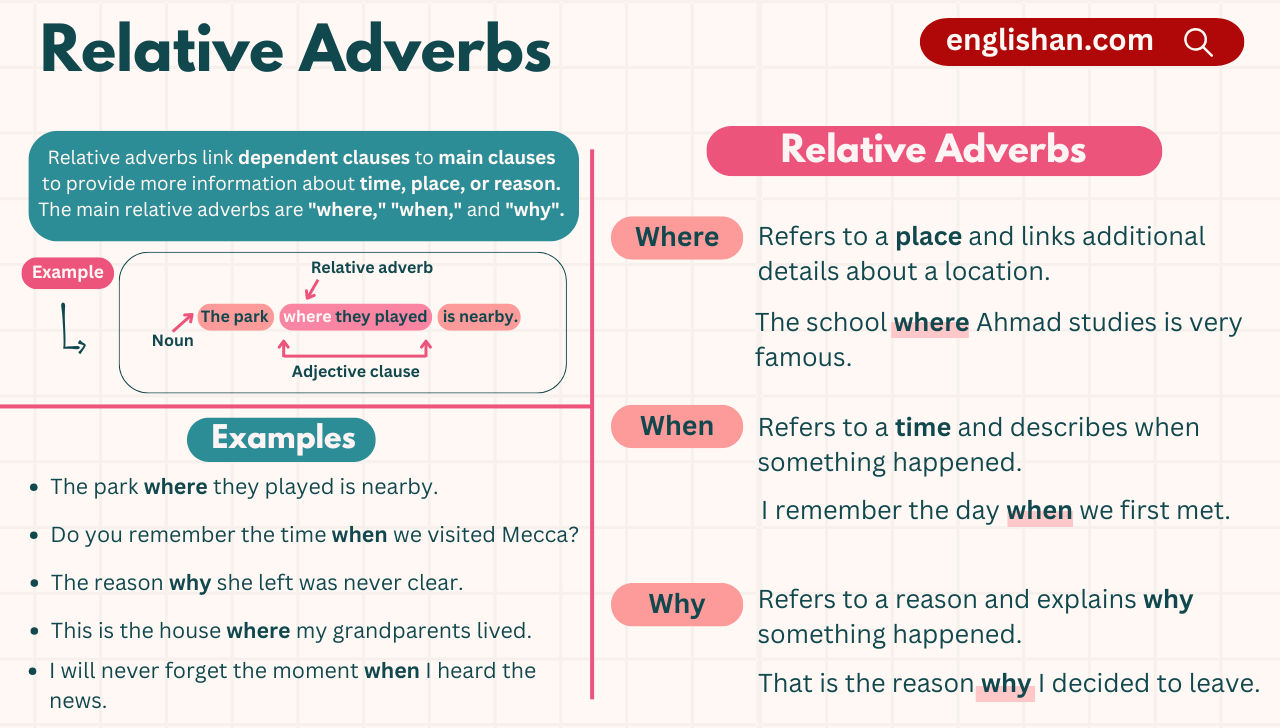
An interjection is a word or short phrase that expresses a sudden feeling and takes no grammatical role in the sentence around it. Wow, ouch and hello all qualify. Delete one from a sentence and the sentence still works, which separates it from every other part of speech. That independence also governs how you punctuate it.
What Is An Interjection
An interjection is a word or short phrase that expresses a sudden feeling or reaction and forms no grammatical link with the words around it. The name derives from the Latin interjicere, to throw between, which describes exactly where the word goes: thrown in between thoughts rather than built into one.
Two properties make the class testable, and each one gives you a check to run on any sentence.
The first is independence. Remove the word and the rest of the sentence stays untouched.
- Ouch! That hurts. Take ouch away and that hurts still works as a full sentence, with the same meaning and the same grammar. No other part of speech behaves that way, since removing a verb or a subject breaks the clause.
The second is that the class takes no inflection. It forms no plural, no past tense and no comparative. English gives you ouches, ouched and ouchest nowhere, because the word reports a reaction rather than naming a thing, an action or a quality.
Types Of Interjections
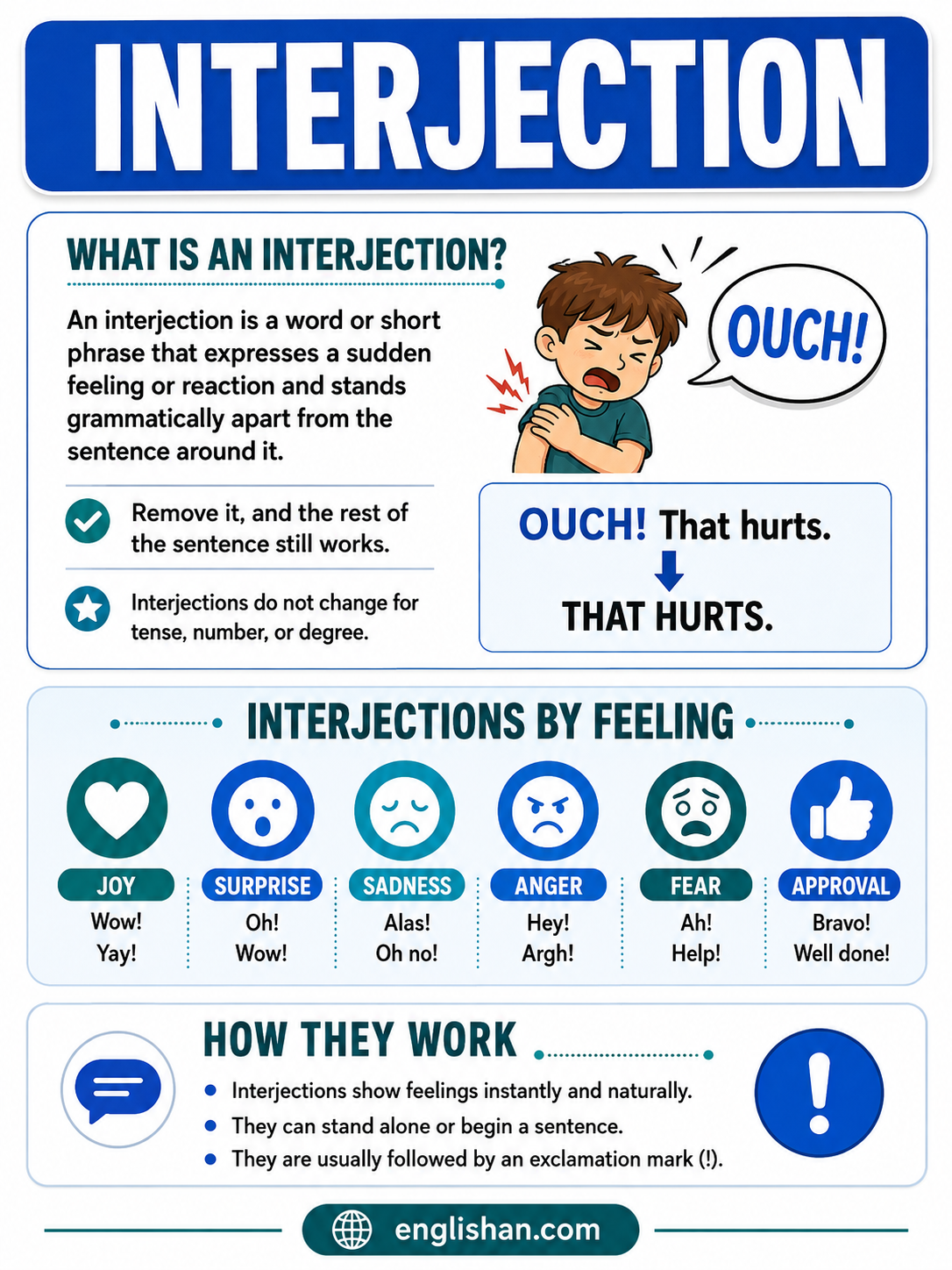
You classify an interjection twice. The first classification asks what the word is by origin, which gives you the primary and secondary classes. The second asks what the word does in the moment, which gives you emotive, volitive, cognitive and phatic. Every word in the class takes one label from each set, so shh is primary by origin and volitive by function at the same time.
Primary And Secondary Interjections
A primary interjection does this job and no other. Ouch, psst, yikes, oops and ugh belong here. None of them names a person, an action or a quality, and none appears anywhere else in the grammar.
A secondary interjection borrows a word from another part of speech. Goodness is a noun, shoot is a verb, awesome is an adjective, and each turns into one the moment a speaker throws it out alone to react.
The test is whether the word survives outside the reaction. Goodness still works in she showed real goodness, so it is secondary. Psst works in no other sentence in English, so it is primary.
Emotive Interjections
An emotive interjection reports what the speaker feels. Ew reports disgust, yay reports delight, alas reports regret and ouch reports pain. Nothing is asked of the listener, since the word only shows the speaker’s state.
Ew! I am not eating that.
Volitive Interjections
A volitive interjection asks the listener for something. Shh asks for silence, psst asks for attention, ahem asks someone to notice you and hush asks a child to settle.
This is where learners misfile words, so watch the verb. Be quiet! and Stop talking! do the same job as shh, but each one is a full command with its own verb, which makes it an imperative clause instead. Shh has no verb at all, and that absence is what keeps it inside the word class.
Cognitive Interjections
A cognitive interjection reports thinking rather than feeling. Aha marks the moment a speaker understands, hmm marks doubt, um marks the pause while a speaker searches for a word, and eureka announces a solution.
Speech takes these far more than writing does. Write um and er into dialogue and they sound real; write them into an essay and they read as a mistake.
Phatic Interjections
A phatic interjection manages the contact between two speakers instead of reporting a state. Hello opens contact, bye closes it, uh-huh signals that you are still listening, and with thanks a speaker acknowledges what someone did.
These attach to no clause exactly as ouch does, which is why they take the same label. Some grammarians argue that greetings answer a social convention rather than a feeling, so they treat them as a separate class. For a learner the practical result is identical: they attach to no clause and they follow the same punctuation rules.
List Of Interjections With Meanings
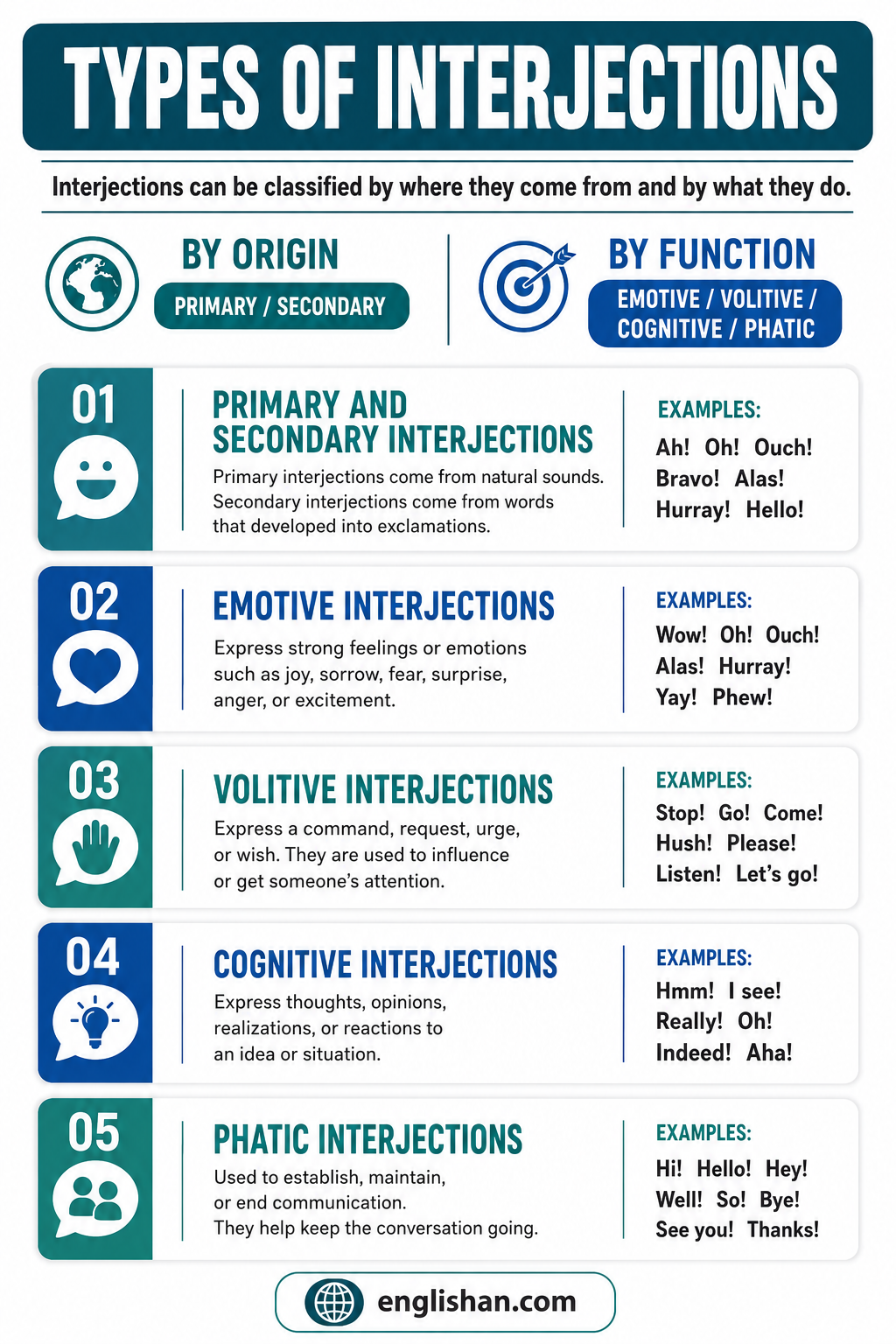
One interjection rarely fits two emotions, so choosing the wrong one changes your message. Yikes reports alarm and yuck reports disgust, and swapping the two makes a speaker sound confused. Each word is given with the feeling it reports and a sentence showing that feeling in context.
In the Corpus of Global Web-Based English, the most frequently tagged interjections are yes, no, oh, yeah, hi, hey, wow, hello, ah and hmm. The everyday ones outrank the dramatic ones by a wide margin in real English.
For More Interjections: List Of Interjections
Joy and celebration: these words follow a win or good news.
| Word | Meaning | Example |
|---|---|---|
| Hurray | Celebration at a victory or big news | Hurray! Our team took the cup. |
| Yay | Delight at a small everyday win | Yay! My parcel arrived early. |
| Yippee | Playful delight, common with children | Yippee! No school tomorrow. |
| Woohoo | The loudest of these cheers | Woohoo! We got the flat. |
| Whoopee | Older cheer, now playful or ironic | Whoopee! Another meeting. |
| Hallelujah | Relief at good news, from religious praise | Hallelujah! The rain has stopped. |
| Huzzah | Old cheer kept for jokes and period drama | Huzzah! The feast is served. |
| Cheers | Toast, and a casual thank you in British English | Cheers! Here is to the two of you. |
| Yes | Celebration rather than an answer | Yes! I passed. |
Surprise and amazement: these words react to something unexpected.
| Word | Meaning | Example |
|---|---|---|
| Wow | Reaction to something impressive | Wow! That view is unreal. |
| Whoa | Shock, or a call to slow down | Whoa! Not so fast. |
| Oh | Surprise, pain or realisation, set by the voice | Oh! You are here already. |
| Goodness | Mild shock, borrowed from the noun | Goodness! Look at the price. |
| Gosh | Softer goodness, for polite company | Gosh! I did not expect that. |
| Golly | Gentle surprise, now dated | Golly! What a machine. |
| Blimey | Loud surprise in British speech | Blimey! That was close. |
| Crikey | Alarm mixed with awe, British and Australian | Crikey! Look at the size of it. |
| My word | Formal, old-fashioned surprise | My word! You have grown. |
Approval and praise: these words back what someone has just done.
| Word | Meaning | Example |
|---|---|---|
| Bravo | Praise for a performance | Bravo! That solo was faultless. |
| Well done | Praise for the effort as much as the result | Well done! You finished the whole course. |
| Excellent | Approval, borrowed from the adjective | Excellent! That is exactly right. |
| Nice | Mild praise for something small | Nice! The colour suits you. |
| Awesome | Everyday praise in American English | Awesome! Do that trick again. |
| Amen | Strong agreement, from worship | Amen! That is exactly the problem. |
| Hear hear | Support for a speaker in a meeting or debate | Hear hear! Well argued. |
| Encore | Call for one more piece | Encore! Play the last song again. |
Sorrow and regret: these words mark loss or disappointment.
| Word | Meaning | Example |
|---|---|---|
| Alas | Regret, now mostly in writing | Alas! The plan came to nothing. |
| Oh dear | Sympathy at bad news | Oh dear! Is your father unwell? |
| Aw | Pity, and also tenderness | Aw! The poor thing is shivering. |
| Oh no | The moment something goes wrong | Oh no! The ship is sinking. |
| Boo hoo | Mock crying at someone’s self-pity | Boo hoo! You lost one game. |
| Ah well | Acceptance of a small disappointment | Ah well! There is always next year. |
| Sigh | Weariness, written for the breath | Sigh. Another form to fill in. |
| Woe | Grief, kept in the phrase woe is me | Woe is me! Everything has gone wrong. |
Pain: these words report physical hurt.
| Word | Meaning | Example |
|---|---|---|
| Ouch | Sudden sharp pain | Ouch! That needle stung. |
| Ow | Smaller pain, or an ache that lasts | Ow, my back. |
| Aargh | Pain mixed with frustration | Aargh! I have hit my thumb again. |
| Oof | Blow to the body, or a sudden weight | Oof! That box is heavier than it looks. |
| Yowch | Playful pain, common in comics | Yowch! The pan is still hot. |
Fear and alarm: these words react to danger or a fright.
| Word | Meaning | Example |
|---|---|---|
| Eek | Small fright | Eek! There is something in the sink. |
| Yikes | Alarm at bad news you did not expect | Yikes! The exam is tomorrow. |
| Uh-oh | The second you realise something is wrong | Uh-oh. I left the door open. |
| Heavens | Old-fashioned alarm | Heavens! What was that noise? |
| Good grief | Alarm mixed with disbelief | Good grief! Not again. |
| Help | Call for rescue | Help! My hand is stuck in the door. |
Disgust: these words reject something unpleasant.
| Word | Meaning | Example |
|---|---|---|
| Ew | Disgust at a sight, taste or smell | Ew! This milk has turned. |
| Yuck | The same disgust, common with children | Yuck! I am not touching that. |
| Ugh | Disgust, and also plain weariness | Ugh! Another delay. |
| Blech | Strong distaste, imitating a gag | Blech! That tastes of soap. |
| Phooey | Dismissal of something worthless | Phooey! I do not believe a word of it. |
| Bah | Scorn for an idea | Bah! Sentimental nonsense. |
Relief: these words come after a scare or a long wait.
| Word | Meaning | Example |
|---|---|---|
| Phew | Release after a near miss | Phew! We made the train. |
| Whew | The American spelling of phew | Whew! That was close. |
| Thank goodness | Relief at an outcome that went well | Thank goodness! She is safe. |
| At last | Relief at something overdue | At last! My turn. |
| Finally | Relief at the end of a long wait | Finally! The results are out. |
Greeting and parting: these words open and close contact between speakers.
| Word | Meaning | Example |
|---|---|---|
| Hello | Opening contact, spoken or written | Hello! Come in. |
| Hi | Greeting for someone you know well | Hi! Good to see you. |
| Hiya | Warm greeting in British informal speech | Hiya! How was the trip? |
| Howdy | Greeting from the American South and West | Howdy! Long time no see. |
| Yo | Greeting that also calls attention | Yo! Over here. |
| Goodbye | Formal parting in full form | Goodbye! We shall meet again next summer. |
| Bye | Everyday parting | Bye! See you on Tuesday. |
| So long | Parting that will last a while | So long! Write when you land. |
| Farewell | Final parting, now literary | Farewell! Our paths part here. |
Attention and command: these words act on the listener rather than report a feeling.
| Word | Meaning | Example |
|---|---|---|
| Hey | Call for attention, or a protest | Hey! Wait for me. |
| Psst | Quiet call to one person | Psst! Pass me a pen. |
| Shh | Request for silence | Shh! The baby has just gone down. |
| Hush | Gentler request, suited to a child | Hush now, the film has started. |
| Look | Direction of the eyes or the attention | Look! A shooting star. |
| Behold | Attention in old and ceremonial English | Behold! The king approaches. |
| Ahoy | Call across water, now mostly playful | Ahoy! Ship to starboard. |
| Yoo-hoo | Friendly call across a distance | Yoo-hoo! I am over by the gate. |
| Watch out | Warning of danger the listener has not seen | Watch out! The step is loose. |
Agreement and refusal: these words answer without a full sentence.
| Word | Meaning | Example |
|---|---|---|
| Yeah | Relaxed agreement | Yeah, that works for me. |
| Yep | Brisk agreement that ends the exchange | Yep, I have sent it. |
| Uh-huh | Signal that you are still listening | Uh-huh, go on. |
| Okay | Acceptance of what someone proposed | Okay, we will meet at six. |
| Sure | Easy agreement without fuss | Sure, take mine. |
| Nope | Brisk refusal | Nope, that will not work. |
| Nah | Soft refusal, friendlier than a flat no | Nah, I am fine here. |
| Uh-uh | Refusal marked by a falling sound | Uh-uh, do not touch that. |
Thinking and hesitation: these words report a mind at work.
| Word | Meaning | Example |
|---|---|---|
| Um | Pause while a speaker searches for a word | The answer is, um, forty. |
| Uh | The American um | I was, uh, running late. |
| Er | The British um | Lima is the capital of, er, Peru. |
| Hmm | Doubt or thought in progress | Hmm, I am not so sure. |
| Well | Pause before a reply | Well, that depends. |
| Aha | The moment a speaker understands | Aha! So that is where it was. |
| Eureka | Solution announced after a struggle | Eureka! The formula works. |
Mistakes and frustration: these words follow a slip or a setback.
| Word | Meaning | Example |
|---|---|---|
| Oops | Small mistake admitted at once | Oops! Wrong window. |
| Whoops | The same slip, lighter and sillier | Whoops! I have knocked your cup over. |
| Darn | Stand-in for a stronger word | Darn! I have missed the post. |
| Dang | The American darn | Dang! The engine will not start. |
| Rats | Annoyance at a small setback | Rats! The shop has closed. |
| Drat | The same annoyance, older and British | Drat! I have forgotten my keys. |
| Oh well | Acceptance that drops the subject | Oh well, there is always tomorrow. |
Doubt and dismissal: these words reject an idea or refuse to take it seriously.
| Word | Meaning | Example |
|---|---|---|
| Meh | Indifference | Meh, the film was watchable. |
| Pfft | Dismissal with a puff of air | Pfft! As if he would. |
| No way | Refusal, or disbelief at a claim | No way! She never said that. |
| Come on | Urging, or protest at a claim you distrust | Come on! You do not expect me to believe that. |
Interjection Examples In Sentences
Reading one inside a full sentence shows both its type and its punctuation at once. Each example names the class of the word.
- Yippee! We are going to the coast. Yippee is a primary interjection by origin, since the word does no other job in English, and an emotive one by function, since it reports delight.
- Shoot! My flight has been cancelled. Shoot is a secondary interjection, because the same word works as a verb in shoot the ball. Here it reports frustration instead.
- Psst, the answer is on the second page. Psst is volitive, since it asks the listener to do something, in this case to lean in and listen.
- Hmm, that price looks wrong to me. Hmm is cognitive, because it reports the speaker’s doubt rather than an emotion or a request.
- Bye! Give my love to your mother. Bye is phatic, since it closes the contact between two speakers instead of reporting a feeling.
Notice that in every one of these sentences you delete the first word and the rest still works on its own. That is the property that defines the whole word class, and it is what your teacher tests when they ask you to find the interjection.
How To Punctuate Interjections
Four punctuation marks follow this word class, and you choose between them by the strength of the feeling.
| Mark | Write it when | Example |
|---|---|---|
| Exclamation mark | The feeling is strong or sudden | Yikes! A wasp. |
| Comma | The feeling is mild and the interjection joins the sentence | Well, I suppose so. |
| Full stop | The feeling is mild and you want a deliberate pause | Oops. Wrong file. |
| Question mark | The interjection asks something | Huh? Say that again. |
The mark you choose then determines the capital letter, and this is where most written mistakes appear. An exclamation mark, a question mark or a full stop closes it, so the next word begins a new sentence and takes a capital.
- Wow! that view is unreal. ❌ The exclamation mark has already ended one sentence, so that starts a new one and needs a capital T.
- Wow! That view is unreal. ✅ Both parts now read as complete sentences, which matches how you would say them aloud.
A comma works the opposite way, because it keeps the word inside the sentence that follows.
- Well, We can try again tomorrow. ❌ The comma has joined the two parts into one sentence, so we stays lowercase.
- Well, we can try again tomorrow. ✅ One sentence, one capital letter at the start, and the comma marks the small pause after well.
One caution remains on exclamation marks. Two or three in a row (Wow!!!) work in a message to a friend and in nothing else. Formal writing allows one, and a text full of them weakens every one in it.
Where Interjections Go In A Sentence
This word class takes four positions, and each position changes the punctuation around it rather than the meaning of the word.
At the start: the word sets the feeling before the sentence itself, and this is the position you will meet most.
- Phew! We made the train with a minute to spare.
In the middle: the word interrupts the thought, and a comma on each side marks the break.
- The cake was, ugh, far too sweet for me.
At the end: the word closes the sentence and adds the reaction after the fact.
- We finished the whole project on time, finally!
Alone: the word forms a complete utterance with no clause attached at all.
- Ouch!
That last position explains why interjections are called grammatically independent. A noun or a verb standing alone leaves a sentence unfinished, while one of these on its own is finished already.
How To Identify An Interjection
Three tests separate this class from every word it resembles. Run them in order on any word you are unsure about.
- Delete the word and read the sentence again: if what remains still works as a full sentence with the same meaning, the deleted word is an interjection. In Alas, the shop had closed, deleting alas leaves the shop had closed, which works perfectly well. Delete the verb instead and the sentence stops working, which is the difference.
- Try to change its form: the class accepts no plural, no tense and no comparison. Oops gives you no oopsed and no oopser, while a genuine verb or adjective in the same position changes shape without trouble.
- Look for a verb inside the word group: a word group with its own verb is a clause, not an interjection. Shh is an interjection and Be quiet! is an imperative clause, even though the two do the same job in conversation. This one catches out more learners than the other two together.
The tests work on secondary interjections as well. In Goodness! The queue is enormous, goodness passes all three: the sentence survives without it, the word takes no interjection-specific ending here, and no verb comes with it. In She showed real goodness, the same word fails test one, because deleting it breaks the sentence. The word class depends on the job the word does in that sentence, not on the word itself.
Interjections In Formal And Informal Writing
Interjections start in speech, and every written setting that copies speech takes them naturally. Text messages, casual email, dialogue in fiction, comics, personal essays, blogs and advertising all accept them without trouble.
Formal writing rules them out. An academic essay, a business report, a research paper, a legal document and an exam answer take none of them, because each one asks you to argue rather than to react. Writing Wow, the results were unexpected in a lab report costs you marks that the results were unexpected would have kept.
One exception applies in every formal setting: quoted speech. Reporting what someone said keeps their words intact, interjections and all, since the reaction is the speaker’s rather than yours.
- The witness told the court, “Oh no, the car never stopped.”
Two mild ones are accepted in formal speech, and well and indeed are the ones. Both appear in interviews, presentations and formal conversation without sounding out of place, which is why examiners treat them differently from yikes and ugh.
Interjections Vs Exclamations
An interjection is a single word or a short phrase, while an exclamation is a full sentence spoken with force. Wow! is an interjection. What a beautiful house this is! is an exclamation, because it carries a subject and a verb inside a complete clause.
The exclamation mark causes the confusion, since both take one. Look past the mark and count the parts instead. If the words form a clause with a subject and a verb, you have an exclamation; if they form neither, you have an interjection.
- Ouch! is an interjection, since it is one word with no clause behind it.
- That really hurt my foot! is an exclamation, since it is a full clause spoken with force.
A sentence carries both at once, as in Ouch! That really hurt my foot!, which is one interjection followed by one exclamation.
Interjections Vs Onomatopoeia
This word class reports a state inside the speaker, while onomatopoeia imitates a sound in the world outside. Ouch reports the speaker’s pain, and thud names the sound the falling book made. Neither word attaches to a clause, which is why the two get mixed up.
The question to ask is whose reaction the word registers. Alas registers the speaker’s regret and names nothing audible, so it is an interjection. Boom, meow, buzz and crash record a noise that anyone in the room would hear, so they are onomatopoeic.
A few words work as both, and aargh is the plainest case. Written into a comic beside a falling character it imitates a scream, and spoken by a frustrated reader it reports feeling instead. The label follows from the job the word does in that sentence, exactly as it does with secondary interjections.
If you want to see how the same word-class logic works elsewhere in the grammar, the types of adverbs follow a similar split between form and function.
FAQs
Interjections divide along two lines at once. By origin they are primary, working only in this role, or secondary, borrowed from another part of speech. By function they are emotive, volitive, cognitive or phatic, depending on whether the word reports a feeling, asks the listener for something, reports a thought or manages contact between speakers.
Two classifications apply, which gives six named types in total. The origin classification names two, primary and secondary. The function classification names four, emotive, volitive, cognitive and phatic.
Yes, an interjection works alone as a complete utterance, and Ouch! or Hello! needs nothing added to it. That independence defines the word class, since the word attaches to no clause in the first place. A noun or a verb left alone that way would read as unfinished.
An interjection takes a capital letter when it starts a sentence, exactly as any other word does, and stays lowercase in the middle of one. The word after it follows a second rule: an exclamation mark closes the interjection, so the next word begins a new sentence and takes a capital, while a comma keeps it lowercase.
The difference is length and structure. An interjection is a single word or a short phrase with no subject and no verb, as in Wow! An exclamation is a complete clause spoken with force, as in What a view this is! Both take an exclamation mark, which is what makes them look alike in writing.
Almost any short word or phrase works this way when a speaker says it alone in reaction, which is how goodness, shoot and awesome joined the class. The condition is that the word must attach to no clause and take no grammatical role in the sentence beside it. A word still tied into the clause is doing its original job instead.
You May Also Like
- Parts Of Speech In English
- Types Of Adjectives With Their Examples
- Pronouns In English: Definition, Types, and Examples
Interjections Quiz
Interjections
Which word is an interjection?
'Ouch' bursts out to show pain.
an interjection expresses sudden feeling
Ouch! That hurt.
How is a strong interjection punctuated?
A strong interjection ends with an exclamation mark.
strong interjections take an exclamation mark
Wow! We won.
Which interjection is a greeting?
'Hello' greets someone.
greetings function as interjections
Hello! Come in.
Which expresses sorrow?
'Alas' voices grief or regret.
'alas' expresses grief or regret
Alas, we lost.
Choose the correct sentence.
A mild interjection is set off by a comma.
a mild interjection is set off by a comma
Well, I suppose you're right.
Name the part of speech.
In 'Yes, I agree', 'Yes' works as a(n) ___.
As a standalone response, 'Yes' acts as an interjection.
response words like 'yes' act as interjections
Yes, I agree.
Which word is an interjection?
Pick the interjection.
'Ouch!' bursts out to voice a feeling, so it is an interjection.
interjections voice sudden emotion
Ouch! That hurt.
What does the interjection express?
'Ouch!' expresses ___.
'Ouch!' bursts out in response to pain.
some interjections voice pain: ouch, ow
Ouch! I stubbed my toe.
What does the interjection express?
'Hurrah!' expresses ___.
'Hurrah!' celebrates, so it voices joy.
some interjections voice joy: hurrah, yay
Hurrah! We won the match.
What does the interjection express?
'Alas!' expresses ___.
'Alas!' voices grief or regret.
some interjections voice sorrow: alas
Alas! The plan failed.
True or false?
Interjections express sudden feeling and often end with an exclamation mark.
Interjections burst out with emotion and frequently close with an exclamation mark.
interjections stand apart and voice emotion
Wow! What a finish.
Which interjection voices surprise?
Pick the interjection of surprise.
'Wow!' reacts with surprise or admiration.
some interjections voice surprise: wow, oh
Wow! I didn't expect that.
Which word is an interjection?
Pick the interjection.
'Hey!' bursts out to catch attention, so it is an interjection.
interjections voice sudden feeling or catch attention
Hey! Wait for me.
What does the interjection express?
'Yuck!' expresses ___.
'Yuck!' reacts with disgust.
some interjections voice disgust: yuck, ugh
Yuck! This milk has gone off.
What does the interjection express?
'Bravo!' expresses ___.
'Bravo!' voices praise for a fine performance.
some interjections voice approval: bravo, well done
Bravo! That was a stunning finish.
Name the kind of interjection.
'Hello!' is an interjection of ___.
'Hello!' opens contact, so it voices a greeting.
some interjections greet: hello, hi
Hello! Come on in.
What does the interjection express?
'Oops!' expresses ___.
'Oops!' marks a small slip or error.
some interjections mark a slip: oops, whoops
Oops! I dropped my keys.
True or false?
An interjection holds a grammatical link to the rest of the sentence.
An interjection stands apart and carries no grammatical link to the sentence.
interjections stand apart from the sentence
Wow! The view is breathtaking.
What does the interjection express?
'Phew!' expresses ___.
'Phew!' releases tension, so it voices relief.
some interjections voice relief: phew, whew
Phew! We made the train.
Choose the punctuation.
A strong interjection is followed by ___.
A strong interjection closes with an exclamation mark to carry its force.
strong interjections take an exclamation mark
Wow! What a goal.
Turn on JavaScript for the interactive quiz. The full practice set is shown above.