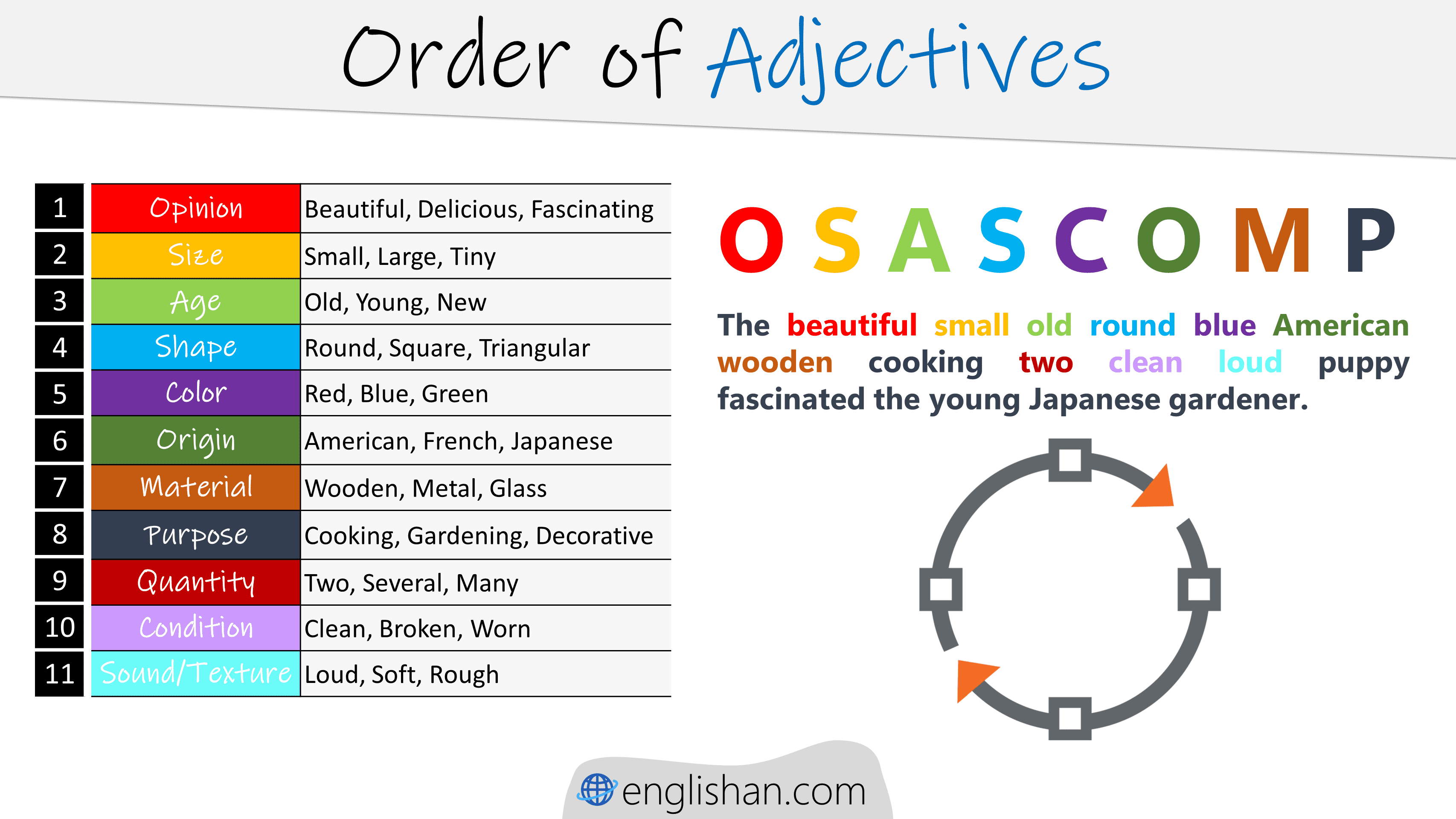
Why does “a beautiful old house” sound correct, but “an old beautiful house” sounds completely wrong? This happens because English has a strict, natural sequence called the order of adjectives.
As a teacher, I have seen many students feel frustrated when their descriptions don’t sound quite right to a native speaker. I have written this article to simplify these unwritten rules for you. I will show you the exact hierarchy used to organize multiple adjectives, moving from your personal opinions to physical facts. By the end of this guide, you will have a clear framework to build descriptive sentences with total confidence.
What Is the Order of Adjectives?
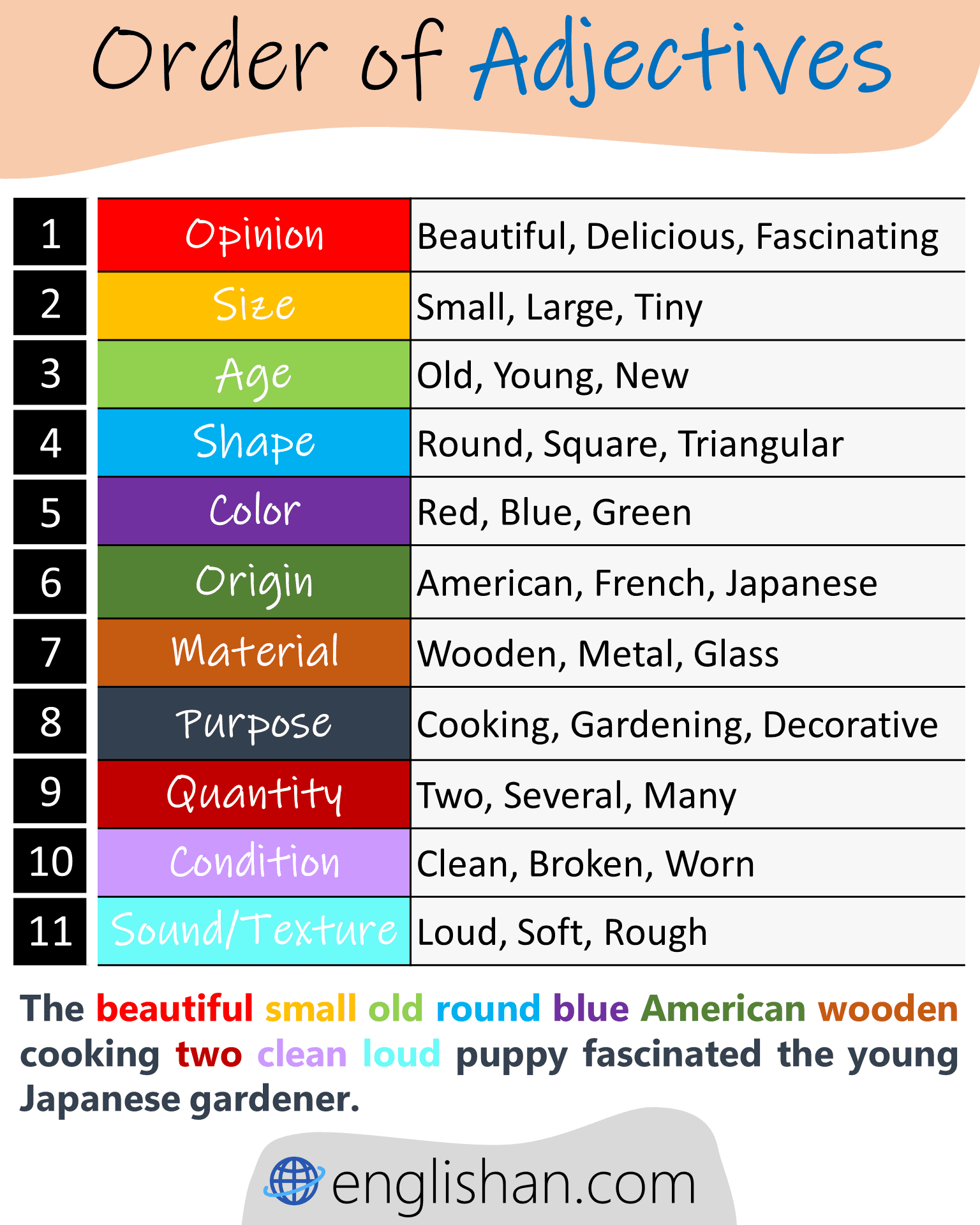
In English, when you use more than one adjective before a noun, the adjectives must be placed in a specific order. Native speakers often follow this order naturally, but it can be confusing for learners. The correct order of adjectives is generally as follows:
| Category | Explanation | Examples |
|---|---|---|
| Quantity | How many? | two, several, many |
| Opinion | What is the general opinion? | beautiful, ugly, lovely |
| Size | How big or small? | large, small, tiny |
| Age | How old? | young, old, ancient |
| Shape | What shape? | round, square, oval |
| Color | What color? | red, green, blue |
| Origin | Where is it from? | American, Mexican, Asian |
| Material | What is it made of? | wooden, metal, plastic |
| Purpose | What is it used for? | dining (table), running (shoes) |
Applying the Order of Adjectives
Understanding the order of adjectives is one thing; applying it correctly is another. Here are a few examples to illustrate:
Correct Examples
- A small round red ball.
- An old Italian wooden chair.
- A beautiful large green garden.
Incorrect Examples
- A red round small ball. ❌
- An wooden old Italian chair. ❌
- A green large beautiful garden. ❌
In each of the incorrect examples, the adjectives are out of order, making the sentence awkward and unclear.
Trick for Order of Adjectives
OSASCOMP
Each letter in the mnemonic represents the corresponding category of adjectives in the correct order:
- Opinion
- Size
- Age
- Shape
- Color
- Origin
- Material
- Purpose

Mnemonic Sentences
| Noun Phrase | Explanation |
|---|---|
| A beautiful large old round red Italian wooden dining table | Opinion (beautiful), Size (large), Age (old), Shape (round), Color (red), Origin (Italian), Material (wooden), Purpose (dining) |
| A delicious small new square white Japanese plastic bento box | Opinion (delicious), Size (small), Age (new), Shape (square), Color (white), Origin (Japanese), Material (plastic), Purpose (bento) |
| An interesting tiny ancient green French silk scarf | Opinion (interesting), Size (tiny), Age (ancient), Color (green), Origin (French), Material (silk), Purpose (scarf) |
Order Of Adjectives Examples
- I bought a new blue jacket.
- She adopted a small brown cat.
- He drove a fast red car to work.
- They live in a quiet old neighborhood.
- We ate a fresh hot meal.
- I carried a heavy large black bag.
- She wore a beautiful long silk dress.
- He found a strange old wooden box.
- We sat on a comfortable wide leather sofa.
- They bought a cheap small silver phone.
- She opened an elegant small round gold locket.
- He repaired a solid old black metal gate.
- I ordered a delicious hot Mexican chicken soup.
- We visited a beautiful large ancient stone temple.
- They rented a cozy small modern white apartment.
- He gifted a lovely small old round red vase.
- She bought a charming large new rectangular green rug.
- I used a useful small new black plastic container.
- They admired a stunning large old oval blue Italian mirror.
- He wore an amazing small new square white French cotton travel backpack.
Order Of Adjectives Common Mistakes
Mistakes in adjective order happen when adjectives are placed in an unnatural sequence. English follows a regular pattern, where opinion usually comes before factual details like size, age, color, origin, and material. Using the right order makes sentences sound natural and easy to understand.
- Putting color before opinion
Opinion adjectives come first.
Wrong: A red beautiful dress.
Right: A beautiful red dress. - Reversing size and age
Size normally comes before age.
Wrong: An old small house.
Right: A small old house. - Placing origin before color
Color comes before origin.
Wrong: A German black car.
Right: A black German car. - Placing material before origin
Origin comes before material.
Wrong: A wooden Italian chair.
Right: An Italian wooden chair. - Putting purpose too early
Purpose adjectives stay closest to the noun.
Wrong: A sleeping comfortable bag.
Right: A comfortable sleeping bag. - Using too many adjectives together
Too many adjectives make sentences hard to read.
Wrong: A lovely nice small young adorable puppy.
Right: An adorable small puppy. - Using commas incorrectly
Do not use commas between cumulative adjectives.
Wrong: A big, red car.
Right: A big red car. - Mixing similar adjectives without commas
Adjectives from the same group need commas.
Wrong: A red black and white watch.
Right: A red, black, and white watch. - Using the wrong article
Articles depend on sound, not spelling.
Wrong: A old apartment.
Right: An old apartment. - Placing “little” too late
“Little” often acts like an opinion word.
Wrong: A black little cat.
Right: A little black cat.
FAQs
In English, adjectives usually follow a specific order: Quantity, Opinion, Size, Age, Shape, Color, Origin, Material, Purpose (Q+OSASCOMP).
For example: Three small old round red French wooden chairs.
OSASCOMP is a rule for adjective order in English. It stands for Opinion, Size, Age, Shape, Color, Origin, Material, Purpose.
Example: An interesting tiny ancient green French silk scarf.
The correct order of adjectives in English is Quantity, Opinion, Size, Age, Shape, Color, Origin, Material, Purpose. For example, we say “two lovely small vintage round red Italian leather chairs” following this order naturally.
The adjective order trick in English is to remember “OSASCOMP”: Opinion, Size, Age, Shape, Color, Origin, Material, Purpose.
Example: a beautiful large old round brown leather chair.
Order Of Adjectives Worksheet With Answers
Check Your Understanding by Solving
You May Also Like
- Wrong Usage of Nouns
- 60 Examples of Adjectives
- Types of Adjectives
- Colors with Names
- English Essay Writing Tips For CSS
- Types of Adverb with Example
Order of Adjectives Quiz
Order of Adjectives
Choose the natural order.
Opinion comes before size.
opinion before size
a lovely big house
Choose the natural order.
Size comes before colour.
size before colour
a small black bag
Choose the natural order.
Age comes before colour.
age before colour
an old red car
Choose the natural order.
Colour comes before origin.
colour before origin
a white Italian shirt
Choose the natural order.
Opinion, size, shape, then material follow in order.
opinion, size, shape, then material
a beautiful small round wooden table
Choose the natural order.
Colour comes before material, and material sits nearest the noun.
colour before material, material nearest the noun
a red silk dress
Choose the natural order.
Pick the phrase that sounds right.
Size comes before colour in English adjective order.
order: size before colour
a big red ball
Choose the natural order.
Pick the phrase that sounds right.
Age comes before material.
order: age before material
an old wooden table
Choose the natural order.
Pick the phrase that sounds right.
Opinion comes before age.
order: opinion before age
a beautiful young woman
Choose the natural order.
Pick the phrase that sounds right.
Size comes before shape.
order: size before shape
a small round mirror
True or false?
In English, colour comes before size.
Size comes before colour: 'a big red ball', not 'a red big ball'.
size before colour
a big red ball
Choose the natural order.
Pick the phrase that sounds right.
Opinion comes before size.
order: opinion before size
a lovely little cottage
Choose the natural order.
Pick the phrase that sounds right.
Opinion comes before size or length.
order: opinion before size
a nice long walk
Choose the natural order.
Pick the phrase that sounds right.
Size comes before shape.
order: size before shape
a large square box
Choose the natural order.
Pick the phrase that sounds right.
Age comes before material.
order: age before material
a new silk scarf
Choose the natural order.
Pick the phrase that sounds right.
Size comes before colour.
order: size before colour
a tall green tree
Choose the natural order.
Pick the phrase that sounds right.
Opinion comes before origin.
order: opinion before origin
an expensive Italian car
True or false?
In English, material comes before age.
Age comes before material: 'an old wooden table', not 'a wooden old table'.
age before material
an old wooden table
Choose the natural order.
Pick the phrase that sounds right.
Shape comes before material.
order: shape before material
a round wooden table
Choose the natural order.
Pick the phrase that sounds right.
Opinion comes before age.
order: opinion before age
a beautiful old house
Turn on JavaScript for the interactive quiz. The full practice set is shown above.