Ask how many types of adverbs exist and every source answers differently: six, seven, eight, ten. All of those answers are valid, because grammarians divide the same words differently rather than disagreeing about the words. Fourteen types of adverb have a fixed name and a fixed job, and once you know what separates them, placing any adverb becomes a matter of asking two questions.
Types Of Adverbs
Three traditions divide adverbs three ways, and each one adds a layer to the one before it.
School grammar teaches five to seven types of adverb: it counts only the adverbs that answer a question about the verb, how, when, where, how often, how much, and how long. That set covers ordinary writing and most exam papers, which is why classroom textbooks stop there. She spoke quietly and He arrives tomorrow both belong to this layer.
Descriptive grammars add the adverbs that comment on a whole sentence: perhaps, frankly, and never modify nothing inside the clause. They tell you how confident the speaker is, what standpoint the statement comes from, or whether it is true at all. In Frankly, the estimate was too hopeful, the word frankly describes the speaker rather than the estimating. Counting this layer takes the total to eight or ten.
Reference grammars add the adverbs with a structural job: however joins two clauses, where introduces one, why opens a question, and only restricts a single word. None of them describes an action or comments on a statement, so a classification built around meaning leaves them out and one built around function keeps them. Adding this layer gives fourteen.
| Where the line is drawn | Types added | Running total |
|---|---|---|
| Adverbs that describe the action | Manner, time, place, frequency, degree, duration, purpose | 5 to 7 |
| Plus adverbs that comment on the sentence | Certainty, viewpoint, affirmation and negation | 8 to 10 |
| Plus adverbs with a structural job | Conjunctive, relative, interrogative, focusing | 14 |
That gives you the test. Ask what an adverb does to the sentence around it. Describing the action puts it in the first layer, commenting on the whole statement puts it in the second, and doing a job without describing anything puts it in the third.
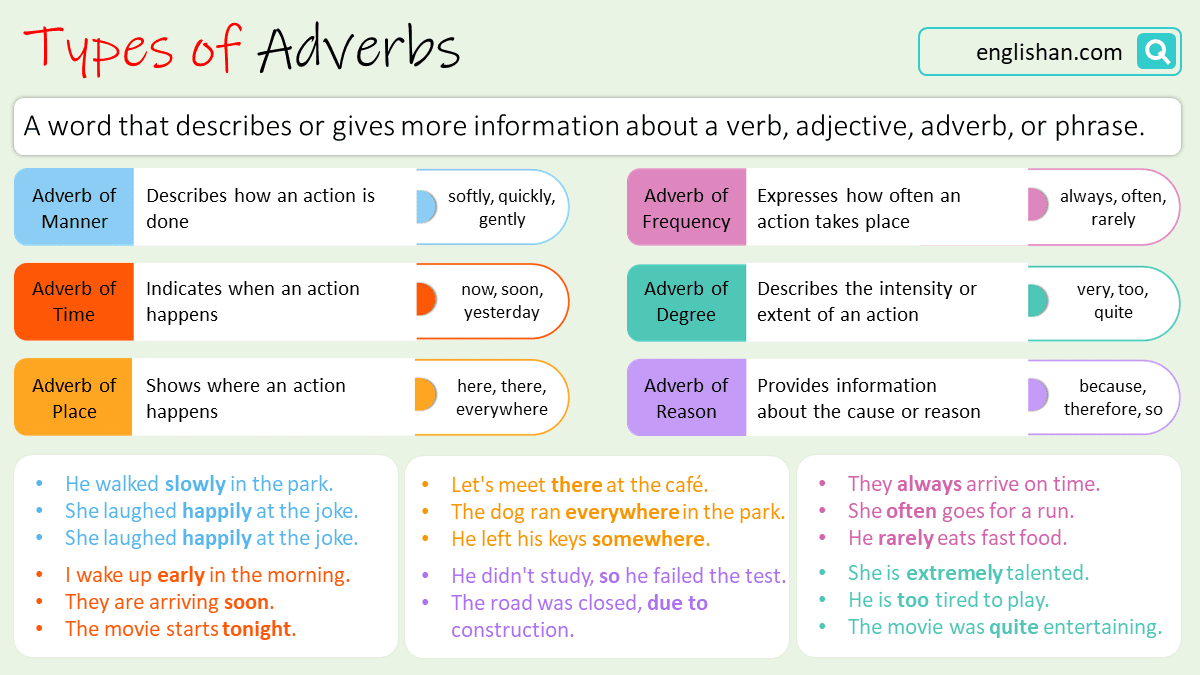
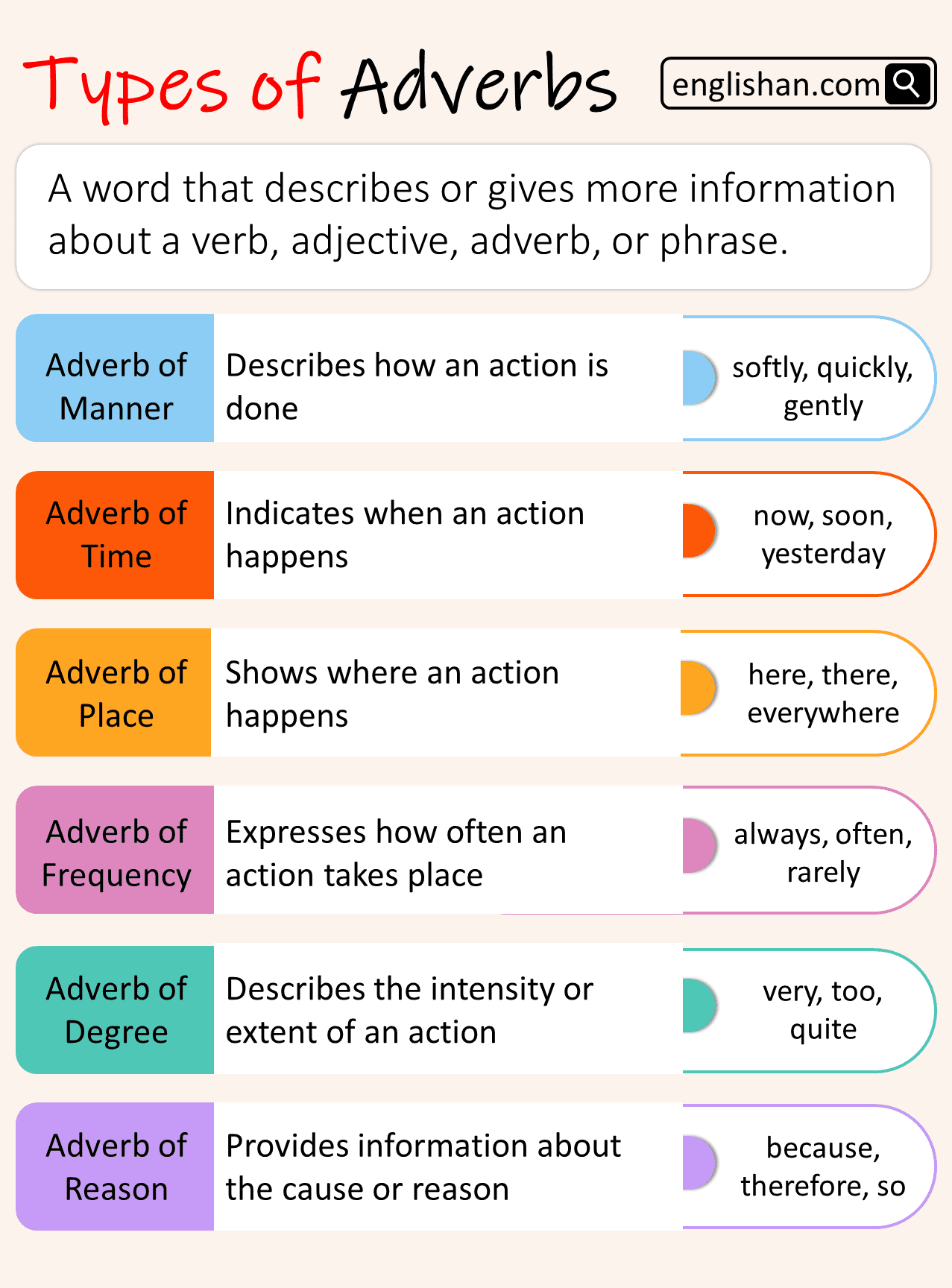
Adverbs are one of the eight parts of speech, and the fourteen types of adverb divide by function rather than by form. The seven that describe an action come first.
Adverbs Of Manner
Manner adverbs answer how an action was carried out, and they form the largest type in English because almost any adjective changes into one with -ly.
Examples: quickly, carefully, loudly, softly, badly, well, angrily, gently, fluently, awkwardly.
- She answered the question confidently.
Confidently describes the way she answered, so it modifies the verb answered. The formation rules and irregular forms are set out in full under adverbs of manner.
Manner tells you how. The next type tells you when.
Adverbs Of Time
Time adverbs answer when an action happened. English splits them by whether they fix an exact moment or leave it open, and the two behave differently in a sentence.
Definite Time Adverbs
These name a specific point and take end position.
Examples: yesterday, today, tomorrow, tonight, now, then, afterwards, at noon.
- The results arrive tomorrow.
Indefinite Time Adverbs
These leave the moment open and take mid position, before the main verb.
Examples: recently, lately, soon, already, still, yet, formerly, since.
- She has recently changed jobs.
Both kinds answer when, and adverbs of time works through the position rules in detail. Where time fixes the moment, place fixes the location.
Adverbs Of Place
Place adverbs answer where, and they divide by whether they name a fixed location or a movement toward one.
Position Adverbs
These name where something is or happens.
Examples: here, there, everywhere, nearby, outside, upstairs, abroad, indoors.
- The keys were nearby the whole time.
Direction Adverbs
These name which way something moves.
Examples: forward, backward, upward, downward, away, inside, homeward, northward.
- The crowd surged forward.
The difference counts because a verb of motion takes a direction adverb while a verb of state takes a position adverb, and adverbs of place covers the pairs that work either way. Location settles one question. How often the action repeats is a separate one.
Adverbs Of Frequency
Frequency adverbs answer how often an action repeats, and like time adverbs they divide by precision.
Definite Frequency Adverbs
These state an exact rate and take end position.
Examples: daily, weekly, monthly, yearly, hourly, twice, once, annually.
- The committee meets monthly.
Indefinite Frequency Adverbs
These state a rough rate and take mid position, before the main verb but after be.
Examples: always, never, rarely, seldom, frequently, occasionally, ever, normally.
- He rarely answers his phone.
That position rule is why He rarely answers works and He answers rarely reads as an afterthought. Full ordering rules are set out under adverbs of frequency. Where frequency counts how many times, degree asks how far.
Adverbs Of Degree
Degree adverbs answer how much or to what extent, and they modify adjectives and other adverbs at least as often as they modify verbs.
Examples: very, extremely, quite, rather, almost, barely, hardly, entirely, too, enough.
- The room was extremely cold.
Here extremely intensifies the adjective cold rather than describing any action, which is what separates degree from manner. Intensifiers and softeners are treated separately under adverbs of degree. Intensity is one measurement, and length of time is another.
Adverbs Of Duration
Duration adverbs answer how long something lasts. Several sources treat them as time adverbs, which is one reason the counts differ.
Examples: briefly, forever, temporarily, permanently, momentarily, indefinitely, overnight, always.
- The power failed briefly during the storm.
Briefly states the length of the failure rather than the moment it happened, which is the difference between duration and time. After how long comes the question of why.
Adverbs Of Purpose And Reason
Purpose and reason adverbs answer why an action happened. Single-word examples are fewer here than in other types, because English shows reason through a phrase or a clause more of the time.
Examples: therefore, hence, thus, consequently, accordingly, so, intentionally, deliberately.
- The bridge was closed, and the traffic was therefore diverted.
Phrase forms are covered alongside these single words under adverbs of reason. Longer reason expressions belong to adverbial phrases rather than to this type.
Those seven types all describe the action. The next three describe the speaker’s attitude to the whole statement instead.
Adverbs Of Certainty
Certainty adverbs state how confident the speaker is about the statement, and they modify the entire clause rather than any single word.
Examples: certainly, definitely, probably, possibly, perhaps, undoubtedly, surely, maybe.
- Perhaps the meeting was cancelled.
Delete perhaps and the sentence is still complete, which is the test for a clause-level adverb. Beyond rating how likely something is, a speaker can also mark the standpoint the statement comes from.
Adverbs Of Viewpoint
Viewpoint adverbs tell you from what standpoint the statement is made. They open a sentence more than any other type does, and they take a comma after them.
Examples: honestly, frankly, personally, technically, officially, financially, biologically, legally.
- Technically, the contract expired last week.
Technically signals that the statement is true under one specific standard, which tells you about the speaker’s angle rather than about the expiring. A viewpoint adverb frames a statement without settling it. Two smaller types settle it outright.
Adverbs Of Affirmation And Negation
These adverbs confirm or deny the statement outright. They are the smallest type and the one most sources leave out, which explains part of the count gap.
Examples, affirming: absolutely, indeed, surely, definitely, certainly.
Examples, denying: never, not, hardly, scarcely, nowhere.
- She has never missed a deadline.
Several of these words also work as certainty adverbs, and the difference is whether the speaker is rating a chance or settling the point. Certainly rates confidence in She will certainly come, and it affirms in Certainly, I agree.
Those ten types either describe an action or comment on a statement. The last four do neither, because their job is structural.
Conjunctive Adverbs
Conjunctive adverbs join two main clauses and show the link between them. Every grammar source covers this type, and it does the most work in formal writing where the links have to be spelled out.
Examples: however, therefore, moreover, nevertheless, furthermore, consequently, otherwise, meanwhile, instead, similarly.
- The proposal was late, however the committee reviewed it anyway.
That sentence shows the punctuation error these adverbs cause, and the mistakes below return to it. Before a conjunctive adverb you need a semicolon or a full stop, since a comma alone cannot join two main clauses. Where a conjunctive adverb joins two clauses, a relative adverb opens one.
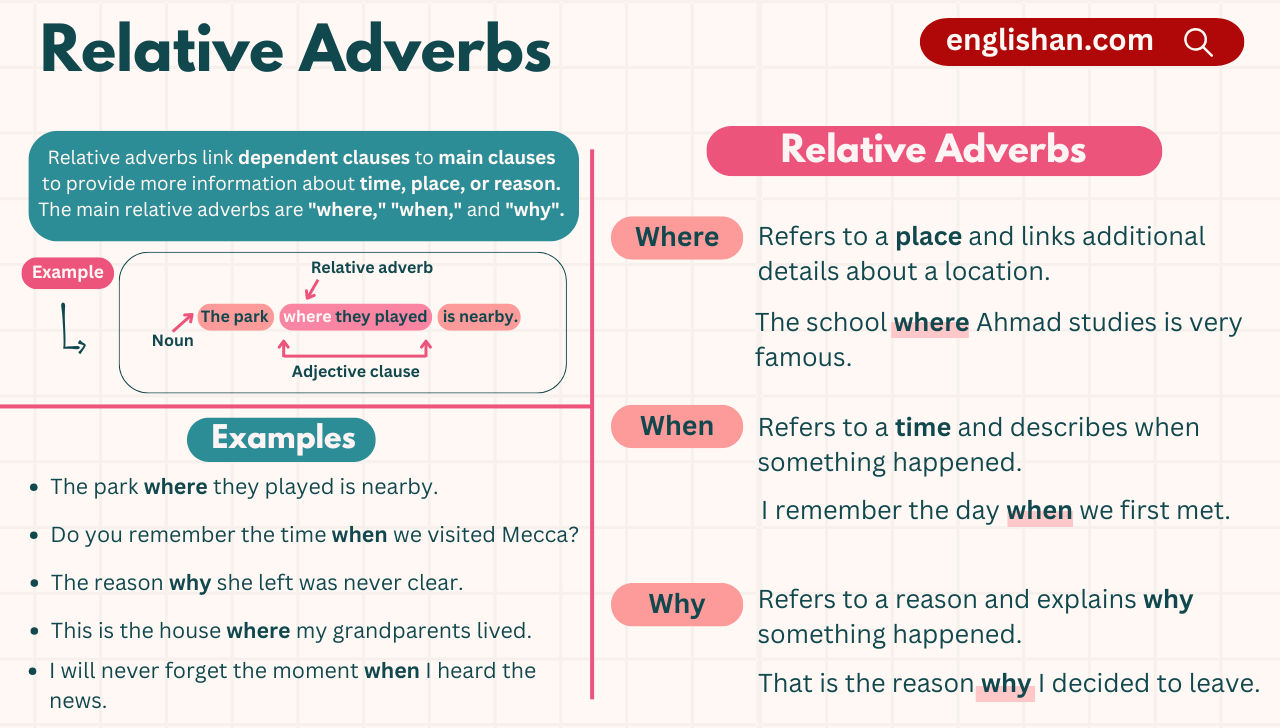
Relative Adverbs
Relative adverbs introduce a relative clause that modifies a noun. English has three, and each replaces a preposition plus which.
Examples: where, when, why.
- This is the building where the treaty was signed.
Where introduces a clause describing building, and it replaces in which. The relative adverbs worksheets work through all three with answers. Those same three words take on a second job when they open a question.
Interrogative Adverbs
Interrogative adverbs open a direct question. English uses the same four words for this job, and three of them overlap with the relative set.
Examples: how, when, where, why.
- How did the committee reach that decision?
The word is identical to the relative adverb, and only the job changes. When the meeting ended uses when relatively, and When did the meeting end? uses it interrogatively. One type of adverb remains, and it describes nothing at all.
Focusing Adverbs
Focusing adverbs point the reader at one part of the sentence rather than describing anything. They change the meaning of a sentence when moved, which makes their position a rule rather than a choice.
Examples: only, even, just, mainly, especially, particularly, also, largely, simply, purely.
- Only she reported the fault.
- She reported only the fault.
The first sentence says nobody else reported it. In the second, she reported nothing besides the fault. One word moved two places, and the sentence now sets a different limit. That is why focusing adverbs go straight before whatever they restrict.
All fourteen types of adverb are now covered. The chart sets them side by side.
Types Of Adverbs Chart
| Type | Answers | Examples | Modifies |
|---|---|---|---|
| Manner | How? | quickly, well, gently | Verb |
| Time | When? | yesterday, soon, now | Verb |
| Place | Where? | here, outside, forward | Verb |
| Frequency | How often? | always, daily, rarely | Verb |
| Degree | How much? | very, almost, barely | Adjective or adverb |
| Duration | How long? | briefly, forever, overnight | Verb |
| Purpose and reason | Why? | therefore, hence, thus | Verb or clause |
| Certainty | How sure? | probably, perhaps, surely | Whole clause |
| Viewpoint | From what standpoint? | honestly, technically, legally | Whole clause |
| Affirmation and negation | Yes or no? | absolutely, never, hardly | Whole clause |
| Conjunctive | What is the link? | however, therefore, moreover | Joins two clauses |
| Relative | Which one? | where, when, why | Introduces a clause |
| Interrogative | Question word | how, when, where, why | Opens a question |
| Focusing | Which part? | only, even, just | The word it precedes |
The last column sorts them fastest, because what an adverb modifies decides its type better than what it means. Reading down that column works once you have the adverb in front of you. Finding the type from scratch takes a set of questions.
How To Identify Types Of Adverbs
Three questions, asked in order, place any adverb in one of the fourteen types of adverb.
Question 1, does it describe the action? Ask how, when, where, how often, how much, how long, or why about the verb. An answer puts the adverb in one of the seven action types.
Question 2, does it comment on the whole statement? Delete the adverb. If the sentence is still complete and only the speaker’s attitude has gone, the adverb is certainty, viewpoint, or affirmation and negation.
Question 3, does it do a job in the sentence instead? Check whether it joins two clauses, introduces a clause about a noun, opens a question, or restricts one word. Those four types of adverb are conjunctive, relative, interrogative, and focusing.
Run all three on this sentence:
- Frankly, the team only trains twice a week, and the results are therefore predictable.
Question 1 catches twice, which answers how often about trains, making it frequency. Question 2 catches frankly, since deleting it leaves the sentence intact. Question 3 catches only, which restricts twice a week rather than describing anything, and therefore, which joins the two clauses. Four adverbs, four different types of adverb, one pass through the questions.
Identifying the type is one skill. Placing it correctly is another.
Adverb Placement In A Sentence
Three positions are available, and each of the types of adverb prefers one of them.
Front position, before the subject: viewpoint, certainty, and conjunctive adverbs, followed by a comma.
- Honestly, the estimate was too hopeful.
Mid position, before the main verb: indefinite frequency, indefinite time, and degree adverbs.
- She always checks the figures twice.
End position, after the verb or its object: manner, place, definite time, definite frequency, and duration adverbs.
- He explained the process patiently.
One rule applies across all three positions: nothing goes between a verb and its direct object.
She explained patiently the process. ❌
She explained the process patiently. ✅
Placement settles one adverb. Two or three in the same sentence follow a further rule.
Order Of Adverbs In A Sentence
When several adverbs share an end position, English orders them by their types of adverb rather than by preference. The sequence is manner, place, frequency, time, purpose.
- She worked quietly in the library every evening last term to finish her thesis.
That sentence runs all five in order. No real sentence would, but it shows the sequence. Two or three adverbs is the realistic case.
He runs in the park quickly every morning. ❌
He runs quickly in the park every morning. ✅
The right version puts manner before place before frequency, which is the order a native reader expects even when nobody has taught them the rule.
Order and placement handle correct sentences. Two errors remain common enough to name.
Common Mistakes With Adverbs
Joining clauses with a conjunctive adverb and a comma: a conjunctive adverb is an adverb, not a conjunction, so it cannot join two main clauses on its own. The result is a comma splice.
The deadline passed, however the report was accepted. ❌
The deadline passed; however, the report was accepted. ✅
Placing a focusing adverb loosely: only, even, and just restrict whatever follows them, so a loose placement restricts the wrong word.
I only lent him the car for a day. ❌
I lent him the car for only a day. ✅
The first sentence restricts lent, which suggests lending was the sole thing you did. The second restricts a day, which is the intended limit. Both wrong versions are grammatical, which is why a proofread misses them and practice catches them.
Types Of Adverbs Exercises
Name the type of each bolded adverb.
- The train arrives hourly.
- She spoke frankly about the delay.
- He waited outside.
- The soup was too salty.
- Where did you park?
- The system failed briefly.
- Even the manager was surprised.
- The vote was postponed; therefore, no decision was reached.
Answers 1 to 4: definite frequency, viewpoint, place, degree.
Answers 5 to 8: interrogative, duration, focusing, conjunctive.
Choose the correct sentence in each pair.
- (a) She sings beautifully. (b) She sings beautiful.
- (a) He reads slowly the instructions. (b) He reads the instructions slowly.
- (a) They meet weekly always. (b) They always meet weekly.
- (a) The results were, however, disputed. (b) The results were however disputed.
Answers: 9a, 10b, 11b, 12a.
Put the adverbs in the correct order.
- She practises (every day / at home / diligently).
- He drove (last night / recklessly / through town).
- They rehearse (twice a week / in the hall / quietly).
Answers: diligently at home every day. Recklessly through town last night. Quietly in the hall twice a week.
Correct the punctuation.
- The flight was delayed however the connection was held.
- Technically the warranty had expired.
- She only signed the form after reading it twice.
Answers: The flight was delayed; however, the connection was held. Technically, the warranty had expired. She signed the form only after reading it twice.
FAQs
Fourteen types of adverb have a fixed name and function, though sources publish counts of six, seven, eight, or ten. The difference comes from how far each system goes past the five that describe an action. Manner, time, place, frequency, and degree appear in every source; the remaining nine appear in some and not others.
The five that every system covers are manner (quickly), time (yesterday), place (outside), frequency (always), and degree (very). These five all describe the action of the verb, which is why no source leaves them out. The nine beyond them either comment on the whole statement or perform a grammatical job.
Only is a focusing adverb. It restricts whatever follows it rather than describing an action, which is why moving it changes the meaning of the sentence. Only she signed names one signer, and She signed only the form names one document.
An adverb modifies a verb, an adjective, or another adverb, and several types also modify a whole clause. Manner and place adverbs modify verbs, degree adverbs modify adjectives and adverbs above all, and certainty and viewpoint adverbs modify the entire statement.
A conjunctive adverb joins two main clauses and names the link between them, as however, therefore, and moreover do. It remains an adverb rather than a conjunction, so it needs a semicolon or a full stop before it. A comma alone produces a comma splice.
A relative adverb introduces a relative clause that describes a noun, and English has three: where, when, and why. Each replaces a preposition plus which, so the day when we met means the same as the day on which we met.
You May Also Like
Types of Adverbs Quiz
Types of Adverbs
Choose the adverb of manner.
She sang ___.
An adverb of manner tells how, often ending in -ly.
adverbs of manner often end in -ly
She sang beautifully.
Which is an adverb of time?
'Yesterday' tells when.
adverbs of time tell when
They arrived yesterday.
Which is an adverb of place?
'Outside' tells where.
adverbs of place tell where
The children played outside.
Choose the correct sentence.
A frequency adverb sits before the main verb.
frequency adverbs go before the main verb
She rarely arrives late.
Choose the correct sentence.
An adverb modifies the verb 'drives'.
use an adverb to modify a verb
He drives carefully.
Name the type.
In 'very tired', 'very' is an adverb of ___.
'Very' intensifies the adjective 'tired'.
adverbs of degree intensify adjectives or adverbs
very tired
Name the adverb type.
In 'She sang beautifully', 'beautifully' is an adverb of ___.
It tells how she sang.
adverbs of manner tell how
She sang beautifully.
Name the adverb type.
In 'The children played outside', 'outside' is an adverb of ___.
It tells where they played.
adverbs of place tell where
The children played outside.
Name the adverb type.
In 'We'll leave soon', 'soon' is an adverb of ___.
It tells when they will leave.
adverbs of time tell when
We'll leave soon.
Name the adverb type.
In 'He always arrives early', 'always' is an adverb of ___.
It tells how often he arrives.
adverbs of frequency tell how often
He always arrives early.
Name the adverb type.
In 'The tea is very hot', 'very' is an adverb of ___.
It tells to what extent the tea is hot.
adverbs of degree tell to what extent
The tea is very hot.
True or false?
In 'She drove carefully', 'carefully' is an adverb of manner.
'Carefully' tells how she drove, so it is an adverb of manner.
adverbs of manner tell how an action happens
She drove carefully.
Name the adverb type.
In 'She walked slowly', 'slowly' is an adverb of ___.
It tells how she walked.
adverbs of manner tell how
She walked slowly.
Name the adverb type.
In 'They searched everywhere', 'everywhere' is an adverb of ___.
It tells where they searched.
adverbs of place tell where
They searched everywhere.
Name the adverb type.
In 'We arrived yesterday', 'yesterday' is an adverb of ___.
It tells when they arrived.
adverbs of time tell when
We arrived yesterday.
Name the adverb type.
In 'He never lies', 'never' is an adverb of ___.
It tells how often he lies.
adverbs of frequency tell how often
He never lies.
Name the adverb type.
In 'The soup is quite cold', 'quite' is an adverb of ___.
It tells to what extent the soup is cold.
adverbs of degree tell to what extent
The soup is quite cold.
Name the adverb type.
In 'Come here', 'here' is an adverb of ___.
It tells where to come.
adverbs of place tell where
Come here.
True or false?
In 'She sang loudly', 'loudly' is an adverb of manner.
'Loudly' tells how she sang, so it is an adverb of manner.
adverbs of manner tell how
She sang loudly.
Name the adverb type.
In 'We leave tomorrow', 'tomorrow' is an adverb of ___.
It tells when they leave.
adverbs of time tell when
We leave tomorrow.
Turn on JavaScript for the interactive quiz. The full practice set is shown above.