Adjectives are an essential part of speech that we use every day. They help us add meaning and depth to our language, making it more clearer and expressive. Adjectives describe nouns or pronouns, which help us describe things and convey emotions. Without adjectives, descriptions can be quite dull and lack detail. So, it’s important to learn about adjectives, their usage, types, and examples. and in this article, we will learn what is an adjective, its types, and examples. so, let’s get started!
What is an adjective?
An adjective is a word that describes or modifies a noun or pronoun. It adds more information about the noun or pronoun by giving details about its size, color, shape, quality, or other characteristics. Adjectives make sentences more interesting and help us to create a clear picture of what we are talking about. Adjectives can also be used to compare two or more nouns. They often answer the questions such as “What kind?” “Which one?” or “How many?” etc. Adjectives usually come before or after the noun they describe in a sentence. For example,
She eats a big, red apple.
in this sentence “big” and “red” are adjectives that tell us what kind of apple she eats.
Types of adjectives
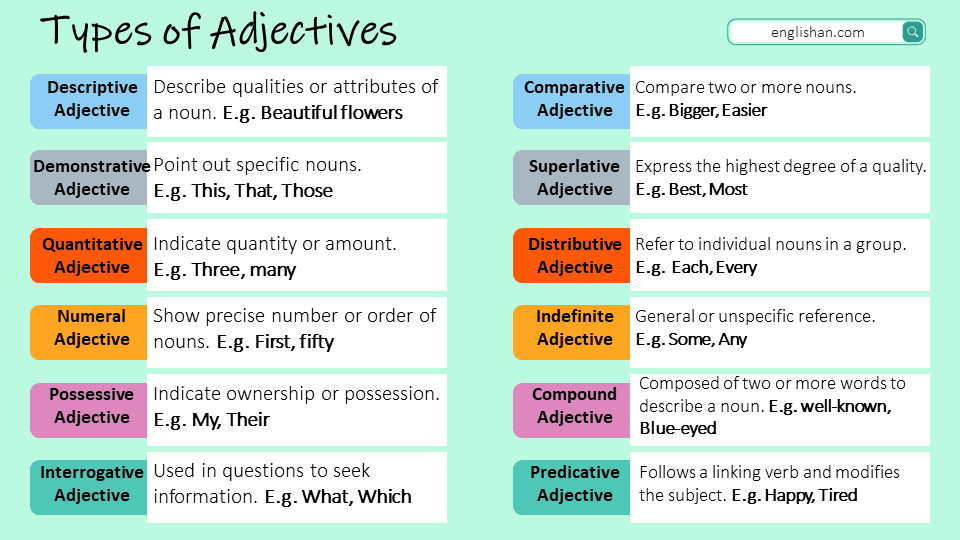
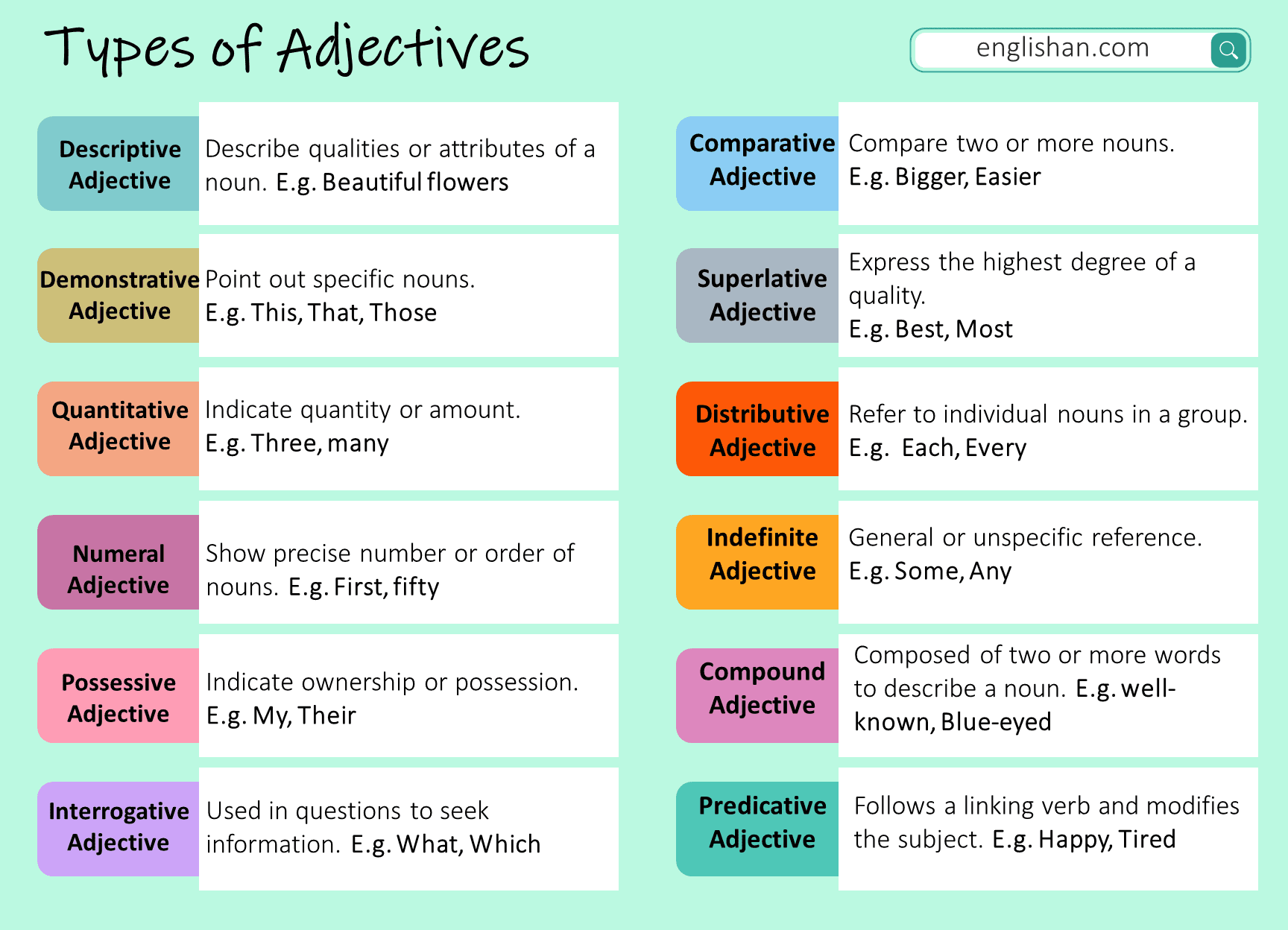
There are different types of adjectives, some of them are as follows:
- Descriptive adjectives
- Possessive adjectives
- Quantitative adjectives
- Demonstrative adjectives
- Comparative adjectives
- Superlative adjectives
- Compound adjectives
- Interrogative adjectives
- Proper adjectives
- Predicate adjectives
- Distributive adjectives
- Participial adjectives
- Attributive adjectives
- Ordinal & Cardinal adjectives
Descriptive adjectives
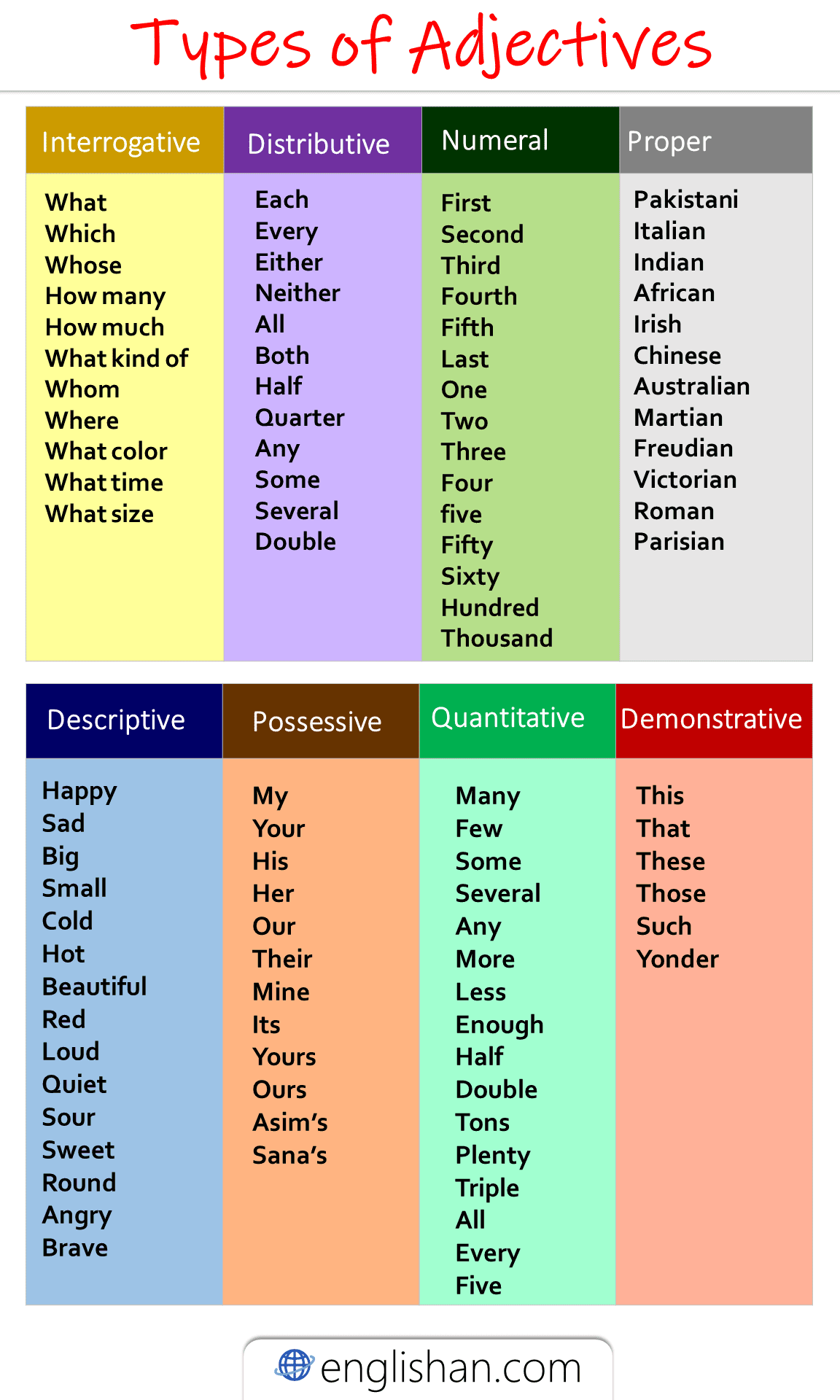
These adjectives describe the physical or emotional qualities of a noun or pronoun. For example, “big”, “small”, “happy”, “sad”, “beautiful”, “blue”, “cold”, “hot”, etc.
Examples,
Here are some example sentences of descriptive adjectives.
- The elephant was big.
- The ice cream was cold.
- She is very happy today.
- He was not very tall.
- she has red hair.
Possessive adjectives
These adjectives show ownership or possession. They indicate who the noun belongs to. For example, “my,” “your,” “his,” “her,” “its,” “our,” and “their.”
Examples,
Here are some example sentences of possessive adjectives.
- This is my book.
- I like your confidence.
- He found his keys.
- They have their troubles.
- The bag is yours.
Quantitative adjectives
These adjectives describe the quantity of a noun or pronoun. For example, “many,” “few,” “some,” “all,” “most,“ and “least.“
Examples,
Here are some example sentences of quantitative adjectives.
- Can I have some water, please?
- We may be here for several days.
- I have many chocolates.
- All human beings are equal.
- I need a few minutes.
Demonstrative adjectives
These adjectives point out or demonstrate which noun is being referred to. For example “this,” “that,” “these,” and “those”.
Examples,
Here are some example sentences of demonstrative adjectives.
- I love this novel.
- That is my house.
- These flowers are beautiful.
- Those shoes are black.
Comparative adjectives
These adjectives are used to compare two or more things, indicating a higher or lower degree. For example: “better,” “faster,” “smarter.”
Examples,
Here are some example sentences of comparative adjectives.
- I’m smarter than you.
- Today is better than tomorrow
- What grief can be greater than this?
- John is taller than Ali.
Superlative adjectives
These adjectives are used to compare three or more nouns, indicating which one has the highest degree of a certain quality. For example, “biggest,” “smallest,” “fastest,” “prettiest.“
Examples,
Here are some example sentences of superlative adjectives.
- This is the smallest box I’ve ever seen.
- This is the most interesting story.
- You have the prettiest eyes.
Compound adjectives
These adjectives are formed by combining two or more words to describe a noun. For example, “blue-eyed,” “well-known,” or “high-tech.”
Examples,
Here are some example sentences of compound adjectives.
- She is a well–known singer.
- My parents aren’t very broad-minded.
- He belongs to a well-to-do family.
Interrogative adjectives
These adjectives are used to ask questions about nouns. For example: “which,” “what,” or “whose.”
Examples,
Here are some example sentences of interrogative adjectives.
- Which fruit do you like the most?
- Whose pen is this?
- Which country would you like to travel to?
Proper adjectives
These adjectives are derived from proper nouns and describe a specific noun. For example: “American,” “Chinese,” or “Shakespearean“ etc.
Examples,
Here are some example sentences of proper adjectives.
- She is an Irish girl.
- He is a Pakistani player.
- I love Chinese food.
Predicate adjectives
Predicate adjectives are words that describe the subject in a sentence. They come after linking verbs like “is,” “am,” or “seems.”
Examples,
- The movie seems interesting.
- The room feels warm.
- The flowers are beautiful.
Distributive adjectives
A distributive adjective describes individual members within a group, like “each“, “either” or “every,” emphasizing their separate qualities.
Examples,
- He comes here every week.
- Each pen costs fifty rupees.
- I’ll be happy with either choice
Participial adjectives
Participial adjectives are formed from verbs and end in “-ed” or “-ing.” They describe the noun and often show how the noun feels or looks. For example, “excited”, “broken”, “running”, “confused”, etc.
Examples,
- He has driven the car.
- I saw a broken window in the old house.
- The tired boy fell asleep quickly.
Attributive adjectives
Attributive adjectives are used to describe a single noun or pronoun. For example, “red”, “warm”, “tall”, “old”, etc.
Examples,
- The red car is fast.
- The blue sky looks amazing today.
- I love reading interesting books.
Ordinal & Cardinal adjectives
Ordinal; These adjectives indicate the order of items in a series. Examples are “first,” “second,” “third,” “last“ etc.
Cardinal; These adjectives are used to describe quantity or how many of something, such as “two,” “five,” or “ten.“
Examples,
- There are five apples in the basket.
- She won the first prize in the competition.
- There are six students in the class.
Example Sentences Of Adjectives
- Lahore is a large city.
- She is a brave girl.
- A little knowledge is dangerous.
- I live in a small house.
- This box is very heavy.
- It’s more red than pink.
- Most people love cricket.
- Kim is an Irish boy.
- I like a red rose.
- I can’t give you any bag.
- There are five apples in the basket.
- She wears a black suit.
- I have a little milk.
- He lost all his money.
Paragraph Analysis
Identify the types of adjectives in this paragraph;
A happy little child played joyfully with his caring father in the beautiful park. They ran quickly across the green grass, laughing loudly as they chased colorful butterflies. The playful child held his father’s strong hand tightly, feeling safe and loved in his company. They shared delicious ice cream, enjoying the sweet, creamy treat together. The sunny day in winter made their fun-filled adventure even more delightful.
Analysis,
In the paragraph, we have descriptive adjectives such as “happy,” “little,” “beautiful,” “green,” “playful,” “sweet,” “ colorful,” “ strong,’ “creamy,” “fun-filled,” and “delightful.”
Quantitative Adjective: “Three,”
Possessive Adjective: “His”
Articles: “The” is used in phrases like “the beautiful park” and “the sunny day.” etc.
Quiz of adjectives
Adjective Exercise:
- Ali is ____ than Aslam.
- older
- elder
- old
- oldest
- I have ____ friends.
- little
- large
- few
- a little
- He is ____ wise than clever.
- most
- many
- nor
- more
4. what kind of adjective is this, “This box is very heavy.
- Distributive
- Demonstrative
- Descriptive
- Comparative
5. He found ____ keys.
- her
- his
- their
- there
- She has ____ money.
- few
- A few
- some
- any
- Which phrase contains the proper adjective?
- brave and wise
- Irish lady
- this book
- other house
Answers:
- older 2. few 3. more 4. Demonstratives 5. his 6. Some 7. Irish lady
FAQs:
Answer: An adjective is a word that describes or modifies a noun or pronoun.
Answer: An adverb modifies a verb, adjective, or other adverbs, while an adjective describes a noun or pronoun.
Answer: Adjectives come in three forms, known as degrees:
Positive, Comparative, and Superlative.
Answer: Here are some examples of adjectives:
Happy, sad, brave, calm, kind, bright, clever, honest, wise, fast, slow, etc.
Answer: There are eight types of adjectives in English;
1. Descriptive adjectives
2. Possessive adjectives
3. Quantitative adjectives
4. Demonstrative adjectives
5. Interrogative adjectives
6. Proper adjectives
7. Distributive adjectives
8. Numeral adjectives
Download High-Quality Printable Types of Adjectives Document
Our school/platform was featured in the article titled: “31+ Free Games and Activities to Learn English”, published on Twinkl’s educational platform. Visit the publisher’s site to explore free educational resources.
You May Also Like
Types of Adjectives Quiz
Types of Adjectives
Name the adjective.
In 'the tall building', the adjective is ___.
'Tall' describes the noun 'building'.
an adjective describes a noun
the tall building
Name the type.
In 'three apples', 'three' is an adjective of ___.
'Three' tells how many.
adjectives of quantity tell how many
three apples
Which is a demonstrative adjective?
___ book is mine.
'This' points out a specific noun.
demonstrative adjectives point out a noun
This book is mine.
Choose the possessive adjective.
___ car is red.
'Their' sits before a noun to show possession.
possessive adjectives come before a noun
Their car is red.
Choose the correct sentence.
'Italian' is a proper adjective and takes a capital.
proper adjectives are capitalized
I love Italian food.
Choose the distributive adjective.
___ student got a prize.
'Each' singles out members one by one and takes a singular noun.
distributive adjectives take a singular noun
Each student got a prize.
Name the adjective type.
In 'a beautiful garden', 'beautiful' is a ___ adjective.
'Beautiful' names a quality, so it is descriptive.
descriptive adjectives name a quality
a beautiful garden
Name the adjective type.
'This', 'that', 'these', and 'those' are ___ adjectives.
These words point out which noun is meant.
demonstrative adjectives point out nouns
this book, those chairs
Name the adjective type.
In 'three apples', 'three' is a ___ adjective.
'Three' states how many, so it is quantitative.
quantitative adjectives state amount or number
three apples
Name the adjective type.
In 'Which road leads home?', 'which' is a ___ adjective.
'Which' before a noun asks a question, so it is interrogative.
interrogative adjectives ask: which, what, whose
Which road leads home?
Name the adjective type.
In 'my house', 'my' is a ___ adjective.
'My' shows who owns the noun, so it is possessive.
possessive adjectives show ownership: my, your, his
my house
True or false?
In 'four books', 'four' is a descriptive adjective.
'Four' states a number, so it is a quantitative adjective, not descriptive.
numbers are quantitative adjectives
four books
Name the adjective type.
In 'a tall building', 'tall' is a ___ adjective.
'Tall' names a quality, so it is descriptive.
descriptive adjectives name a quality
a tall building
Name the adjective type.
In 'these shoes', 'these' is a ___ adjective.
'These' points out which shoes are meant.
demonstrative adjectives point out nouns
these shoes
Name the adjective type.
In 'many visitors', 'many' is a ___ adjective.
'Many' states amount, so it is quantitative.
quantitative adjectives state amount
many visitors
Name the adjective type.
In 'Whose bag is this?', 'Whose' is a ___ adjective.
'Whose' before a noun asks a question.
interrogative adjectives ask: which, what, whose
Whose bag is this?
Name the adjective type.
In 'our garden', 'our' is a ___ adjective.
'Our' shows who owns the noun.
possessive adjectives show ownership
our garden
Name the adjective type.
In 'that mountain', 'that' is a ___ adjective.
'That' points out which mountain is meant.
demonstrative adjectives point out nouns
that mountain
True or false?
In 'a blue sky', 'blue' is a descriptive adjective.
'Blue' names a quality of the sky, so it is descriptive.
colour words are descriptive adjectives
a blue sky
Name the adjective type.
In 'several options', 'several' is a ___ adjective.
'Several' states amount, so it is quantitative.
quantitative adjectives state amount
several options
Turn on JavaScript for the interactive quiz. The full practice set is shown above.