
Parts of speech are the main word classes in English grammar that show how each word is used in a sentence. Every word you say or write belongs to a part of speech such as noun, verb, or adjective. These categories help explain the word’s job in communication. Learning the parts of speech builds a solid grammar base and helps learners write and understand English more clearly, step by step.
What Are Parts of Speech?
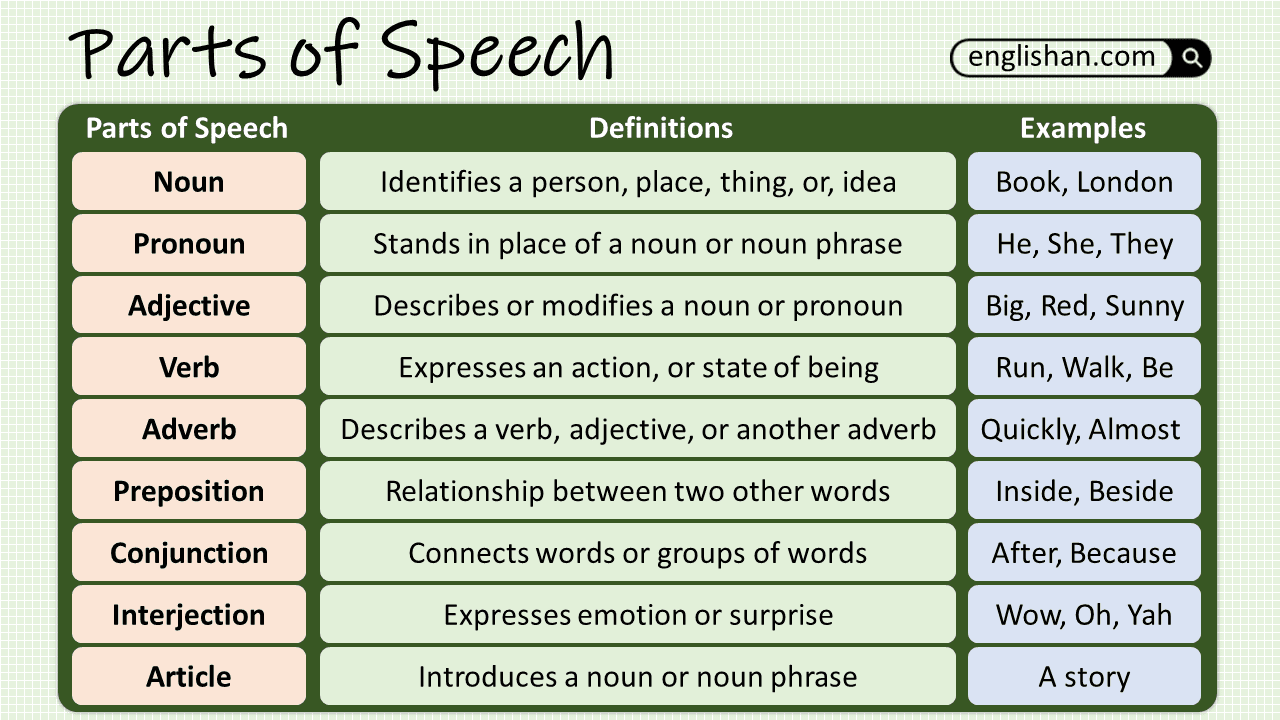
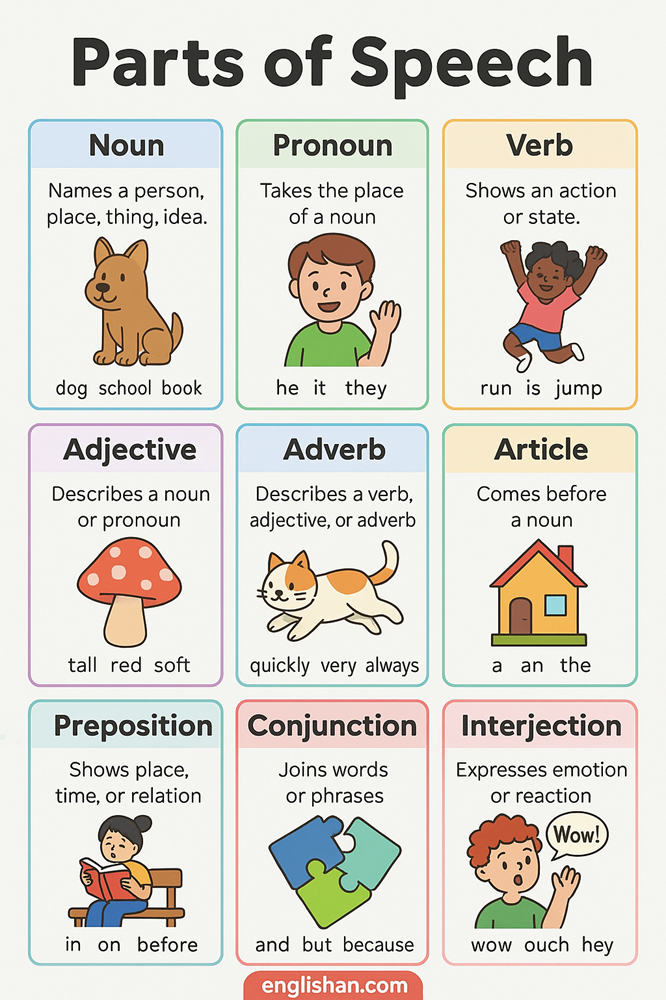
Parts of speech are the main categories that classify words based on their function in a sentence. There are eight parts of speech in English:
- Noun
- Pronoun
- Adjective
- Verb
- Adverb
- Preposition
- Conjunction
- Interjection
Parts of Speech and Their Types
Noun
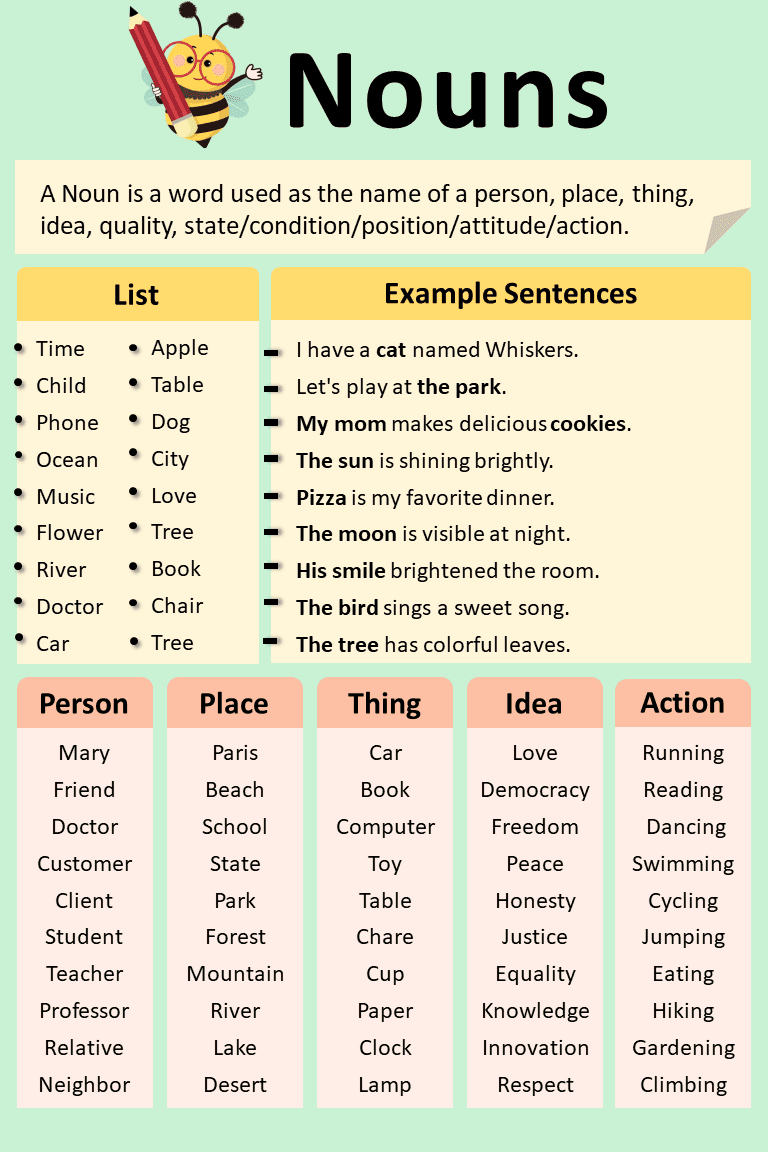
A noun is a word used as the name of a person, place, thing, idea, quality, condition, or action. Nouns come in many types, each showing a different kind of naming.
Types of Nouns:
- Common Nouns: boy, city, dog
- Proper Nouns: Sarah, London, Mars
- Concrete Nouns: apple, table, rain
- Abstract Nouns: honesty, joy, sadness
- Countable Nouns: books, pencils, apples
- Uncountable Nouns: milk, sugar, air
- Collective Nouns: team, family, group
- Compound Nouns: toothpaste, basketball, mother-in-law
Example sentences:
- The team is practicing on the field.
- Sarah loves reading books.
- We need some sugar for the recipe.
Pronoun
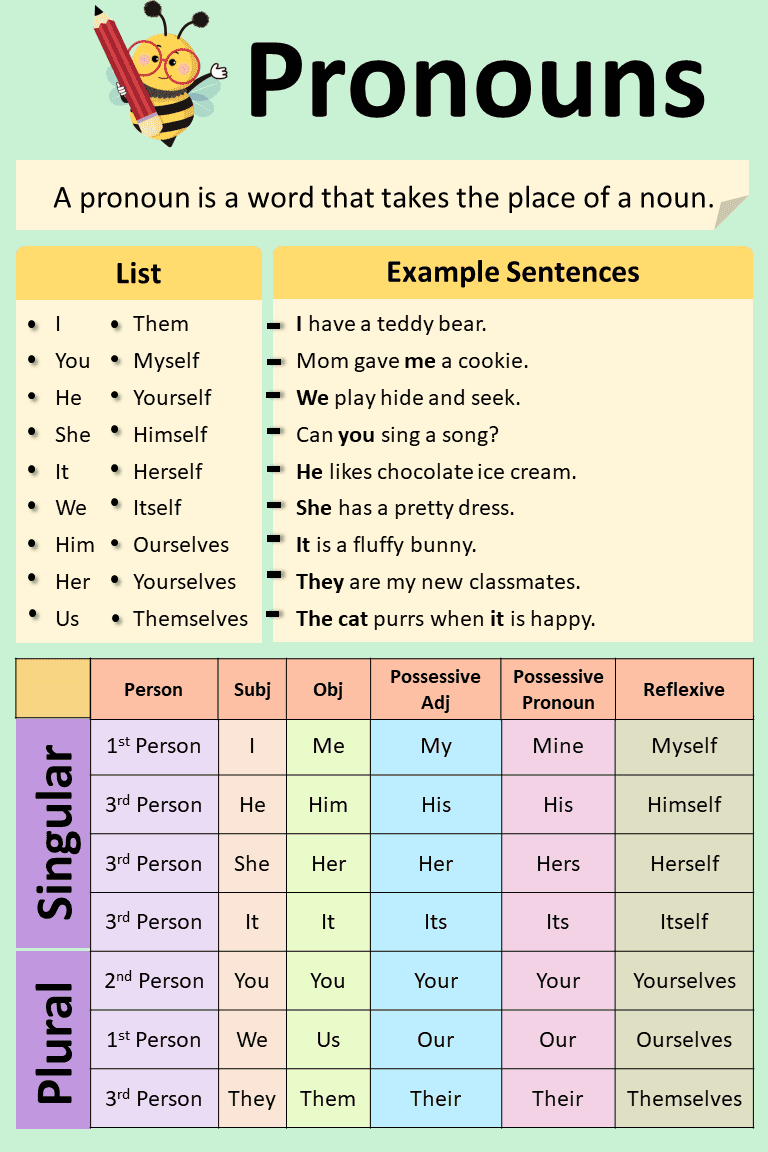
A pronoun is a word that takes the place of a noun to avoid repetition. There are many kinds of pronouns used in different situations.
Types of Pronouns:
- Personal Pronouns: I, you, he, she, it, we, they
- Possessive Pronouns: mine, yours, his, hers, ours, theirs
- Reflexive Pronouns: myself, yourself, himself, herself, itself, ourselves, yourselves, themselves
- Demonstrative Pronouns: this, that, these, those
- Interrogative Pronouns: who, whom, whose, which, what
- Relative Pronouns: who, whom, whose, which, that
- Indefinite Pronouns: someone, anyone, everyone, nobody, something
Example sentences:
- They are going to the store.
- That book is mine.
- Who is knocking at the door?
Adjective
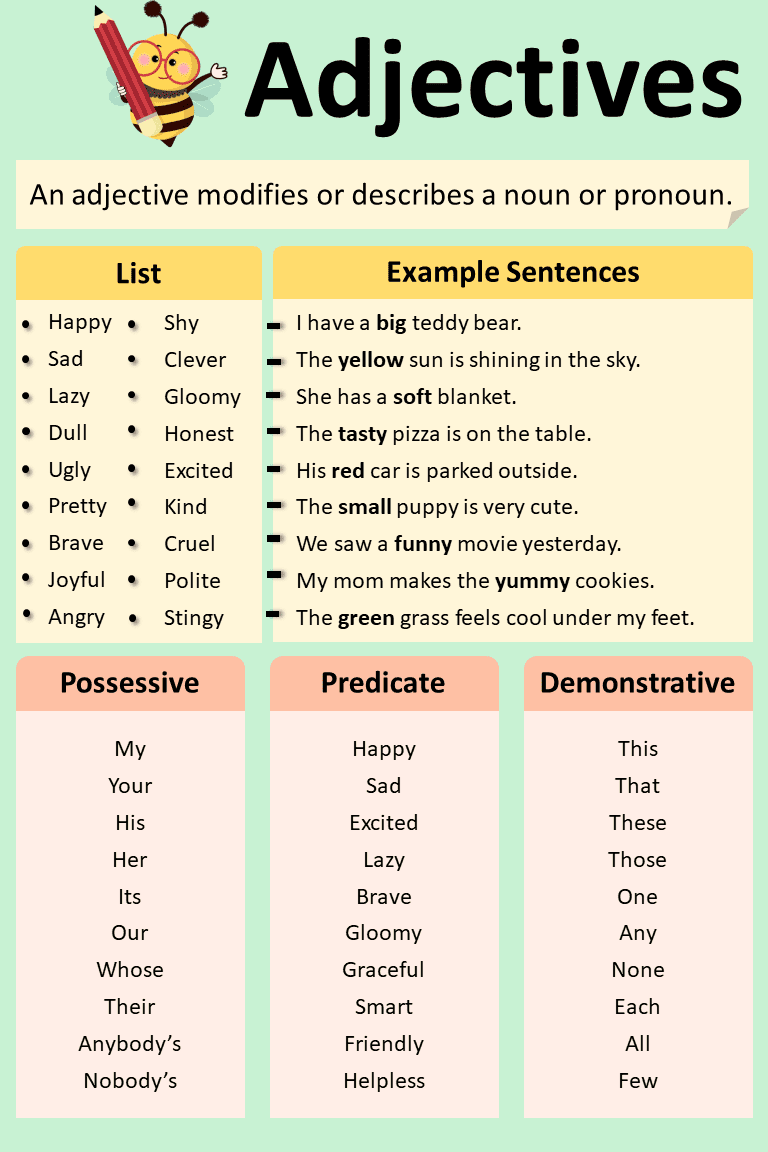
An adjective describes a noun or pronoun. It adds more detail about size, color, quantity, feeling, or other qualities. Adjectives come in different types.
Types of Adjectives:
- Descriptive Adjectives: blue, tall, happy
- Quantitative Adjectives: few, many, ten
- Demonstrative Adjectives: this, that, these, those
- Possessive Adjectives: my, your, his, her, its, our, their
- Interrogative Adjectives: which, what, whose
- Proper Adjectives: American, Chinese, Islamic
- Comparative and Superlative Adjectives: bigger, biggest, more beautiful, most helpful
Example sentences:
- She wore a beautiful dress.
- I have three books in my bag.
- Which subject do you like best?
Verb
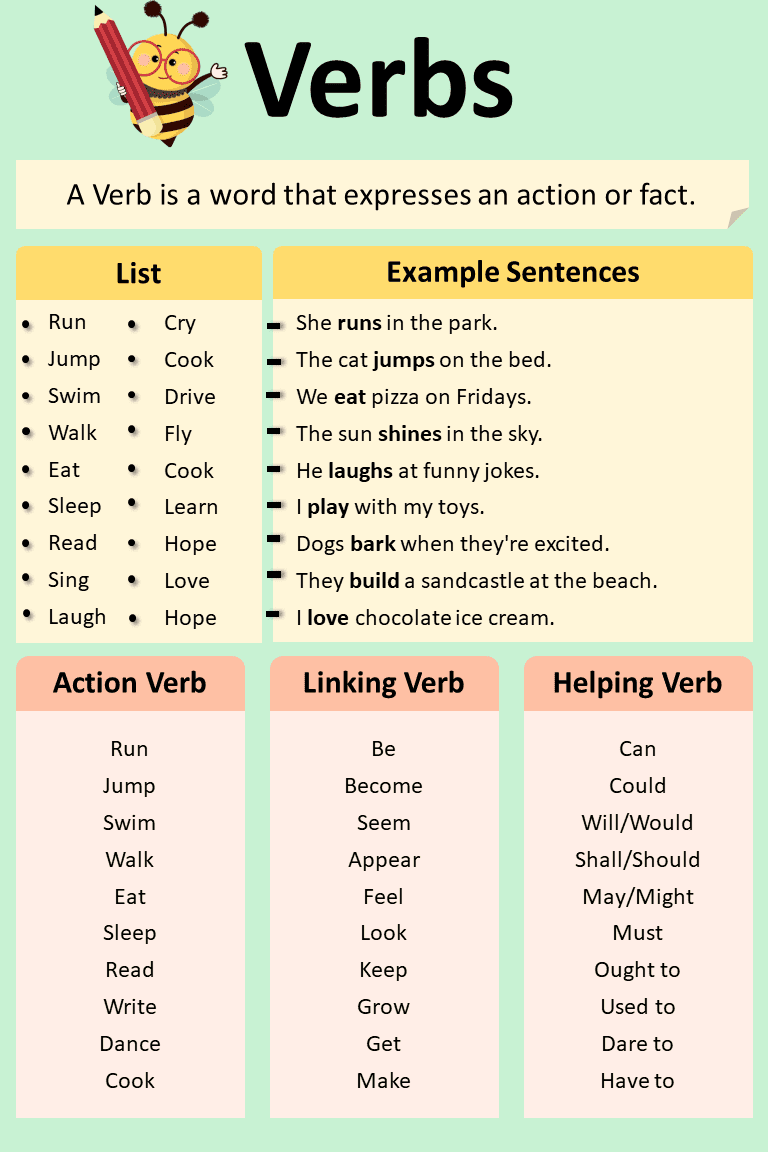
A verb tells what the subject does or what state it is in. Verbs can show action or link the subject to more information. Verbs come in many types.
Types of Verbs:
- Action Verbs: run, jump, sing
- Linking Verbs: is, are, was, seem, become
- Helping (Auxiliary) Verbs: is, am, are, was, were, have, has, had, will, shall, can, may
- Transitive Verbs: need a direct object (e.g., She reads a book.)
- Intransitive Verbs: do not need an object (e.g., He sleeps.)
- Regular Verbs: end in -ed in past tense (walk – walked)
- Irregular Verbs: have unique past forms (go – went, eat – ate)
Example sentences:
- I am reading a new novel.
- She sang a lovely song.
- The kids played outside.
Adverb
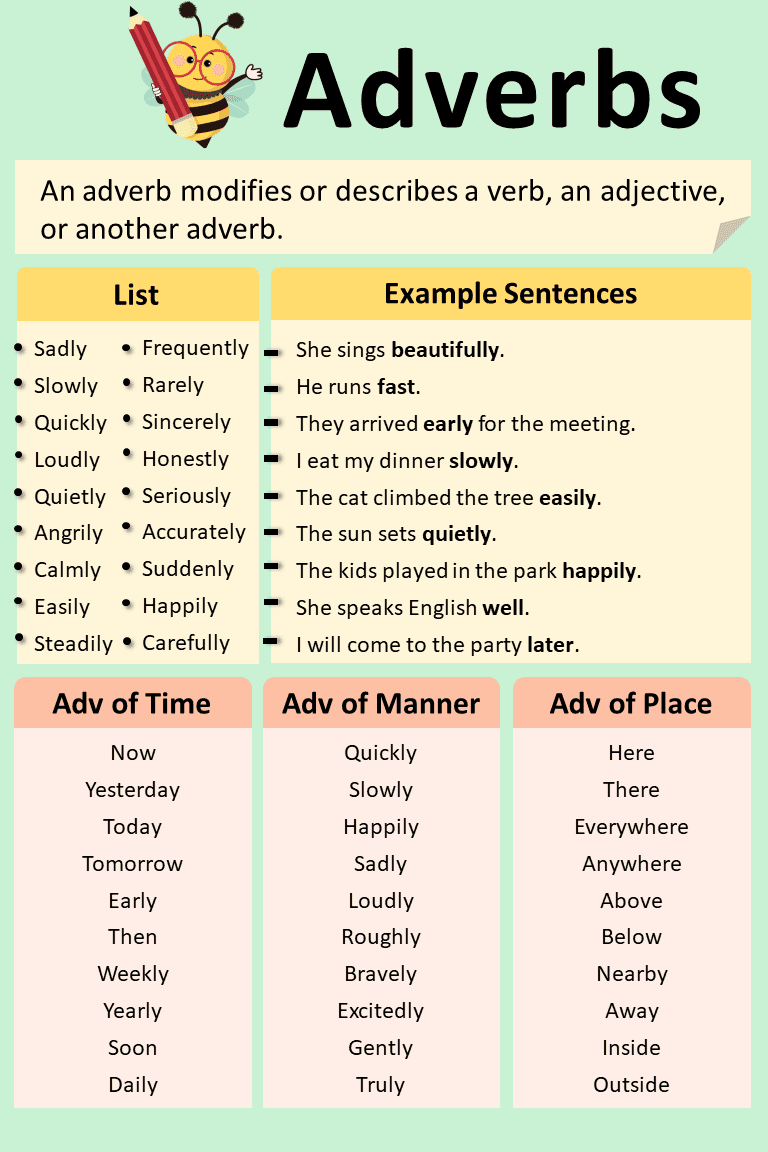
An adverb gives more information about how, when, where, or how often something happens. There are many types that each describe things differently.
Types of Adverbs:
- Adverbs of Manner: quickly, slowly, loudly
- Adverbs of Time: now, soon, yesterday
- Adverbs of Place: here, there, outside
- Adverbs of Frequency: always, often, never, sometimes
- Adverbs of Degree: very, too, quite, almost
- Interrogative Adverbs: when, where, why, how
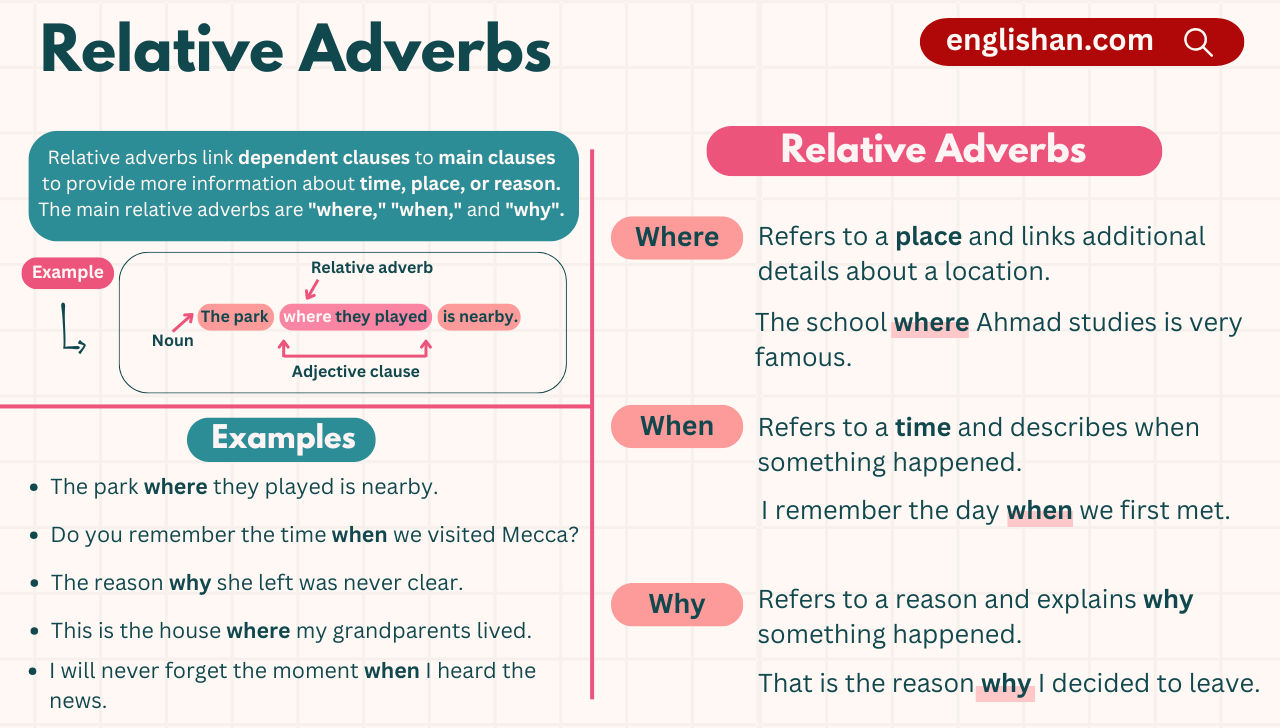
- Relative Adverbs: when, where, why
Example sentences:
- He drives carefully.
- We’ll meet tomorrow.
- She is always cheerful.
Prepositions
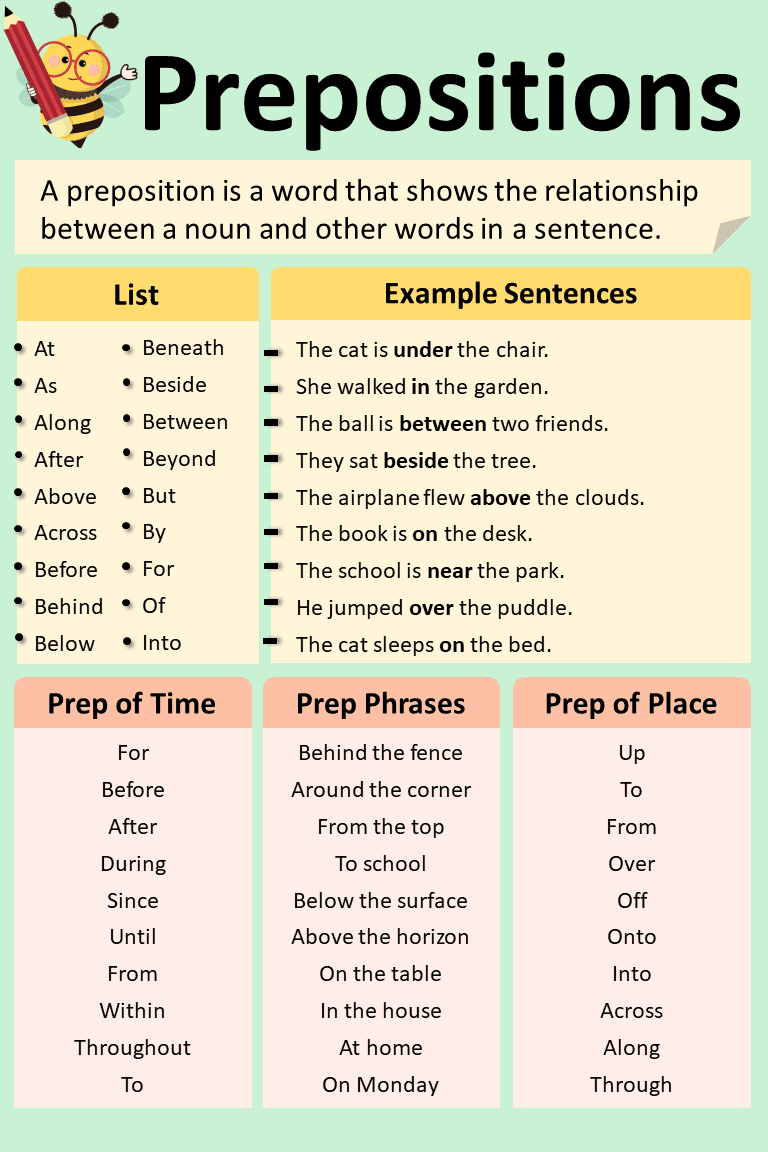
A preposition links a noun or pronoun to other words and shows relationships of time, place, direction, or reason. Prepositions are grouped by what they show.
Types of Prepositions:
- Prepositions of Place: in, on, at, under, beside
- Prepositions of Time: before, after, during, since
- Prepositions of Direction/Movement: to, into, onto, across, through
- Prepositions of Agent or Instrument: by, with
- Prepositions of Cause, Reason, or Purpose: for, due to, because of
Example sentences:
- The clock is on the wall.
- We will go after lunch.
- She walked into the room quietly.
Conjunction
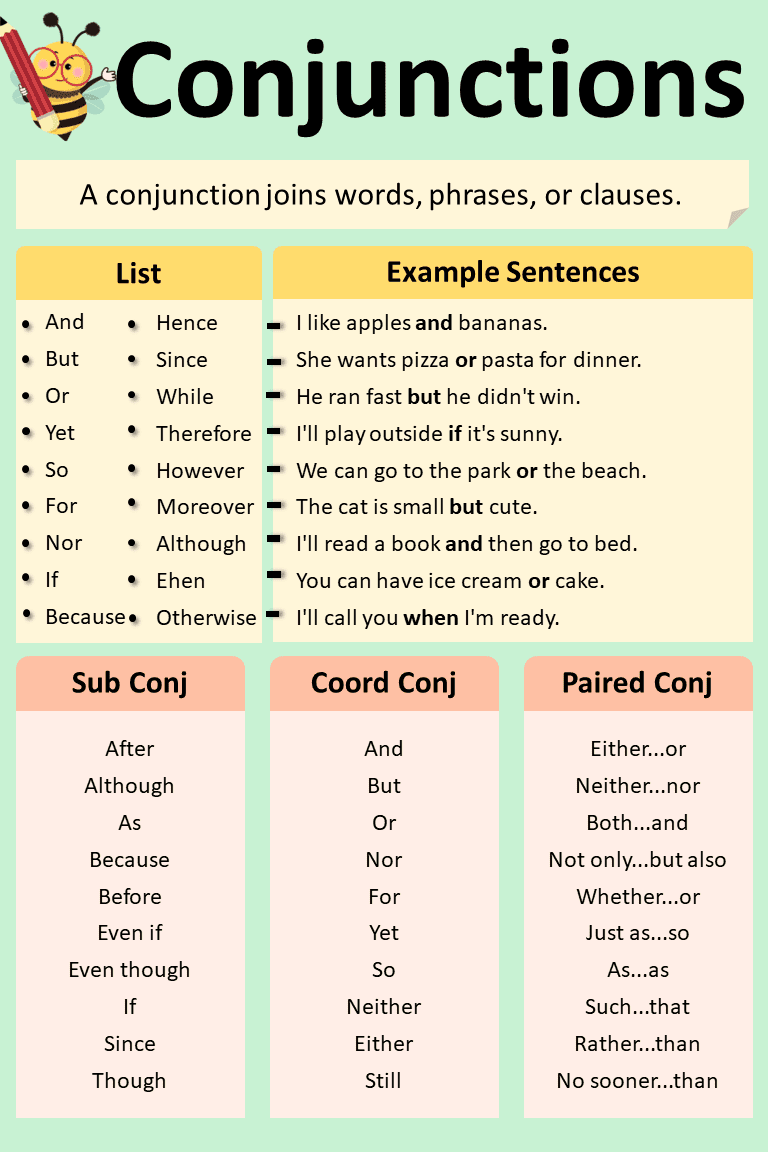
A conjunction connects words, phrases, or clauses. It helps build longer and clearer sentences. Conjunctions are grouped by how they connect ideas.
Types of Conjunctions:
- Coordinating Conjunctions: and, but, or, nor, for, so, yet
- Subordinating Conjunctions: because, although, since, while, if, when, unless, before, after
- Correlative Conjunctions: either…or, neither…nor, not only…but also, both…and
Example sentences:
- I want tea and biscuits.
- You can go if you finish your work.
- Either you study hard or you fail.
Interjection – Shows Feeling or Reaction
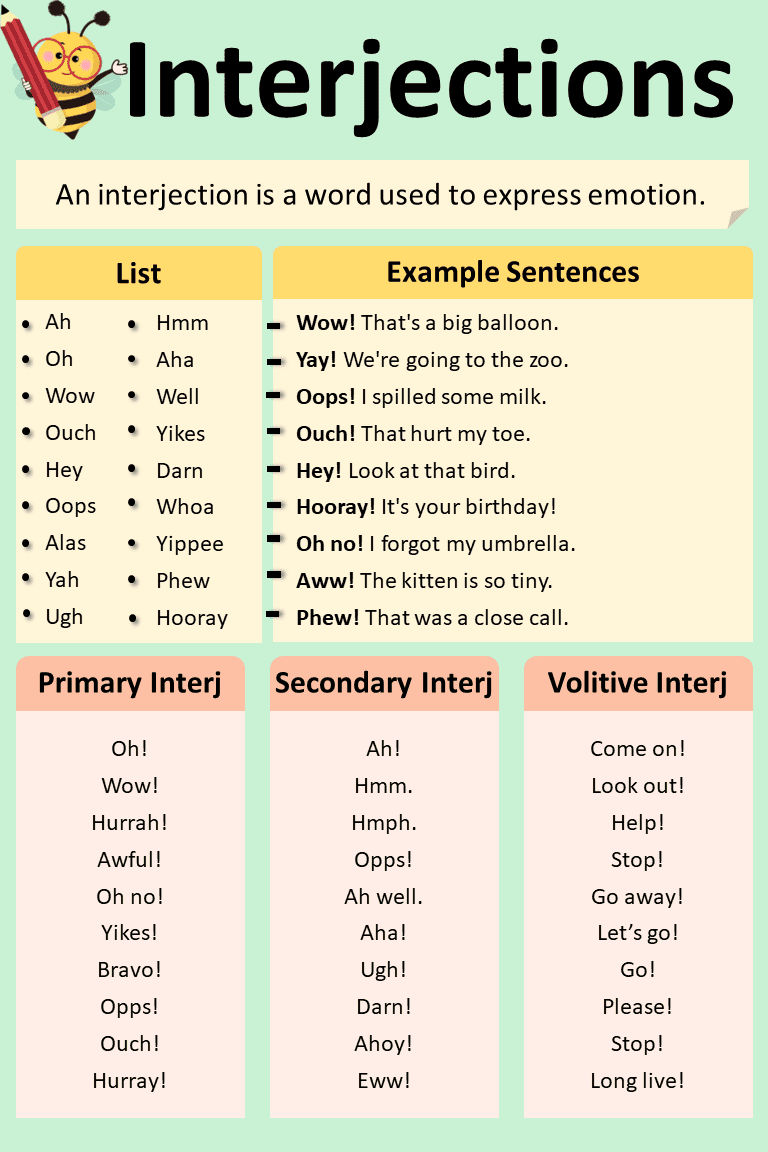
An interjection is a short word or phrase that shows sudden feeling or emotion. Different kinds of interjections express different moods.
Common uses of interjections:
- Greetings: hello, hi, hey
- Expressing joy: yay, hooray, wow
- Showing surprise: oh, ah, whoa
- Expressing pain or sorrow: ouch, alas, oh no
- Giving praise: bravo, well done
- Hesitating or thinking: hmm, uh, um
Example sentences:
- Hey! Are you coming?
- Ouch! That really hurt.
- Hooray! We won the game!
Final Tip on Mastering Parts of Speech
Each part of speech has a special function in grammar. Learning them helps you build strong English sentences. Practice identifying parts of speech in your reading and writing to get better at using them!
FAQs About Parts of Speech
Parts of speech are categories of words with similar grammatical properties. They help classify and understand the functions of words in sentences.
There are eight main parts of speech: nouns, pronouns, verbs, adjectives, adverbs, prepositions, conjunctions, and interjections.
A noun is a word used as the name of a person, place, thing, idea, quality, state, condition, position, attitude, or action.
Pronouns include words like he, she, it, they, we, you, me, him, her, and us. They replace nouns in a sentence.
Verbs express actions, occurrences, or states of being in a sentence. They are crucial for conveying what the subject is doing or experiencing.
Adjectives describe or modify nouns by providing more information about their qualities, such as color, size, shape, or other attributes.
Adverbs modify verbs, adjectives, or other adverbs. They add details about how, when, where, or to what extent an action occurs.
Prepositions include words like in, on, under, above, beside, between, and among. They show the relationship between a noun and other words in a sentence.
You May Also Like
Parts of Speech Quiz
Parts of Speech
Name the part of speech.
In 'The cat slept', 'cat' is a ___.
'Cat' names a living thing, so it is a noun.
a noun names a person, place, or thing
The cat slept.
Name the part of speech.
In 'She ran quickly', 'quickly' is a ___.
'Quickly' tells how she ran, so it modifies the verb.
an adverb modifies a verb
She ran quickly.
Name the part of speech.
In 'Wow, that's amazing!', 'Wow' is a(n) ___.
'Wow' bursts out to show feeling.
an interjection expresses sudden emotion
Wow, that's amazing!
Name the part of speech.
In 'the book on the table', 'on' is a(n) ___.
'On' links 'book' to 'table' by position.
a preposition links a noun to other words
the book on the table
Name the part of speech.
In 'Water the plants', 'Water' is a ___.
Here 'water' names the action of watering.
a word's part of speech depends on its job
Water the plants.
Name the part of speech.
In 'She and I left', 'and' is a(n) ___.
'And' joins 'she' and 'I'.
a conjunction joins words or groups
She and I left.
Name the part of speech.
In 'The bird sang sweetly', 'sang' is a ___.
'Sang' names the action the bird performed.
verbs name actions or states
The bird sang sweetly.
Name the part of speech.
In 'She is very kind', 'kind' is a ___.
'Kind' describes the subject 'she'.
adjectives describe nouns and pronouns
She is very kind.
Name the part of speech.
In 'He ran quickly', 'quickly' is an ___.
'Quickly' tells how he ran, so it modifies the verb.
adverbs modify verbs, adjectives, or other adverbs
He ran quickly.
Name the part of speech.
'Under', 'over', and 'between' are ___.
These words show the relationship of a noun to something else.
prepositions show relationships of place, time, or direction
The cat hid under the table.
Name the part of speech.
In 'Wow! What a view.', 'Wow' is an ___.
'Wow' expresses sudden feeling and stands apart from the sentence.
interjections express sudden emotion
Wow! What a view.
True or false?
'They' is a pronoun.
'They' stands in for a noun, so it is a pronoun.
pronouns replace nouns
They arrived on time.
Name the part of speech.
In 'The teacher smiled', 'teacher' is a ___.
'Teacher' names a person, so it is a noun.
nouns name people, places, or things
The teacher smiled.
Name the part of speech.
In 'They built a house', 'built' is a ___.
'Built' names the action the subject performed.
verbs name actions or states
They built a house.
Name the part of speech.
In 'a red car', 'red' is an ___.
'Red' describes the noun 'car'.
adjectives describe nouns
a red car
Name the part of speech.
In 'She spoke softly', 'softly' is an ___.
'Softly' tells how she spoke, so it modifies the verb.
adverbs modify verbs, adjectives, or other adverbs
She spoke softly.
Name the part of speech.
In 'the book on the shelf', 'on' is a ___.
'On' shows the position of the book in relation to the shelf.
prepositions show relationships of place, time, or direction
the book on the shelf
Name the part of speech.
In 'bread and butter', 'and' is a ___.
'And' joins the two nouns.
conjunctions join words, phrases, or clauses
bread and butter
Name the part of speech.
In 'He called me', 'me' is a ___.
'Me' stands in for a noun as the object.
pronouns replace nouns
He called me.
True or false?
In 'Ouch! That stings', 'Ouch' is an interjection.
'Ouch' voices sudden feeling and stands apart from the sentence, so it is an interjection.
interjections voice sudden emotion
Ouch! That stings.
Turn on JavaScript for the interactive quiz. The full practice set is shown above.