

Wow, ouch and hey each express a complete feeling on their own, with no grammatical link to the sentence around them. That independence is what makes an interjection an interjection, and it is why one word works as a full reply. Interjections also do more than react to pain or surprise, since greetings, agreement, hesitation and quick apologies all belong to the same part of speech.
Interjections List With Meanings
What is an Interjection?
An interjection is a word or short phrase that expresses a feeling or reaction on its own, without any grammatical link to the rest of the sentence. The most frequent ones in written English are yes, no, oh, yeah, hi, hey, wow, hello and ah. Most of them express more than one meaning, and the punctuation you write after them shows which meaning applies.
Interjections For Surprise
More English interjections express surprise than any other feeling, and they range from a whispered oh to a shouted holy cow.
| Interjection | Meaning | Example |
|---|---|---|
| Wow | Something impressive amazes you. | Wow, that view is something else. |
| Oh | You have just noticed or realised something small. | Oh, I left the door open. |
| Ah | You now understand what you did not a moment ago. | Ah, so you two have met before. |
| Whoa | Something sudden startles you. | Whoa, slow down a second. |
| What | You cannot believe what you just heard. | What? She said that out loud? |
| Gosh | You are surprised, and a stronger word would sound harsh. | Gosh, I never thought of it that way. |
| Goodness | Mild shock, at something you saw or heard. | Goodness, look at the state of this room. |
| Gee | You are surprised, in a gentle American style. | Gee, that was quick. |
| Golly | Wide-eyed surprise, in a playful older style. | Golly, they built that fast. |
| My word | Polite astonishment, in British English. | My word, what a turnout. |
| Oh my | Something startles you or seems a little too much. | Oh my, that is a tall cake. |
| Holy cow | Loud astonishment, in informal speech. | Holy cow, look at the size of it. |
| No way | You refuse to believe what someone told you. | No way, you met him in person? |
| Really | You are checking whether what you heard is true. | Really? He walked the whole way? |
Interjections For Joy And Excitement
These are the loudest interjections in English, and several of them appear only as shouts.
| Interjection | Meaning | Example |
|---|---|---|
| Yay | Everyday good news pleases you. | Yay, the tickets arrived. |
| Hooray | You are celebrating a win or a good result. | Hooray, the rain has stopped. |
| Hurrah | You are cheering, in a formal older style. | Hurrah, the team is through. |
| Woohoo | You got what you wanted, and you are excited. | Woohoo, we got the flat. |
| Yippee | Delight, in a child-like burst. | Yippee, no school tomorrow. |
| Whee | You are enjoying speed or motion. | Whee, this slide is fast. |
| Wahoo | You are shouting in triumph. | Wahoo, we made it to the top. |
| Yahoo | You are celebrating a success out loud. | Yahoo, the exam is over. |
| Bravo | You are praising a fine performance. | Bravo, that solo was perfect. |
| Hot dog | Good luck pleases you, in older American English. | Hot dog, my order came early. |
| Oh boy | Something exciting is coming, or trouble is. | Oh boy, this is going to be good. |
| Eureka | You have just discovered the answer. | Eureka, the missing file was in the drafts. |
| Ha | You laugh briefly, or claim a small triumph. | Ha, I knew it all along. |
| Haha | You are writing laughter into a message. | Haha, that caption is perfect. |
Interjections For Pain And Injury
You say a different word for a sharp sting than for a heavy knock, so match the sound to the hurt.
| Interjection | Meaning | Example |
|---|---|---|
| Ouch | A sharp pain hits you suddenly. | Ouch, that pin was sharp. |
| Ow | A smaller or duller pain hurts. | Ow, my shoulder again. |
| Aargh | Pain and frustration hit at once. | Aargh, I hit my head on the shelf. |
| Oof | Something strikes you, or you lift a heavy load. | Oof, that box weighs a ton. |
| Yowch | A stinging pain hurts, and you half joke about it. | Yowch, that water is boiling. |
| Owie | A child names a small cut or scrape. | Owie, I scraped my knee. |
Interjections For Sadness And Regret
Writers spell out sob and sigh in print to show a sound the reader cannot hear, so both belong to written English more than to speech.
| Interjection | Meaning | Example |
|---|---|---|
| Alas | You regret something, in a literary style. | Alas, the offer closed yesterday. |
| Oh no | Bad news reaches you. | Oh no, the flight is cancelled. |
| Oh dear | Gentle dismay or concern. | Oh dear, she looks upset. |
| Aww | You feel sympathy or tenderness. | Aww, the poor thing is soaked. |
| Boohoo | Someone is crying, and you are mocking it. | Boohoo, you lost one point. |
| Sob | A writer spells out the sound of crying. | Sob, my plant finally died. |
| Sigh | A writer spells out a weary breath. | Sigh, another form to fill in. |
| Shucks | You brush off disappointment, or deflect praise. | Shucks, anyone would have done the same. |
| Oh well | You accept a small disappointment and move on. | Oh well, there is always next year. |
| Woe | You grieve, in an old formal style. | Woe, the harvest has failed again. |
Interjections For Anger And Frustration
Several of these started as softened oaths, which is why darn, drat and blast sound forceful without sounding rude.
| Interjection | Meaning | Example |
|---|---|---|
| Ugh | Weary disgust or irritation. | Ugh, this queue has not moved. |
| Grr | You growl at something annoying. | Grr, the printer jammed again. |
| Darn | A small setback annoys you, and you soften the curse. | Darn, I forgot the charger. |
| Dang | The same annoyance, in casual American English. | Dang, that hurt more than I expected. |
| Drat | Annoyance, in a mild old-fashioned style. | Drat, the shop shut at five. |
| Blast | Sharp annoyance, in British English. | Blast, I have left my keys inside. |
| Shoot | You made a mistake and softened a stronger word. | Shoot, I sent it to the wrong address. |
| Rats | A small defeat disappoints you. | Rats, the last one just sold. |
| Humph | You disapprove and say nothing more. | Humph, that strikes me as unfair. |
| Bah | You dismiss something as not worth attention. | Bah, the whole idea is nonsense. |
| Phooey | You reject something with mock scorn. | Phooey, the film was nothing special. |
| Good grief | You are exasperated and cannot believe it. | Good grief, not this again. |
| Crud | Something has gone wrong, and you react mildly. | Crud, the battery died mid call. |
Interjections For Disgust And Dislike
Disgust and boredom overlap in English, so you will hear bleh and meh in both situations depending on how the speaker says them.
| Interjection | Meaning | Example |
|---|---|---|
| Eww | Something revolts you. | Eww, this milk has turned. |
| Yuck | A taste, a smell or a sight repels you. | Yuck, I cannot eat that. |
| Blech | Something makes you feel queasy. | Blech, that medicine is bitter. |
| Bleh | Something strikes you as dull and unappealing. | Bleh, another grey afternoon. |
| Ick | Something slimy or creepy touches you. | Ick, there is a spider in the sink. |
| Pew | A bad smell reaches you. | Pew, something has gone off in that fridge. |
| Meh | Flat indifference. | Meh, the sequel added nothing new. |
| Blah | Boredom, or a dull mood. | Blah, nothing on television tonight. |
Interjections For Fear And Alarm
Fear interjections do two different jobs. Some express your own fright, while help and look out warn another person directly.
| Interjection | Meaning | Example |
|---|---|---|
| Eek | A small fright startles you. | Eek, a mouse ran under the sofa. |
| Yikes | Something alarming or awkward happens. | Yikes, that bill came to more than I expected. |
| Aah | You scream in genuine fear. | Aah, something just touched my foot. |
| Gah | Panic and frustration hit together. | Gah, the deadline is tomorrow. |
| Help | You call for rescue. | Help, the boat is drifting out. |
| Look out | You warn someone of immediate danger. | Look out, that branch is falling. |
| Heavens | Alarm, in a mild formal style. | Heavens, the ceiling is leaking. |
| Jeepers | A fright startles you, in a dated playful style. | Jeepers, that dog came from nowhere. |
Interjections For Relief
You say these only after a worry ends, so each one depends on the situation immediately before it.
| Interjection | Meaning | Example |
|---|---|---|
| Phew | A close call has passed. | Phew, the train waited for us. |
| Whew | Hard effort or heat has ended. | Whew, that hill was steeper than it looked. |
| Thank goodness | Something turned out well after worry. | Thank goodness, the results came through. |
| At last | A long wait has ended. | At last, the plumber is here. |
| Finally | Something overdue has happened. | Finally, the update installed. |
| Ahh | You feel comfort or ease. | Ahh, that first sip is worth the wait. |
Interjections For Agreement And Approval
Yes and no are the two most frequent interjections in English, and the rest express the same answer at different levels of formality.
| Interjection | Meaning | Example |
|---|---|---|
| Yes | You agree plainly. | Yes, that works for me. |
| No | You refuse or deny plainly. | No, that is not what I meant. |
| Yeah | You agree casually in speech. | Yeah, I will be there by six. |
| Yep | You agree briskly and informally. | Yep, all done. |
| Yup | You agree in a relaxed, clipped way. | Yup, that is the one. |
| Uh-huh | You agree while you listen. | Uh-huh, go on. |
| Okay | You accept a plan or an instruction. | Okay, I will book the table. |
| Sure | You agree without hesitation. | Sure, take mine. |
| Right | You follow what someone just explained. | Right, I see what you mean now. |
| Indeed | You agree with emphasis, formally. | Indeed, the figures back you up. |
| Absolutely | You agree strongly and without reservation. | Absolutely, count me in. |
| Amen | You endorse a statement wholeheartedly. | Amen, that needed saying. |
| Hear hear | You support a speaker publicly. | Hear hear, well argued. |
| Gotcha | You confirm you have understood, informally. | Gotcha, I will hold the line. |
Interjections For Hesitation And Thinking
Dictionaries such as Merriam-Webster class um and uh as interjections, though they do a different job from the rest: they give the speaker time to think rather than expressing a feeling.
| Interjection | Meaning | Example |
|---|---|---|
| Um | You pause while you search for words. | It was, um, sometime last April. |
| Uh | You pause briefly before answering. | Uh, let me check the diary. |
| Er | You pause, in British speech. | The capital is, er, Canberra. |
| Erm | You pause for longer, in British speech. | Erm, I am not sure that is right. |
| Hmm | You are thinking, or you doubt something. | Hmm, the colours clash a little. |
| Mmm | A taste or a sound pleases you. | Mmm, this soup is excellent. |
| Well | You take a moment before a considered reply. | Well, that depends on the budget. |
| Huh | You are confused, or you want it repeated. | Huh? Say that again. |
| Eh | You invite agreement, or ask for a repeat. | Cold out there, eh? |
| Aha | You have just worked something out. | Aha, so that is where the fault was. |
Interjections For Greetings And Goodbyes
You say a greeting because the situation calls for one rather than because you feel something, which is why some grammarians treat greetings as a subtype of their own.
| Interjection | Meaning | Example |
|---|---|---|
| Hello | You greet someone in a neutral way. | Hello, thanks for waiting. |
| Hi | You greet someone casually. | Hi, good to see you. |
| Hey | You greet a friend informally. | Hey, how did the interview go? |
| Yo | You greet someone with street informality. | Yo, over here. |
| Howdy | You greet warmly, in an American style. | Howdy, come on in. |
| Hiya | You greet brightly, in British speech. | Hiya, sorry I am late. |
| Greetings | You greet formally, or with mock ceremony. | Greetings, fellow travellers. |
| Welcome | You receive an arriving guest. | Welcome, let me take your coat. |
| Cheers | You toast a drink, or thank someone in British English. | Cheers, that is very kind of you. |
| Bye | You part casually. | Bye, see you Tuesday. |
| Goodbye | You part formally. | Goodbye, and thank you for everything. |
| Farewell | You part before a long absence. | Farewell, my friend. |
| Cheerio | You part cheerfully, in British English. | Cheerio, mind how you go. |
| So long | You part in a relaxed, dated style. | So long, and good luck. |
| See ya | You part quickly among friends. | See ya, text me later. |
Interjections For Calling Attention
Several of these copy sounds the body makes rather than any word, and a listener notices them across a noisy room.
| Interjection | Meaning | Example |
|---|---|---|
| Psst | You attract attention quietly. | Psst, your phone is ringing. |
| Ahem | You clear your throat to be noticed. | Ahem, I believe that seat is mine. |
| Yoo-hoo | You call to someone at a distance. | Yoo-hoo, we are over by the gate. |
| Shh | You ask for quiet. | Shh, the baby has just gone down. |
| Hush | You ask for silence, gently. | Hush, listen to that. |
| Behold | You direct attention, in a grand older style. | Behold, the finished bridge. |
| Listen | You demand attention before what you most want heard. | Listen, you need to hear this bit. |
| Ahoy | You hail someone at a distance, at sea or in jest. | Ahoy, is anyone aboard? |
| Excuse me | You interrupt politely. | Excuse me, does this train stop at York? |
Interjections For Mistakes And Accidents
Speakers reach these in the half-second between an error and an apology, and with each one you admit a different amount of fault.
| Interjection | Meaning | Example |
|---|---|---|
| Oops | You acknowledge a small blunder. | Oops, wrong button. |
| Whoops | You stumble or slip. | Whoops, I nearly dropped that. |
| Uh-oh | You spot trouble the moment it starts. | Uh-oh, the tap is still running. |
| My bad | You take the blame informally. | My bad, I misread the date. |
| Doh | You catch your own mistake. | Doh, the answer was on the first page. |
| Oopsy-daisy | You steady a child after a small tumble. | Oopsy-daisy, up you get. |
| Pardon me | You apologise for a small breach of manners. | Pardon me, I did not mean to push. |
Alphabetical List Of Interjections A To Z
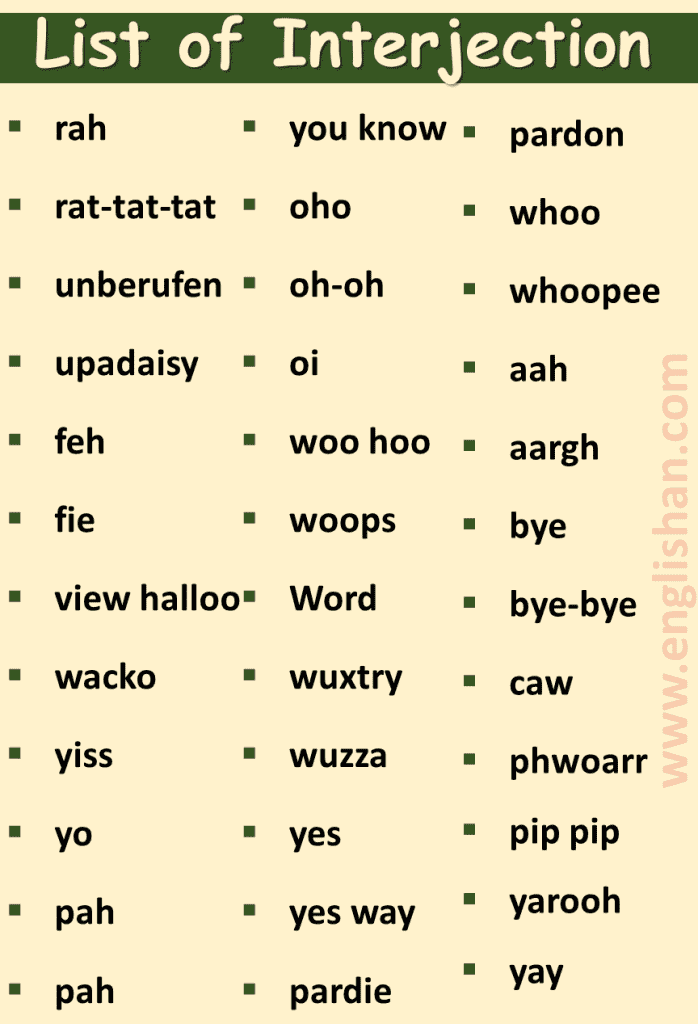
Alphabetical order suits a different search: you half-remember a word, you know its first letter, and you want to confirm the spelling before you write it.
A: Aah, Aargh, Absolutely, Ah, Aha, Ahem, Ahh, Ahoy, Alack, Alas, Amen, At last, Aww
B: Bah, Behold, Blah, Blast, Blech, Bleh, Blimey, Boohoo, Bravo, Bye
C: Cheerio, Cheers, Cor, Crikey, Crud
D: Dang, Darn, Doh, Drat
E: Eek, Egad, Eh, Er, Erm, Eureka, Eww, Excuse me
F: Farewell, Fie, Finally, Forsooth
G: Gadzooks, Gah, Gee, Golly, Good grief, Goodbye, Goodness, Gosh, Gotcha, Gramercy, Greetings, Grr
H: Ha, Haba, Haha, Hark, Harrow, Hear hear, Heavens, Hello, Help, Hey, Hi, Hiya, Hmm, Holy cow, Hooray, Hot dog, Howdy, Huh, Humph, Hurrah, Hush
I: Ick, Indeed
J: Jeepers
L: Lah, Listen, Lo, Look out
M: Meh, Mmm, My bad, My word
N: No, No way
O: Och, Oh, Oh boy, Oh dear, Oh my, Oh no, Oh well, Oi, Okay, Oof, Oops, Oopsy-daisy, Ouch, Ow, Owie
P: Pardon me, Pew, Phew, Phooey, Prithee, Psst
R: Rats, Really, Right
S: See ya, Shh, Shoot, Shucks, Sigh, So long, Sob, Strewth, Sure
T: Thank goodness
U: Ugh, Uh, Uh-huh, Uh-oh, Um
W: Wahoo, Welcome, Well, Wellaway, What, Whee, Whew, Whoa, Whoops, Woe, Woohoo, Wow
Y: Yaar, Yahoo, Yay, Yeah, Yep, Yes, Yikes, Yippee, Yo, Yoo-hoo, Yowch, Yuck, Yup
Z: Zounds
No common English interjection starts with K, Q, V or X, and the largest number of them start with H or O.
List Of Most Common Interjections
Frequency counts across billions of words of written English rank a small handful far ahead of the rest. The ranking surprises most learners, because the loudest interjections appear well down the list.
The most frequent interjections in English writing are yes, no, oh, yeah, hi, hey, wow, hello, ah, ha, blah, eh, yep, alas, haha, cheers, huh and hmm. Plain agreement and plain greeting outrank every expression of emotion. Wow ranks seventh, and ouch, the one most learners study first, appears nowhere near this group.
Frequency also shifts over time. Nay ranked among the commonest interjections in American writing of the 1820s and has since faded to almost nothing, while yeah appears in no text from that decade and now ranks near the top. If your goal is natural-sounding speech, learn the eighteen above before anything else.
Interjections List For Kids
Children say interjections before they master full sentences, and these are the ones they learn first. Each meaning is written for a young reader.
- Wow: something looks amazing.
- Yay: something good just happened.
- Oops: you made a small mistake.
- Ouch: something hurt you.
- Owie: you have a small cut or scrape.
- Uh-oh: something has gone wrong.
- Eek: something gave you a fright.
- Yuck: something tastes or smells horrible.
- Ick: something feels slimy or creepy.
- Shh: please be quiet.
- Hey: look over here.
- Huh: you did not understand.
- Hi: you are greeting someone.
- Bye: you are leaving.
- Hooray: your team or your side won.
- Whee: you are going fast and enjoying it.
- Yippee: you are very excited.
- Aww: something is sweet, or someone needs sympathy.
- Phew: the scary part is over.
- Boohoo: someone is crying.
Types Of Interjections With Examples
Grammarians classify interjections two different ways at once, first by the word’s origin and then by its function, and five labels do the whole job.
Primary interjections: you will never find these words in any other role, because they are never a noun, a verb or an adjective. Strip the emotion out and nothing remains. Examples: ah, oh, ouch, eek, wow, ugh, psst, phew, aargh, hmm.
Secondary interjections: these are ordinary words from other word classes. Each one becomes an interjection only when it is separated from the clause. Examples: goodness, shoot, blast, help, welcome, right, indeed, heavens, listen, well. Compare the shoot broke off the stem, where shoot is a noun, with Shoot, I forgot the milk, where nothing else in the sentence connects to it.
Emotive interjections: you say these to report what you feel. Examples: ouch, eww, yay, alas, grr.
Volitive interjections: you say these to direct the listener. Examples: shh, hush, look out, listen, help.
Cognitive interjections: you say these when you have just understood or discovered something. Examples: aha, hmm, oh, eureka, uh-huh.
The two systems overlap, so one word takes a label from each. Shh is primary by origin and volitive by function, while help is secondary by origin and volitive by function.
List Of Archaic Interjections
More English interjections have fallen out of use than remain in it. These survive in older texts, in carols and in period drama, and knowing them answers the question every reader of Shakespeare eventually asks.
| Interjection | Meaning | Where you still meet it |
|---|---|---|
| Alack | Speakers said this in sorrow or regret. | Shakespeare and Victorian verse |
| Alas | Writers still say this in regret, and it is the one survivor of the group. | Formal and literary prose today |
| Gramercy | Speakers thanked each other with this, from the French grand merci. | Chaucer and Middle English texts |
| Wellaway | Speakers lamented misfortune with this Old English cry. | Old and Middle English poetry |
| Fie | Speakers rebuked something shameful. | Shakespeare, and modern mock scolding |
| Egad | Speakers softened an oath for polite company. | Eighteenth-century comedy |
| Zounds | Speakers swore by Christ’s wounds, and listeners were shocked. | Elizabethan drama |
| Gadzooks | Speakers softened another oath on the same pattern. | Historical fiction and pantomime |
| Lo | Speakers called attention to something remarkable. | The King James Bible |
| Prithee | Speakers asked politely, shortening I pray thee. | Shakespeare and period drama |
| Hark | Speakers ordered a listener to pay attention. | Carols and older verse |
| Forsooth | Speakers insisted something was true, and today you hear it only in mockery. | Mock-medieval speech |
| Harrow | Speakers cried out in alarm or distress. | Chaucer and Middle English romance |
British And Regional Interjections
Interjections vary more by country than almost any other vocabulary. A speaker in Lagos, Glasgow and Singapore each says one that the other two never do, and corpus evidence confirms how local some of them remain.
| Interjection | Region | Meaning |
|---|---|---|
| Oi | Britain and Australia | You call out to someone sharply. |
| Crikey | Australia and Britain | You are astonished. |
| Blimey | Britain | You are surprised. British speakers shortened it from an oath. |
| Cor | Britain | You admire something, or you are surprised. |
| Strewth | Australia | You cannot believe it, from God’s truth. |
| Och | Scotland and Ireland | You feel mild regret, or you dismiss something. |
| Lah | Singapore and Malaysia | Speakers add it at the end of a sentence to soften it. |
| Yaar | India and Pakistan | You address a friend warmly. |
| Haba | Nigeria | You are surprised, or you protest. |
Cheerio, hiya and ta-ta stay British in the same way, and an American reader meets them mostly in imported television.
How To Punctuate Interjections
The punctuation mark after an interjection changes its strength, so the same word reads differently with a full stop and with an exclamation mark. Write Oops. for a small slip and Oops! for a disaster.
Exclamation mark: strong feeling. It closes the interjection, and the next word starts a fresh sentence with a capital letter. Yikes! That was close. This is also how most exclamatory sentences end.
Comma: mild feeling. The interjection joins the sentence that follows it, and that sentence keeps its lowercase start. Well, I suspected as much.
Question mark: doubt, or a request to repeat. Huh? Say that again.
Full stop: a deliberate, flat pause. Oh well. On to the next one.
An interjection inside a sentence takes a comma on each side: The cake was, ugh, far too sweet. One at the end takes a comma before it: We are late, oh no.
Capitalise an interjection when it opens a sentence, and leave it lowercase everywhere else. The mistake to watch for is the missing mark altogether:
- Wow that cake is huge. ❌ Without a comma the reader takes wow as a modifier of that cake, which is not the job an interjection does.
- Wow, that cake is huge. ✅ The comma separates the interjection from the clause and keeps it grammatically independent, which is what the word class requires.
FAQs
Ten common English interjections are wow, ouch, oops, hey, yay, ugh, phew, huh, alas and hooray. Each one works alone as a complete reaction: Ouch! on its own answers a stubbed toe, and Phew! on its own answers a near miss. All ten also work at the start of a sentence.
Everyday English runs on roughly forty common interjections, while dictionaries record several thousand more, counting regional, archaic and rare ones. The set stays open, because speakers form new ones from sounds whenever they need them. That is why no single figure covers the whole class.
Yes, plenty of interjections run to two or three words. Oh dear, good grief, hear hear, holy cow, so long and my bad each work as a single unit, and you cannot split one without losing its meaning. Grammarians count each of these as one interjection rather than as a phrase.
Yes, an interjection works at the start, in the middle or at the end. At the end it takes a comma before it, as in We are late, oh no. In the middle it takes a comma on each side, as in The film was, ugh, far too long.
Capitalise an interjection when it opens a sentence, exactly as you would any first word. Inside a sentence or at the end of one, it stays lowercase. The only other capital letters are the ones the word already needs, such as God in Oh my God.
Yes, listen works as an interjection when it is separated from the clause and demands attention, as in Listen, you need to hear this bit. It is volitive, because it directs the hearer rather than reporting a feeling. It remains an ordinary verb everywhere else, which makes it a secondary interjection.
Yes, traditional grammar counts interjections as one of the eight parts of speech, alongside nouns, verbs and the rest. Some modern grammarians describe the class as marginal, since interjections never combine with other words to build phrases. Schools, exams and coursebooks still teach them as a full part of speech.
No, formal and academic writing leaves interjections out, apart from quoted speech and dialogue. Two exceptions hold in formal argument: indeed and well pass in careful prose, because both read as measured rather than spontaneous. Everything else suits speech, fiction and informal writing.
You May Also Like