

An adverb intensifies an adjective as well as modifying a verb. Many adverbs that start with V express force: vastly, vehemently, violently and voraciously all intensify an action, and very grades an adjective, as in very quiet. Vividly, vaguely and visibly tell how something looks or is done, and virtually gives degree. Pairs that trade places in print are defined apart near the end.
Choose the first letter:
A · B · C · D · I · K · L · M · N · R · S · T · V
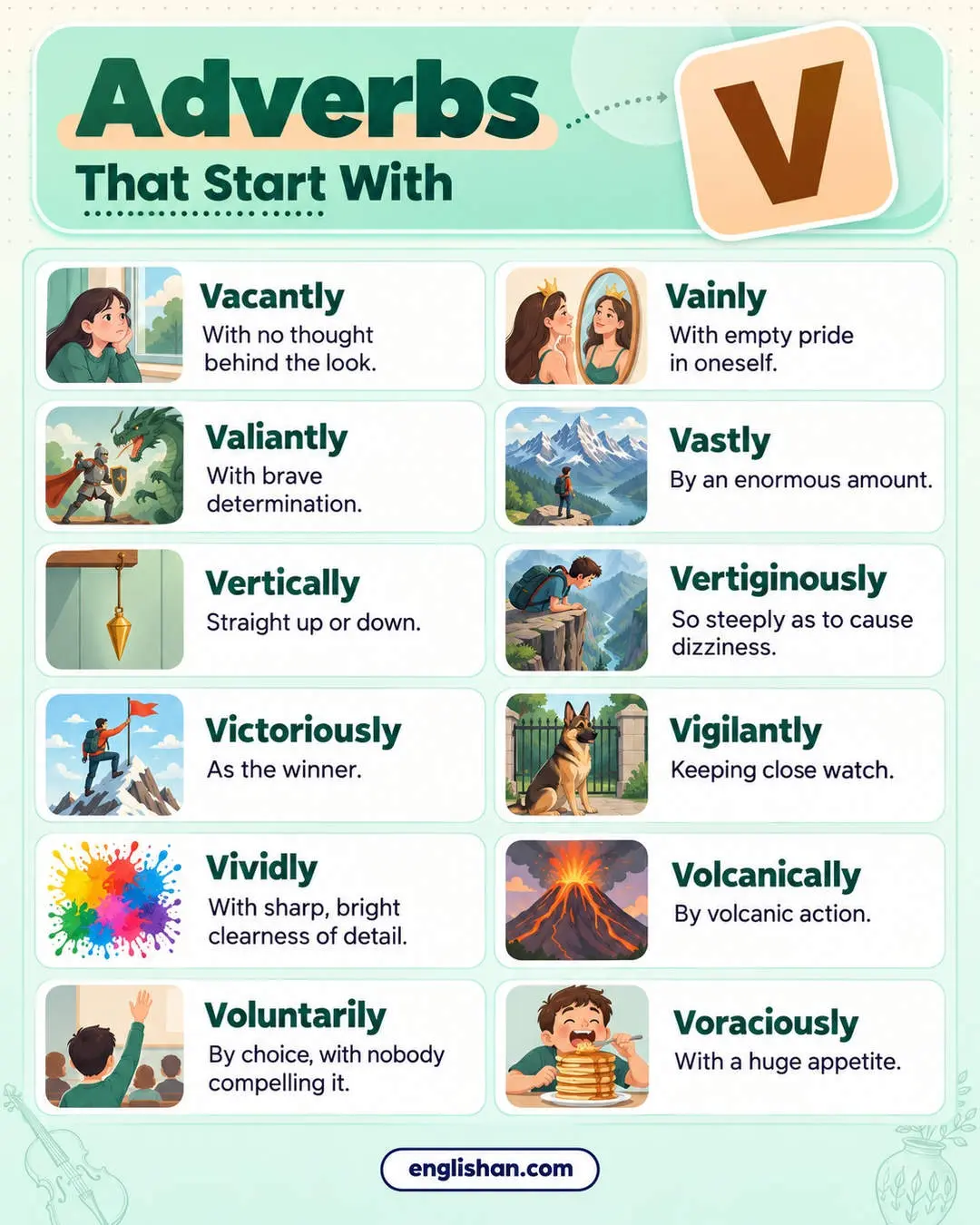
Adverbs That Start With V
The adverbs that start with V run alphabetically from vacantly to voluntarily, with the meaning beside the word and a sentence showing where the adverb belongs.
| Adverb | Meaning | In a sentence |
|---|---|---|
| Vacantly | With no thought behind the look. | He stared vacantly at the diagram. |
| Vaguely | Without definite outline. | The boundary is described vaguely. |
| Validly | In a way that holds up. | The notice was served validly. |
| Vapidly | Flatly, with nothing in it. | The preface reads vapidly. |
| Variably | Changing from one time to the next. | The spring runs variably through August. |
| Variously | In different ways by different people. | The hamlet is spelled variously in the deeds. |
| Venally | Open to bribery. | The licences were granted venally. |
| Verbally | In words, or by speech rather than writing. | The agreement was reached verbally. |
| Verbosely | At far greater length than needed. | The clause is drafted verbosely. |
| Verifiably | So as to stand up to a check. | The dating is verifiably correct. |
| Vertically | Straight up or down. | The crack travels vertically through the render. |
| Vertiginously | So steeply as to cause dizziness. | The stair climbs vertiginously to the belfry. |
| Vexedly | With irritation showing. | He queried the total vexedly. |
| Viably | In a way that works in practice. | The mill was restored viably as a workshop. |
| Vicariously | Through the experience of somebody else. | He followed the climb vicariously. |
| Vigilantly | Keeping close watch. | The bank was patrolled vigilantly. |
| Virtuously | With moral uprightness. | The trust was administered virtuously. |
| Visually | By sight, or in appearance. | The two panels differ visually. |
| Vocally | Out loud, and with the voice. | The tenants objected vocally. |
| Vocationally | In relation to a trade or calling. | The apprentices are trained vocationally. |
| Volcanically | By volcanic action. | The island was formed volcanically. |
| Voluntarily | By choice, with nobody compelling it. | The land was surrendered voluntarily. |
How to Use Very as an Adverb
Very is the shortest word on the letter and the one a reader meets a hundred times for every vociferously. It modifies adjectives and other adverbs, and it will not modify a verb, which is the rule that catches writers out.
| What very modifies | Sample | Verdict |
|---|---|---|
| An adjective | The lintel is very old. | Correct |
| Another adverb | He worked very quickly. | Correct |
| A past participle used as an adjective | She was very tired. | Correct |
| A plain verb | He very ran to the gate. | Wrong |
| An absolute adjective | The design is very unique. | Wrong |
- The lintel is very much older than the porch.
- He worked very quickly through the frost.
- She was very tired by the third shift.
- That answer was very nearly right.
- The cellar was very wet after the thaw.
An absolute adjective admits no degree, so unique, complete and identical take no very in careful writing.
- The design is very unique ❌
- The design is unique ✅
Very also refuses a verb outright, and the word a writer wants in that position is much or greatly.
- The schedule very slipped in April ❌
- The schedule slipped badly in April ✅
Positive Adverbs That Start With V
Approval sits in the positive adverbs that start with V, and the letter runs to courage and energy rather than to warmth. Valiantly and valorously report bravery, while vibrantly and vivaciously report life.
| Adverb | Meaning | In a sentence |
|---|---|---|
| Valiantly | With brave determination. | The crew fought the fire valiantly. |
| Valorously | Showing courage under danger. | The lifeboat put out valorously. |
| Vibrantly | With bright, living energy. | The border was planted vibrantly. |
| Victoriously | As the winner. | The team came off the field victoriously. |
| Vigorously | With strength and energy. | The ditch was cleared vigorously. |
| Vivaciously | In lively high spirits. | She hosted the evening vivaciously. |
| Vividly | With sharp, bright clearness of detail. | He remembered the flood vividly. |
Vividly applies to memory and description rather than to conduct, so a flood remembered vividly says nothing about the person remembering it.
Adverbs of Manner That Start With V
Manner is the second group among the adverbs that start with V, and a manner adverb answers the question how. The standard position is after the verb, or after the object where there is one. Front position is available for stress.
- The agreement was reached verbally.
- He stared vacantly at the diagram.
- Vigilantly, the bank was patrolled all winter.
- The ditch was cleared vigorously.
- The tenants objected vocally.
The position to rule out is between the verb and its object, where the adverb separates a pair that belongs together.
- They cleared vigorously the ditch ❌
- They cleared the ditch vigorously ✅
The intensity adverbs on V take the same two positions, described under adverbs of manner and across the types of adverbs.
Negative Adverbs That Start With V
Disapproval runs through the negative adverbs that start with V, and the letter holds more words for malice than for any other fault. Venomously, vindictively and vitriolically all report an intent to wound.
| Adverb | Meaning | In a sentence |
|---|---|---|
| Venomously | With poisonous spite. | The letter was written venomously. |
| Viciously | With cruel savagery. | The dog had been treated viciously. |
| Vilely | In a disgusting or wicked way. | The yard was left vilely fouled. |
| Villainously | With deliberate wickedness. | The will was altered villainously. |
| Vindictively | Out of a wish for revenge. | The notice was posted vindictively. |
| Violently | By great physical force. | The gate slammed violently in the gust. |
| Virulently | With bitter hostility, or with fast-spreading harm. | The rot spread virulently through the beam. |
| Vitriolically | With burning, corrosive scorn. | The review attacked the staging vitriolically. |
| Vulgarly | Without taste or refinement. | The hall was decorated vulgarly. |
Virulently applies to a disease as readily as to a person, which is why rot spreads virulently through a beam and no malice is implied.
Adverbs of Degree That Start With V
The degree adverbs that start with V include very, which grades an adjective. Virtually and visibly pull a statement down to a measured level, while vastly and veritably push it up.
| Adverb | Meaning | In a sentence |
|---|---|---|
| Vastly | By an enormous amount. | The second scheme is vastly cheaper. |
| Veritably | Truly, and without exaggeration. | The cellar was veritably a cistern by March. |
| Very | To a high degree. | The lintel is very much older than the porch. |
| Virtually | Almost entirely. | The ledger is virtually complete. |
| Visibly | Enough to be seen. | The beam has sagged visibly since the survey. |
| Vitally | In a way the whole depends on. | The draw depends vitally on the flue. |
| Voluminously | In great bulk or at great length. | The archive is catalogued voluminously. |
Vitally now reads as an intensifier, so a draw that depends vitally on the flue depends on it absolutely and nothing in the sentence concerns life, as adverbs of degree sets out.
Adverbs That Start With V to Describe a Person
Manner adverbs take the weight when a person heads the sentence, and the adverbs that start with V run to volume and appetite. He answered vehemently and he answered volubly report one action and two different people.
| Adverb | Meaning | In a sentence |
|---|---|---|
| Vainly | With empty self-regard, or without success. | He preened vainly at the mirror. |
| Vehemently | With passionate force. | She denied the charge vehemently. |
| Viscerally | From the gut rather than the head. | He reacted viscerally to the figure. |
| Vociferously | Loudly and insistently. | The tenants complained vociferously. |
| Volubly | At length and with ease of speech. | He explained the system volubly. |
| Voluptuously | With rich, sensual fullness. | The curtain fell voluptuously to the floor. |
| Voraciously | With a huge appetite. | He read the ledgers voraciously. |
Vainly has two unrelated senses, since a man preens vainly out of self-regard and a crew works vainly when the effort fails.
Commonly Confused V Adverbs
Pairs among the adverbs that start with V trade places in print, and the split turns on whether the word reports a method or a force. Half a dozen pairs account for most of the trouble.
| Pair | What separates them |
|---|---|
| Vainly / Vacantly | Vainly is self-regard or failure; vacantly is blankness. |
| Variably / Variously | Variably changes over time; variously differs between people. |
| Virtually / Veritably | Virtually means almost; veritably means truly. |
| Viciously / Virulently | Viciously implies cruelty; virulently implies fast spread. |
| Vocally / Verbally | Vocally means out loud; verbally means in words. |
| Vigorously / Vehemently | Vigorously is physical energy; vehemently is passion. |
- The spring runs variably through August.
- That hamlet is spelled variously in the deeds.
- The ledger is virtually complete.
- By March the cellar was veritably a cistern.
- Tenants objected vocally at the meeting.
Variably reports change over time and variously reports difference between hands, so a spring runs variably and a place name is spelled variously.
- The hamlet is spelled variably in the deeds ❌
- The hamlet is spelled variously in the deeds ✅
The adverbs that start with V give a writer force rather than finish. Very is the commonest, and much of the rest of the letter grades intensity, so three of them in close succession will overload a passage.
Related:
- Adverbs Ending in LY
- Adverbs That Do Not End in LY
- Adverb Examples
- Adverbs of Time
- Adverbs of Frequency
- Adverbs of Place
- Types of Adverbs
- Relative Adverbs
- Adverbs of Reason
FAQs
About fifty qualify in standard English, and 52 adverbs that start with V are gathered here with a meaning and a sentence. The letter is short because few V adjectives take the -ly ending, and very is the only one of the group with no ending at all.
Very is the most common of the adverbs that start with V and one of the most common words in English. Nothing else on the letter comes near it, and vastly, vividly and violently lead the rest at a long distance.
Very modifies adjectives, other adverbs and past participles used as adjectives, so very old, very quickly and very tired all read correctly. It will not modify a plain verb, and it takes no absolute adjective, so very unique and he very ran are both wrong.
Valiantly, valorously, vibrantly, victoriously and vigorously are approving words, and all five belong in a reference. The letter runs to courage and energy, so it offers no close equivalent of kindly or warmly.
Vehemently, vociferously, volubly and voraciously report how a person acts rather than what they are, so the verb keeps the action and the adverb holds the force behind it. Vainly has two senses, self-regard and failure, and only the sentence around it shows which one applies.
A manner adverb such as vigorously goes after the verb, or after the object where there is one. A degree word such as very or vastly goes immediately in front of the adjective or adverb it measures.