

The -ly ending forms the great majority of English adverbs, which modify verbs, adjectives and other adverbs. The ending is productive, so a writer forms a new adverb from almost any adjective without looking it up. That freedom explains how many there are, and it is why the adverbs ending in LY do five unrelated jobs rather than one. Quickly answers how, completely answers how much, weekly sets frequency, certainly states confidence, and frankly comments on the sentence it opens.
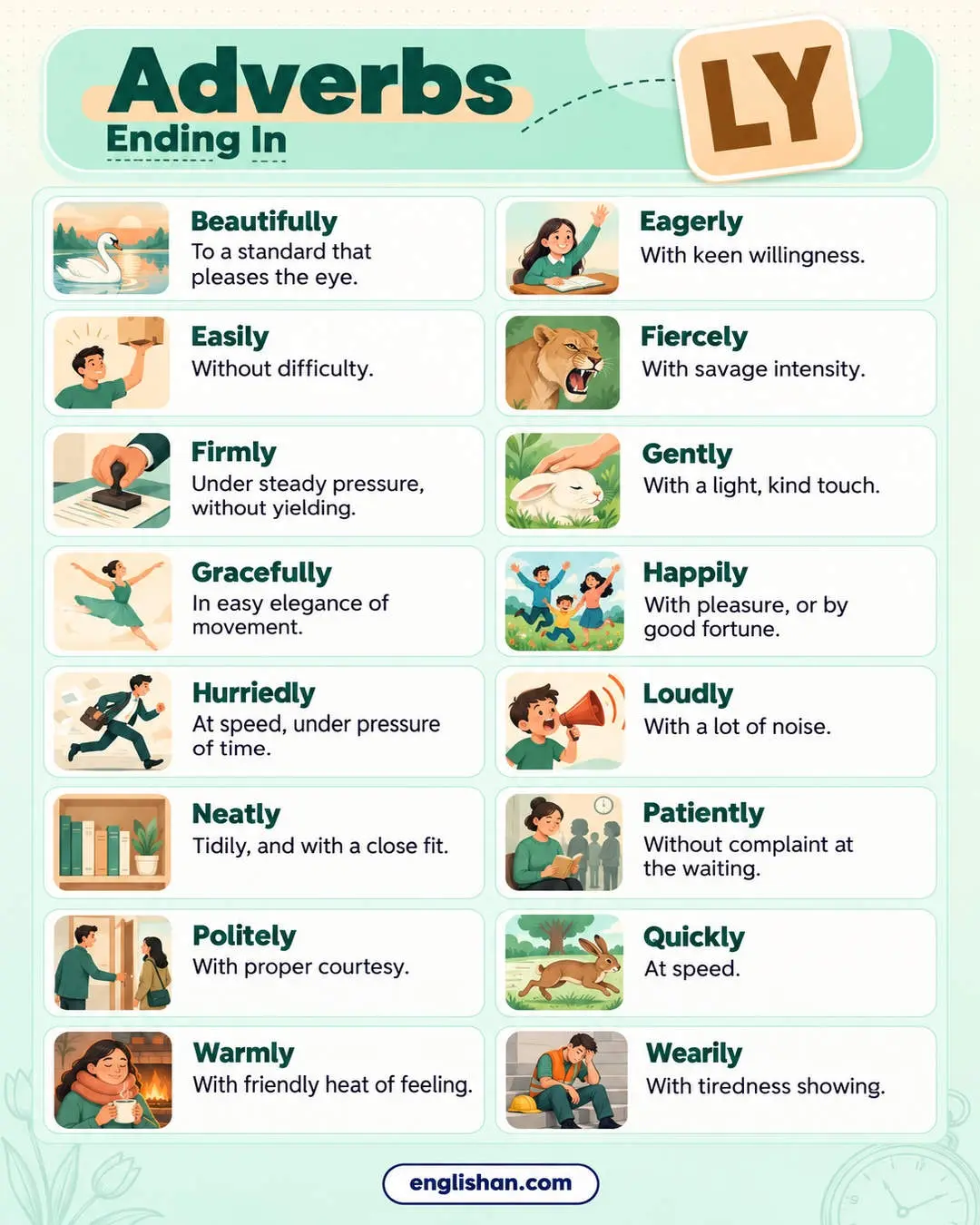
Adverbs Ending in LY for Manner
Choose the first letter:
A · B · C · D · I · K · L · M · N · R · S · T · V
Manner is the largest of the five jobs, and these are the adverbs ending in LY that answer the question how. The standard position is after the verb, or after the object where the verb takes one. Most of the adverbs ending in LY on this page belong here.
| Adverb | Meaning | In a sentence |
|---|---|---|
| Abruptly | Suddenly, with no warning. | The line ended abruptly at the fence. |
| Angrily | With anger. | He slammed the ledger shut angrily. |
| Anxiously | Worried about the outcome. | The family waited anxiously for the tide. |
| Awkwardly | Clumsily, or with embarrassment. | The gate hangs awkwardly on one hinge. |
| Beautifully | To a standard that pleases the eye or ear. | The staircase was restored beautifully. |
| Bitterly | With resentment that has set hard. | He spoke bitterly about the pension. |
| Bravely | In the face of fear or danger. | The crew went back bravely for the last man. |
| Briskly | At a quick, efficient pace. | He walked briskly to the gate. |
| Calmly | Without agitation in the voice or manner. | She read out the verdict calmly. |
| Carefully | With attention paid to avoiding error. | Lift the frame carefully at both corners. |
| Carelessly | Without the attention the work needed. | The valve was fitted carelessly. |
| Cheerfully | With good spirits showing. | He took on the extra shift cheerfully. |
| Clumsily | Awkwardly, with poor control. | The apology was worded clumsily. |
| Coldly | Without warmth of feeling. | The offer was refused coldly. |
| Confidently | With belief in one’s own ability. | She presented the figures confidently. |
| Correctly | Without error. | The invoice was totalled correctly. |
| Cruelly | So as to cause deliberate pain. | The dog had been treated cruelly. |
| Deftly | With neat, skilled quickness. | The joint was cut deftly in one pass. |
| Eagerly | With keen willingness. | The apprentices took the work eagerly. |
| Easily | Without difficulty. | The sash lifts easily once the cord is renewed. |
| Fiercely | With savage intensity. | The fire took hold fiercely in the loft. |
| Firmly | Under steady pressure, and without yielding. | Press the seal firmly into the rebate. |
| Gently | With a light, kind touch. | Lower the glass gently onto the bed. |
| Gracefully | In easy elegance of movement. | The heron lifted gracefully off the bank. |
| Happily | With pleasure, or by good fortune. | The frost lifted happily before the planting. |
| Hastily | Too quickly, and without care. | The notice was drafted hastily. |
| Heavily | With great weight or force. | The rain fell heavily all afternoon. |
| Honestly | Without any attempt to mislead. | He answered the auditor honestly. |
| Hurriedly | At speed, under pressure of time. | The crates were stacked hurriedly. |
| Kindly | In a kind manner. | She spoke kindly to the frightened child. |
| Loudly | With a lot of noise. | The alarm sounded loudly across the yard. |
| Methodically | In an ordered, step-by-step way. | The archive was catalogued methodically. |
| Neatly | Tidily, and with a close fit. | The joint was finished neatly. |
| Nervously | With nerves showing. | He read the statement nervously. |
| Patiently | Without complaint at the waiting. | The crew sat patiently through the squall. |
| Politely | With proper courtesy. | The request was refused politely. |
| Quickly | At speed. | The frost cleared quickly after nine. |
| Quietly | With little sound. | She closed the vestry door quietly. |
| Reluctantly | Unwillingly, and only under pressure. | The tenant signed reluctantly. |
| Roughly | Without care for finish, or approximately. | The render was floated roughly. |
| Rudely | Without courtesy. | The question was cut off rudely. |
| Sharply | With sudden force or a cutting edge. | Prices rose sharply in the second quarter. |
| Silently | Without sound. | The cat crossed the room silently. |
| Slowly | At a low speed. | Read the clause slowly and then sign it. |
| Smoothly | Without friction or interruption. | The handover went smoothly. |
| Softly | With a gentle, low sound or touch. | She closed the door softly. |
| Stealthily | Quietly, so as to avoid notice. | The fox moved stealthily along the hedge. |
| Suddenly | Without warning. | The line went dead suddenly. |
| Tightly | Firmly, with no looseness. | The lid was screwed tightly onto the drum. |
| Violently | By great physical force. | The gate slammed violently in the gust. |
| Warmly | With friendly heat of feeling. | The new tenant was welcomed warmly. |
| Wearily | With tiredness showing. | He folded the chart wearily. |
| Willingly | Without needing to be asked twice. | The volunteers gave the Saturday willingly. |
| Wisely | With good judgement. | They booked the earlier crossing wisely. |
Hardly belongs with degree rather than with the manner adverbs ending in LY, since it means scarcely and has nothing to do with the manner hard suggests.
LY Adverbs of Degree
Degree answers how much, and the adverbs ending in LY in this group attach to adjectives and to other adverbs as readily as to verbs. Barely, scarcely and slightly pull a statement down, while completely, utterly and extremely push it up as far as it goes.
| Adverb | Meaning | In a sentence |
|---|---|---|
| Absolutely | Completely, with nothing held back. | The clause is absolutely plain. |
| Almost | Very nearly. | The lintel is almost two metres long. |
| Barely | Only just, and no more. | The lintel barely clears the frame. |
| Completely | In full, with nothing left out. | The ledger was completely rewritten. |
| Considerably | By a large amount. | Costs rose considerably after the delay. |
| Deeply | Far in, or to a great degree. | The frost went deeply into the bed. |
| Enormously | To a very great degree. | The hall gained enormously from the rewiring. |
| Entirely | Wholly, with no part excepted. | The wall was rebuilt entirely. |
| Extremely | At the furthest degree. | The flue is extremely narrow for its height. |
| Fairly | To a moderate degree. | The engine ran fairly well after the service. |
| Fully | To the whole extent. | The mortar had not fully cured. |
| Greatly | By a large measure. | The yield improved greatly after the drainage. |
| Hardly | Scarcely at all. | There is hardly room for two chairs. |
| Highly | To a high degree. | The method is highly regarded in the trade. |
| Largely | In the main, with the rest elsewhere. | The damp is largely in the north wall. |
| Nearly | Almost, but not quite. | The lintel is nearly two metres long. |
| Perfectly | Without any fault at all. | The sash closes perfectly after the easing. |
| Scarcely | Hardly at all. | The spring scarcely runs by August. |
| Slightly | To a small degree. | The floor slopes slightly towards the door. |
| Thoroughly | Completely, with nothing skipped. | The flue was swept thoroughly. |
| Totally | In full, with nothing excepted. | The schedule was totally rewritten. |
| Utterly | Absolutely, and beyond recovery. | The second scheme failed utterly. |
Nearly and almost trade places freely, while hardly and barely add a note of surprise the other two lack. Those four are the adverbs ending in LY a careful writer checks before using.
Adverbs Ending in LY for Time and Frequency
The time and frequency words among the adverbs ending in LY stand alone in being built on nouns, and they cover when and how many times. Day gives daily, week gives weekly, and year gives yearly.
| Adverb | Meaning | In a sentence |
|---|---|---|
| Annually | Once a year. | The gutters are cleared annually. |
| Constantly | All the time, without break. | The alarm chirped constantly until replaced. |
| Daily | Once in each day. | The gauge is read daily. |
| Early | Before the expected time. | The surveyor called early. |
| Eventually | In the end, after a delay. | The grant came through eventually. |
| Finally | At the last, after everything else. | The deeds were registered finally in 1974. |
| Formerly | At an earlier time. | The barn was formerly a forge. |
| Frequently | Many times over a period. | The lane floods frequently in October. |
| Hourly | Once an hour. | The levels are logged hourly. |
| Immediately | At once, with no gap. | Shut the valve immediately. |
| Instantly | Within the same moment. | The fuse blew instantly. |
| Lately | In the recent past. | The lock has been rebuilt lately. |
| Monthly | Once a month. | The gauges are read monthly. |
| Occasionally | Now and then. | The weir overtops occasionally. |
| Presently | Shortly, or at the present time. | The surveyor will call presently. |
| Promptly | Without delay. | The claim was settled promptly. |
| Rarely | On few occasions. | The upper gallery is rarely open. |
| Recently | In the near past. | The lock was recently rebuilt. |
| Regularly | At even intervals. | The gutters are cleared regularly. |
| Repeatedly | Many times over. | The gate was left open repeatedly. |
| Shortly | In a little while. | The surveyor will call shortly. |
| Weekly | Once a week. | The bins go out weekly. |
| Yearly | Once in each year. | The chimney is swept yearly. |
A frequency word such as frequently belongs in front of the main verb, while a time word such as recently stands at either end. Both classes are mapped under adverbs of time and adverbs of frequency.
LY Adverbs That Show Certainty
The adverbs ending in LY in this group report how sure the writer is rather than anything about the action. They sit next to the verb or at the front of the clause, and they are the adverbs ending in LY most easily overused, since a reader who meets obviously three times stops believing it.
| Adverb | Meaning | In a sentence |
|---|---|---|
| Certainly | Beyond any doubt. | The deeds were certainly signed before 1900. |
| Clearly | With nothing left obscure. | The terms are set out clearly on page two. |
| Definitely | Without any doubt. | The lintel is definitely older than the porch. |
| Doubtless | Without doubt. | The deeds are doubtless in the strongbox. |
| Evidently | On the evidence to hand. | The flue was evidently never lined. |
| Indisputably | Beyond argument. | The stone is indisputably older than the porch. |
| Inevitably | So that nothing was going to stop it. | The ground floor flooded inevitably. |
| Obviously | So plainly as to need no proof. | The render is obviously modern. |
| Plainly | Openly, and without disguise. | The motive shows plainly in the second letter. |
| Surely | Without fail, or as anyone must agree. | The weir will surely overtop by March. |
| Undeniably | In a way nobody argues with. | The porch is undeniably the oldest part. |
| Undoubtedly | Beyond all doubt. | The mill undoubtedly stood on that footing. |
| Unquestionably | With no question remaining. | The deeds are unquestionably genuine. |
Surely has two senses, and only the sentence around it shows which applies, since a weir that will surely overtop is a prediction while surely you knew is an appeal. No other adverb ending in LY splits so far between its two uses.
Adverbs Ending in LY That Comment on a Sentence
These adverbs ending in LY stand outside the clause they open and give the reader a viewpoint rather than a detail. Frankly does not report how something was said, it reports that the writer is being frank in saying it.
| Adverb | Meaning | In a sentence |
|---|---|---|
| Admittedly | As has to be granted. | Admittedly, the render is newer than the wall. |
| Curiously | Oddly, and worth a second look. | Curiously, the two surveys give different spans. |
| Financially | In money terms. | Financially, the second scheme is the cheaper. |
| Frankly | Speaking without reserve. | Frankly, the roof will not last the winter. |
| Fortunately | By good luck. | Fortunately, the frost held off until April. |
| Historically | Taking the past into account. | Historically, the weir was raised twice. |
| Ideally | In the best case. | Ideally, the render comes off before the frost. |
| Incidentally | As a side matter. | Incidentally, the deeds were never registered. |
| Legally | By the terms of the law. | Legally, the covenant binds both plots. |
| Personally | Speaking for oneself alone. | Personally, I would relay the whole floor. |
| Strictly | Going by the exact rule. | Strictly, the licence lapsed in March. |
| Technically | By the strict terms of the rule. | Technically, the extension needed consent. |
| Thankfully | With gratitude, or to the reader’s relief. | Thankfully, the frost lifted before the planting. |
| Unfortunately | By bad luck. | Unfortunately, the original roof was removed. |
A comma after the word marks this use, so frankly, the roof will not last comments on the statement while he spoke frankly reports a manner. The comma is the only signal, which makes these the hardest adverbs ending in LY to place correctly.
The Four Spelling Rules for Adding LY
Building an adverb ending in LY is regular, and four rules cover almost every case. The base word decides which rule applies, and the only exceptions worth memorising are truly, duly and wholly.
| Base word ends in | Rule | Word |
|---|---|---|
| A consonant | Add -ly unchanged | Quick becomes quickly |
| Consonant plus y | Change y to i, then add -ly | Happy becomes happily |
| Consonant plus -le | Drop the e, then add -y | Gentle becomes gently |
| -ic | Add -ally, not -ly | Basic becomes basically |
- The frost cleared quickly after nine.
- The frost lifted happily before the planting.
- Lower the glass gently onto the bed.
- The fault is basically in the pump.
- The notice was duly served on the tenant.
True, due and whole drop a letter the rules do not account for. That makes truly, duly and wholly the adverbs ending in LY to learn rather than derive.
- The notice was truely served ❌
- The notice was truly served ✅
One word breaks the -ic rule on its own, since public gives publicly rather than publically.
- The accounts were publically audited ❌
- The accounts were publicly audited ✅
Words Ending in LY That Are Not Adverbs
The ending does two jobs, not one. On an adjective it builds an adverb, and on a noun it builds an adjective, which is why friend gives the adjective friendly and no adverb stands behind it. Not every word that looks like an adverb ending in LY is one.
| Word | What it is | How to use it |
|---|---|---|
| Friendly | Adjective | A friendly greeting, never she waved friendly |
| Lovely | Adjective | A lovely morning, never she sang lovely |
| Lonely | Adjective | A lonely farm, never he waited lonely |
| Silly | Adjective | A silly mistake, never he argued silly |
| Cowardly | Adjective | A cowardly retreat, never they withdrew cowardly |
| Elderly | Adjective | An elderly tenant, never he walked elderly |
- It was a lovely morning for the crossing.
- The warden gave them a friendly nod.
- That was a silly mistake to make twice.
- A cowardly retreat left the flank open.
- An elderly tenant holds the end cottage.
An adjective dropped into an adverb slot is the error this group produces, and the repair is a real adverb ending in LY or a rebuilt sentence.
- She waved friendly from the towpath ❌
- She waved in a friendly way from the towpath ✅
Adverbs That Work With and Without LY
Several adjectives give two adverbs, one bare and one with the ending, and the two are not interchangeable. The bare form belongs to the instruction or the fixed phrase, and the -ly form to the description. These are the adverbs ending in LY a writer is most apt to misplace.
| Pair | Bare form | LY form |
|---|---|---|
| Slow / Slowly | Go slow past the school | He drove slowly all the way |
| Hard / Hardly | The crew worked hard | There is hardly room for two |
| Late / Lately | The surveyor arrived late | The lock has been rebuilt lately |
| Near / Nearly | The depot stands near | The lintel is nearly two metres |
| High / Highly | The swallows flew high | The method is highly regarded |
| Free / Freely | The tickets went free | The hinge now turns freely |
- Go slow past the school.
- He drove slowly all the way to the yard.
- The crew worked hard through the frost.
- There is hardly room for two chairs.
- The method is highly regarded in the trade.
Hard and hardly catch writers out more than any other pair here, since the adverb ending in LY means scarcely and reverses the sense of the bare form.
- The crew worked hardly through the frost ❌
- The crew worked hard through the frost ✅
Position of LY Adverbs in a Sentence
Position depends on the job the word is doing, which is why one rule will not cover the adverbs ending in LY as a whole. A manner adverb follows the verb or the object, and a frequency word goes in front of the main verb. A degree word sits beside the word it measures, and a sentence adverb opens the clause with a comma.
- She closed the door softly.
- The lane frequently floods in October.
- The floor slopes slightly towards the door.
- Frankly, the roof will not last the winter.
- The deeds were certainly signed before 1900.
The position to rule out is between the verb and its object, where manner adverbs ending in LY separate a pair that belongs together.
- She closed softly the door ❌
- She closed the door softly ✅
Position for the adverbs ending in LY as a class is mapped under adverbs of manner and across the types of adverbs.
One ending does five jobs here, and the job decides both the position and the meaning. A writer who knows which of the five an adverb ending in LY belongs to will place it correctly without thinking about it.
Related:
- Adverbs That Do Not End in LY
- Adverb Examples
- Adverbs of Frequency
- Adverbs of Place
- Adverbs of Degree
- Types of Adverbs
- Relative Adverbs
- Adverbs of Reason
FAQs
The group has no fixed size, because the ending is productive and a new one forms from almost any adjective. The 126 adverbs ending in LY set out here all come with a meaning and a sentence, under the five jobs the ending does.
Add the ending to the adjective and adjust the spelling by four rules, which cover almost every adverb ending in LY. A consonant takes -ly unchanged, consonant plus y changes the y to i, consonant plus -le drops the e, and a word ending in -ic takes -ally. Truly, duly, wholly and publicly are the exceptions.
No. Fast, well, hard, soon, here, there, now and very are all adverbs with no ending at all, and several of them have no adverb ending in LY anywhere in the language.
No. Friendly, lovely, lonely, silly, cowardly and elderly are adjectives rather than adverbs ending in LY, because the ending also attaches to nouns and builds adjectives from them. A sentence needing an adverb in that slot takes a different word or a rebuilt phrase.
Hard means with effort and hardly means scarcely, so the two adverbs ending in LY reverse each other. A crew that worked hard put the effort in, and a crew that hardly worked did almost nothing.
A manner adverb such as softly follows the verb or the object, and a frequency word such as frequently goes in front of the main verb. A degree word such as slightly sits beside the word it measures. A sentence adverb such as frankly opens the clause with a comma after it.