

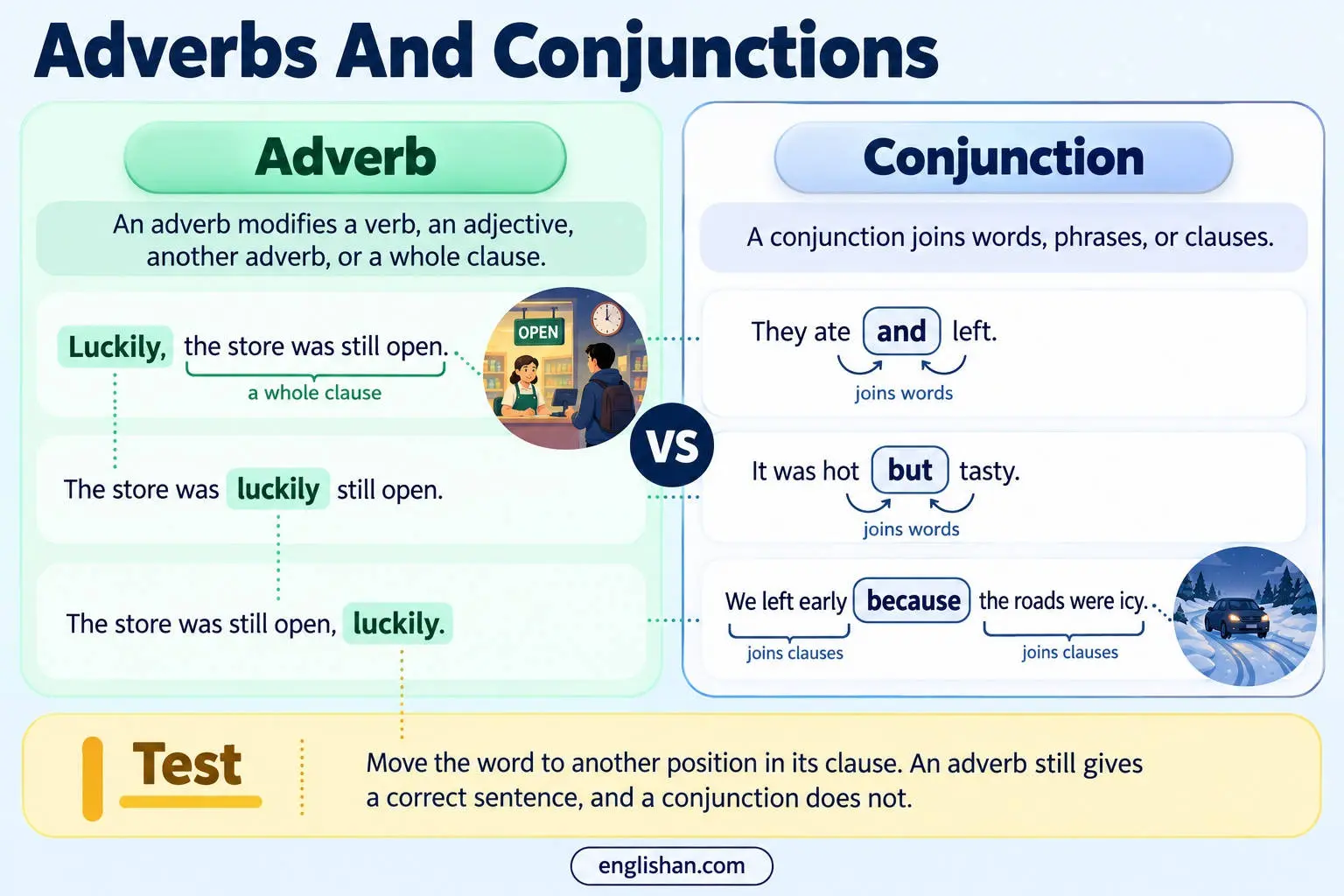
Adverbs and conjunctions are two different parts of speech: an adverb modifies a verb, an adjective, another adverb, or a whole clause, and a conjunction joins words, phrases, or clauses. A conjunction has a fixed position between the parts it joins, while an adverb can usually move to another position in its clause.
The two classes meet in linking words. A conjunctive adverb such as “however” or “therefore” links two ideas in the way “but” and “so” do, yet it is still an adverb, so it takes different punctuation from a conjunction. A few common words, including “so”, “yet”, and “since”, belong to both classes, and their job in the sentence shows the class.
Adverbs and conjunctions are separate word classes. A conjunction such as “and”, “but”, or “because” joins words or clauses and stays between them. An adverb such as “quickly”, “often”, or “however” modifies a word or a clause and can usually move. That is why “however” takes a semicolon or a full stop before it, while “but” takes only a comma.
What Are Adverbs And Conjunctions?
An adverb is a word that modifies a verb, an adjective, another adverb, or a whole clause. Most adverbs tell us how, when, where, how often, or how much something happens. A conjunction is a word that joins two words, two phrases, or two clauses and shows how they relate.
- Our guests ate quickly. (adverb)
- They ate and left. (conjunction)
- The soup was very hot. (adverb)
- It was hot but tasty. (conjunction)
There are three main types of conjunctions: coordinating, subordinating, and correlative. A coordinating conjunction such as “and”, “but”, or “so” joins two parts of equal rank. A subordinating conjunction such as “because”, “although”, or “when” joins a dependent clause to a main clause. A correlative conjunction comes in a pair, as in “both… and” and “either… or”.
A conjunctive adverb is an adverb that links its clause to an idea in the clause or sentence before it, as “however”, “therefore”, and “meanwhile” do. It is also called a linking adverb. A conjunctive adverb shows the same relations as a conjunction, such as contrast and result, but it does not join the two clauses into one grammatical sentence.
Adverbs Vs Conjunctions
Adverbs and conjunctions can both show how two ideas relate in time, contrast, or result. The difference is in the job: a conjunction joins two parts of a sentence, and an adverb modifies one part. Position follows from that job, because a conjunction stays between the parts it joins, while an adverb can usually move inside its clause.
- Luckily, the store was still open.
- The store was luckily still open.
- The store was still open, luckily.
Conjunctions do not move in this way: “The store was open, but the café was closed” is correct, while “The store was open, the café was closed but” is not English. A subordinating conjunction can move to the start of the sentence, but only together with its whole clause, and it always stays at the front of that clause.
- We left early because the roads were icy.
- Because the roads were icy, we left early.
| Property | Adverb | Conjunction |
|---|---|---|
| Job | Modifies a verb, an adjective, an adverb, or a clause | Joins words, phrases, or clauses |
| Position | Can usually move in its clause | Stays between the parts or at the front of its clause |
| Joins two independent clauses | No | Yes (coordinating) |
| After “and” or “but” | Possible (“and then”, “but still”) | Not possible (“and but”) |
| Examples | Quickly, often, then, however, therefore | And, but, or, because, although |
Where a linking word is unclear, move it to another position in its clause. An adverb still gives a correct sentence after the move, and a conjunction does not.
A common error treats “also” as a conjunction between two clauses. The word “also” is an adverb, so the clauses take “and” or a full stop.
She speaks French, also she speaks German. ❌
She speaks French, and she also speaks German. ✅
An adverb cannot join two independent clauses, so a conjunction joins them or a full stop separates them.
Coordinating Conjunctions Vs Conjunctive Adverbs
Coordinating conjunctions and conjunctive adverbs show the same relations between two ideas: “but” and “however” both show contrast, and “so” and “therefore” both show a result. The difference is grammatical. A coordinating conjunction joins two independent clauses into one sentence, and a conjunctive adverb links the ideas but cannot join the clauses by itself. An independent clause is a clause that can stand alone as a sentence.
The punctuation follows from that difference. A coordinating conjunction between two independent clauses takes a comma before it. A conjunctive adverb at the start of the second clause takes a semicolon or a full stop before it and usually a comma after it.
- I was tired, but I went to the gym.
- I was tired; however, I went to the gym.
- She was tired. However, she went to the gym.
- The rent went up, so we moved.
- The rent went up. We therefore moved.
As an adverb, “however” can also come in the middle or at the end of its clause. Commas then separate it from the rest of the clause: “I went to the gym, however.” A coordinating conjunction has no such freedom, and “but” cannot end the clause it introduces.
A common error with conjunctive adverbs is the comma splice: two independent clauses joined only by a comma, with a conjunctive adverb treated as if it were “but”. The error copies the punctuation of “but” because the two words share a meaning.
I was tired, however I went to the gym. ❌
I was tired; however, I went to the gym. ✅
A comma cannot join two independent clauses, so a semicolon or a full stop comes before “however”.
Another error puts the conjunction and the conjunctive adverb together, so the contrast is shown twice.
The tickets were expensive, but however we bought them. ❌
The tickets were expensive, but we bought them. ✅
Each relation takes one linking word, so the sentence keeps either “but” or “however” with its own punctuation. The full list of conjunctive adverbs, with their meanings and positions, has its own lesson.
Conjunctive Adverbs Vs Subordinating Conjunctions
Conjunctive adverbs and subordinating conjunctions can both open a clause and show contrast, cause, or time. A subordinating conjunction turns its clause into a dependent clause, which cannot stand alone as a sentence. A conjunctive adverb leaves its clause independent, so the clause is still a full sentence.
- Although the train was late, we made the meeting.
- The train was late. However, we made the meeting.
- We stayed inside because it was raining.
- It was raining. We therefore stayed inside.
- After the guests left, we washed the dishes.
- The guests left. Afterwards, we washed the dishes.
The punctuation rule for subordinating conjunctions depends on the order of the clauses. When the dependent clause comes before the main clause, a comma follows it. When the main clause comes before, there is usually no comma. A clause that begins with a subordinating conjunction functions as an adverb in the sentence, so it is called an adverb clause.
A dependent clause written as a full sentence is a fragment, and “although” with a full stop after its clause is a common case.
Although the train was late. We made the meeting. ❌
Although the train was late, we made the meeting. ✅
A clause that starts with “although” is a dependent clause, so a comma joins it to the main clause.
The pair “although… but” in one sentence is a second error. Chinese and several other languages pair “although” with “but” in one sentence, and the English sentence takes only one of them.
Although the hotel was small, but the rooms were clean. ❌
Although the hotel was small, the rooms were clean. ✅
A subordinating conjunction already joins the two clauses, so “but” has no clause left to join.
Adverbs As Conjunctions
Some words belong to both classes, and the class depends on the word’s job in the sentence. A word that joins two clauses is a conjunction, and the same word modifying a verb, an adjective, or a clause on its own is an adverb.
So: The conjunction “so” joins a result clause to its cause. The adverb “so” is an adverb of degree that comes before an adjective or an adverb, as in “so cold” and “so quickly”.
- It started to rain, so we went inside. (conjunction)
- The room was so cold that nobody took off their coat. (adverb)
Yet: Between two contrasting clauses, “yet” is a conjunction that means ‘but’. Usually at the end of a negative sentence or a question, it is an adverb of time that means ‘up to now’.
- The plan was cheap, yet it worked. (conjunction)
- The results haven’t arrived yet. (adverb)
Once: The conjunction “once” means ‘as soon as’ and introduces a dependent clause. With no clause after it, “once” is an adverb that means ‘one time’ or ‘at some time in the past’.
- Once you finish the report, send it to me. (conjunction)
- I have visited Lisbon only once. (adverb)
Since: A clause of time or of reason can begin with the conjunction “since”. The adverb “since” usually comes at the end of a clause, often after “ever”, and means ‘from then until now’.
- I have lived here since I was ten. (conjunction)
- They met at college and have been friends ever since. (adverb)
Before and after: Both words are conjunctions when a clause of time follows them, and adverbs when no clause or noun follows them. Before a noun, as in “before lunch”, the same words are prepositions.
- Call me before you leave. (conjunction)
- I have seen this film before. (adverb)
- The rain stopped soon after. (adverb)
Then and still: These two words are adverbs only, even though they link ideas like a conjunction. In speech and quick messages, “then” often follows a comma between two clauses, but formal writing takes “and then” or a full stop.
I finished the report, then I went home. ❌
I finished the report, and then I went home. ✅
The room was cold, still we stayed. ❌
The room was cold, but we still stayed. ✅
An adverb after a comma cannot join two independent clauses, so “and” or “but” comes before it.
Examples Of Adverbs And Conjunctions
Most sentences contain both adverbs and conjunctions, and each word keeps its own job. The conjunction joins two parts of the sentence, while the adverb modifies one word or one clause.
- The kids were tired, so they went to bed early. (conjunction, adverb)
- Although the hotel was quite small, the rooms were clean. (conjunction, adverb)
- I rarely cook because my shifts end at nine. (adverb, conjunction)
- When the parcel arrives, open it carefully. (conjunction, adverb)
- Our flight was delayed. Then the hotel lost our booking. (adverb)
- Sam revised every evening; however, the exam was really difficult. (adverb, adverb)
- Do you want tea or coffee? (conjunction)
The sentences with “then” and “however” contain no conjunction, because both linking words are adverbs and a full stop or a semicolon separates the clauses.
Adverbs And Conjunctions List
The adverbs and conjunctions list starts with the common conjunctions by type. The words “so”, “yet”, “once”, “since”, “before”, and “after” appear in it as conjunctions, though they also function as adverbs.
| Type | Conjunctions |
|---|---|
| Coordinating | For, and, nor, but, or, yet, so |
| Subordinating: time | After, as, before, once, since, until, when, whenever, while |
| Subordinating: reason | Because, as, since |
| Subordinating: contrast | Although, though, even though, whereas, while |
| Subordinating: condition | If, unless, provided that, in case |
| Subordinating: purpose | So that, in order that |
| Subordinating: place | Where, wherever |
| Correlative | Both… and, either… or, neither… nor, not only… but also |
Conjunctive adverbs come in a separate list, because they take a semicolon or a full stop before them when they link two independent clauses. The last column gives the coordinating conjunction with the nearest meaning, which takes only a comma.
| Relation | Conjunctive adverbs | Nearest conjunction |
|---|---|---|
| Addition | Also, besides, furthermore, moreover | And |
| Contrast | However, nevertheless, nonetheless, still | But, yet |
| Result | Therefore, consequently, thus, hence, accordingly | So |
| Alternative | Otherwise, instead | Or |
| Time | Then, meanwhile, afterwards, finally, subsequently | And |
| Comparison | Likewise, similarly | None |
| Emphasis | Indeed | None |
FAQs
Conjunctive adverbs are adverbs because they modify the whole clause they belong to and can move inside it, as "however" can open, interrupt, or end its clause. Unlike a conjunction, a conjunctive adverb cannot join two independent clauses by itself.
An adverbial conjunction is another name for a conjunctive adverb, a word such as "however", "therefore", or "meanwhile" that links its clause to an earlier idea. Despite the name, it is an adverb, so it takes a semicolon or a full stop before it when it links two independent clauses.
Yes, a few adverbs of degree and focus modify subordinating conjunctions, as in "just before", "long after", "right after", and "only if". The adverb narrows the time or the condition: "She arrived just before the meeting started."
The word "however" is usually an adverb, either a conjunctive adverb that shows contrast or an adverb of degree before an adjective or an adverb, as in "however hard I try". It is a conjunction only when it means ‘in whatever way’ and introduces a clause, as in "Decorate the room however you like."
No, an adverb clause begins with a subordinating conjunction such as "because", "when", "although", or "if". A coordinating conjunction like "and" or "but" joins two clauses of equal rank, so the clause after it is a main clause, not an adverb clause.
Related:
