

Most adverbs are formed by adding -ly to an adjective. The adverbs that start with K, such as kindly and keenly, express manner; knowingly and knowledgeably express awareness, and kinetically expresses movement. Kindly alone has four uses, as a manner adverb, a request softener, an adjective and a cold refusal, and knee-deep and knee-high are the two with no -ly ending.
Choose the first letter:
A · B · C · D · I · K · L · M · N · R · S · T · V
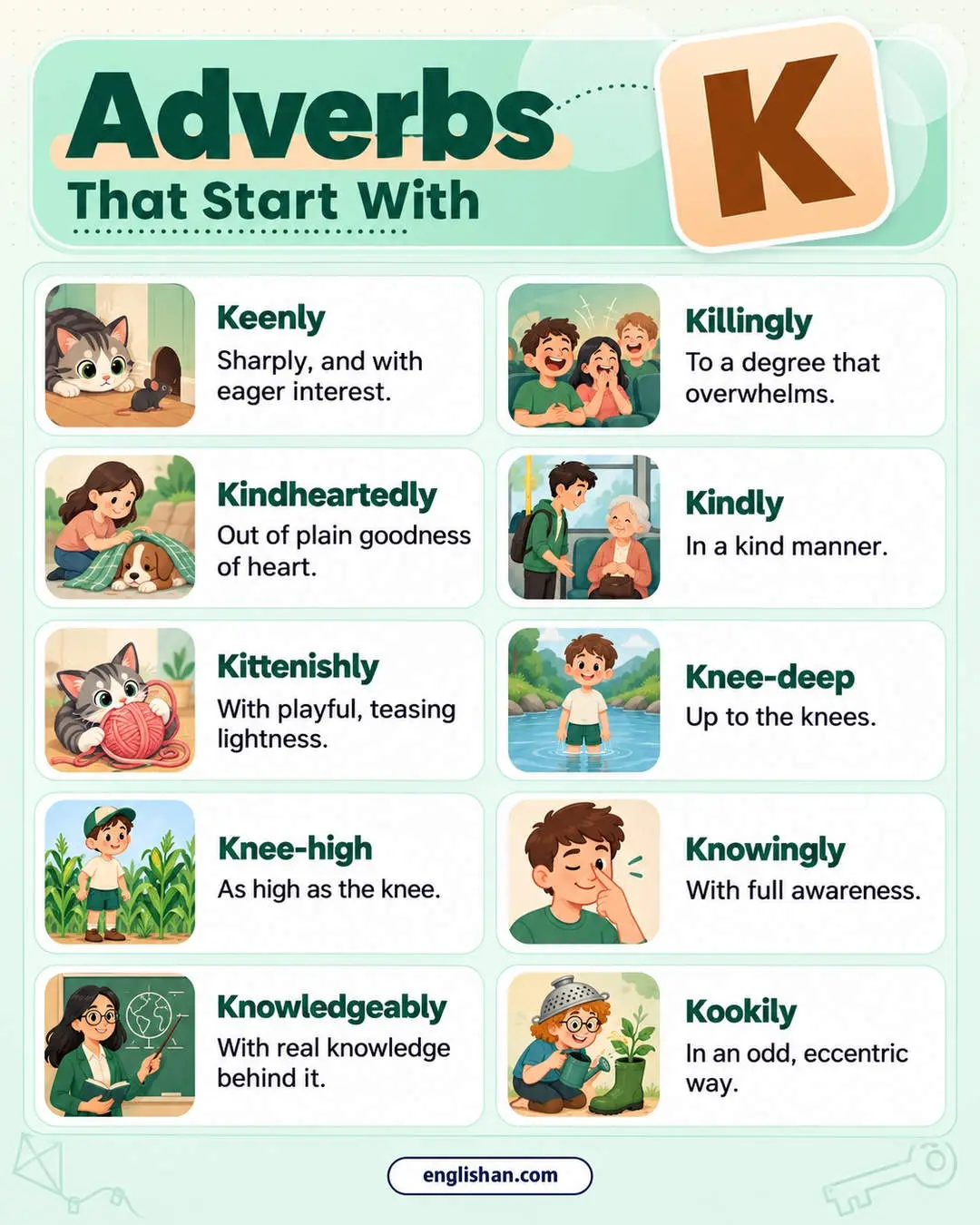
Adverbs That Start With K
The adverbs that start with K run alphabetically from kaleidoscopically to kookily, and sixteen words make up the whole letter. The meaning sits beside the word and a sentence shows where the adverb belongs. A pair of them, knee-deep and knee-high, take no -ly ending at all.
| Adverb | Meaning | In a sentence |
|---|---|---|
| Kaleidoscopically | In shifting colour. | The window throws light kaleidoscopically onto the floor. |
| Karmically | By a return of what was given out. | The arrangement worked out karmically for both of them. |
| Keenly | Sharply, and with eager interest. | The shortage was felt keenly in March. |
| Killingly | To a degree that overwhelms. | The second act is killingly funny. |
| Kinaesthetically | Through the sense of movement in the body. | Children learn the step kinaesthetically. |
| Kindheartedly | Out of plain goodness of heart. | The rent was waived kindheartedly. |
| Kindly | In a kind manner. | She spoke kindly to the frightened child. |
| Kinetically | By movement or in relation to it. | The sculpture works kinetically in the wind. |
| Kinkily | Twisted, or bent out of line. | The cable had been run kinkily behind the panel. |
| Kittenishly | With playful, teasing lightness. | She answered the question kittenishly. |
| Knavishly | With low, dishonest cunning. | The will was contested knavishly. |
| Knee-deep | Up to the knees. | The crew stood knee-deep in the floodwater. |
| Knee-high | As high as the knee. | The nettles had grown knee-high by June. |
| Knowingly | With full awareness of what is being done. | The false figure was entered knowingly. |
| Knowledgeably | With real knowledge behind it. | He discussed the roof timbers knowledgeably. |
| Kookily | In an odd, eccentric way. | The shopfront was painted kookily. |
Adverbs of Manner That Start With K
Almost the whole letter answers the question how, which leaves manner as the one large class among the adverbs that start with K. The standard position is after the verb, or after the object where there is one. Front position is available for stress.
- She spoke kindly to the frightened child.
- He discussed the roof timbers knowledgeably.
- Keenly, the shortage was felt all through March.
- The false figure was entered knowingly.
- The will was contested knavishly.
The position to rule out is between the verb and its object, where the adverb separates a pair that belongs together.
- She spoke kindly the words of comfort ❌
- She spoke the words of comfort kindly ✅
All sixteen take those two positions, described under adverbs of manner and across the types of adverbs.
How to Use Kindly as an Adverb
Kindly has four distinct uses, and they are not interchangeable. It reports a manner, softens an order, reads as an adjective in front of a noun, and turns cold when a request is refused with it.
| Use | How it reads | Sample |
|---|---|---|
| Manner adverb | Reports how something was done | She spoke kindly to the child. |
| Request softener | Makes an order sound formal | Kindly close the gate behind you. |
| Adjective | Sits in front of a noun | A kindly neighbour took the parcel in. |
| Cold refusal | Turns the formality against the reader | Kindly do not ask again. |
- She spoke kindly to the child.
- Kindly close the gate behind you.
- A kindly neighbour took the parcel in.
- Kindly do not ask again.
- He took the news kindly enough.
The softener and the refusal share identical wording, so only what follows separates them. Kindly in front of a polite instruction reads as courtesy, and in front of a prohibition it reads as a rebuke.
- Kindly do not ask again, and thank you for your kind help ❌
- Please do not ask again, and thank you for your help ✅
Adverbs That Start With K Without LY
A pair of the adverbs that start with K take no ending, and both measure height against the body. Knee-deep reports how far something comes up a person standing in it, and knee-high reports how tall a thing has grown.
- The crew stood knee-deep in the floodwater.
- Nettles had grown knee-high by June.
- He waded knee-deep through the reeds.
- The wheat stood knee-high at the end of May.
- The cellar filled knee-deep within the hour.
The two are not interchangeable, since a person stands knee-deep in water and a plant grows knee-high beside it.
- The crew stood knee-high in the floodwater ❌
- The crew stood knee-deep in the floodwater ✅
Why the Letter K Has So Few Adverbs
An -ly adverb needs an adjective underneath it, and English holds almost no adjectives beginning with K. The reason is the small number of K adjectives, since an -ly adverb needs one behind it. The letter offers keen, kind, knowing and few beside the hard k sound and handed it cold, clean and calm.
Most K words in English are nouns and verbs rather than adjectives, which is where the shortage star more readily than adjectives. Keen is the one old K adjective still in common use, which is why keenly is the one adverb on the letter a reader meets without noticing it.
- The shortage was felt keenly in March.
- She spoke kindly to the child.
- The figure was entered knowingly.
- He talked about the timbers knowledgeably.
- The sculpture works kinetically in the wind.
A writer who wants a K word for a quality is nearly always better served by the adjective, since a keen interest reads where keenly interested strains.
Positive and Negative Adverbs That Start With K
Tone divides the letter unevenly, and the adverbs that start with K lean towards warmth. Kindly, kindheartedly and knowledgeably express approval, while only knavishly and knowingly turn against the person described.
| Tone | Words | What they report |
|---|---|---|
| Positive | Kindly, kindheartedly, knowledgeably, keenly | Warmth, generosity, real command of a field |
| Negative | Knavishly, knowingly, kinkily | Dishonesty, deliberate wrongdoing, something out of true |
| Neutral | Kinetically, kinaesthetically, knee-deep, knee-high | Movement, bodily sense, measured height |
| Playful | Kittenishly, kookily, kaleidoscopically, killingly | Teasing, eccentricity, shifting colour, overwhelming effect |
Knowingly is the one that shifts with the sentence, since a glance given knowingly is shared amusement and a false figure entered knowingly is fraud.
- She glanced knowingly, and the auditors charged her ❌
- She glanced knowingly, and the pair shared the joke ✅
The adverbs that start with K make a whole letter of sixteen, and kindly holds four of the jobs on its own. A writer reaching for this letter is better served by the adjective underneath the word.
Related:
- Adverbs Ending in LY
- Adverbs That Do Not End in LY
- Adverb Examples
- Adverbs of Time
- Adverbs of Frequency
- Adverbs of Place
- Adverbs of Degree
- Types of Adverbs
- Relative Adverbs
- Adverbs of Reason
FAQs
Sixteen qualify in standard English, and all sixteen adverbs that start with K are on this page with a meaning and a sentence. The letter is complete rather than sampled, which is unusual for a word list of this kind.
An -ly adverb needs an adjective behind it, and very few English adjectives begin with K. The letter offers keen, kind, knowing, knowledgeable and a short run beside them, which is the whole base the ending has to work from.
Kindly is the most common of the adverbs that start with K, followed by keenly and knowingly. Those three account for almost all ordinary use, and the remaining thirteen turn up rarely enough that a reader notices them.
Kindly, kindheartedly, knowledgeably and keenly express approval, and all four belong in a reference.
At the front of a sentence kindly turns an order into a formal request, as in kindly close the gate. In front of a prohibition the same word reads as a rebuke, so kindly do not ask again is colder than the plain refusal it replaces.
A manner adverb such as kindly or knowingly goes after the verb, or after the object where there is one. Knee-deep and knee-high follow the verb they measure, as in stood knee-deep, and never sit in front of a noun.