

A prepositional adverb is a word that has the form of a preposition but takes no object and functions as an adverb. Short words such as “up”, “down”, “in”, “out”, “on”, and “off” are prepositions when a noun or pronoun follows them as their object, and they are prepositional adverbs when they stand alone and modify the verb.
Prepositional adverbs, also called adverbial particles, are the second word of most phrasal verbs, as in “give up” and “turn off”. The spelling is the same in both cases, so the part of speech depends on whether the word has an object of its own.
Prepositional adverbs are words like “up”, “down”, “in”, “out”, “off”, and “over” used without an object, as in “She sat down” and “Come in“. The same words are prepositions when a noun or pronoun follows them, as in “She ran down the stairs”. With a pronoun object, the prepositional adverb comes after the pronoun: “Put it on.”
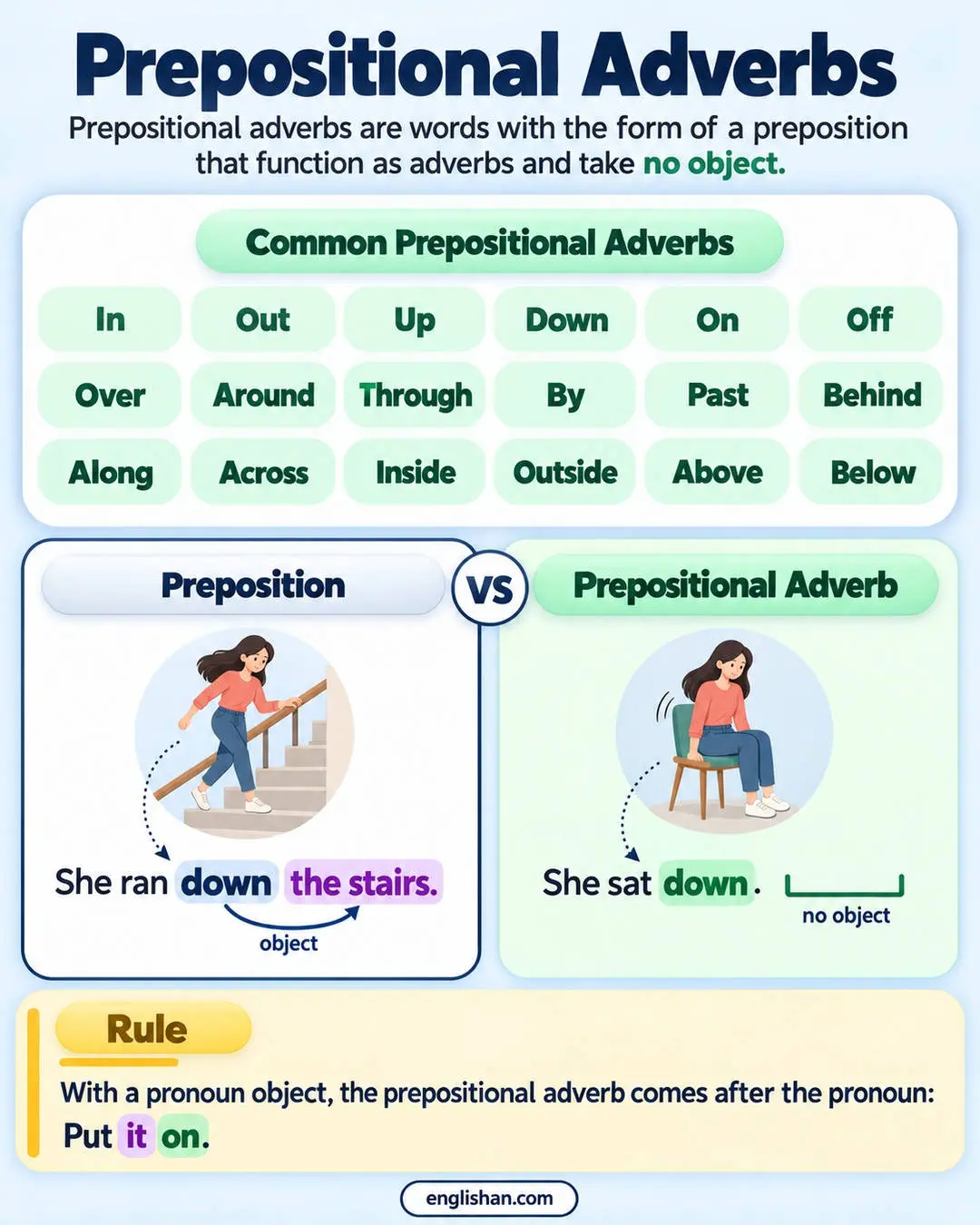
What Is A Prepositional Adverb?
A prepositional adverb is an adverb that looks like a preposition but has no noun or pronoun after it as its object. The common ones are “in”, “out”, “up”, “down”, “on”, “off”, “over”, “around”, “through”, “by”, “past”, “behind”, “along”, “across”, “inside”, “outside”, “above”, and “below”. Most of them tell us where something happens or in which direction it moves, so many prepositional adverbs are also adverbs of place. Those that show the direction of a movement, as “across” and “through” do, belong to the adverbs of movement as well.
- The children ran outside after lunch.
- Please come in and close the door.
- A helicopter flew over while we were eating.
- Rents have gone up again this year.
- We walked past without stopping.
- The cat wouldn’t come down from the roof.
In each sentence the prepositional adverb answers the question “where?” or “which way?” about the verb, and nothing in the sentence is its object. The phrase “from the roof” in the last example is a separate prepositional phrase with its own preposition, “from”, so “down” still has no object.
A prepositional adverb is a single word. The prepositional phrase “down the stairs” is a group of words, a preposition plus its object, and that phrase can act as an adverb too, but it is not a prepositional adverb.
Prepositions As Adverbs
Many prepositions can be adverbs. The word is a preposition when a noun or pronoun follows it as its object, and the same word is a prepositional adverb when it has no object and modifies the verb directly. The pairs show one word as a preposition and then as a prepositional adverb:
- She ran down the stairs. (preposition)
- She sat down. (prepositional adverb)
- The keys are in my bag. (preposition)
- Do you want to come in? (prepositional adverb)
- We walked across the bridge. (preposition)
- The bridge was closed, so we swam across. (prepositional adverb)
- Tom hid behind the sofa. (preposition)
- The others ran ahead, and Tom stayed behind. (prepositional adverb)
The hard case is a noun that comes after the word but is not its object. In “Turn down the music”, the word “down” is followed by a noun, yet “the music” is the object of the verb “turn”, so “down” is still a prepositional adverb. A prepositional adverb lets the noun move in front of it, as in “Turn the music down“, while a preposition keeps its object after it, so “She ran the stairs down” is not possible.
Where the part of speech is unclear, move the noun in front of the word: if the sentence still reads correctly, the word is a prepositional adverb.
Examples Of Prepositional Adverbs
The first meaning of most prepositional adverbs is place or direction, and many of them have a second meaning that has nothing to do with place. That second meaning is often about completion, continuation, or a change of state, as in “The milk ran out” or “Keep on walking”.
| Prepositional adverb | Place or direction | Other common meaning |
|---|---|---|
| In | Into a room, building, or space | At home, arriving |
| Out | From inside to outside | Gone, finished, or no longer burning |
| Up | Higher | Completely, or more and louder |
| Down | Lower | Less, quieter, or written on paper |
| On | Onto a surface | Continuing, or wearing |
| Off | Away from a place or surface | Not working, disconnected, or leaving |
| Over | Above, or across to another side | Finished, or to someone’s home |
| Around | In a circle, here and there | Nearby |
| Through | From one side to the other | From start to finish |
| By | Near, or going past | Visiting briefly |
| Past | Going beyond | No other common meaning |
| Behind | At the back | Staying after others leave |
| Along | Forward | With someone |
| Across | From one side to the other | Understood by others |
| Inside, outside | In or out of a building | No other common meaning |
| Above, below | Higher or lower | Earlier or later in a text |
With the second meanings, the sentence no longer describes a place or a movement:
- The candle went out when the window opened.
- Drink up before the taxi arrives.
- Keep on until you reach the station.
- Read the contract through before you sign it.
- Our neighbors came over for dinner on Friday.
- Did your point come across in the meeting?
- The full list of times is printed below.
Prepositional Adverbs In Phrasal Verbs
A phrasal verb is a verb followed by a prepositional adverb, and the two words together have one meaning. The meaning is often different from the meanings of the two words alone: “give up” means ‘stop trying’, “find out” means ‘discover’, and “turn up” can mean ‘arrive’.
- The car broke down on the way to the airport.
- She grew up in a small town near the coast.
- We set off before sunrise.
- I’ll find out the train times tonight.
- Don’t give up now.
Some phrasal verbs take no object, as in “The car broke down” and “We set off”. Others take an object, as in “find out the train times”, and with these the position of the prepositional adverb changes with the kind of object.
A verb can also be followed by a preposition that keeps its object, as in “look after the children” or “depend on the weather”. A verb plus a preposition of this kind is a prepositional verb, and the word after the verb is a preposition, not a prepositional adverb. The same word can belong to both: “get off” is a phrasal verb in “The bus stopped and we got off” and a verb plus a preposition in “We got off the bus”.
Position Of Prepositional Adverbs
A prepositional adverb with no object comes directly after the verb, usually at the end of the clause: “The plane took off” and “Please sit down”. When the verb has an object, the position of the prepositional adverb depends on whether that object is a noun or a pronoun.
Noun object: The prepositional adverb can come before or after a short noun object, and the meaning stays the same.
- Put on your coat.
- Put your coat on.
- Can you switch off the lights?
- Can you switch the lights off?
Long object: A long noun phrase usually comes after the prepositional adverb, so “Put on the coat you bought in Lisbon” is more natural than “Put the coat you bought in Lisbon on”.
Pronoun object: A pronoun such as “it”, “them”, “her”, or “me” has only one position, between the verb and the prepositional adverb.
Put on it. ❌
Put it on. ✅
With a pronoun object, “put on” splits around the pronoun.
I’ll pick up you at six. ❌
I’ll pick you up at six. ✅
The verb “pick up” splits around “you” in the same way, because “up” has no object of its own.
Preposition, not adverb: The pronoun rule is true only for prepositional adverbs. After a preposition, the pronoun follows the preposition like any other object, so “turn off the light” becomes “turn it off“, while “get off the bus” becomes “get off it”. In speech, the prepositional adverb is usually stressed (“turn it OFF”), but a short preposition is usually unstressed (“look at it”).
At the front: In stories and lively speech, a prepositional adverb can come at the start of the clause for effect. With a noun subject the verb then comes before the subject, as in “Down came the rain”, but with a pronoun subject the order stays normal, as in “Off we went”.
FAQs
No, adverbs and prepositions are different parts of speech, but a small number of words belong to both. The words "down", "in", "over", and "behind" are prepositions when they have an object and adverbs when they do not. Most adverbs, such as "quickly", "often", and "very", are never prepositions.
A prepositional adverb is an adverb, because it modifies a verb. Some of the same words can function as adjectives before a noun, as in "the inside pages" or "the down escalator", and there they describe the noun instead. After "be", as in "The meeting is over" or "The lights are off", the word describes the state of the subject and functions like an adjective.
Yes, and it often does, because a prepositional adverb has no object to follow it. Sentences such as "Come in", "The plane took off", and "Turn it down" all end correctly on the prepositional adverb. A sentence can also end on a preposition whose object comes earlier, as in "Who are you waiting for?", and that is standard English too.
No, a preposition such as "of", "from", "at", "for", "into", or "during" always takes an object and is never used as an adverb. The words "away" and "back" are the opposite case: they appear in phrasal verbs such as "go away" and "come back" but are not used as prepositions.
Related:
- Types of Adverbs
- Adverb Phrases
- Adverbial Prepositional Phrases
- Separable and Inseparable Phrasal Verbs
- Adverb vs Preposition
- Dangling Prepositions
