

An adverb states how or when an action happens, or denies it. The adverbs that start with N split between how and whether: neatly, nicely and naturally give manner, now, next and never give time, and no, not, nowhere, neither and nor reject a clause outright. Nevertheless, nonetheless and notwithstanding link a sentence to what came before, and all three are defined with a sentence.
Choose the first letter:
A · B · C · D · I · K · L · M · N · R · S · T · V
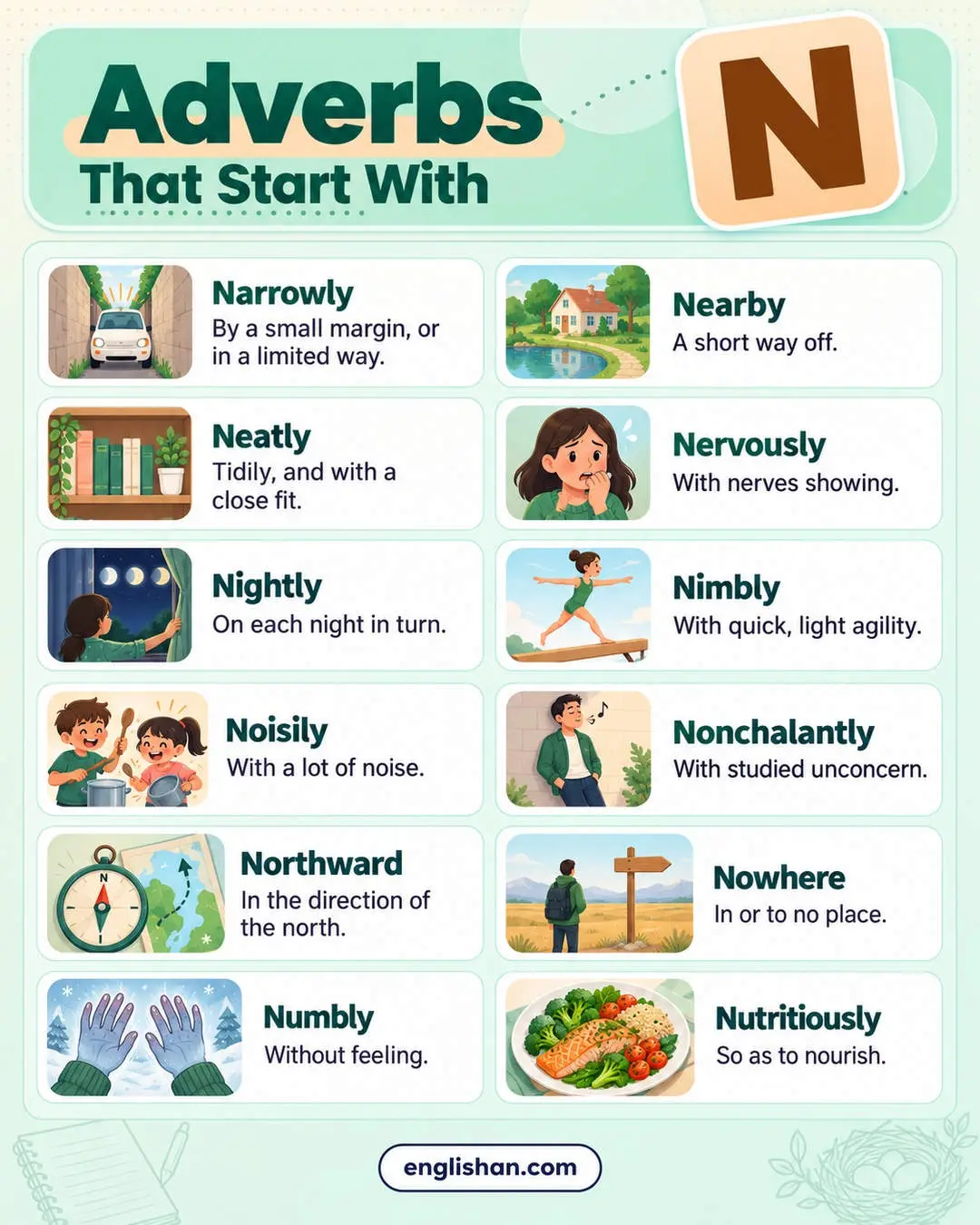
Adverbs That Start With N
The adverbs that start with N run alphabetically from naively to nutritionally, with the meaning beside the word and a sentence showing where the adverb belongs. The letter splits into two parts so that near-neighbours stay close enough to weigh against one another.
Adverbs That Start With Na to Ne
| Adverb | Meaning | In a sentence |
|---|---|---|
| Naively | With inexperience showing. | The clause was accepted naively. |
| Nakedly | Openly, with nothing covered. | The motive shows nakedly in the second letter. |
| Namely | That is to say, introducing the detail. | One clause was struck out, namely the right of way. |
| Narrowly | By a small margin, or in a limited way. | The motion passed narrowly. |
| Nasally | Through the nose. | He pronounced the vowel nasally. |
| Nationalistically | By strong feeling for one’s own nation. | The anniversary was marked nationalistically. |
| Nationally | Across the whole country. | The scheme was rolled out nationally. |
| Naturalistically | In a way true to nature. | The figures are carved naturalistically. |
| Naturally | By nature, or without effort. | The spring runs naturally into the pond. |
| Nautically | In relation to ships and sailing. | The chart is marked nautically in fathoms. |
| Nay | Indeed, and more than that. | The repair was costly, nay ruinous. |
| Nebulously | Vaguely, with no firm outline. | The boundary is described nebulously. |
| Necessarily | As a matter of necessity. | A wet spring does not necessarily ruin the crop. |
| Needfully | As the need requires. | The ration was divided needfully. |
| Needlessly | Without any need for it. | The wall was rebuilt needlessly. |
| Negatively | In a way that denies or harms. | The works affected the spring negatively. |
| Negligently | With a duty of care left undone. | The boiler was serviced negligently. |
| Nervelessly | Without strength or feeling in the grip. | The rope slid nervelessly through his hands. |
| Neurologically | In relation to the nervous system. | The two cases differ neurologically. |
| Neurotically | With anxious obsession. | The hours were logged neurotically. |
| Neutrally | Without taking a side. | The findings were reported neutrally. |
| Nevermore | Never again. | The forge stood silent nevermore to be lit. |
Adverbs That Start With Ni to Nu
| Adverb | Meaning | In a sentence |
|---|---|---|
| Niftily | Smartly and with quick skill. | The gasket was swapped niftily. |
| Nihilistically | With rejection of all value. | The final chapter reads nihilistically. |
| Nippily | Briskly, or with a cold bite. | The wind came nippily off the water. |
| Nocturnally | By night. | The badgers work the bank nocturnally. |
| Noiselessly | Making no sound. | The barn owl crossed the yard noiselessly. |
| Nominally | In name rather than in fact. | He is nominally the freeholder. |
| Nonsensically | In a way that makes no sense. | The schedule was drawn nonsensically. |
| Nonverbally | Without words. | The agreement was reached nonverbally. |
| Normatively | By what the standard prescribes. | The guidance is written normatively. |
| Northerly | Towards or from the north. | The breeze held northerly all afternoon. |
| Nostalgically | With fondness for the past. | He described the old forge nostalgically. |
| Notionally | In theory rather than in practice. | The plot is notionally two acres. |
| Notoriously | With a bad reputation attached. | The lane floods notoriously in October. |
| Numerically | By number rather than by weight or value. | The two batches are numerically equal. |
| Nutritionally | In relation to nutrition. | The two varieties differ nutritionally. |
Adverbs of Negation That Start With N
The negative words of English all begin with the same letter, and the adverbs that start with N hold all of them. No goes in front of a comparative, not denies a verb, neither and nor chain two denials together, and nothing turns a comparison into a flat denial.
| Adverb | Meaning | In a sentence |
|---|---|---|
| Neither | Not either of two. | Neither gate was locked. |
| No | Not at all, in front of a comparative. | The second batch is no better. |
| Nor | And not, after a negative. | The deeds were not registered, nor was the plan lodged. |
| Not | Expressing refusal or denial. | The flue was not lined. |
| Nothing | In no way, as an intensifier. | The copy is nothing like the original. |
Doubling two of these produces the error the group is known for, since not and nothing in one clause cancel each other and leave the opposite of what was meant.
- The flue was not lined with nothing ❌
- The flue was not lined at all ✅
Positive Adverbs That Start With N
Approval sits in the positive adverbs that start with N, and the letter runs to finish rather than to warmth. Neatly and nicely report work done well, while nimbly and nobly report how it was done.
| Adverb | Meaning | In a sentence |
|---|---|---|
| Neatly | Tidily, and with a close fit. | The joint was finished neatly. |
| Nicely | Pleasingly, and to a good standard. | The lime render has weathered nicely. |
| Nimbly | With quick, light agility. | He crossed the beam nimbly. |
| Nobly | With high principle, or in grand style. | The gift was made nobly. |
| Notably | To a degree worth marking. | The yield improved notably after the drainage. |
| Noticeably | Enough to be seen or felt. | The damp has dried noticeably. |
| Nutritiously | So as to nourish. | The ward meals were planned nutritiously. |
Notably and noticeably run close without matching, since a yield that improved notably is worth marking and damp that dried noticeably shows to the eye.
Adverbs of Manner That Start With N
The -ly half of N is mostly manner, and manner is the how of an action. The standard position is after the verb, or after the object where there is one. Front position is available for stress.
- The joint was finished neatly.
- He crossed the beam nimbly.
- Naturally, the spring runs into the pond.
- The findings were reported neutrally.
- The barn owl crossed the yard noiselessly.
The position to rule out is between the verb and its object, where the adverb separates a pair that belongs together.
- He finished neatly the joint ❌
- He finished the joint neatly ✅
The -ly half of the letter places the same way, as stated under adverbs of manner and across the types of adverbs.
Negative Adverbs That Start With N
Disapproval runs through the negative adverbs that start with N, and the letter is unusual in keeping tone and negation apart. Nastily and noxiously pass a verdict, while not and never only deny.
| Adverb | Meaning | In a sentence |
|---|---|---|
| Nastily | Spitefully, or unpleasantly. | The letter was worded nastily. |
| Naughtily | With mild, deliberate misbehaviour. | The child answered naughtily. |
| Nauseatingly | So as to turn the stomach. | The corridor smelled nauseatingly of paraffin. |
| Neglectfully | With care withheld. | The archive was kept neglectfully. |
| Niggardly | Meanly, in grudging amounts. | The butter was spread niggardly. |
| Noisily | With a lot of noise. | The bar emptied noisily at midnight. |
| Noisomely | With an offensive smell. | The ditch ran noisomely past the cottages. |
| Noxiously | So as to harm or poison. | The paint burned noxiously in the shed. |
Niggardly means meanly, and the resemblance it carries to an unrelated slur is reason enough to choose meanly instead when putting it in print.
Adverbs That Start With N to Describe a Person
Manner adverbs take the weight when a person heads the sentence, and the adverbs that start with N run to nerves. He answered nervously and he answered nonchalantly report one action and two different people.
| Adverb | Meaning | In a sentence |
|---|---|---|
| Needily | With obvious want of attention. | He telephoned needily twice a day. |
| Nervily | Edgy, and bold with it. | The understudy went on nervily. |
| Nervously | With nerves showing. | He read the statement nervously. |
| Nigglingly | In small persistent complaint. | He queried the total nigglingly. |
| Nonchalantly | With studied unconcern. | She mentioned the overdraft nonchalantly. |
| Nosily | With prying curiosity. | The neighbour asked nosily about the sale. |
| Numbly | Without feeling. | She signed the papers numbly. |
Nervily and nervously pull in opposite directions, since the first reports edgy boldness and the second reports fear.
Adverbs of Time and Frequency That Start With N
Now and never are among the commonest words in English, one a time word and the other a frequency word. A frequency word such as nightly or normally belongs in front of the main verb, while nowadays takes either end of the sentence.
| Adverb | Meaning | In a sentence |
|---|---|---|
| Never | On no occasion. | The deeds were never registered. |
| Newly | Only just, and recently. | The lock was newly rebuilt. |
| Next | Immediately after, in order or in time. | Fit the gasket next. |
| Nightly | On each night in turn. | The gates are locked nightly. |
| Nonstop | Without any break. | The pump ran nonstop for three days. |
| Normally | As a rule, in the usual way. | The weir holds normally until February. |
| Now | At this present moment. | The surveyor is here now. |
| Nowadays | In the present time, as against the past. | The mill grinds for visitors nowadays. |
Newly attaches to a participle and nowhere else, so a lock newly rebuilt reads correctly while a lock newly reads as nothing. Both classes are mapped under adverbs of time and adverbs of frequency.
Adverbs of Place and Direction That Start With N
Place on this letter runs on nearness and on north. A place adverb follows the verb or the object, and it comes after a manner adverb when the two stand together.
| Adverb | Meaning | In a sentence |
|---|---|---|
| Near | At a short distance. | The depot stands near to the sidings. |
| Nearby | A short way off. | A second gate opens nearby. |
| Nigh | Close at hand. | Winter was drawing nigh. |
| North | Towards the north. | The track runs north from the quarry. |
| Northward | In the direction of the north. | The geese moved northward in March. |
| Northwards | Towards the north. | Push the marker northwards on the chart. |
| Nowhere | In or to no place. | The lane leads nowhere beyond the ford. |
Northward and northwards are both correct, with the -s form standard in British writing, as adverbs of place sets out.
Adverbs of Degree That Start With N
Degree is the smallest type on the letter, and nearly is almost the whole of it. Negligibly pulls a statement down to almost nothing, and nowise is a formal survivor that denies the degree outright.
| Adverb | Meaning | In a sentence |
|---|---|---|
| Nearly | Almost, but not quite. | The lintel is nearly two metres long. |
| Negligibly | By an amount too small to count. | The reading shifted negligibly. |
| Nowise | In no way at all. | The tenant was nowise bound by the clause. |
Nearly and narrowly are not the same, since a lintel nearly two metres long falls short of the measure and a motion that passed narrowly cleared it, as adverbs of degree sets out.
Nevertheless Nonetheless and Notwithstanding
A small group of adverbs that start with N joins two statements that pull against each other, and all of them belong to formal writing. They sit at the front of the second statement, or after its first word, and they take a comma.
| Adverb | Meaning | In a sentence |
|---|---|---|
| Nevertheless | In spite of what has just been said. | The render is modern. Nevertheless, the wall beneath it is Tudor. |
| Nonetheless | All the same, despite that. | Costs rose. Nonetheless, the work finished on time. |
| Notwithstanding | In spite of that. | The covenant stands, the sale notwithstanding. |
Nevertheless and nonetheless mean the same thing and differ only in weight, while notwithstanding also follows the noun it governs, which the other two never do.
- Nevertheless the covenant, the sale went through ❌
- The covenant notwithstanding, the sale went through ✅
Commonly Confused Adverbs That Start With N
Pairs among the adverbs that start with N trade places in print, and two of them are among the commonest slips in formal English. The split turns on what the word measures.
| Pair | What separates them |
|---|---|
| Nearly / Narrowly | Nearly falls short; narrowly just clears. |
| Notably / Noticeably | Notably is worth marking; noticeably shows to the eye. |
| Naturally / Normally | Naturally means by nature; normally means as a rule. |
| Nevertheless / Notwithstanding | Nevertheless opens a clause; notwithstanding also follows a noun. |
| Nervily / Nervously | Nervily is edgy boldness; nervously is fear. |
| No / Not | No goes before a comparative; not denies a verb. |
- That lintel is nearly two metres long.
- The motion passed narrowly.
- The yield improved notably after the drainage.
- Damp in the gable has dried noticeably.
- The second batch is no better.
Nearly reports falling short and narrowly reports just clearing, so a measurement takes the first and a vote takes the second.
- The motion passed nearly ❌
- The motion passed narrowly ✅
The adverbs that start with N split two unrelated types across one letter. The -ly half behaves like any other letter, and the short half holds the negative words no, not, never, nowhere, neither and nor.
Related:
- Adverbs Ending in LY
- Adverbs That Do Not End in LY
- Adverb Examples
- Adverbs of Frequency
- Types of Adverbs
- Relative Adverbs
- Adverbs of Reason
- Conjunctive Adverbs
FAQs
About eighty-five qualify in standard English, and 85 adverbs that start with N are gathered here with a meaning and a sentence. The letter runs shorter than S or C because fewer N adjectives take the -ly ending. It makes up the difference because every negative word begins with N.
Not is the most common of the adverbs that start with N followed by now, never, nearly and next. None of the five takes an -ly ending.
Neatly, nicely, nimbly, nobly and notably read as approval, and all five belong in a reference. The letter runs to finish and standard rather than to warmth, so it offers no close equivalent of kindly or warmly.
Nervously, nonchalantly, nosily and needily report how a person acts rather than what they are, so the verb keeps the action and the adverb holds the state behind it. Nervily is the exception, since it reports boldness rather than fear.
Both join two statements that pull against each other, and nevertheless opens the second clause while notwithstanding also follows the noun it governs. A writer says nevertheless, the work finished on time and the covenant notwithstanding, the sale went through.
A manner adverb such as neatly goes after the verb, or after the object where there is one. A frequency word such as nightly goes in front of the main verb, a place word such as nearby follows the verb, and not goes between the auxiliary and the main verb.