

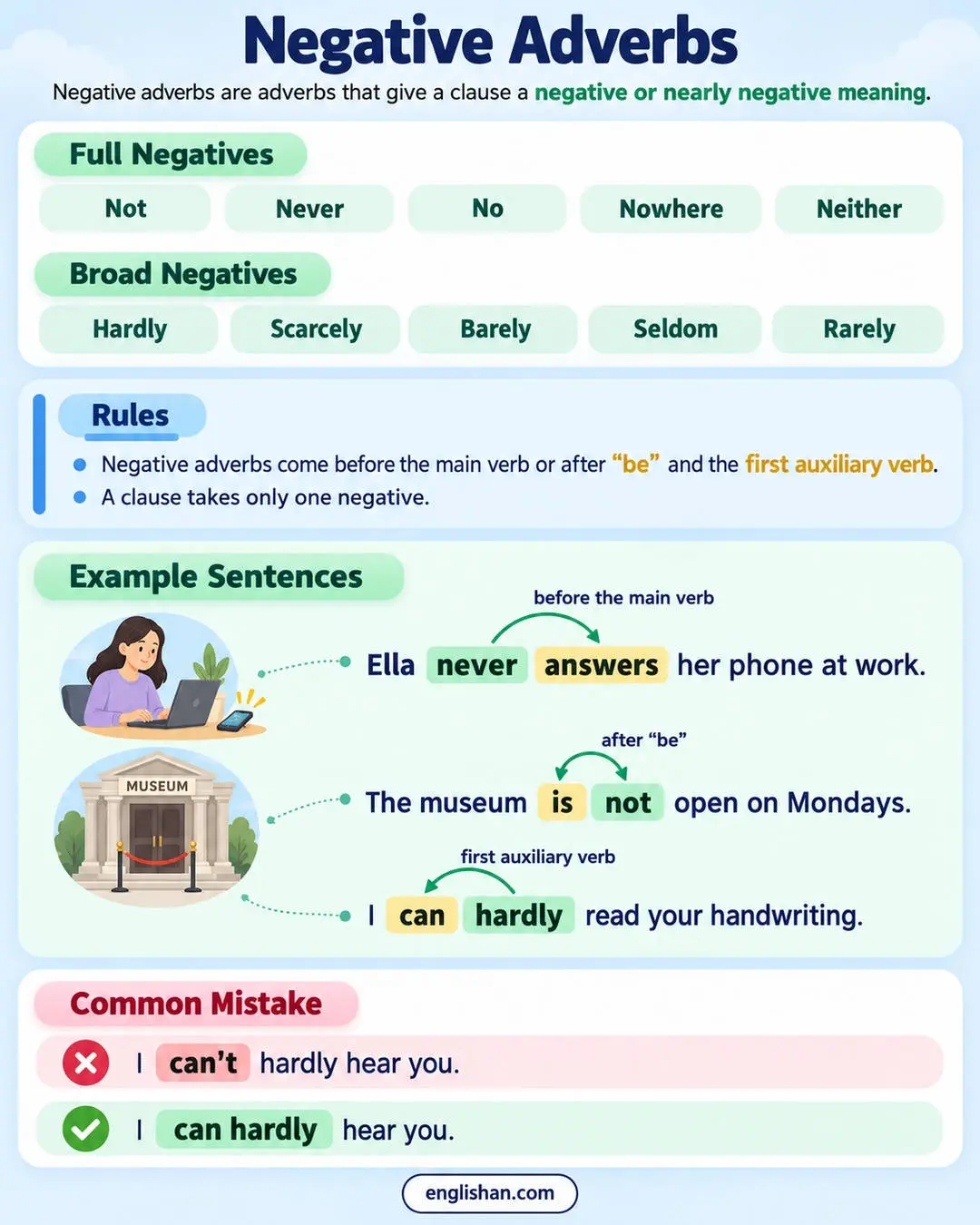
Negative adverbs are adverbs that give a clause a negative meaning, showing that an action does not happen or that a statement is not true. The words “not”, “never”, “no”, “nowhere”, and “neither” are fully negative, while “hardly”, “scarcely”, “barely”, “seldom”, and “rarely” are broad negative adverbs that mean ‘almost not’ or ‘not often’.
Both kinds count as negative words in a sentence, so they share the same rules for word order, inversion, and question tags. A clause in standard English takes only one negative word, and that limit is the reason “I can hardly hear you” is correct while “I can’t hardly hear you” is not.
Negative adverbs are adverbs such as not, never, nowhere, hardly, barely, seldom, and rarely that give a clause a negative meaning. They usually come before the main verb or after “be” and the first auxiliary verb. At the start of a formal sentence they are followed by inversion, as in “Never have I seen such a mess”, and a clause takes only one negative.
What Are Negative Adverbs?
Negative adverbs are the adverbs that negate a verb, an adjective, or another adverb. They belong to the adverb word class, so they modify the same words other adverbs modify, and the most common of them, “not”, can negate all three:
- We did not wait for the bus.
- The museum is not open on Mondays.
- The drive was not very long.
- Ella never answers her phone at work.
A negative word before a noun is not an adverb. The word “no” in “no milk” is a determiner, and “nothing”, “nobody”, and “none” are pronouns. These words still count toward the one-negative limit, but they are not adverbs.
There is not milk in the fridge. ❌
There is no milk in the fridge. ✅
Before a noun with no other determiner, the negative is “no” or “not any”, not the adverb “not” alone.
In speech and informal writing, the adverb “not” usually contracts to “n’t” after an auxiliary or a form of “be”, as in “didn’t”, “can’t”, and “isn’t”. The other negative adverbs have no short form, so “never” and “hardly” are written in full in every register.
Negative Adverbs List
There are two main kinds of negative adverbs: full negatives, which mean ‘not’ or ‘not ever’, and broad negatives, which mean ‘almost not’ or ‘not often’. The full negatives deny the action completely, while the broad negatives allow for a little of it or a rare case.
| Negative adverb | Meaning | Kind |
|---|---|---|
| Not | Negates a verb, an adjective, or an adverb | Full |
| Never | Not ever, at no time | Full |
| No | Not at all, before a comparative | Full |
| Nowhere | In or to no place | Full |
| Neither | Also not | Full |
| Hardly | Almost not | Broad |
| Scarcely | Almost not, more formal than hardly | Broad |
| Barely | Only just, almost not | Broad |
| Seldom | Not often, mostly formal | Broad |
| Rarely | Not often | Broad |
Example sentences from one shared flat show the whole list in use:
- Sam does not wash his dishes.
- He never takes out the trash.
- The flat is no cleaner than last week.
- His keys are nowhere to be found.
- I don’t like the mess, and neither does Priya.
- Priya and I hardly see him on weekdays.
- He barely pays the rent on time.
- Our landlord rarely visits the building.
Among the full negatives, “no” and “neither” appear mainly in one structure each. The adverb “no” comes before a comparative, as in “no cleaner” and “no longer”, and “neither” starts a short clause with inversion, as in “neither does Priya”. Before an ordinary verb, “no” is not possible, so “I do not agree” is correct and “I no agree” is not.
Broad Negative Adverbs
Broad negative adverbs are adverbs that mean ‘almost not’ or ‘not often’ rather than a complete ‘not’. Their meaning is weaker than “never”, but in the sentence they still count as negative words, so they take the same tags, the same inversion, and the same one-negative limit as “not”.
The five broad negatives divide by meaning. The adverbs “hardly”, “scarcely”, and “barely” are adverbs of degree meaning ‘almost not’. With “ever”, “hardly” and “scarcely” mean ‘almost never’, close in meaning to “seldom” and “rarely”, the two adverbs of frequency meaning ‘not often’:
- I can hardly read your handwriting.
- The train was so full that we could barely move.
- She had scarcely sat down when the meeting started.
- My parents seldom eat out during the week.
- We rarely get snow in this part of the country.
- He hardly ever checks his messages.
Of the two frequency adverbs, “seldom” is more formal than “rarely”, and in conversation people often say “not often” or “hardly ever” instead. The adverb “barely” is the one broad negative with a second meaning, ‘only just’, as in “We barely caught the last bus”, where the action did happen but with almost no time left.
He worked hardly all weekend. ❌
He worked hard all weekend. ✅
The adverb of manner for effort is “hard”, and “hardly” means ‘almost not’, so the first sentence says he almost did no work.
Negative Adverbs And Word Order
In a normal statement, negative adverbs usually go in the middle of the clause: after “be” as a main verb, after the first auxiliary or modal verb, and before any other main verb. The adverb “not” takes the same position after “be” and after auxiliary verbs.
- The printer is not working again.
- You should never share your password.
- We have rarely seen prices this high.
- My brother seldom calls before noon.
- The children did not finish their homework.
- Your file is nowhere on the shared drive.
When a sentence has no auxiliary and the main verb is not “be”, “not” takes the auxiliary “do”, “does”, or “did”, and the main verb returns to its base form. The other negative adverbs take no auxiliary, so “She never eats meat” keeps the verb “eats” in the present simple. The adverb “nowhere” is an adverb of place, so it comes after the verb, as in “We went nowhere”.
She not likes coffee. ❌
She does not like coffee. ✅
The adverb “not” comes after an auxiliary, so a main verb other than “be” takes “do” or “does” first.
I go never to the gym on Sundays. ❌
I never go to the gym on Sundays. ✅
A negative adverb in mid position comes before the main verb, not after it. In a short answer, the order changes, and “never” comes before the auxiliary: “Have you been to Peru?” “No, I never have.”
Inversion After Negative Adverbs
When a negative adverb starts a sentence for emphasis, the auxiliary verb comes before the subject, as in a question, although the sentence is a statement. The order is negative adverb, then auxiliary, then subject, then main verb. With no auxiliary in the sentence, “do”, “does”, or “did” is added, and with “be” as the main verb, “be” itself comes before the subject.
- Never have I seen the office so quiet.
- Rarely do we eat dinner before eight.
- Seldom was the manager this cheerful on a Monday.
- Nowhere is the coffee better than in this café.
The same inversion follows negative adverbials, which are adverb phrases and single words with a negative or limiting meaning, such as “not until”, “not only”, “at no time”, “under no circumstances”, and “little”:
- Under no circumstances should you open this door.
- Not only did she pass the exam, but she also got the top mark.
- Little did he know that the party was for him.
- At no time did the pilot lose control of the plane.
- Not until the plane landed did I relax.
After “not until” and “only after”, the inversion goes in the main clause, so “the plane landed” keeps its normal order. A phrase with “no” or “not” causes inversion only when it makes the clause negative. The phrase “in no time” means ‘very quickly’ and “not long ago” means ‘recently’, so both are followed by normal order: “In no time, the kids had finished the pizza.”
Hardly and no sooner: With the past perfect, inversion after these adverbs describes one past event that happened just before another. The adverbs “hardly”, “scarcely”, and “barely” pair with “when”, and “no sooner” pairs with “than”:
- Hardly had we sat down when the fire alarm went off.
- No sooner had she sent the email than she noticed the mistake.
Hardly had I arrived than the phone rang. ❌
Hardly had I arrived when the phone rang. ✅
Only “no sooner” takes “than”, and “hardly”, “scarcely”, and “barely” take “when”.
Inversion after a negative adverb belongs to formal writing, speeches, and storytelling. In everyday speech, the same idea keeps normal order: “I’ve never seen the office so quiet.”
Never I have seen such a long line. ❌
Never have I seen such a long line. ✅
After a negative adverb at the start of a sentence, the auxiliary comes before the subject.
Double Negative Adverbs
A clause in standard English takes one negative word, so a negative adverb does not combine with “not” or with another negative in the same clause. A clause with two negatives is a double negative, which is heard in some regional and informal speech but is not standard in writing or formal speech.
There are two ways to correct a double negative: remove one of the negatives, or change the second one to its positive form. The positive forms are “ever” for “never”, “anywhere” for “nowhere”, “any” for “no”, and “anything” for “nothing”.
I can’t hardly hear you. ❌
I can hardly hear you. ✅
The broad negative “hardly” is already negative, so the clause takes no “not”.
We don’t never eat fast food. ❌
We don’t ever eat fast food. ✅
The second negative changes to its positive form, so “never” becomes “ever” after “don’t”.
In Spanish, French, Italian, and Russian, two negative words in one clause are standard and still express one negative, so the English error “We don’t never eat fast food” often follows that first-language pattern.
The one-negative limit applies inside a single clause. Separate clauses can each have a negative, as in “I didn’t say that he never helps”, and “not” before an adjective with a negative prefix is standard: “The delay was not unusual” means the delay was fairly normal.
Tag Questions With Negative Adverbs
A statement with a negative adverb is a negative statement, so it takes a positive question tag. The broad negatives follow the same rule, because “hardly”, “seldom”, and “rarely” make the statement negative even though their meaning is not a complete ‘not’.
- You never eat breakfast, do you?
- She can hardly swim, can she?
- Your neighbors seldom complain, do they?
- The shop is rarely busy on Tuesdays, is it?
- Your sister has barely started the course, has she?
The tag repeats the auxiliary from the statement, and when the statement has no auxiliary, the tag takes “do”, “does”, or “did”. In “He hardly ever calls”, the verb “calls” is in the present simple, so the tag is “does he?”
He hardly ever calls, doesn’t he? ❌
He hardly ever calls, does he? ✅
The adverb “hardly ever” gives the statement a negative meaning, so the tag is positive.
FAQs
Yes, "not" and "never" are both adverbs. The adverb "not" negates a verb, an adjective, or another adverb, and "never" means ‘not ever’, so it is also an adverb of frequency. Neither word is a verb or a determiner.
In grammar, yes: "barely" is a broad negative adverb meaning ‘only just’ or ‘almost not’, as in "We barely made the train." It counts as a negative, so it takes a positive tag and does not combine with "not". Unlike "hardly", it is not usually paired with "ever" to mean ‘almost never’.
Both are broad negative adverbs and adverbs of frequency, and they mean ‘not often’. They take positive tags, as in "She rarely complains, does she?", and they are followed by inversion at the start of a formal sentence, as in "Seldom have we seen such crowds."
No, "only" is a limiting adverb, not a negative one, because it does not mean ‘not’. It is followed by the same inversion when "only" and a time expression start a sentence, as in "Only then did I understand the problem." Unlike "never" or "seldom", it takes a negative tag: "He only eats fish, doesn’t he?"
Before a comparative it is, as in "no better" and "no longer", where "no" means ‘not at all’. Before a noun, as in "There is no time", the word "no" is a determiner, not an adverb.
Affirmative adverbs, also called adverbs of affirmation, show that a statement is true or agreed, such as "certainly", "surely", "definitely", and "indeed". Negative adverbs express the opposite meaning, as "not", "never", and "hardly" do. Both kinds usually come in mid position, before the main verb or after "be".
Related:
