

Adverb placement in a sentence is the position an adverb takes in its clause, and there are three main positions: front, mid, and end. The position usually depends on the type of adverb and on the word it modifies.
An adverb is a word that modifies a verb, an adjective, another adverb, or a whole sentence. Most adverbs come close to the word they modify, which is why “very” comes directly before an adjective and “carefully” follows the verb it describes. When an adverb moves, the meaning of the sentence can move with it, and the same word can be correct in one position and wrong in another.
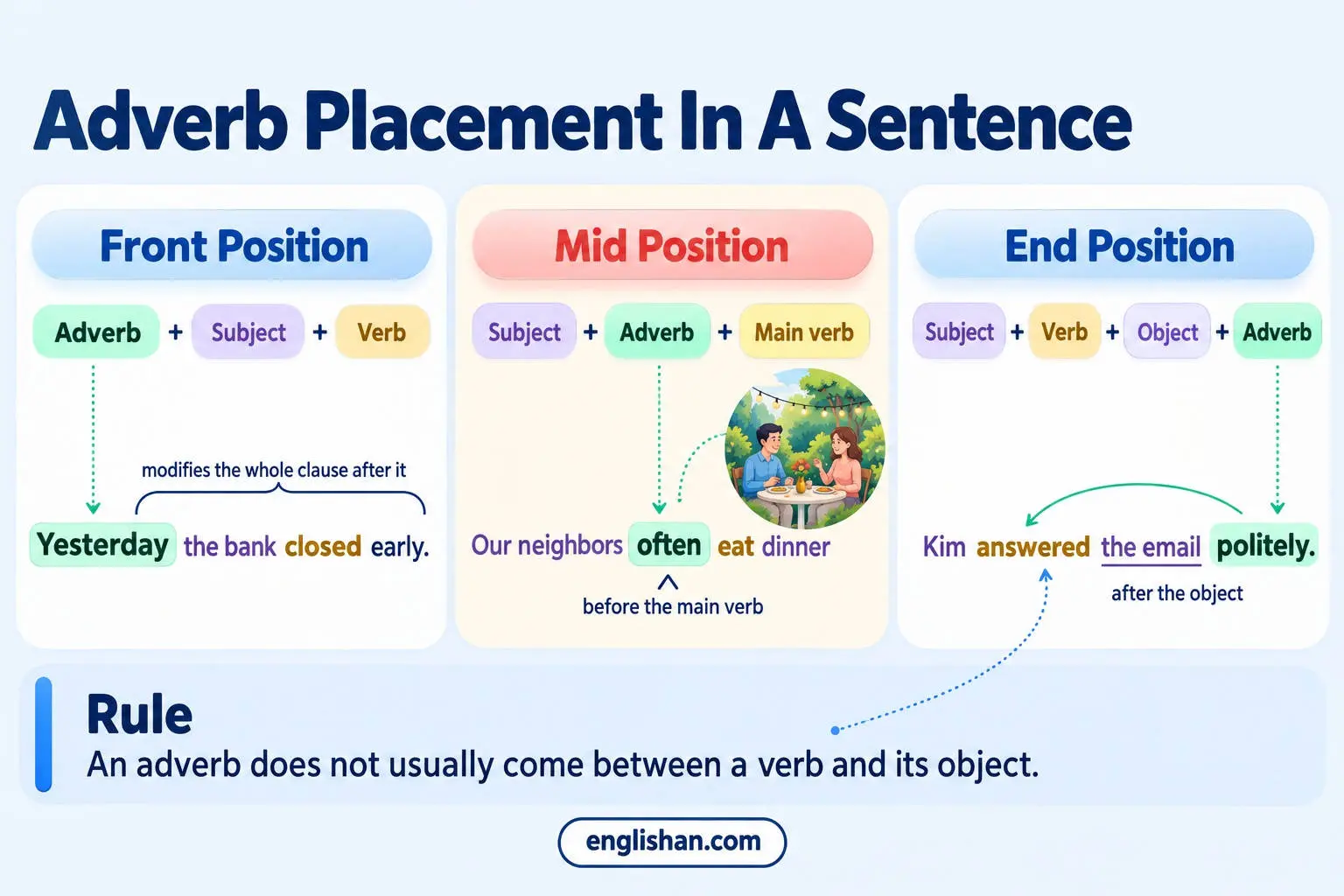
An adverb can go in front position before the subject, in mid position before the main verb, or in end position after the verb or its object. In mid position, the adverb comes after “be” or after the first auxiliary. Adverbs of frequency usually take mid position, adverbs of manner, place, and time take end position, and an adverb does not usually come between a verb and its object.
Adverb Placement Rules
Adverb placement in a sentence has three positions for an adverb that modifies a verb or a clause: front position, mid position, and end position. Front position is the start of the clause, before the subject. Mid position is between the subject and the main verb, and end position is after the verb, or after the object when the verb has one:
- Yesterday the bank closed early.
- Our neighbors often eat dinner in the garden.
- Kim answered the email politely.
Each type of adverb has its own usual position, which depends on what the adverb modifies and how long it is:
| Type of adverb | Usual position | Common examples |
|---|---|---|
| Adverbs of frequency | Mid | Always, usually, often, rarely, never |
| Adverbs of manner | End, or mid in writing | Quickly, carefully, well, badly |
| Adverbs of place | End | Here, there, outside, upstairs |
| Adverbs of time | End, or front for contrast | Today, yesterday, soon, later |
| Adverbs of degree | Before an adjective or adverb, or mid | Very, quite, almost, nearly |
| Adverbs of certainty | Mid | Probably, definitely, certainly |
| Sentence adverbs | Front | Luckily, honestly, sadly |
| Focusing adverbs | Mid, or before the word in focus | Only, even, just, also |
An adverb of one word is flexible, but a longer adverb phrase, such as “every day” or “last summer”, takes front or end position and not mid position.
I every day walk to work. ❌
I walk to work every day. ✅
The phrase “every day” comes after the object, while a one-word adverb such as “usually” comes before the verb: “I usually walk to work.”
Adverbs At The Beginning Of A Sentence
Sentence adverbs, conjunctive adverbs, adverbs of time, and a few adverbs of frequency come at the beginning of a sentence. An adverb in front position, also called an opening adverb, modifies the whole clause after it, and a comma usually follows it when it comments on the sentence or links it to the one before:
- Fortunately, nobody was hurt in the crash.
- However, the rent went up again in March.
- Tomorrow we fly to Lisbon.
- Sometimes the last bus doesn’t come at all.
- Outside, the children were building a snowman.
Sentence adverbs such as “fortunately” and “honestly” express the speaker’s comment on the whole statement, so the front is their normal position. Conjunctive adverbs such as “however” and “therefore” join the idea to the sentence before. A time adverb at the front sets the time for everything that follows, and the comma after a short one is optional.
Only some adverbs of frequency take front position. The adverbs “sometimes”, “usually”, “often”, and “occasionally” can open a statement, but “always” stays in mid position, apart from commands such as “Always lock the door”, and “never” opens a statement only with inversion.
Always I drink coffee in the morning. ❌
I always drink coffee in the morning. ✅
In a statement, “always” comes before the main verb, not before the subject.
When a negative adverb such as “never” or “rarely” opens a statement for emphasis, the auxiliary comes before the subject, as in “Never have I seen such a crowd”, and the full rules of that inversion belong to negative adverbs.
Mid Position Of Adverbs
Mid position is the position next to the main verb: before a main verb, after “be” when it is the main verb, and after the first auxiliary in a verb with two or more parts. The order with each kind of verb, with its common errors, is taught in full under adverb vs verb:
- My uncle rarely answers his phone.
- The kitchen is always warm in the morning.
- The guests have probably left by now.
- You should definitely try the soup.
Adverbs of frequency, adverbs of certainty, focusing adverbs, and short adverbs of degree such as “almost” and “hardly” all take mid position. The adverbs “still” and “already” usually come before the main verb too, as in “She still lives with her parents.”
Adverbs of manner take mid position mainly in writing, as in “She quietly closed the door.” The adverbs “fast”, “hard”, and “late” have the same form as their adjectives, and they come at the end, not in mid position.
He fast drove home. ❌
He drove home fast. ✅
The adverb “fast” comes after “drove home”, in end position.
Adverbs At The End Of A Sentence
Yes, an adverb can go at the end of a sentence, and end position is the usual position for adverbs of manner, place, and time. An adverb at the end comes after the verb, or after the object when the verb has one:
- The baby slept soundly.
- Our cousins are staying upstairs.
- I’ll send you the photos tonight.
- Do you come here often?
- The team played very badly on Saturday.
Ending a sentence with an adverb is correct in speech and in formal writing. The adverbs of frequency “often”, “sometimes”, and “occasionally” can also end a sentence, but “always” and “never” do not usually take end position in a statement.
Verb and object: An adverb does not come between a verb and its object, apart from a focusing adverb such as “only”. The object follows the verb directly, so the adverb moves to the end.
We visited last summer our grandparents. ❌
We visited our grandparents last summer. ✅
The object “our grandparents” stays next to “visited”, and the time phrase comes after it.
Two verbs: In a sentence with two verbs, an adverb at the end modifies the nearer verb. In “I asked him to leave quickly“, the adverb describes the leaving, so it moves before “asked” when it describes the asking: “I quickly asked him to leave.”
Order Of Adverbs
When several adverbs come at the end, adverb placement in a sentence usually follows the order manner, place, frequency, time, and then purpose. Place before time is the firmest part of that order, and a long list of adverbs at the end is rare in speech:
- Nadia spoke calmly at the meeting yesterday. (manner, place, time)
- We swim in the lake twice a week in summer. (place, frequency, time)
- He jogs slowly around the park every evening to relax. (all five)
- The parcel arrived here on Monday. (place, time)
With a verb of movement such as “go”, “come”, or “walk”, the place word usually comes before the adverb of manner. That place word is often one of the adverbs of movement, such as “home”, “away”, or “upstairs”:
- She walked home slowly.
- The kids ran upstairs noisily.
To shorten a long end, move the time phrase to the front: “Every evening, he jogs slowly around the park.”
I am going tomorrow to the dentist. ❌
I am going to the dentist tomorrow. ✅
Place comes before time at the end of the sentence. The wrong order follows German and Dutch, where time comes before place.
Adverbs Before Adjectives
An adverb that modifies an adjective or another adverb comes directly before it. Adverbs of degree such as “very”, “really”, “quite”, and “too” are the most common in this position:
- The test was surprisingly easy.
- We watched a really good film last night.
- My sister drives very carefully.
- This room is too small for a party.
The adverb “enough” is the exception, because it comes after the adjective or adverb it modifies.
The coffee is enough hot. ❌
The coffee is hot enough. ✅
With an adjective, “enough” follows it; before a noun, “enough” comes first, as in “enough chairs”.
Position Of Focusing Adverbs
A focusing adverb is an adverb that limits or adds to one part of a sentence, such as “only”, “even”, “just”, and “also”. It usually takes mid position or comes directly before the word in focus, and its position changes the meaning:
- Only Sam ate the cake. (nobody else)
- Sam ate only the cake. (nothing else)
- Sam only ate the cake. (stress shows focus)
In speech, “only” usually takes mid position, as in “I only had coffee”, and stress on the word in focus shows the meaning. In careful writing, “only” comes directly before the word in focus, as in “I had only coffee”, because a written sentence has no stress to show the focus.
The adverb “even” adds the idea of surprise, and it comes before the part it focuses on, as in “Even my grandmother sends voice messages” and “She even remembered my birthday.” The adverb “also” takes mid position, while “too” and “as well” with the same meaning come at the end:
- My brother also plays the drums.
- My brother plays the drums too.
I like also jazz. ❌
I also like jazz. ✅
The adverb “also” comes before a main verb, not between the verb and its object.
Adverbs In Questions And Negatives
In a question, a mid-position adverb comes after the subject, because the auxiliary moves before the subject and the adverb stays next to the main verb. End-position adverbs stay at the end, and interrogative adverbs such as “where” and “why” open the question:
- Do you usually walk to work?
- Have they ever been to Canada?
- Is your manager still at the office?
- Did you sleep well?
- Why did the train stop suddenly?
In a negative sentence, most mid-position adverbs usually come after “not”, as in “I don’t always eat lunch.” With “really”, the order changes the meaning: “She doesn’t really like jazz” means she likes it only a little, while “She really doesn’t like jazz” means she strongly dislikes it.
Adverbs of certainty take the opposite order. In a positive sentence, “probably” follows the auxiliary, as in “He will probably come”, but it comes before a negative short form such as “won’t”, “isn’t”, or “doesn’t”. With a full “not”, it can still follow the auxiliary, as in “He will probably not come”, which is more formal:
He won’t probably come to the party. ❌
He probably won’t come to the party. ✅
The adverbs “probably”, “certainly”, and “definitely” come before a negative short form such as “won’t”, not after it.
Adverb Placement In Passive Voice
With a passive verb, adverb placement in a sentence follows the mid-position rule, so the adverb comes after the first auxiliary and before the past participle, the “-ed” or third form of the verb. Adverbs of manner often take this position in the passive, even though they usually come at the end in an active sentence:
- The house was badly damaged in the storm.
- The roads have already been cleared.
- Your order will probably be shipped on Friday.
- The event was well organized.
End position is also correct in the passive, as in “The bridge was built quickly“, though “well” and “badly” usually come before the past participle.
The letters have been already sent. ❌
The letters have already been sent. ✅
The adverb follows the first auxiliary, “have”, and comes before “been”.
FAQs
Both positions are correct, and the choice depends on the type of adverb. Adverbs of frequency, certainty, and focusing adverbs usually come before the main verb, as in "She often sings." Adverbs of manner, place, and time usually come after the verb or its object, as in "She sings beautifully."
No, though some adverbs move more freely than others. The adverb "sometimes" can take front, mid, or end position, while "always" stays in mid position and "very" comes only before an adjective or adverb. A focusing adverb such as "only" changes the meaning of the sentence when it moves.
Not usually, because an adjective, not an adverb, describes a noun: "a quick answer", not "a quickly answer". A few adverbs come before a whole noun phrase to focus or limit it, such as "only", "even", "almost", and "quite", as in "almost everyone" and "quite a long trip".
No, adverbs are a normal part of English sentences, and words such as "not", "never", and "already" have no replacement. Advice to cut adverbs usually targets an adverb of manner that repeats the meaning of its verb, such as "whispered quietly". A sentence can contain several adverbs when each one is in its correct position.
Related: