

The interrogative adverbs are “when”, “where”, “why”, and “how”. Each one fronts a question and marks a different circumstance of the action: its time, its place, its reason, or its manner. In Where did you park the car? the word “where” marks place, and whatever replaces it in reply is an adverbial rather than a noun. That substitution puts these words in the adverb class, and it governs the word order the question takes.
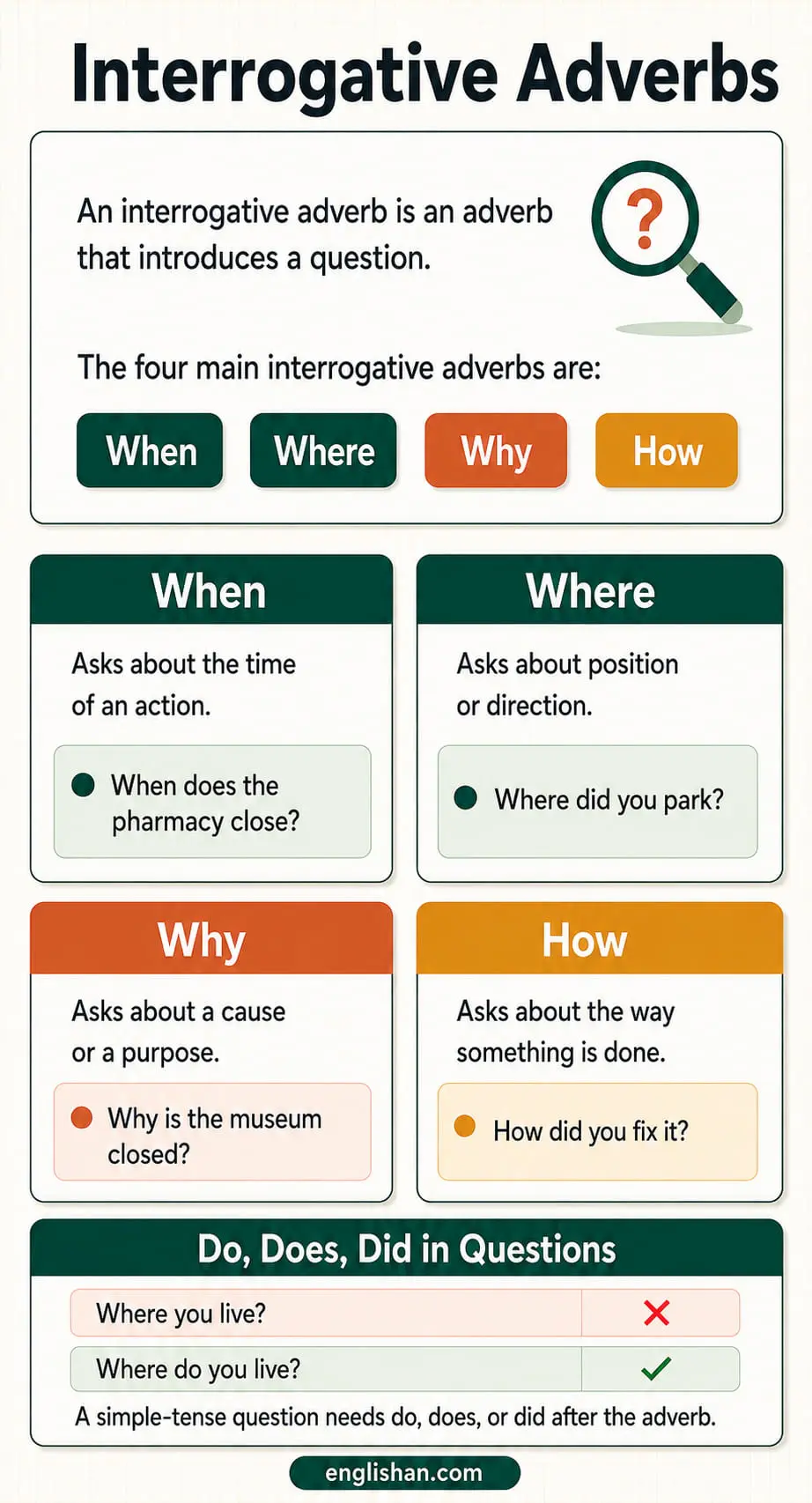
What Are Interrogative Adverbs
An interrogative adverb is a question word that asks about the time, place, reason, or manner of an action. The four of them are “when”, “where”, “why”, and “how”.
What makes them adverbs is the kind of reply they take.
- How did she fix it?
The reply is “carefully”, or “with a screwdriver”, or “by watching a video”. Expressions like these are called adverbials, and an adverbial is what an adverb stands for in a sentence.
- What did she fix?
The reply is “the tap”, which is a noun. That makes “what” a pronoun rather than an adverb, even though both words sit at the front of the question.
Two rules follow from this, and each one works as a test. An interrogative adverb is never the subject of its own question, so the auxiliary verb always comes before the subject. And its reply is never a noun, so a noun reply means the word at the front is a pronoun.
Types Of Interrogative Adverbs
Each category takes its name from the kind of reply the word asks for, so “when” names the time category and “why” the reason category.
Related: Types of Adverbs
Interrogative Adverbs Of Time
“When” asks about the time of an action. The reply is a single word such as “yesterday”, a phrase such as “on Tuesday”, or a whole clause such as “after the bell rang”. Take “when” out of a question and a full sentence is still left behind, which is one way to tell it apart from a word the sentence needs.
- When does the pharmacy close?
- When did you last renew your passport?
- She asked when the plumber was coming.
- When don’t the buses run on this route?
- When will your brother finish his apprenticeship?
What time: the phrase marks time without being an interrogative adverb.
- What time does the train leave?
“What time” is a noun phrase with “what” as an interrogative determiner, so no interrogative adverb is present. The one-word equivalent is “when”.
Interrogative Adverbs Of Place
“Where” asks about position or direction. The reply is a phrase such as “under the stairs”, or a single word such as “there”. With “be” as the main verb the place cannot be left out at all, because “The bag is” is not a sentence while “I arrived” is.
- Where did you park?
- Where is the nearest cash machine?
- I never found out where she moved to after the divorce.
- Where does this cable go?
- Where don’t you want the furniture placed?
Interrogative Adverbs Of Reason
“Why” asks about the cause or the purpose. The reply is a clause beginning with “because”, a “to” phrase that gives a purpose, or a phrase beginning with “for”. “Why” works as a relative adverb too, and there it follows almost one noun only, “reason”.
- Why are you late?
- Why did the flight turn back?
- She never explained why she resigned so suddenly.
- Why won’t the engine start in cold weather?
- Do you know why he keeps rewriting the same paragraph?
Interrogative Adverbs Of Manner
“How” asks about the way something is done. The reply is an “-ly” word such as “carefully”, a phrase with “by” or “with” such as “by hand”, or an “-ing” clause such as “running all the way”. Put another word straight after “how” and the question switches from manner to degree.
- How did you fix it?
- How does this printer connect to the network?
- How is your mother?
- She showed me how the lock opens from the inside.
- How did the meeting go?
Forming Questions With Interrogative Adverbs
The adverb fronts the question and the auxiliary verb moves in front of the subject, which gives every question of this type the same shape.
Interrogative adverb + auxiliary + subject + main verb
Which one applies depends on the verb already in the statement.
- An auxiliary or modal is already there: She has left. becomes Why has she left?
- The tense is simple and no auxiliary is present: You live there. becomes Where do you live?
- Be is the main verb: The keys are here. becomes Where are the keys?
“Who” and “what” stand in for noun phrases, so either one can be the subject of its own question.
- Who broke the window?
A subject question takes no inversion, so the order here is that of a statement.
An interrogative adverb never functions as subject, which is why inversion is obligatory here.
- Why you are calling so late? ❌
- Why are you calling so late? ✅
In the first version the auxiliary “are” stays behind the subject, so the sentence reads as a statement with a question mark attached. Every direct question with an interrogative adverb needs the auxiliary in front of the subject.
When the adverb stays in place: an echo question repeats what the speaker has just heard and leaves the adverb where the missing words would stand.
- You left when?
Statement order survives because nothing has been fronted. Spoken English uses echo questions, and they are the one case in which the adverb does not open the question.
Uses Of How In Questions
“How” combines with a following word, and what it modifies changes with each combination.
| Combination | What “how” modifies | Example |
|---|---|---|
| “How” alone | The verb | How did you get here? |
| “How” plus adjective | The adjective | How tall is your brother? |
| “How” plus adverb | The adverb | How quickly does the paint dry? |
| “How” plus much or many | The determiner | How many people replied? |
| “How come” | Nothing, a fixed expression | How come you are here so early? |
Two of these rows carry conditions of their own.
- How much flour does the recipe need?
“Much” is the determiner for uncountable nouns, and “many” replaces it before a countable noun such as “people”.
- How come nobody told me?
“How come” is informal and chiefly American, and the clause after it keeps statement word order instead of inverting.
None of these combinations is an extra interrogative adverb. “How” is the interrogative adverb in every row, and the word beside it is an adjective, an adverb, or a determiner under its modification. To identify which combination a question uses, read the word straight after “how”: an adjective or adverb signals degree, “much” or “many” signals quantity, and nothing at all signals manner.
How To Identify An Interrogative Adverb
Three checks settle it, and each works on a question you have never seen.
1. The answer test: Replace the question word with a plausible answer and look at what kind of phrase fits. An adverbial answer marks an interrogative adverb, and a noun phrase marks a pronoun or a determiner.
- Where did you go?
The answer is “To the market”, an adverbial, so “where” is an adverb.
- What did you buy?
The answer is “A melon”, a noun phrase, so “what” is a pronoun.
One use of “how” breaks this test.
- How are you?
The reply “Fine” is an adjective, because “how” marks state here rather than manner. Every other use takes an adverbial.
2. The subject test: Make the question word the subject of its own question.
- Who called?
Grammatical, and no inversion occurs, because “who” is the subject of “called”.
- Why called?
Ungrammatical, because “why” cannot occupy subject position. Any question word that forces the auxiliary in front of the subject is an adverb.
3. The word test: The word itself must be “when”, “where”, “why”, “how”, or one of the archaic members. Phrases such as “what time”, “in what way”, and “to what extent” ask the same kind of question, and each is a phrase rather than a single adverb.
Interrogative Adverbs In Indirect Questions
An indirect question is reported inside a longer sentence, and reporting it changes the word order back to statement order.
| Direct question | Indirect question |
|---|---|
| Where does she live? | I asked where she lives. |
| Why did the train stop? | Nobody explained why the train stopped. |
| When will the shop open? | Do you know when the shop opens? |
| How does this work? | Tell me how this works. |
Two changes happen together: the subject moves back in front of the verb, and “do”, “does”, and “did” disappear unless the main clause needs one of them. The stretch beginning with the interrogative adverb is a noun clause, and it fills the object slot after “asked”, “explained”, “know”, or “tell”.
- Can you tell me where is the station? ❌
- Can you tell me where the station is? ✅
The inversion belongs to a direct question, and this clause is embedded, so “is” has no reason to come before “the station”. Statement order returns after “where”.
Related: Direct and Indirect Speech
Interrogative Adverbs Vs Interrogative Pronouns
Both classes open questions, and what substitutes for the word marks the difference.
| Question word | Class | What substitutes for it |
|---|---|---|
| When, where, why, how | Interrogative adverb | An adverbial, as “outside the library” does for “where” |
| Who, whom | Interrogative pronoun | A noun phrase naming a person, as “my cousin” does for “who” |
| What | Interrogative pronoun or determiner | A thing, or a noun it specifies |
| Which, whose | Interrogative determiner or pronoun | A noun phrase, or a noun it specifies |
“Whose” shows the determiner reading most clearly. In Whose coat is this? it specifies the noun “coat” instead of replacing it.
Words That Are Not Interrogative Adverbs
Each word here opens a question or joins a clause without being an interrogative adverb, and each has a word class of its own. “What”, “which”, and “whom” fail the answer test, since a noun phrase substitutes for them, while “whereby” and “however” never open a question at all.
- What: an interrogative pronoun when it replaces a noun phrase, and an interrogative determiner when it specifies one. What did you say? against What size do you take?
- Which: an interrogative determiner or pronoun, used for a choice within a known set. Which platform does it leave from?
- Whom: the object form of the interrogative pronoun “who”, and formal in modern writing. To whom did you speak?
- Whereby: a relative adverb that introduces a clause rather than a question. A system whereby staff rotate shifts.
- However: a conjunctive adverb linking two statements. The train, however, was late.
When a subordinating conjunction looks identical: “I will call you when the meeting ends” uses “when” to open an adverbial clause. Nothing is being asked, so “when” is a subordinating conjunction in that sentence.
When an exclamative looks identical: How quiet the house is! uses “how” to express degree. The clause keeps statement order and ends in an exclamation mark, which rules out a question.
Interrogative Adverbs Vs Relative Adverbs
The same four words also introduce relative clauses, and the antecedent shows which job a word is doing.
- Where did she grow up?
- This is the village where she grew up.
Nothing precedes “where” in the question for it to refer back to. In the statement it refers back to “village” and joins the clause to that noun, which makes it a relative adverb.
- Why did he resign?
- Nobody understood the reason why he resigned.
“Why” has no antecedent in the question. In the statement it refers back to “reason”, so the clause describes that noun instead of asking anything.
A relative adverb always has an antecedent in the same sentence. An interrogative adverb has none, and it marks what the speaker does not know. Punctuation confirms the reading: a direct question ends in a question mark, and a relative clause is embedded in a statement.
Whence And Whither In Older English
Three older interrogative adverbs survive in literary and legal writing, and each has a modern one-word equivalent. All three still front the question and still trigger inversion, so the word is archaic and the word order is not.
| Adverb | Meaning | Modern equivalent |
|---|---|---|
| Whence | From what place, source, or cause | Where from |
| Whither | To what place | Where to |
| Wherefore | For what reason | Why |
“Whence” and “whither” are archaic outside poetry, hymns, and set phrases, and a modern question uses “where” with a preposition instead.
- Whither are you going?
Ordinary English replaces this with Where are you going?, and only the level of formality differs.
“Whence” already means ‘from what place’, so no preposition goes in front of it.
Wherefore: the archaic interrogative adverb of reason.
- Wherefore art thou Romeo?
The sense is ‘why are you Romeo’, so the line questions his name rather than his location.
Common Mistakes With Interrogative Adverbs
Each of these five errors breaks a rule already stated, and each has a one-step fix.
- Why you are late? ❌
- Why are you late? ✅
The auxiliary has to move in front of the subject.
- I wonder where is my phone. ❌
- I wonder where my phone is. ✅
The clause is embedded, so the inversion of the direct form is carried over by mistake.
- Where you live? ❌
- Where do you live? ✅
The tense is simple present with no auxiliary of its own, so “do” supplies one and takes its place before the subject.
- How much people signed up? ❌
- How many people signed up? ✅
“People” is countable, and countable nouns take “many” after “how”.
- How long time does the journey take? ❌
- How long does the journey take? ✅
“Long” already asks about duration, so “time” repeats it. The structure is “how” plus one adjective or adverb, with nothing added after.
Interrogative Adverbs List
Every form is paired with the kind of adverbial its answer supplies.
| Adverb | What it asks about | Answer type | Example |
|---|---|---|---|
| When | Time | A time, date, or event | When does the term start? |
| Where | Place or direction | A place or destination | Where did you leave it? |
| Why | Reason | A cause or motive | Why is the road closed? |
| How | Manner or method | A method, means, or state | How did you travel? |
| How much | Quantity, uncountable | An amount | How much water is left? |
| How many | Quantity, countable | A number | How many chairs do we need? |
| How long | Duration or length | A period or measurement | How long is the flight? |
| How often | Frequency | A frequency | How often does it rain here? |
| How far | Distance | A distance | How far is the border? |
| How come | Reason, informal | A cause or motive | How come nobody told me? |
| Whence | Source or origin, archaic | A place or cause | Whence came the rumour? |
| Whither | Destination, archaic | A place | Whither are you going? |
| Wherefore | Reason, archaic | A cause | Wherefore did he leave? |
The six rows built on “how” combine it with another word rather than naming separate adverbs, and “how” is the interrogative adverb in each of them.
FAQs
Four interrogative adverbs are in current use: “when”, “where”, “why”, and “how”. Three archaic forms exist alongside them, “whence”, “whither”, and “wherefore”, and none of the three is used in ordinary modern English. Sequences such as “how much” and “how many” combine “how” with another word rather than adding to that set.
Yes, whenever it opens a question about time. When does the ferry leave? marks time, and an adverbial completes it. The same word is a subordinating conjunction in “I will call you when the ferry leaves”, because nothing is being asked in that sentence.
These questions cover every interrogative adverb, with a final one for a “how” combination.
When did you arrive?
Where is my bag?
Why is she upset?
How does this open?
How much does it weigh?
The first four use “when”, “where”, “why”, and “how” in turn, and the last shows “how” combining with a determiner.
Yes, and the word order changes when they are. An indirect question keeps statement order, so Where is the station? becomes Do you know where the station is? The auxiliary “do” also disappears in the embedded clause, as in “I asked where she lives”.
Yes, in two ways. Inside an indirect question the adverb heads a noun clause within a statement, as in “Nobody explained why the meeting was moved”. The same four words also introduce relative clauses, and in that job they are relative adverbs rather than interrogative ones.
The interrogative adverb of reason is “why”, the word that marks cause or motive. Why did the alarm go off? takes an answer such as “Because the window was open”. The archaic equivalent is “wherefore”, which survives only in older writing.
The difference is the antecedent. A relative adverb refers back to a noun already in the sentence, which is what “where” does in “the village where she grew up”. An interrogative adverb has no antecedent, and it opens a question instead of describing a noun.
Interrogative Adverbs Quiz
Interrogative Adverbs
Choose the interrogative adverb.
___ do you live?
'Where' asks about place.
'where' asks about place
Where do you live?
Choose the interrogative adverb.
___ does the train leave?
'When' asks about time.
'when' asks about time
When does the train leave?
Choose the interrogative adverb.
___ are you late?
'Why' asks about the reason.
'why' asks about reason
Why are you late?
Choose the interrogative adverb.
___ did you fix it?
'How' asks about the manner or method.
'how' asks about manner
How did you fix it?
Choose the interrogative phrase.
___ is the nearest station?
'How far' asks about distance.
'how far' asks about distance
How far is the nearest station?
Choose the interrogative adverb.
___ do you go to the gym?
'How often' asks about frequency.
'how often' asks about frequency
How often do you go to the gym?
Choose the interrogative phrase.
___ does the film last?
'How long' asks about duration.
'how long' asks about duration
How long does the film last?
Choose the interrogative adverb.
___ did they meet?
'Where' asks about the place of the meeting.
'where' asks about place
Where did they meet?
True or false?
Interrogative adverbs open questions about time, place, reason, or manner.
'When', 'where', 'why', and 'how' begin such questions.
when/where/why/how open questions
Why did you call?
Choose the interrogative adverb.
___ did she leave so early?
'Why' asks the reason for leaving early.
'why' asks about reason
Why did she leave so early?
Choose the interrogative phrase.
___ money do you need?
'How much' asks about an uncountable quantity.
'how much' asks about an uncountable quantity
How much money do you need?
Choose the interrogative adverb.
___ do birds migrate?
'Why' asks the reason birds migrate.
'why' asks about reason
Why do birds migrate?
Complete the question.
___ old are you? (asking age with an adverb)
'How' combines with 'old' to ask about age.
'how old' asks about age
How old are you?
Choose the interrogative phrase.
___ people came to the event?
'How many' counts the countable noun 'people'.
'how many' counts people
How many people came to the event?
Choose the interrogative adverb.
___ can I get to the airport?
'How' asks about the method of getting there.
'how' asks about method
How can I get to the airport?
Choose the interrogative adverb.
___ will the guests arrive?
'When' asks about the time of arrival.
'when' asks about time
When will the guests arrive?
Choose the interrogative adverb.
___ did you put my keys?
'Where' asks about the place of the keys.
'where' asks about place
Where did you put my keys?
True or false?
'How' can ask about manner, and it can also combine with other words to ask about degree or amount.
'How' asks about manner and joins words like 'far', 'long', and 'many' for degree or amount.
'how' asks manner, and 'how far/long/many' ask degree or amount
How far, how long, how many?
Choose the interrogative adverb.
___ do you look so happy?
'Why' asks the reason for looking happy.
'why' asks about reason
Why do you look so happy?
Choose the interrogative phrase.
___ is it from here to the coast?
'How far' asks about the distance.
'how far' asks about distance
How far is it from here to the coast?
Turn on JavaScript for the interactive quiz. The full practice set is shown above.