Two people perform the same action in one sentence, and the sentence names the verb once. “Ravi and his sister walk to work together” has two walkers and one verb. That doubled subject is a compound subject, and one verb agrees with the whole of it. Which form that verb takes depends on the word joining the two subjects, and on what those subjects name.
What Is A Compound Subject
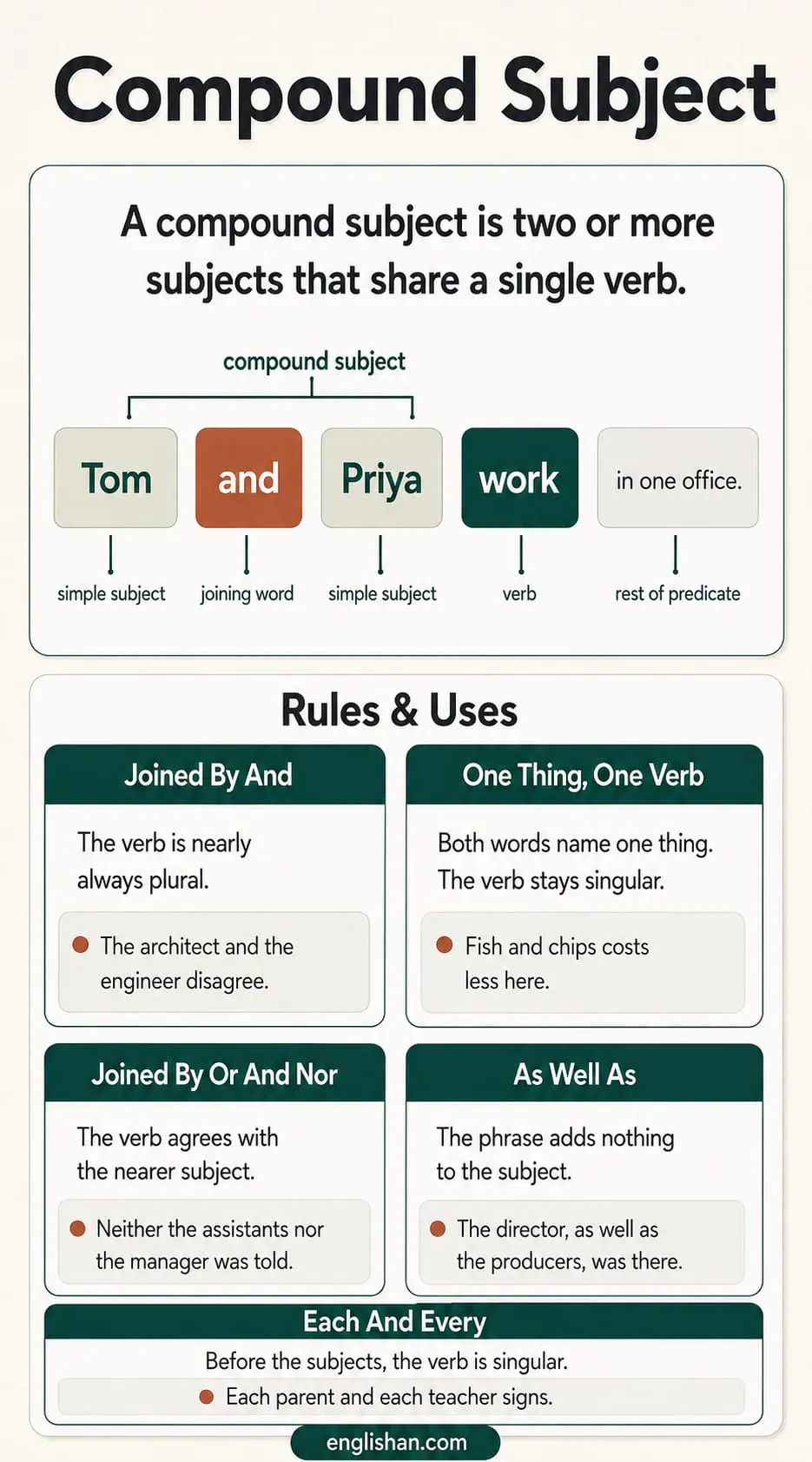
A compound subject is a subject made of two or more simple subjects that share one verb. A simple subject is the single noun or pronoun a verb agrees with. Join two of them with a conjunction, give them one verb, and the pair is the compound subject of that clause.
The shared verb is what separates a compound subject from two clauses pushed together. If each subject has its own verb, the sentence has two clauses and the subject is not compound.
- Tom and Priya share an office on the third floor.
Two nouns join with “and”, so the single verb “share” agrees with both of them at once.
- The kettle, the toaster, and the microwave run off one socket.
The subject takes three parts here, with commas separating the first two.
- Neither the driver nor the guard was on the platform.
Since both parts are singular, the verb stays singular even though “nor” joins two subjects.
- Swimming and cycling keep her knees strong.
Gerunds are subjects too, so two of them join like any two nouns.
How To Identify A Compound Subject
Finding one takes three moves.
- Find the verb: mark the word that names the action or the state.
- Ask who or what: put “who” or “what” in front of that verb and answer the question.
- Count the answers: two or more answers sharing that one verb make a compound subject.
| Sentence | The verb | Who or what | Verdict |
|---|---|---|---|
| Marco and Elena run the bakery. | Run | Marco, Elena | Compound subject |
| Marco runs the bakery and closes at six. | Runs, closes | Marco | Compound predicate |
| Marco runs the bakery, and Elena bakes. | Runs, bakes | Marco; Elena | Two clauses |
| The bakery on Green Street opens at six. | Opens | The bakery | Simple subject |
Two or more answers to one verb make one. A single answer is a simple subject however many words the subject phrase takes. Two answers with two separate verbs are two clauses rather than one shared subject.
Compound Subject Examples In Everyday Sentences
Compound subjects appear in speech, in email, and in formal writing, and their shape changes with what joins the parts.
Two nouns joined by and:
- My brother and his flatmate were stuck at the airport for nine hours.
- The invoice and the delivery note arrive in the same envelope.
- Toast and strong coffee are my whole breakfast.
A pronoun with a noun:
- She and her tutor meet every Thursday before class.
- You and I have the same flight number.
Three or more parts:
Commas separate the parts, with “and” before the last one.
- Salt, pepper, and a squeeze of lemon change the whole dish.
- The nurse, the porter, and the ward clerk were all on shift.
Joined by or and nor:
- The train or the bus gets you there before nine.
“Or” presents the train and the bus as alternatives, so only one of them acts and the verb is singular.
- Neither my sister nor my cousin drives.
- Either the tenant or the landlord pays for the repair.
Compound Subjects Joined By And
Two singular subjects joined by “and” take a plural verb. The word “and” is a coordinating conjunction, and two subjects joined by it name more than one thing.
The rule applies whatever the number of the parts. One singular subject beside one plural subject still takes a plural verb, because the whole subject names more than one thing.
- The architect and the engineer disagree about the roof.
- My laptop and my phone were both out of charge.
- The manager and her team have signed the contract.
One singular part beside one plural part still takes a plural verb.
- Bread, milk, and eggs were missing from the delivery.
- Rain and heavy wind are forecast for Thursday.
Rain and wind are uncountable nouns, yet joining them with “and” still makes the subject plural.
- He and his brother were raised by their grandmother.
The they test: read the compound subject back as “they”. “The architect and the engineer” becomes “they disagree”, never “they disagrees”, which confirms the plural verb.
When And Takes A Singular Verb
Two subjects joined by “and” take a singular verb in two situations, and both depend on what the subject names rather than on how many nouns appear.
Two subjects naming one thing:
- Macaroni and cheese is on the menu every Friday.
The two nouns name one dish, so the verb agrees with that single thing.
- Track and field was her sport until she tore a hamstring.
- Fish and chips costs less at the stand by the pier.
Agreement that follows meaning rather than form is called notional agreement.
Two labels for one person:
- My friend and colleague has offered to cover the shift.
The missing second article is the signal that one person here has both labels.
- The founder and chief executive speaks at nine.
Repeat the article and the meaning changes.
- My friend and my colleague have offered to cover the shift.
Once the second “my” names a second person, the verb turns plural.
Compound Subjects Joined By Or And Nor
Two singular subjects joined by “or” or “nor” take a singular verb. “Or” and “nor” present the subjects as alternatives, so one of them acts at a time and the verb agrees with one.
Two plural subjects joined by “or” or “nor” take a plural verb, on the same reasoning.
- The porter or the receptionist has a spare key.
- Neither the printer nor the scanner works after the update.
- The tenants or the neighbours have reported the noise.
Either or and neither nor: these correlative conjunctions follow the identical rule, because the second half of each pair is still “or” or “nor”.
- Either Yusuf or Marta is covering reception.
- Neither the twins nor their parents were home.
When one subject is singular and the other plural, the verb agrees with the subject closer to it. That convention is called the proximity rule.
- Neither the manager nor the assistants were told.
The plural “assistants” is next to the verb, so the verb is plural.
- Neither the assistants nor the manager was told.
Once the two subjects swap and the plural moves next to the verb, the verb changes with it.
The writing convention: put the plural subject second. The sentence then reads naturally to every reader, even for readers who choose the verb by ear.
- Either the receipt or the bank statements prove the payment.
With the plural subject last, the plural verb beside it sounds settled to every reader.
Each And Every Before A Compound Subject
“Each” or “every” in front of singular subjects joined by “and” requires a singular verb. The determiner takes the subjects one at a time, and the verb agrees with one.
- Each parent and each teacher signs the form.
“Each” takes the parent and the teacher one at a time, so the verb is singular.
- Every window and every door was locked before we left.
- Each invoice and receipt goes into the same folder.
One “each” in front of the pair is enough to make the verb singular.
“Each” after a plural subject leaves the verb alone.
- The delegates each receive a badge at the door.
“Delegates” is the plural subject here, so “each” placed after it changes nothing.
Compound Subjects With As Well As
“As well as” does not make a compound subject. Neither do “along with”, “together with”, “in addition to”, or “accompanied by”.
These phrases add material to a sentence without adding to its subject. The subject remains whatever it was before the phrase began, and the verb agrees with that alone.
- The director, as well as the two producers, was at the screening.
Only “the director” is the subject, so the two producers after the comma leave the verb singular.
- The report, along with its appendices, is on your desk.
- My aunt, together with her three dogs, arrives on Sunday.
The removal test: take out the phrase between the commas and read the sentence back. The verb that fits the shortened sentence is the correct one.
- The teacher, along with her students, are visiting the museum. ❌
The phrase after the comma is not part of the subject, so the plural verb has nothing to agree with.
- The teacher, along with her students, is visiting the museum. ✅
Because “the teacher” alone is the subject, the singular “is” agrees with her rather than with the students.
Compound Subjects With I And Me
A compound subject takes subject pronouns, which are “I”, “he”, “she”, “we”, and “they”. The object pronouns “me”, “him”, “her”, “us”, and “them” belong after a verb or a preposition, never inside a subject.
The drop test: remove the other subject and read the sentence back. The pronoun form that survives alone is the correct one.
- My brother and I drove to Leeds on Saturday.
Drop “my brother” and “I drove to Leeds” remains, which confirms the subject form.
- She and her tutor report the same fault every winter.
- The invitation came for my brother and me.
This pair follows a preposition, so the object form “me” is the correct one.
- Me and Sam are meeting at six. ❌
Since “me” is an object pronoun, it does not belong inside a subject in edited writing.
- Sam and I are meeting at six. ✅
The subject pronoun “I” is correct here, though in English “I” comes last in the pair.
“Me and Sam are meeting at six” is standard in spoken English across most of the English-speaking world, and it confuses nobody. In writing that is marked, edited, or read by a stranger, the subject form is the one to use.
Was Or Were With A Compound Subject
“Was” and “were” follow the same rules as “is” and “are”. Subjects joined by “and” take “were”, and singular subjects joined by “or” or “nor” take “was”.
The one construction that unsettles writers opens with “there”. In “there was” and “there were”, the word “there” is an expletive, a placeholder in the subject position while the real subject follows the verb.
- The nurse and the porter were on the same shift.
- Neither the nurse nor the porter was on duty.
- There were a torch and a first aid kit in the boot.
Because the subject follows the verb here, the plural “were” still agrees with it.
- There was a torch and a first aid kit in the boot.
The singular form appears widely in speech, where the verb agrees with the first noun alone.
Compound Subjects In Questions
In a question the verb moves in front of the subject, and it still agrees with the whole compound subject. The inversion changes word order and nothing else.
- Are Tom and Priya coming to the retirement lunch?
- Was the porter or the receptionist holding the key?
- Have the invoice and the delivery note arrived yet?
Find the subject after the auxiliary and apply the rule the statement would take.
Simple Subject Vs Compound Subject
A simple subject is one noun or pronoun with its verb. A compound subject is two or more of them sharing that verb. The number of words in the subject phrase does not affect the label.
- The tall woman in the grey coat was first in the queue.
The subject phrase is seven words long and has one noun, so the subject is simple.
- The woman and her son were first in the queue.
The woman and her son are two nouns sharing one verb, which is what makes the subject compound.
Compound Subject Vs Compound Predicate
A compound subject doubles the subject. A compound predicate doubles the verb. The predicate is everything a sentence says about its subject, and doubling it leaves one subject in place.
- Marco and Elena run the bakery.
The sentence has two subjects and one verb, which makes the subject compound.
- Marco runs the bakery and closes at six.
The sentence has one subject and two verbs, which makes the predicate compound.
| Structure | Subjects | Verbs | Example |
|---|---|---|---|
| Compound subject | Two or more | One | Marco and Elena run the bakery. |
| Compound predicate | One | Two or more | Marco runs the bakery and closes at six. |
| Compound sentence | Two, one per clause | Two, one per clause | Marco runs the bakery, and Elena bakes the bread. |
A compound sentence differs from both. It joins two independent clauses, each with its own subject and its own verb, so neither part is shared.
How To Diagram A Compound Subject
A sentence diagram forks the baseline to show two subjects sharing one verb. The line splits into two prongs, one subject on each prong, and the prongs rejoin before the vertical line between subject and verb. The conjunction goes on a dotted line between the prongs.
- Marco and Elena run the bakery.
“Marco” takes the upper prong and “Elena” the lower, with “and” on the dotted line between them.
A third subject adds a third prong. The verb keeps its place on the baseline, because one verb still agrees with the whole subject.
Common Mistakes With Compound Subjects
A compound subject agrees with all of its parts at once. Every error here ignores one of them, and the correction follows each one.
Agreeing with only the nearest part of the subject:
- The manager of the two branches and the head of finance has signed the report. ❌
Two people signed the report, so agreeing with “the head of finance” alone leaves out half the subject.
- The manager of the two branches and the head of finance have signed the report. ✅
The plural “have” agrees with the manager and the head together, which is what the subject names.
Putting a comma before the verb:
- The manager and the senior auditor, were late for the review. ❌
No comma separates a compound subject from its verb, whatever the length of the subject.
- The manager and the senior auditor were late for the review. ✅
Treating a compound with and as singular:
- The knife and the fork is in the top drawer. ❌
Two singular nouns joined by “and” name two objects, so a singular verb is wrong.
- The knife and the fork are in the top drawer. ✅
Ignoring the plural subject nearest the verb:
- Neither the manager nor the assistants was told about the change. ❌
A singular verb here ignores “assistants”, the plural subject closest to it, which breaks the proximity rule.
- Neither the manager nor the assistants were told about the change. ✅
The verb agrees with “assistants”, the subject next to it, exactly as the proximity rule requires.
Calling two clauses a compound subject:
- Two clauses: Marco runs the bakery, and Elena bakes the bread.
Each subject has its own verb, which makes this two independent clauses.
- Compound subject: Marco and Elena run the bakery.
One verb agrees with both subjects, which is what makes the subject compound.
Related: Printable Subject Verb Agreement Worksheets with Answers
FAQs
Most compound subjects are plural. Subjects joined by “and” take a plural verb, while singular subjects joined by “or” or “nor” take a singular verb. Meaning overrides form when the two parts name one thing, as in “fish and chips is”.
No, three situations produce a singular verb. Singular subjects joined by “or” or “nor” take one, “each” or “every” in front of the subjects requires one, and two nouns naming a single thing take one. Every other compound subject joined by “and” takes a plural verb.
Yes, a simple sentence has exactly one independent clause, and that clause takes a compound subject without becoming a compound sentence. “Marco and Elena run the bakery” has one clause, one verb, and two subjects. What makes a sentence compound is a second clause, not a second subject.
Yes, and the pronoun takes its subject form: “I”, “he”, “she”, “we”, or “they”. “She and her tutor meet on Thursdays” is correct, and “her and her tutor” is not. In English, “I” comes last in a compound subject, as in “my brother and I”.
No, the two labels name different structures. A simple subject is one noun or pronoun with its verb, however many words modify it. A compound subject is two or more of them sharing that verb.
Yes, a compound sentence has two independent clauses, and each clause has its own subject and its own verb. A compound subject is different, because there two subjects share one verb. “Marco runs the bakery, and Elena bakes the bread” is a compound sentence, while “Marco and Elena run the bakery” has a compound subject.
Joint ownership marks only the final name, so “Marco and Elena’s bakery” names one bakery the two of them own. Separate ownership marks both names, so “Marco’s and Elena’s bakeries” names two. When one owner is a pronoun, both parts take the possessive form, as in “Elena’s and my bakery”.
No comma separates a compound subject from its verb, whatever the length of the subject. Commas appear inside the subject when it has three or more parts, as in “salt, pepper, and lemon change the dish”. The final comma before “and” is optional in British style and standard in American style.