

“Am”, “is”, and “are” are the three present-tense forms of the verb “be”, and the subject of the sentence determines which one is used. “I” takes “am”. “He”, “she”, “it”, and any singular noun take “is”. “You”, “we”, “they”, and any plural noun take “are”. Everything difficult about these three forms is a question of identifying the subject correctly.
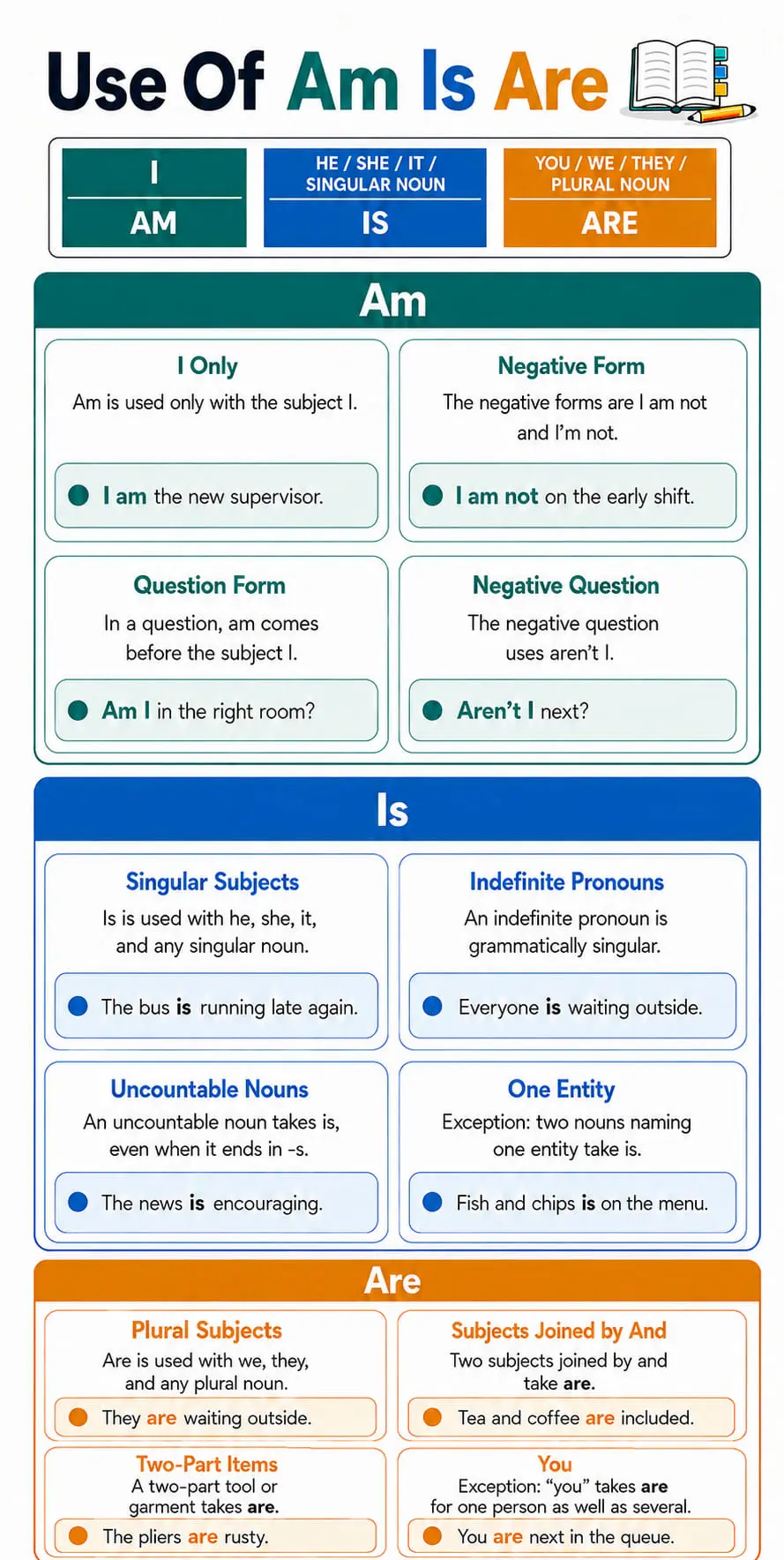
When To Use Am Is And Are
The form of “be” is chosen by the subject, and the subject is whatever the sentence is about rather than the noun standing nearest the verb.
| Subject | Form | Example |
|---|---|---|
| I | am | I am ready. |
| He, she, it, a singular noun | is | The parcel is late. |
| You, we, they, a plural noun | are | The results are in. |
“You” takes “are” whether it refers to one person or to several, because “you” is grammatically plural whatever its number of referents.
- I am the new supervisor.
- She is at the dentist.
- The kettle is boiling.
- We are almost finished.
- They are waiting outside.
- My colleagues are on the early shift.
- The bus is running late again.
- You are next in the queue.
The last sentence is correct whether one person or a whole family is standing in that queue, and the form does not change.
The two uses and the three sentence forms: the next four rules are the linking use, the auxiliary use, the negative, and the question with its short answer.
Am Is And Are As A Linking Verb
A linking verb joins the subject to a word that describes or renames it, and “am”, “is”, and “are” are the commonest linking verbs in English.
What follows is called the subject complement. It takes one of three forms: a noun that renames the subject, an adjective that describes it, or a phrase that places it.
- She is a paediatric nurse.
- My brother is the tallest in the family.
- The soup is cold.
- These figures are wrong.
- I am exhausted.
- The keys are on the hall table.
- The office is above the pharmacy.
- We are in the waiting room.
- The children are at their grandmother’s.
- He is thirty-two.
In every one of these, “am”, “is”, or “are” is the main verb of the sentence. No other verb is present, which is why calling it a helper here is wrong.
What Am Is And Are State About A Subject
The complement after “am”, “is”, and “are” states one of six kinds of information about the subject: identity, job, age, nationality, feeling, or appearance.
Each kind takes its own complement form, and two of them cause errors that no other kind causes.
- I am Priya’s brother. (identity)
- He is an electrician. (job)
- My daughter is eleven. (age)
- They are Portuguese. (nationality)
- We are delighted with the result. (feeling)
- Her hair is dark. (appearance)
- How old are you? (age)
- Where are you from? (nationality)
Age takes a bare number, so “My daughter is eleven” is complete and “My daughter is eleven years” is not. Nationality takes an adjective rather than the name of the country, so “They are Portuguese” is standard and “They are Portugal” is not.
Am Is And Are With Time Weather And Price
“Am”, “is”, and “are” also state the time, the day, the weather, the price, and the distance, and the subject in every one of these is “it”.
“It” names nothing here. It occupies the subject position because an English clause requires a subject, and the words after the verb state the information.
- It is half past four. (time)
- It is Tuesday. (day)
- It is cold on the platform. (weather)
- It is twelve pounds a ticket. (price)
- It is four miles to the station. (distance)
- What time is it? (time)
- How much is the return fare? (price)
- What is the weather like in June? (weather)
The question forms invert “is” with “it” exactly as any other question inverts the verb with its subject. “How much is it?” and “Is it cold?” are built the same way as “Is the report finished?”.
Am Is And Are As An Auxiliary Verb
An auxiliary verb helps another verb build a tense or a voice, and “am”, “is”, and “are” do that in two constructions.
Before an -ing form they build the present continuous. Before a past participle they build the passive voice.
- I am working from home today.
- She is studying for her finals.
- They are rebuilding the bridge.
- The children are sleeping.
- The road is closed for resurfacing.
- These forms are checked twice before filing.
- The parcel is being delivered this afternoon.
- We are being interviewed on Thursday.
- The results are published every Friday.
- He is paid on the last day of the month.
The word directly after the form separates the two uses: an -ing form or a past participle indicates an auxiliary use, and a noun or an adjective indicates a linking use. Deletion separates them too, since “She a paediatric nurse” has no verb left once the form is removed.
Negative Forms Of Am Is And Are
The negative puts “not” directly after the form, and both full and contracted forms are correct.
| Full | Contraction of the verb | Contraction of “not” |
|---|---|---|
| I am not | I’m not | (none) |
| He is not | He’s not | He isn’t |
| They are not | They’re not | They aren’t |
- I am not ready to send this yet.
- She is not in the office today.
- The heating isn’t working again.
- We aren’t taking the early train.
- I’m not convinced by these figures.
- The shops aren’t open on Sunday.
- He is not the person you spoke to.
- These aren’t the right size.
- She’s not feeling well.
- The lift isn’t in service.
The two contractions in the last column are equivalent in meaning, and the difference is which word takes the stress. “He isn’t ready” shortens the negative, and “He’s not ready” leaves “not” full and stresses it.
Questions With Am Is And Are
Take “Are you free on Friday?” The subject and the verb have swapped places, which is the only change a question makes.
To form a yes-or-no question, put “am”, “is”, or “are” in front of the subject. To form a wh-question, put the question word first, then the form, then the subject. A short answer repeats the subject and the form rather than the whole sentence.
| Question | Short answer, yes | Short answer, no |
|---|---|---|
| Are you free? | Yes, I am. | No, I’m not. |
| Is she coming? | Yes, she is. | No, she isn’t. |
| Are they ready? | Yes, they are. | No, they aren’t. |
- Are you the duty manager?
- Is the report finished?
- Are these seats taken?
- Am I in the right room?
- Where is the fire exit?
- Why are the lights still on?
- What time is the appointment?
- How are your parents?
- Who is covering reception?
- Which are the ones you ordered?
- “Is the doctor in?” “Yes, she is.”
- “Are you two related?” “No, we aren’t.”
The short answer never contracts in the positive. “Yes, I am” is correct and “Yes, I’m” is not, because a contraction cannot end a clause.
Amn’t And Aren’t I In Questions
“Amn’t I ready?” is not English, and neither is “am not I ready?”, so the paradigm has no contracted negative question for the first person singular.
“Is” and “are” both have a negative question form, “isn’t he” and “aren’t they”. “Am” has none, because “amn’t” never established itself in standard English. The negative question of “I am” is filled by “aren’t I”, which is standard in speech and in ordinary writing everywhere in the English-speaking world.
- Aren’t I on the list?
- Aren’t I supposed to sign this?
- I’m next, aren’t I?
- You’ve met her before, haven’t you? I have too, aren’t I right?
- Am I not the one who booked it? (formal)
- I’m allowed in here, am I not? (formal or literary)
“Am I not” is the formal alternative, and it reads stiff in speech. In a formal document, recast the sentence instead: “I understood that I was on the list” avoids the problem altogether.
Agreement After There Is And There Are
“There” can occupy the subject position without naming anything, and the form of “be” then agrees with the noun that follows it.
Singular and uncountable nouns take “there is”. Plural nouns take “there are”.
- There is a message for you.
- There are two people waiting.
- Is there a chemist near here?
- Are there any questions?
- There aren’t enough chairs.
Where a list follows “there”: a list beginning with a singular noun takes “there is” in speech and “there are” in careful writing.
Subjects that are hard to count: in the next five rules the noun standing in front of the verb is not the subject, so the form has to be worked out.
Compound Subjects With And Are Plural
Two subjects joined by “and” make a compound subject, and a compound subject takes “are”.
The exception is a pair of nouns that name a single entity rather than two, which takes “is”.
- My sister and her husband are moving to Perth.
- Bread and cheese are on the shopping list.
- Fish and chips is the only thing he orders.
- Your passport and your boarding pass are in the front pocket.
- Health and safety is handled by a separate department.
- The chairman and founder is speaking at three. (one person)
- The chairman and the founder are speaking at three. (two people)
- Bacon and eggs is what he cooks every Sunday.
The last four sentences turn on whether the two nouns name a single entity or two. Repeating the article, as in “the chairman and the founder”, requires the two-person reading.
Either Or And Neither Nor Agree With The Nearer Noun
Which form follows “either … or” and “neither … nor”?
The verb agrees with the noun closest to it, not with both. “Either” and “neither” used alone as the subject are singular, and they take “is” in careful writing however plural the phrase after them sounds.
- Either the manager or her deputy is available.
- Either the deputy or the assistants are available.
- Neither the file nor the backups are where they should be.
- Neither the backups nor the file is where it should be.
- Either of these dates is fine.
- Neither of the applicants is suitable.
- Neither answer is correct.
- Either option is acceptable to us.
In “Either of these dates is fine”, a plural noun stands directly before the verb and the verb stays singular. The subject is “either”, which is singular, and “of these dates” only modifies it.
Is Or Are With Everyone And Nobody
An indefinite pronoun names people or objects without identifying them, and almost all of them take “is”.
Everyone, everybody, everything, someone, somebody, something, anyone, anybody, anything, no one, nobody, nothing, each, either, and neither are all singular. Both, few, many, and several are plural and take “are”. All, some, none, and most follow the noun they refer to.
- Everyone is here.
- Everybody is ready to start.
- Something is wrong with the printer.
- Nobody is answering the phone.
- Each of the rooms is inspected monthly.
- Anything is better than waiting.
- Both are acceptable.
- Several are still outstanding.
- Some of the milk is off.
- Some of the biscuits are stale.
“Everyone” refers to many people and takes a singular verb, which is the mismatch that causes the error. The last two sentences show the third group: “some” takes “is” with an uncountable noun and “are” with a plural one.
Is Or Are With Team And Family
A collective noun names a group as a single unit: team, family, staff, committee, government, jury, audience, class, band.
British and American English split here. American English treats a collective noun as singular and writes “is”. British English writes “is” when the group acts as one body, and “are” when the members are acting individually, which is called notional agreement.
- The team is unbeaten this season. (both varieties)
- The team are arguing among themselves. (British)
- The committee is meeting on Tuesday.
- The committee are divided on the proposal. (British)
- Our staff is highly trained. (American)
- Our staff are highly trained. (British)
- The jury is still out.
- The audience was on its feet.
Pick one variety and use it across a document. Mixing “the team is” and “the team are” in the same report is what a reader notices.
News Is And Scissors Are
Take “The news is good” beside “The scissors are blunt”. Both nouns end in -s, and they take different forms.
An uncountable noun names something that is not counted, and it takes “is” regardless of its ending. News, mathematics, physics, economics, politics, athletics, and measles all end in -s and are singular. Tools and garments made of two parts are plural: scissors, trousers, glasses, pliers, tweezers.
- The news is better than we expected.
- Mathematics is her strongest subject.
- Economics is taught in the north building.
- Measles is far more serious in adults.
- The scissors are in the top drawer.
- My glasses are somewhere in this bag.
- These trousers are too long.
- A pair of scissors is in the top drawer.
- Ten pounds is a fair price.
- Three weeks is long enough to decide.
The last three rows depart from the ordinary count. “A pair of” makes the subject singular, and a quantity treated as one amount takes “is” even when the number is plural.
Is Or Are After A Number Of
Does “a number of” take “is” or “are”?
“A number of” means “several”, so it takes “are”. “The number of” names one figure, so it takes “is”. The two phrases are near-identical in form and take opposite verb forms.
| Phrase | Form | Example |
|---|---|---|
| A number of | are | A number of complaints are outstanding. |
| The number of | is | The number of complaints is rising. |
| A group of | is | A group of tourists is waiting outside. |
| A pair of | is | A pair of gloves is on the seat. |
| A lot of | Follows the noun | A lot of work is left. A lot of files are missing. |
- A number of staff are working from home.
- The number of staff working from home is growing.
- A group of parents is waiting in reception.
- A lot of the paperwork is already done.
- A lot of the forms are already signed.
- A variety of options are available.
- The variety of options is overwhelming.
- A couple of chairs are missing.
Common Mistakes With Am Is And Are
Each error below is a correct rule applied in the wrong environment, so the correction depends on identifying the environment rather than on restating the rule.
- He are the new manager. ❌
- He is the new manager. ✅
- I is ready. ❌
- I am ready. ✅
- You is late. ❌
- You are late. ✅
- Everyone are waiting outside. ❌
- Everyone is waiting outside. ✅
- Either of these dates are fine. ❌
- Either of these dates is fine. ✅
- The number of applicants are falling. ❌
- The number of applicants is falling. ✅
- The news are encouraging. ❌
- The news is encouraging. ✅
- Amn’t I next? ❌
- Aren’t I next? ✅
- She is work in a bank. ❌
- She works in a bank. ✅
The last pair is a different error again. “Is” cannot precede a plain present-tense verb, and the sentence takes either the present simple on its own or an -ing form after “is”.
- Yes, I’m. ❌
- Yes, I am. ✅
Am Is And Are Agreement Chart
| Subject | Form | Example |
|---|---|---|
| I | am | I am on my way. |
| You, singular or plural | are | You are early. |
| He, she, it, a singular noun | is | The train is full. |
| We, they, a plural noun | are | The tickets are booked. |
| Two nouns joined by “and”, naming two entities | are | Tea and coffee are included. |
| Two nouns joined by “and”, naming a single entity | is | Fish and chips is on the menu. |
| Either or, neither nor | Agrees with the nearest noun | Neither the keys nor the card is here. |
| Everyone, someone, nobody, each | is | Everyone is present. |
| Both, few, several, many | are | Several are missing. |
| A collective noun acting as one body | is | The band is on tour. |
| A collective noun acting individually, British English | are | The band are all vegetarians. |
| An uncountable noun ending in -s | is | Physics is compulsory. |
| A two-part tool or garment | are | The pliers are rusty. |
| A number of | are | A number of seats are free. |
| The number of | is | The number of seats is fixed. |
| A quantity treated as one amount | is | Twenty miles is a long walk. |
Every row agrees with the subject rather than with the noun nearest the verb.
FAQs
Q1. Which tense uses “am”?
“Am” is used in the present simple as a main verb, as in “I am a teacher”, and in the present continuous as an auxiliary, as in “I am working”. It also occurs in the present-tense passive, as in “I am paid monthly”. It has no place in any past or future tense, since those use other forms of “be”.
Q2. Why does “you” take “are” even when it refers to one person?
“You” takes “are” because it is grammatically plural, even where it names one person. Older English had “thou art” for one person and “you are” for several, and “you” replaced “thou” in every situation while keeping the plural verb. The rule is settled: “you are” is correct for one listener and for a hundred.
Q3. What are the past and future forms of “am”, “is”, and “are”?
The past forms are “was” and “were”: “I was”, “he was”, “you were”, “they were”. The future takes “will be” for every subject, so “I will be”, “she will be”, and “they will be” are all correct. The base form “be” is what follows a modal verb and what follows “to” in the infinitive.
Q4. Are “am”, “is”, and “are” used in conditional sentences?
Yes, in the first conditional, which uses real present time: “If she is late, we will start without her.” The second conditional uses “were” for every subject instead, so “If I were you” is the standard form. Third conditionals use “had been”, which is a past form rather than one of these three.
Q5. When is “be” used instead of “am”, “is”, or “are”?
“Be” is the base form, and it is used after a modal verb, after “to”, and in the subjunctive. “She must be tired”, “I want to be there”, and “We insist that he be present” all take “be” rather than a tensed form. Imperatives take it too, as in “Be careful” and “Don’t be late”.
Q6. How do you remember which form goes with which subject?
“I” is the only subject that takes “am”. Every other singular subject takes “is” and every plural subject takes “are”, with “you” the one exception, since it takes “are” for one person and for several.