

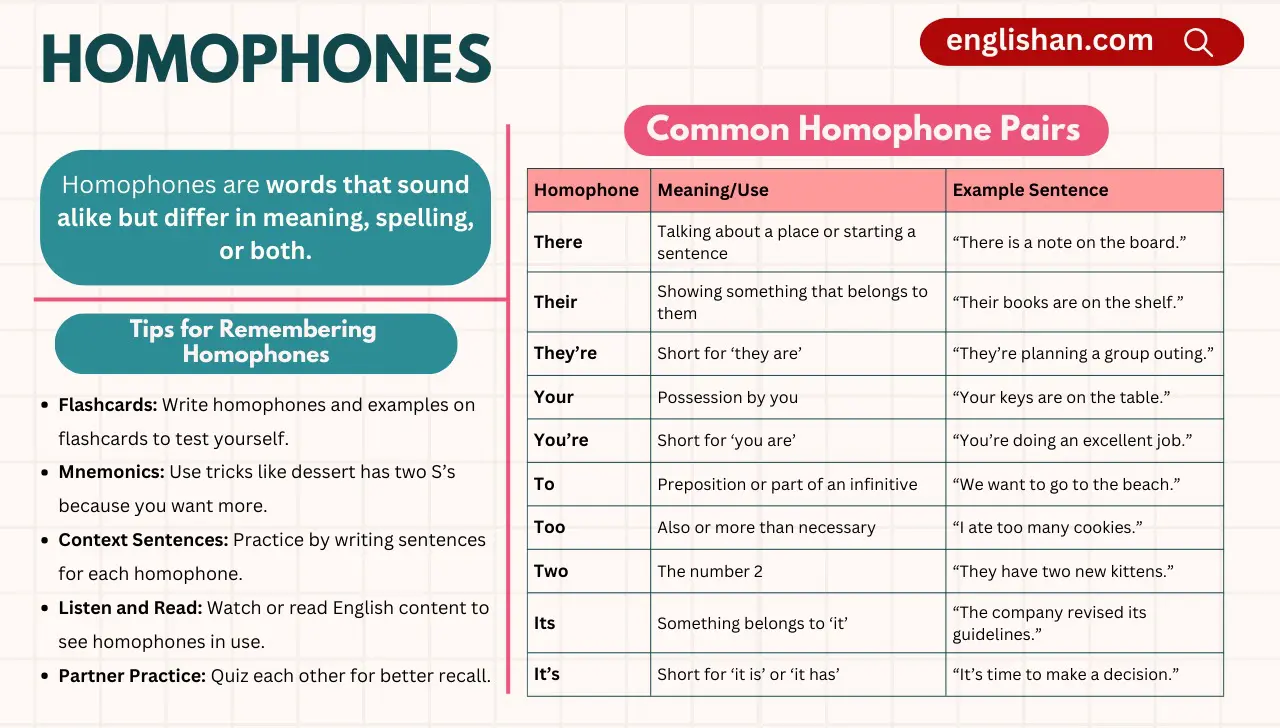
Homophones in English grammar are words that sound the same when spoken but carry different meanings, spellings, or both. They are easy to miss in speech because the ear hears the same sound, but writing exposes the difference: there points to a place, their shows possession, and they’re means they are.
That is why homophones are not only vocabulary words. They affect grammar, spelling, meaning, and sentence accuracy. To choose the right one, you need to read the sentence for context, check the word’s function, and ask what meaning the sentence requires.
Key Takeaways
- Homophones sound the same but differ in meaning, spelling, or usage.
- Context tells you which spelling belongs in the sentence.
- Pronouns, contractions, and possessives cause many homophone mistakes.
- Grammar clues are more reliable than sound when you write.
What Are Homophones in English Grammar?
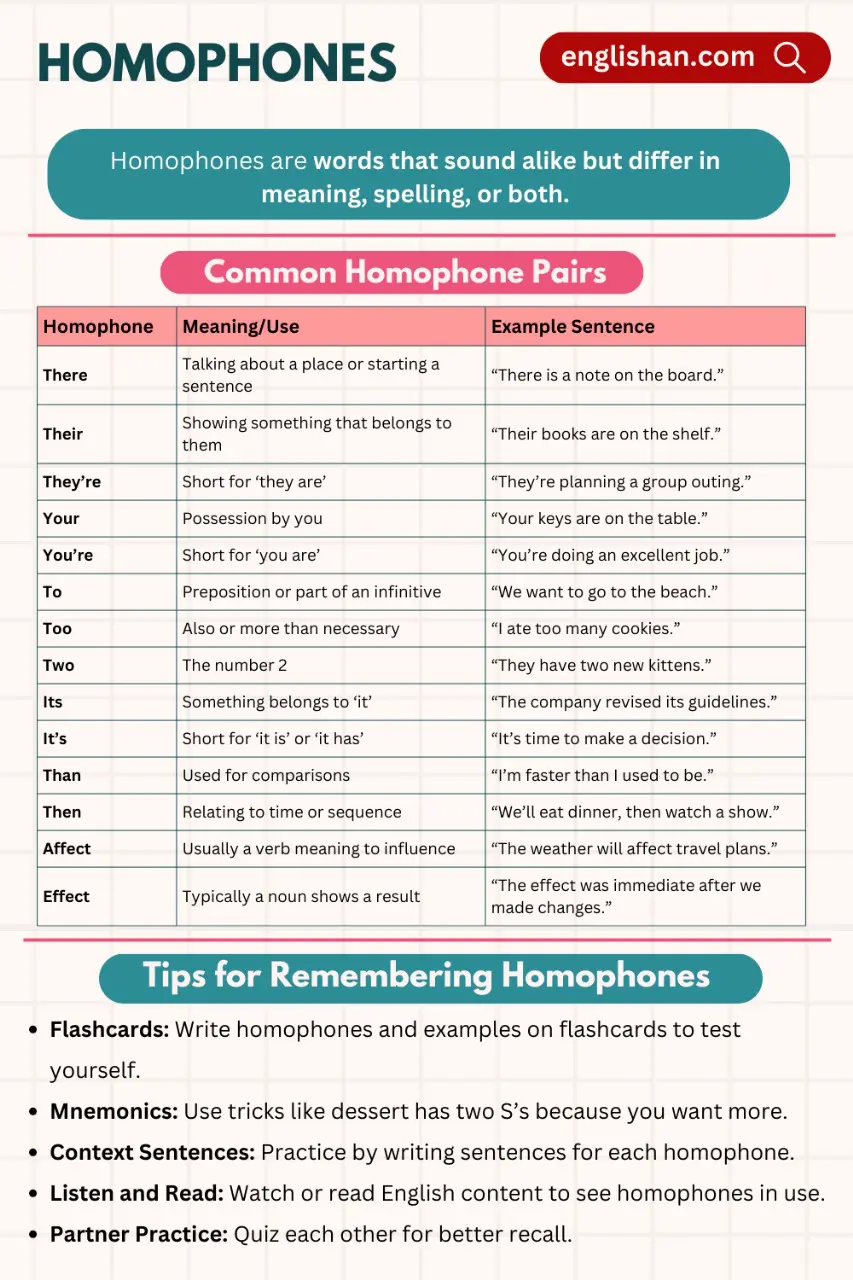
Homophones are words with the same pronunciation but different meanings. Many homophones also have different spellings, such as to, too, and two. Some overlap with other word categories, but the main test is sound: if two words are pronounced alike and mean different things, they are homophones.
The word homophone comes from Greek roots meaning “same sound.” In English grammar, homophones become important because spelling often carries grammar information that pronunciation does not show.
- Your is a possessive adjective.
- You’re is a contraction of you are.
- There can point to a place.
- Their shows possession.
- They’re is a contraction of they are.
In speech, these differences disappear. In writing, they decide whether the sentence is correct.
Homophones Examples in Sentences
A homophone becomes easier to understand when you see it inside a sentence. The spelling changes because the meaning changes.
| Homophones | Meaning Clue | Example Sentence |
|---|---|---|
| To | Direction or infinitive verb marker | She walked to the station before noon. |
| Too | Also or more than needed | The tea is too hot to drink. |
| Two | Number 2 | We bought two tickets for the show. |
| There | Place or position | The keys are there on the table. |
| Their | Belonging to them | Their house has a blue gate. |
| They’re | They are | They’re waiting outside the office. |
| Your | Belonging to you | Your answer is correct. |
| You’re | You are | You’re improving every week. |
| Hear | Listen with your ears | I can hear music from the next room. |
| Here | In this place | Please sit here. |
| Know | Have information | I know the answer. |
| No | Negative answer | No, that is not the right file. |
| Right | Correct or direction | Your answer is right. |
| Write | Form words on a page | Write your name at the top. |
| Peace | Calm or freedom from conflict | The village returned to peace. |
| Piece | A part of something | She gave me a piece of cake. |
These examples show the real grammar problem: the sentence sound alone cannot choose the spelling. The meaning around the word does that work.
Homophones, Homonyms, And Homographs
Homophones, homonyms, and homographs are related terms, but they do not name the same thing. Learners confuse them because all three deal with words that look or sound alike.
| Term | Main Idea | Example |
|---|---|---|
| Homophones | Same sound, different meaning | Sea and see |
| Homographs | Same spelling, different meaning or pronunciation | Bow as a weapon and bow on a ship |
| Homonyms | Same sound or spelling, different meaning | Bat as an animal and bat used in sports |
For everyday writing, focus first on homophones. They cause the most common spelling mistakes because your ear gives you the same pronunciation for two or more different words.
A useful learner test is this: if the words sound alike but need different spellings in writing, treat them as homophones and check the sentence meaning before choosing one.
Why Homophones Cause Writing Mistakes
Homophones cause mistakes because spoken English hides the spelling difference. When you say their, there, and they’re, the listener understands the meaning from context. On the page, the reader sees the spelling, so the wrong form looks like a grammar error.
The mistake usually comes from one of four places.
1. The Words Belong To Different Grammar Jobs
Your describes something that belongs to the person you are speaking to. You’re joins two words: you are. They sound identical, but they do different work in the sentence.
- Your handwriting is neat. ✅
- You’re handwriting is neat. ❌
2. A Contraction Sounds Like Another Word
It’s means it is or it has. Its shows possession. The apostrophe changes the grammar, not the sound.
- It’s raining again. ✅
- The dog wagged its tail. ✅
3. The Sentence Needs A Specific Part Of Speech
Affect is usually a verb. Effect is usually a noun. If the sentence needs an action, affect is the safer choice. If it needs a result, effect is usually correct.
- The weather can affect your mood. ✅
- The medicine had a strong effect. ✅
4. Spell-Check May Not Catch The Mistake
A spelling checker may accept both peace and piece because both are real words. The error is not spelling alone. It is meaning.
Common Homophones in English Grammar
The most valuable homophones are the ones that appear often in real writing. These pairs and groups cause errors in schoolwork, emails, essays, captions, and workplace messages.
There, Their, And They’re
Use there for place, their for possession, and they’re for they are.
| Word | Use | Example |
|---|---|---|
| There | Place or existence | There is a mistake in this sentence. |
| Their | Belonging to them | Their teacher checked the homework. |
| They’re | They are | They’re ready for the exam. |
Quick test: replace the word with they are. If the sentence still works, use they’re.
- They’re coming at six. ✅
- Their coming at six. ❌
Your And You’re
Use your before a noun that belongs to the person you are addressing. Use you’re when you mean you are.
- Your idea sounds practical. ✅
- You’re responsible for the final draft. ✅
- Your going to enjoy this lesson. ❌
- You’re notebook is on the desk. ❌
Quick test: read the sentence with you are. If it sounds right, use you’re.
To, Too, And Two
Use to for direction or before a verb, too for also or excess, and two for the number.
- She went to the library.
- I want to improve my writing.
- He is too tired to continue.
- I have two questions.
The mistake often appears before verbs. Use to before a base verb: to write, to learn, to speak.
Its And It’s
Use its for possession. Use it’s when you mean it is or it has.
- The company changed its policy.
- It’s difficult to choose the right word.
- The cat cleaned it’s paws. ❌
- Its raining outside. ❌
Quick test: expand the word to it is or it has. If the sentence works, use it’s. If not, use its.
Who’s And Whose
Use who’s for who is or who has. Use whose for possession.
- Who’s calling at this hour?
- Whose bag is near the door?
- Who’s book is this? ❌
- Whose going to answer? ❌
Quick test: replace the word with who is. If the sentence still makes sense, use who’s.
Affect And Effect
Use affect mostly as a verb meaning to influence. Use effect mostly as a noun meaning a result.
- Loud noise can affect concentration.
- The new rule had an immediate effect.
- The rain effected the match. ❌
- The effect of the rain was obvious. ✅
This pair is harder because both words can appear in formal English with other uses, but the common learner rule works in most everyday sentences: action takes affect, result takes effect.
Than And Then
Use than for comparison. Use then for time or sequence.
- She is taller than her brother.
- Finish your work, then take a break.
- I would rather stay than leave.
- We ate dinner and then watched a movie.
Quick test: if you are comparing two people, things, or ideas, use than.
Accept And Except
Use accept when someone receives or agrees to something. Use except when something is left out.
- She accepted the invitation.
- Everyone passed except Ali.
- I accept your apology.
- The shop is open every day except Friday.
The first letter gives a memory clue: except often excludes something.
Principal And Principle
Use principal for the head of a school or the main person or amount. Use principle for a rule, belief, or standard.
- The principal spoke to the students.
- Honesty is an important principle.
- The principal reason was cost.
- He refused on principle.
Quick test: if it means a rule or belief, use principle.
Compliment And Complement
Use compliment for praise. Use complement for something that completes or improves another thing.
- She gave him a sincere compliment.
- The blue scarf complements her dress.
- Thank you for the compliment.
- The sauce is a perfect complement to the meal.
A compliment is something kind you say. A complement is something that fits well with another thing.
Weather And Whether
Use weather for conditions such as rain, wind, heat, or cold. Use whether when showing a choice or possibility.
- The weather changed quickly.
- I do not know whether he will come.
- We stayed inside because of the weather.
- Ask whether the office is open.
Quick test: if the sentence involves a choice, use whether.
More Common Homophone Pairs
| Homophones | Meaning Difference | Example |
|---|---|---|
| Allowed, Aloud | Permitted, spoken out loud | Students are allowed to read aloud. |
| Brake, Break | Stop a vehicle, damage or pause | Press the brake before you break the rule. |
| By, Buy, Bye | Near or through, purchase, farewell | She stood by the shop to buy bread and say bye. |
| Cell, Sell | Small room or phone unit, give for money | They sell phones with long battery cell life. |
| Cite, Site, Sight | Quote, place, vision | Cite the source on the site after checking the sight line. |
| Dear, Deer | Beloved, animal | Dear Sara saw a deer near the road. |
| Flour, Flower | Powder for baking, plant bloom | She bought flour and a flower. |
| Knew, New | Past of know, recent | I knew the new teacher. |
| Night, Knight | Dark part of day, armored warrior | The knight rode at night. |
| One, Won | Number 1, past of win | One team won the match. |
| Plain, Plane | Simple or flat area, aircraft | The plane crossed the plain. |
| Rain, Rein, Reign | Water from clouds, horse strap, rule | The king’s reign continued despite heavy rain. |
| Sea, See | Ocean, look | We can see the sea from here. |
| Stationary, Stationery | Not moving, writing materials | The stationary bike stood near the stationery shelf. |
| Weak, Week | Not strong, seven days | He felt weak for a week. |
| Which, Witch | Choice word, magical character | Which story has a witch? |
Pronoun Homophones
Pronoun homophones deserve special attention because they make a sentence look grammatically wrong even when the meaning is easy to guess. The reader may understand you, but the error weakens the sentence.
There, Their, They’re
- There is a new message in your inbox. ✅
- Their new message is in your inbox. ❌
- They’re checking the message now. ✅
Your, You’re
- Your phone is on silent. ✅
- You’re phone is on silent. ❌
- You’re speaking too fast. ✅
Who’s, Whose
- Who’s at the door? ✅
- Whose keys are these? ✅
- Whose going to lead the meeting? ❌
A good pronoun check is to ask whether the word shows possession or replaces two words. Possession needs your, their, or whose. A contraction needs you’re, they’re, or who’s.
Apostrophe Homophones
Apostrophes create many homophone mistakes because contractions sound like possessive words. The apostrophe marks missing letters, not possession in every case.
| Contraction | Full Form | Homophone Pair |
|---|---|---|
| It’s | It is or it has | Its |
| You’re | You are | Your |
| They’re | They are | Their, There |
| Who’s | Who is or who has | Whose |
Use the expansion test before writing a contraction.
- It’s late. = It is late. ✅
- The bird spread its wings. = The bird spread it is wings. ❌
The second expansion fails, so the possessive form its is correct.
How Grammar Helps You Choose The Right Homophone
Grammar gives you clues that sound cannot give. When two words sound the same, look at the job the word performs in the sentence.
Check The Noun After It
If the word comes before a noun and shows ownership, you probably need a possessive form.
- Your answer is correct.
- Their house is near the park.
- Whose notebook is this?
Check For A Verb Meaning
If the word acts as an action, you need the verb form.
- The decision will affect everyone.
- Please write your address clearly.
- I know the reason.
Check For A Noun Meaning
If the word names a thing, result, person, place, or idea, you need the noun form.
- The effect was immediate.
- The site is under construction.
- She gave me a piece of advice.
Check For Comparison
Comparison needs than, not then.
- This bag is lighter than that one.
- I would rather walk than wait.
Check For Time Order
Sequence needs then, not than.
- We reviewed the lesson, then took the quiz.
These checks turn homophones from memory work into grammar decisions.
How To Choose The Correct Homophone
Use this quick process whenever two same-sound words confuse you.
- Read The Whole Sentence First.
Do not choose from sound alone. The sentence meaning decides the spelling. - Replace Contractions With Their Full Forms.
Use you are for you’re, they are for they’re, it is for it’s, and who is for who’s. - Find The Word’s Grammar Job.
Ask whether the sentence needs a noun, verb, adjective, possessive, or comparison word. - Use A Meaning Clue.
If the sentence talks about a place, use there. If it talks about ownership, use their. - Check The Sentence Again After Choosing.
A correct homophone should make the sentence sound natural and carry the right meaning.
Short memory clues also work:
- Too has an extra o because it can mean extra or also.
- Piece contains pie, and a piece of pie is a part.
- Stationery has e for envelope.
- Principal ends with pal, and a school principal can be a person.
FAQs
Homophones are words that sound the same when spoken but have different meanings, spellings, or both. Sea and see are homophones because they sound alike but mean different things.
Common examples include to, too, two, there, their, they’re, your, you’re, its, it’s, hear, here, know, no, right, write, peace, piece, weather, whether, and than, then.
Homophones sound the same but differ in meaning. Homographs are spelled the same but differ in meaning or pronunciation, such as bow as a weapon and bow on a ship.
Yes. There, their, and they’re are homophones because they share the same pronunciation but have different meanings and spellings.
You May Also Like
Homophones Quiz
Homophones
Choose the correct pair.
___ going to love ___ new house.
'They're' means 'they are'; 'their' shows possession.
they're = they are; their = possession; there = place
They're going to love their new house.
Choose the correct word.
___ late again.
'You're' means 'you are'.
you're = you are; your = possession
You're late again.
Choose the correct pair.
The cat licked ___ paw; ___ hungry.
'Its' shows possession; 'it's' means 'it is'.
it's = it is; its = possession
The cat licked its paw; it's hungry.
Type the correct word.
I can't decide ___ to go or stay.
'Whether' introduces a choice; 'weather' names the climate.
whether = choice; weather = climate
I can't decide whether to go or stay.
Choose the correct pair.
The news did not ___ him, but the ___ was lasting.
'Affect' is the verb to influence; 'effect' is the noun for a result.
affect = verb; effect = noun
The news did not affect him, but the effect was lasting.
Choose the correct set.
I want ___ come ___, and I'll bring ___ friends.
'To' marks the infinitive, 'too' means also, 'two' is the number.
to = infinitive; too = also; two = 2
I want to come too, and I'll bring two friends.
Choose the right homophone.
___ going to love the surprise.
'They're' is the contraction of 'they are', which fits the sentence.
they're = they are; their = possessive; there = place
They're going to love the surprise.
Choose the right homophone.
The cat licked ___ paws.
'Its' shows possession without an apostrophe.
its = belonging to it; it's = it is / it has
The cat licked its paws.
Choose the right homophone.
___ book is on the table.
'Your' shows possession of the book.
your = possessive; you're = you are
Your book is on the table.
Type the correct homophone (two / too / to).
I bought ___ tickets for the show.
The number before a plural noun is 'two', not the adverb 'too' or the preposition 'to'.
two = the number; too = also; to = preposition
I bought two tickets for the show.
True or false?
'It's' means 'belonging to it.'
'It's' means 'it is' or 'it has'; the possessive is 'its' with no apostrophe.
it's = it is / it has; its = possessive
The dog wagged its tail because it's happy.
Choose the right homophone.
Let's meet ___ at noon.
'There' points to the place of the meeting.
there = place; their = possessive; they're = they are
Let's meet there at noon.
Choose the right homophone.
The wind ___ hard last night.
'Blew' is the past of 'blow'; 'blue' names a colour.
blew = past of blow; blue = colour
The wind blew hard last night.
Choose the right homophone.
I ate a ___ of cake.
'Piece' names a portion; 'peace' names calm.
piece = portion; peace = calm
I ate a piece of cake.
Choose the right homophone.
She has long ___ .
'Hair' grows on the head; 'hare' is an animal.
hair = on the head; hare = animal
She has long hair.
Choose the right homophone.
Turn ___ at the corner.
'Right' names the direction; 'write' means to put words on paper.
right = direction; write = form words
Turn right at the corner.
Type the correct homophone (their / there / they're).
The players rode ___ bikes home.
'Their' shows that the bikes belong to the players.
their = possessive
The players rode their bikes home.
True or false?
'Whose' and 'who's' mean the same thing.
'Whose' shows possession; 'who's' is the contraction of 'who is'.
whose = possessive; who's = who is
Whose coat is this, and who's wearing it?
Choose the right homophone.
___ coming to the party?
'Who's' is the contraction of 'who is'.
who's = who is; whose = possessive
Who's coming to the party?
Choose the right homophone.
The recipe needs two cups of ___ .
'Flour' is the baking ingredient; 'flower' grows in a garden.
flour = baking ingredient; flower = plant
The recipe needs two cups of flour.
Turn on JavaScript for the interactive quiz. The full practice set is shown above.