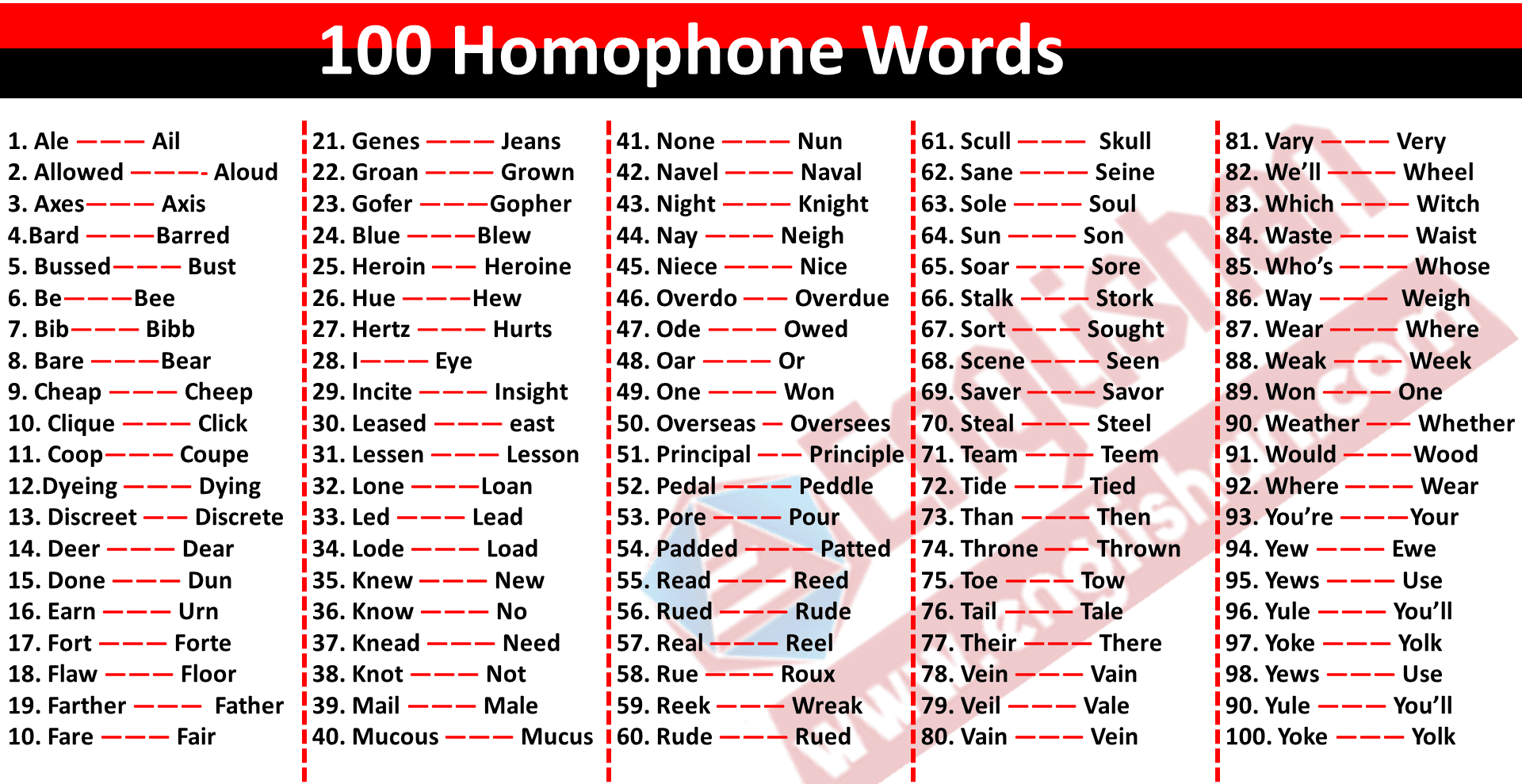
Some words in English sound exactly the same but have different spellings and different meanings. These words are called homophones. For example, their, there, and they’re all sound the same when you say them out loud, but each one means something different in a sentence.
Simple homophones examples make these words easier to learn. The word flour is the powder used to make bread. The word flower is the colorful part of a plant. Both words sound the same, but the spelling and the meaning are not the same. Once you see the difference clearly, the right word becomes easier to choose.
Below, you will learn the most common homophones in English with easy example sentences for each pair. You will see how each word is spelled, what it means, and how to use it correctly in your own writing.
What Are Homophones?
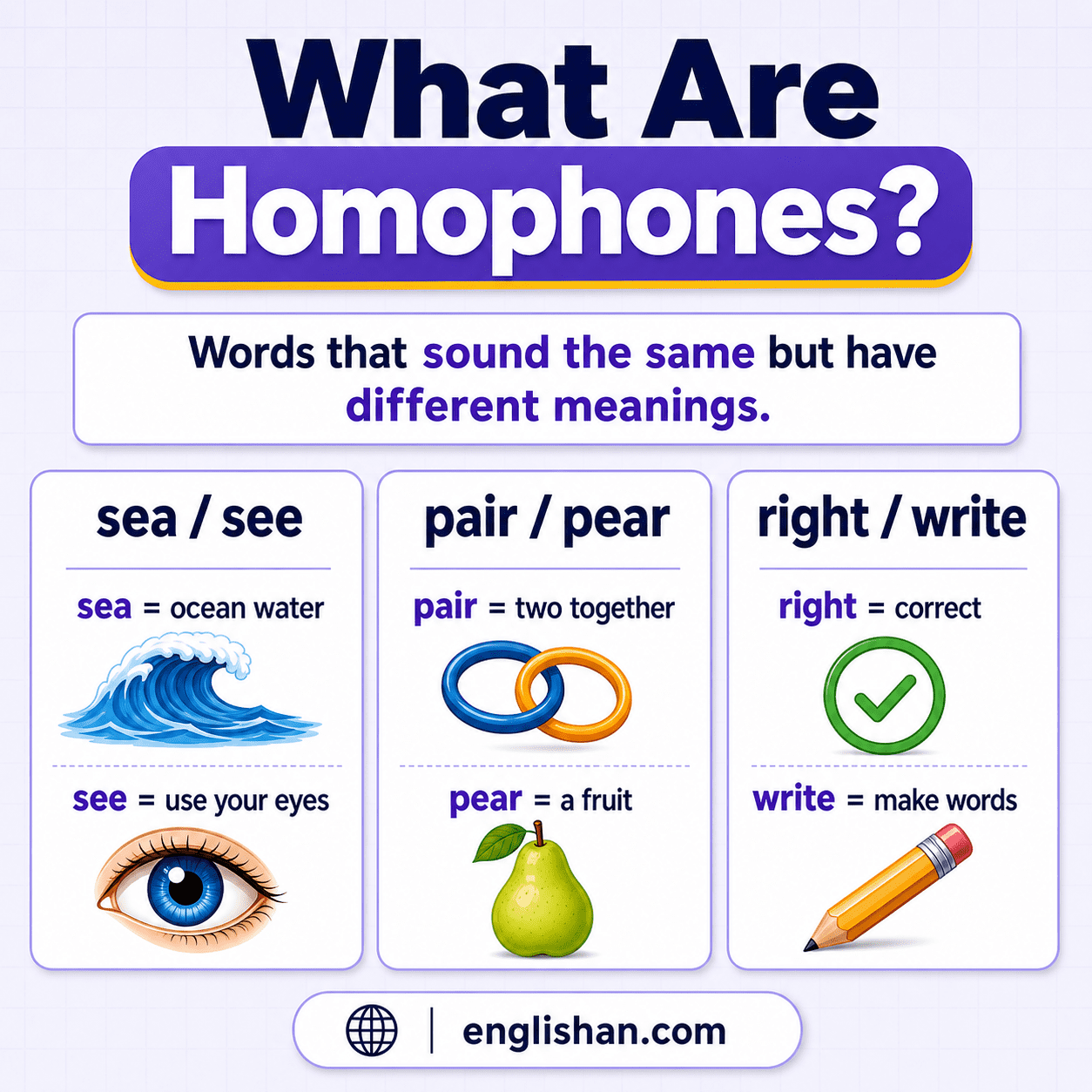
Homophones are words that sound the same but have different meanings. Many homophones also have different spellings, such as sea and see. Some come in pairs, while others come in groups of three, such as to, too, and two.
The sound alone does not tell you the right spelling. The sentence gives the clue.
- I can see the boat on the sea.
- She ate eight grapes.
- Please write the right answer.
Quick Homophones Examples
Here are common homophones you will meet often in daily English.
- Sea / See
Sea means a large body of salt water. See means to look with your eyes.
I can see waves in the sea. - Sun / Son
Sun is the star that gives Earth light. Son is a male child.
My son played outside in the sun. - Flour / Flower
Flour is a powder used for baking. A flower is the colorful part of a plant.
She used flour to bake bread and placed a flower on the table. - Right / Write
Right means correct or the opposite of left. Write means to form words.
Write the right answer in your notebook. - Hear / Here
Hear means to receive sound with your ears. Here means in this place.
I can hear music here. - No / Know
No means not any or not allowed. Know means to understand or remember.
I know the answer is no.
Homophones Examples List From A to Z
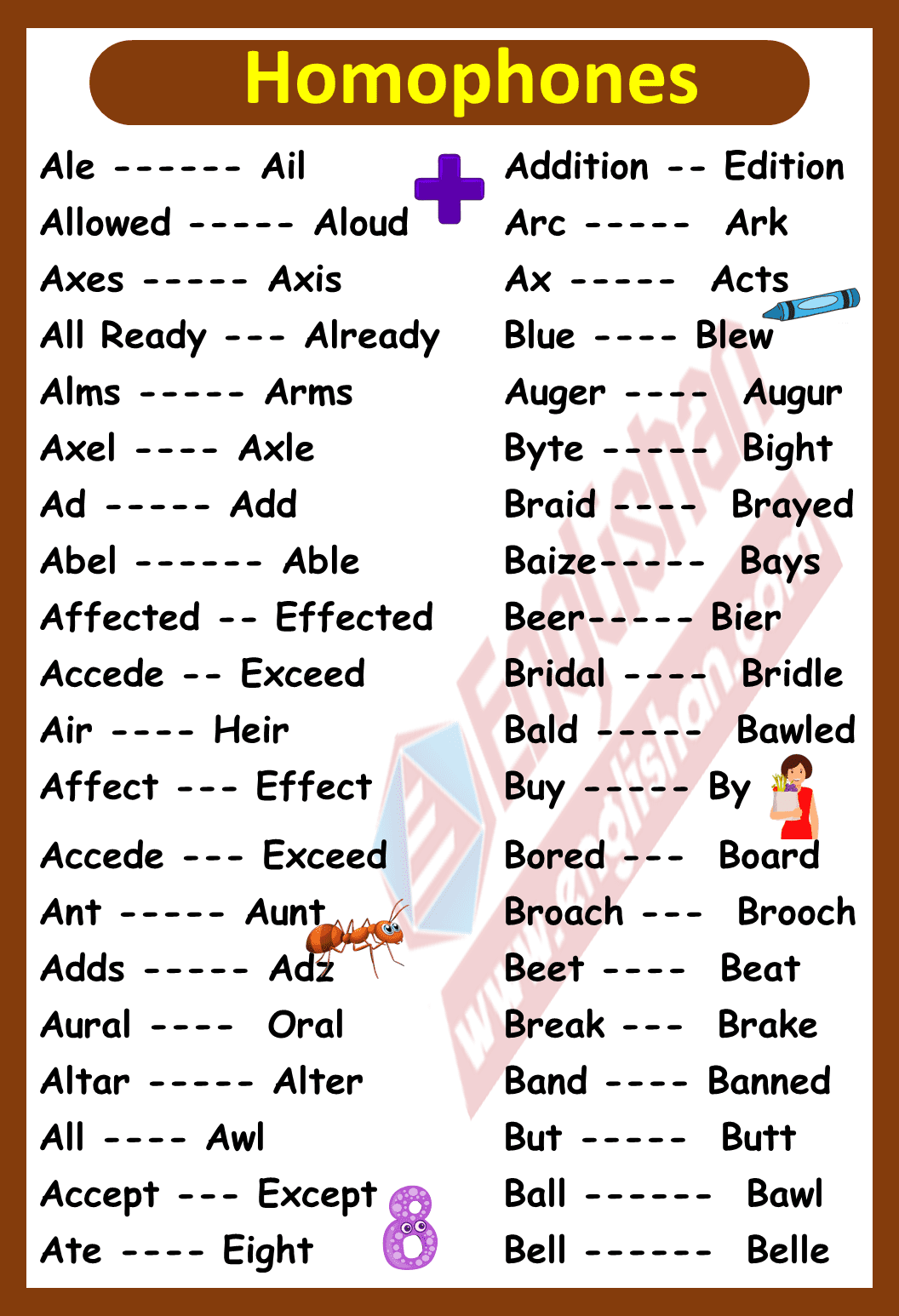
Use each pair with its meaning and sentence. The example sentence shows how the spelling changes with the meaning.
Homophones Examples A to D
- Ad / Add
An ad is a short advertisement. Add means to put something with something else.
The ad says to add one cup of milk. - Ail / Ale
Ail means to trouble or make someone feel unwell. Ale is a type of beer.
The old injury may ail him, but he still ordered ale. - Air / Heir
Air is the gas around us. An heir is a person who receives money, property, or a title after someone dies.
The heir walked outside for fresh air. - Allowed / Aloud
Allowed means permitted. Aloud means spoken so others can hear.
We are allowed to read aloud in class. - Ate / Eight
Ate is the past tense of eat. Eight is the number after seven.
She ate eight strawberries. - Bare / Bear
Bare means uncovered. A bear is a large wild animal.
The bear walked across the bare ground. - Be / Bee
Be means to exist or stay in a state. A bee is a flying insect that makes honey.
Be still if a bee flies near you. - Blew / Blue
Blew is the past tense of blow. Blue is a color.
The wind blew the blue kite across the field. - Board / Bored
A board is a flat piece of wood or another firm material. Bored means not interested.
He sat on the board because he was bored. - Brake / Break
A brake stops a vehicle. Break means to damage, crack, or separate something.
Press the brake before you break the gate. - Buy / By / Bye
Buy means to purchase. By shows nearness or who did something. Bye is a short goodbye.
I will buy snacks by the shop, then say bye. - Cell / Sell
A cell is a small unit, room, or part of a living thing. Sell means to give something for money.
The shop will sell a phone with a stronger battery cell. - Cent / Scent / Sent
A cent is a small unit of money. Scent means smell. Sent is the past tense of send.
He sent a rose with a sweet scent and one cent in the envelope. - Cereal / Serial
Cereal is a breakfast food made from grain. Serial means happening in a series.
She ate cereal while watching a serial drama. - Cite / Sight / Site
Cite means to quote or mention a source. Sight means the ability to see or something seen. Site means a place.
The writer will cite the report about the old site in plain sight. - Coarse / Course
Coarse means rough. A course can mean a class, route, or part of a meal.
The course path had coarse stones. - Dear / Deer
Dear means loved or valued. A deer is a hoofed animal with slender legs.
My dear friend saw a deer near the trees. - Die / Dye
Die means to stop living. Dye means to color something.
Do not let the plant die before you dye the cloth green. - Doe / Dough
A doe is a female deer or rabbit. Dough is the soft mixture used to make bread or pastry.
A doe stood near the kitchen where the dough was rising. - Dual / Duel
Dual means having two parts. A duel is a fight between two people.
The story has a dual ending after the final duel.
Homophones Examples E to H
- Eye / I
An eye is the body part used for sight. I is the pronoun a person uses for themselves.
I hurt my eye while playing outside. - Fair / Fare
Fair can mean just, light-colored, or a public event. Fare is the money paid for travel.
The bus fare seemed fair to everyone. - Feat / Feet
A feat is an impressive act. Feet are the plural of foot.
Running ten miles on tired feet was a real feat. - Flew / Flu
Flew is the past tense of fly. Flu is an illness.
He flew home before the flu became worse. - Flour / Flower
Flour is used for baking. A flower grows on a plant and often has petals.
The baker dropped flour near the flower vase. - For / Four / Fore
For shows purpose or direction. Four is a number. Fore means front or before, often in special uses.
He waited for four people near the fore deck. - Foul / Fowl
Foul means dirty, unpleasant, or against the rules. Fowl means a bird, especially one raised for food.
The fowl ran away from the foul-smelling pond. - Grate / Great
Grate means to shred food into small pieces or can mean a metal frame. Great means very good, large, or important.
It was a great idea to grate the cheese first. - Hair / Hare
Hair grows on the body. A hare is a fast-running animal similar to a rabbit.
The hare had soft brown hair around its ears. - Hail / Hale
Hail is frozen rain or a greeting. Hale means healthy and strong, often in the phrase hale and hearty.
The hale farmer watched hail fall on the roof. - Hall / Haul
A hall is a passage or large room. Haul means to pull or carry something heavy.
They had to haul the chairs through the hall. - Hear / Here
Hear means to receive sound. Here means in this place.
Come here so I can hear you better. - Heal / Heel
Heal means to become healthy again. A heel is the back part of the foot or shoe.
The cut on my heel will heal soon. - Him / Hymn
Him is a male pronoun. A hymn is a religious song.
The choir sang a hymn for him. - Hoarse / Horse
Hoarse means rough or weak in voice. A horse is a large animal people ride.
The rider sounded hoarse after calling the horse all morning. - Hole / Whole
A hole is an empty space or opening. Whole means complete.
The whole wall had one small hole. - Hour / Our
An hour is sixty minutes. Our means belonging to us.
Our train leaves in one hour.
Homophones Examples I to L
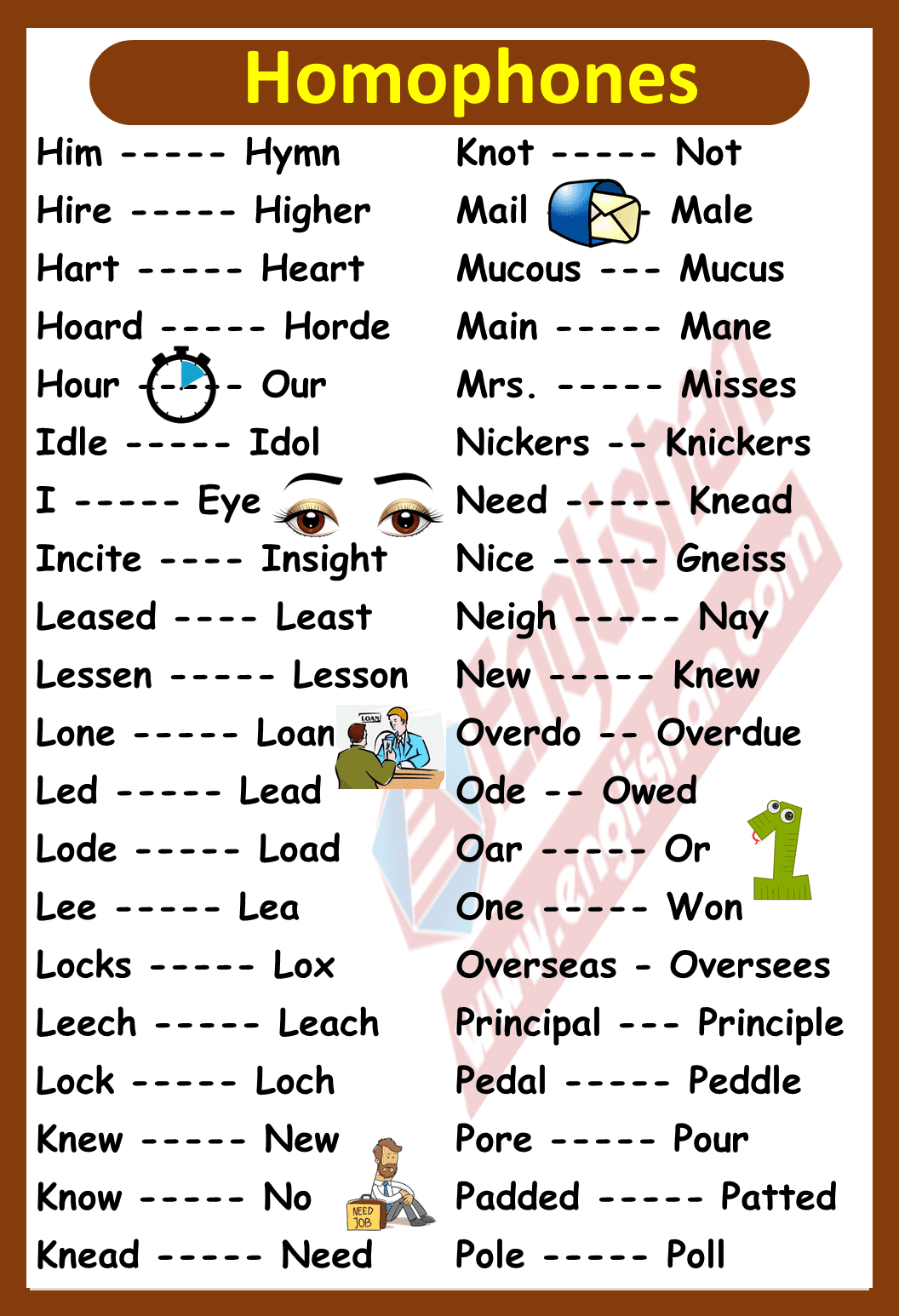
- Idle / Idol
Idle means inactive or not working. An idol is someone or something admired or worshipped.
The idle singer became an idol after one song. - In / Inn
In means inside. An inn is a small place where travelers can stay.
We stayed in an old inn by the river. - Its / It’s
Its shows possession. It’s means it is or it has.
The dog wagged its tail because it’s happy. - Knew / New
Knew is the past tense of know. New means recent or not old.
She knew the new rule already. - Knight / Night
A knight was a warrior in armor. Night is the dark part of the day.
The knight rode through the night. - Knot / Not
A knot is a tied loop or twist. Not makes a sentence negative.
Do not pull the knot too tight. - Leak / Leek
A leak is an unwanted escape of liquid or gas. A leek is a long green vegetable.
A leak dripped beside the basket of leeks. - Led / Lead
Led is the past tense of lead. Lead is a heavy metal when pronounced like led.
The worker led us past a pipe made of lead. - Lessen / Lesson
Lessen means to reduce. A lesson is something taught or learned.
The lesson may lessen your spelling mistakes. - Liar / Lyre
A liar is someone who tells lies. A lyre is a stringed musical instrument.
The story blamed a liar who stole a golden lyre. - Loan / Lone
A loan is borrowed money or something borrowed. Lone means single or alone.
The lone farmer asked for a small loan. - Loot / Lute
Loot means stolen goods or to steal during disorder. A lute is a stringed musical instrument.
The thief hid the loot inside an old lute case.
Homophones Examples M to P
- Made / Maid
Made is the past tense of make. A maid is a female worker who cleans or serves in a house or hotel.
The maid made the bed before noon. - Mail / Male
Mail means letters and packages. Male means a boy, man, or male animal.
The male nurse brought the mail inside. - Meat / Meet
Meat is animal flesh used as food. Meet means to come together.
We will meet at the café that serves grilled meat. - Might / Mite
Might means may or shows strength. A mite is a tiny creature.
A mite might live in dusty cloth. - Morning / Mourning
Morning is the early part of the day. Mourning means grief after a loss.
The family was mourning on a quiet morning. - None / Nun
None means not one. A nun is a woman who belongs to a religious community.
None of the visitors spoke to the nun. - One / Won
One is the number 1. Won is the past tense of win.
One runner won the race. - Pail / Pale
A pail is a bucket. Pale means light in color or weak-looking.
The pale child carried a pail of water. - Pair / Pear
A pair means two matching things. A pear is a sweet fruit.
She packed a pair of socks and a pear for lunch. - Passed / Past
Passed is the past tense of pass. Past means an earlier time or beyond a place.
We passed the school we visited in the past. - Pause / Paws
Pause means to stop briefly. Paws are animal feet with claws or pads.
The cat lifted its paws during the pause in the game. - Peace / Piece
Peace means calm or freedom from war. A piece is a part of something.
She wanted peace and a piece of cake. - Peak / Peek / Pique
A peak is the top of something. Peek means to look quickly. Pique means to arouse interest or irritation.
A peek at the mountain peak may pique your interest. - Plain / Plane
Plain can mean flat, ordinary, or easy to understand. A plane is an aircraft or a flat surface in math.
The plane crossed the plain at sunset. - Principal / Principle
A principal is the head of a school or the main person or thing. A principle is a rule, belief, or standard.
The principal spoke about the principle of honesty.
Homophones Examples Q to T
- Queue / Cue
A queue is a line of people or things waiting. A cue is a signal to act.
The actor waited in the queue for his cue. - Rain / Reign / Rein
Rain is water falling from clouds. Reign means the period or act of ruling. A rein is a strap used to control a horse.
During the king’s reign, riders held the rein through heavy rain. - Read / Red
Read sounds like red when it is the past tense of read. Red is a color.
I read the red sign yesterday. - Right / Write / Rite
Right means correct or the opposite of left. Write means to form words. A rite is a ceremony.
Write the right word beside the wedding rite. - Road / Rode
A road is a path for vehicles. Rode is the past tense of ride.
He rode his bike along the road. - Role / Roll
A role is a part or job. Roll means to move by turning over, or a small piece of bread.
Her role was to roll the dough. - Scene / Seen
A scene is a place in a story, play, film, or real event. Seen is the past participle of see.
I have seen that scene before. - Scent / Sent / Cent
Scent means smell. Sent means dispatched. A cent is a small coin value.
She sent a flower with a fresh scent and a single cent inside the card. - Sole / Soul
Sole means only one or the bottom of a foot or shoe. Soul means the spiritual part of a person.
The sole survivor spoke from the soul. - Son / Sun
Son is a male child. The sun is the star that lights Earth.
Her son smiled in the sun. - Stair / Stare
A stair is one step in a staircase. Stare means to look fixedly.
Do not stare while standing on the stair. - Steal / Steel
Steal means to take something unlawfully. Steel is a strong metal.
Someone tried to steal the steel tools. - Tail / Tale
A tail is the back part of an animal. A tale is a story.
The child told a tale about a fox with a long tail. - Team / Teem
A team is a group working together. Teem means to be full of something.
The pond began to teem with fish while the team watched. - Their / There / They’re
Their shows possession. There points to a place. They’re means they are.
Their bags are over there, and they’re ready to leave. - To / Too / Two
To shows direction, purpose, or connection. Too means also or more than needed. Two is the number 2.
I gave two books to Ali, and Sara wanted one too. - Toe / Tow
A toe is a part of the foot. Tow means to pull a vehicle or object.
The truck had to tow the car after he hurt his toe.
Homophones Examples U to Z
- Vain / Vein / Vane
Vain means too proud or unsuccessful. A vein carries blood in the body. A vane shows wind direction.
The vain sailor watched the weather vane and felt a vein throb in his hand. - Waist / Waste
Waist is the middle part of the body. Waste means to use carelessly or throw away.
Do not waste the belt that fits your waist. - Wait / Weight
Wait means to stay until something happens. Weight means heaviness.
Please wait while I check the weight of the bag. - Ware / Wear / Where
Ware means goods for sale. Wear means to have clothing on the body. Where asks about place.
Where can I wear this jacket near the shop selling kitchenware? - Way / Weigh
Way means path, method, or direction. Weigh means to measure how heavy something is.
The right way to weigh flour is with a scale. - Weak / Week
Weak means not strong. A week is seven days.
He felt weak for a week after the flu. - Weather / Whether
Weather means conditions such as rain, sun, wind, or snow. Whether means if or shows a choice.
I do not know whether the weather will change. - Which / Witch
Which asks about one or more choices. A witch is a person with magic powers in stories.
Which witch wore the black hat? - Yew / You / Ewe
A yew is a type of tree. You refers to the person being spoken to. A ewe is a female sheep.
You watched a ewe stand near the yew tree. - Yoke / Yolk
A yoke is a wooden frame used on animals or a burden. A yolk is the yellow part of an egg.
The farmer cleaned the yoke while the cook broke the yolk. - Your / You’re
Your shows ownership. You’re means you are.
Your answer is correct, and you’re ready for the next one.
Commonly Confused Homophones in Writing
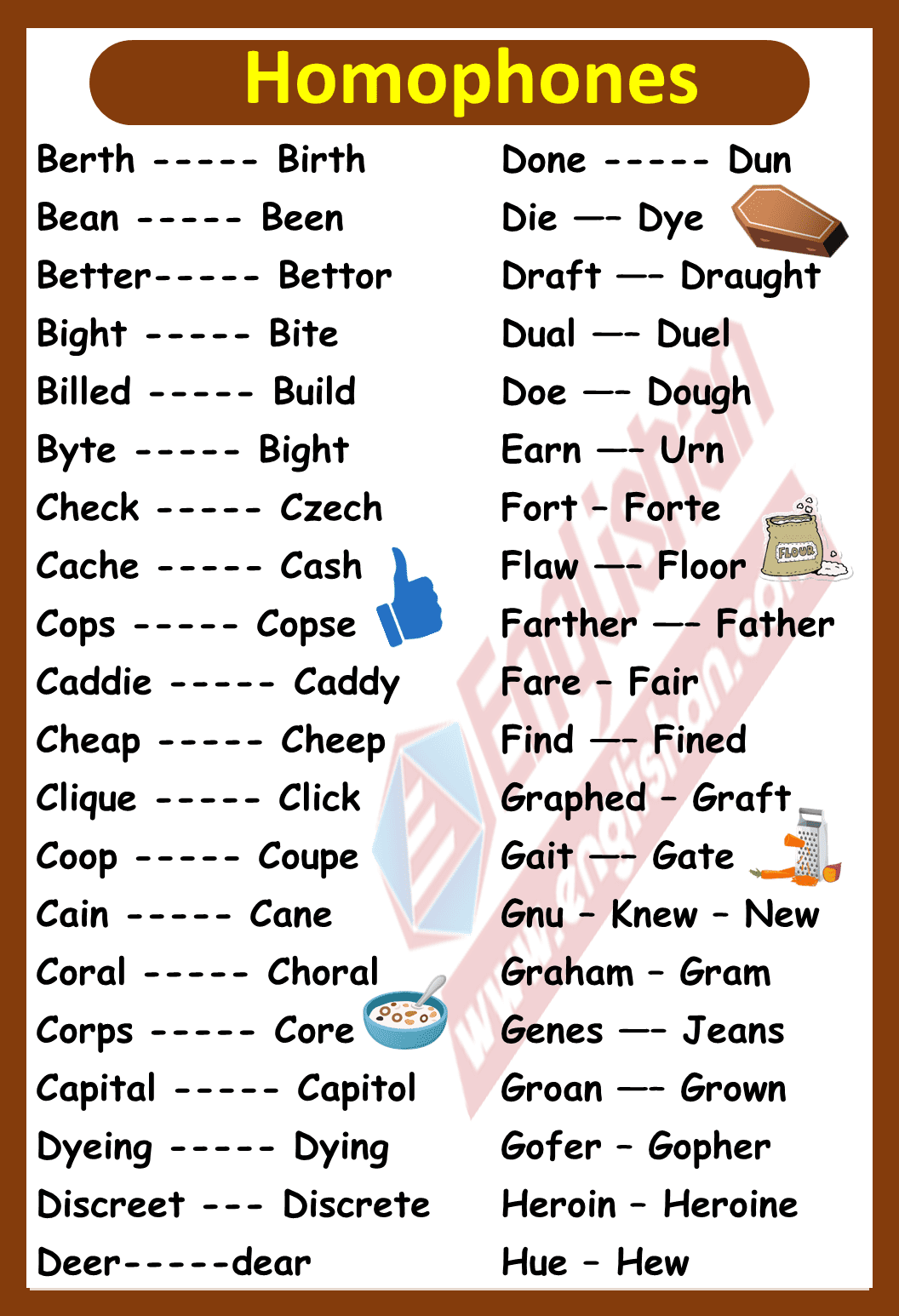
Some homophones cause more mistakes because both words are common in daily writing. These pairs deserve extra attention because the wrong spelling can change the whole sentence.
1. Their / There / They’re
Their shows ownership. There points to a place. They’re means they are.
- Their car is parked there.
- They’re waiting near the gate.
A quick test works well here. If you can say they are, use they’re.
2. To / Too / Two
To often shows direction or purpose. Too means also or more than needed. Two is the number.
- I gave two pencils to Sara.
- I want one too.
- The tea is too hot.
3. Your / You’re
Your shows that something belongs to someone. You’re means you are.
- Your bag is on the chair.
- You’re carrying the wrong bag.
If you are fits the sentence, write you’re.
4. Its / It’s
Its shows ownership. It’s means it is or it has.
- The bird opened its wings.
- It’s flying over the roof.
This pair is tricky because apostrophes often show ownership, but it’s is a contraction.
5. Affect / Effect
Affect is usually a verb. Effect is usually a noun.
- Lack of sleep can affect your focus.
- The effect was visible by noon.
A good shortcut: if you mean “change” as an action, affect is usually the right choice.
6. Principal / Principle
Principal can mean a school head or the main person or thing. Principle means a rule, belief, or standard.
- The principal spoke in the hall.
- Honesty is an important principle.
7. Brake / Break
Brake belongs to vehicles and stopping. Break means to damage, pause, or separate.
- Use the brake before the turn.
- Do not break the glass.
8. Peace / Piece
Peace means calm or freedom from fighting. Piece means a part of something.
- The village wanted peace.
- She cut a piece of bread.
Homophones Examples With Sentences
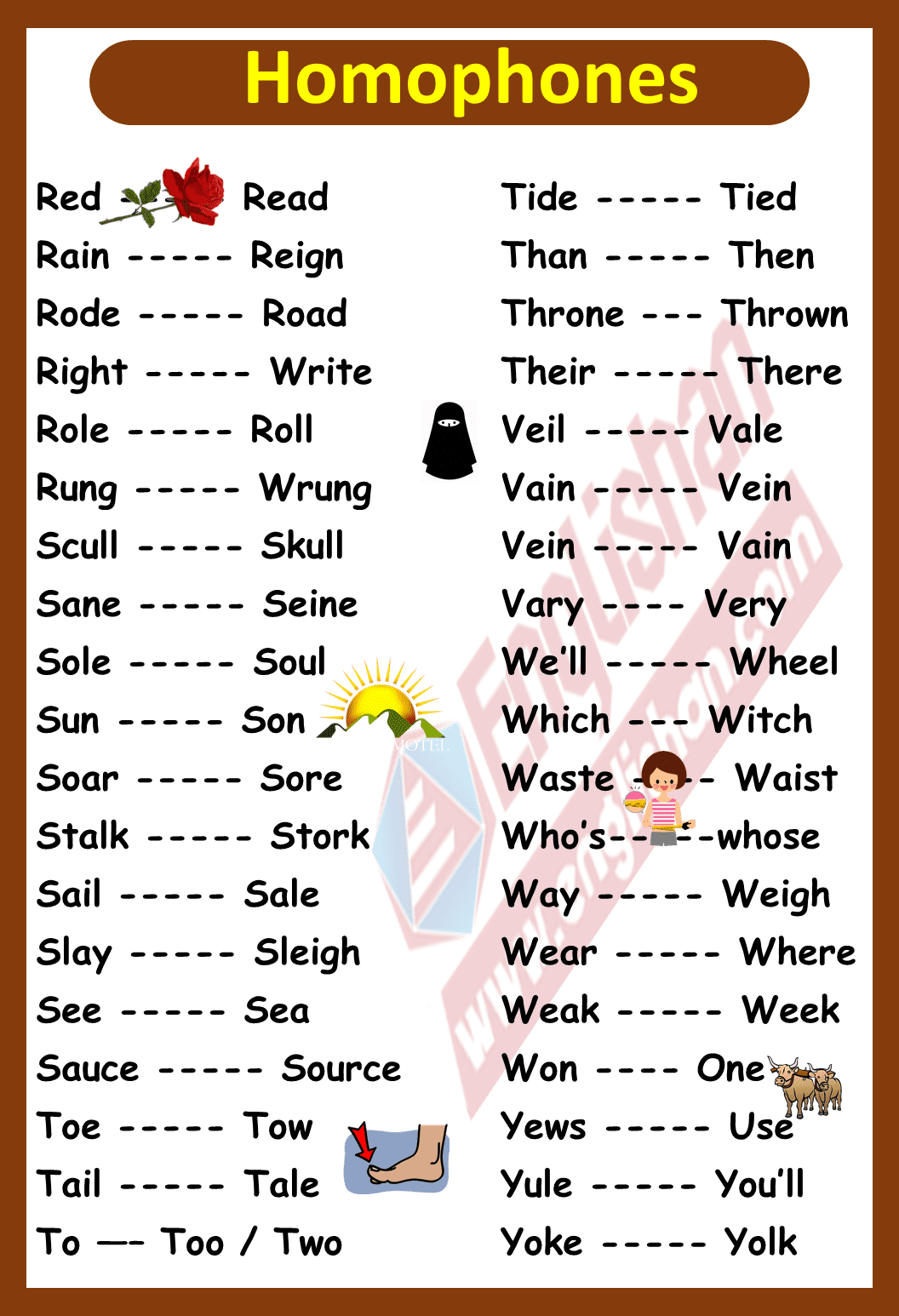
These sentence pairs show how meaning changes even when the sound stays the same.
- I can hear your voice from here.
- The sun is bright, and my son is outside.
- She bought flour to bake bread, not a flower.
- Please write the right answer.
- Their house is over there, and they’re waiting inside.
- We have two tickets, and I want to go too.
- The knight rode through the night.
- He walked by the shop to buy bread.
- The deer looked at my dear friend.
- The plane flew over the plain.
- The maid made the room neat.
- A bee landed near the place where I wanted to be.
- The whole wall had a small hole.
- The red sign said I had read the rule yesterday.
- The road was quiet when he rode home.
- A pair of shoes sat beside a ripe pear.
- The cat lifted its paws during the short pause.
- The team watched the river teem with fish.
- Please wait while I check the weight.
- I do not know whether the weather will improve.
Easy Homophones Examples for Kids
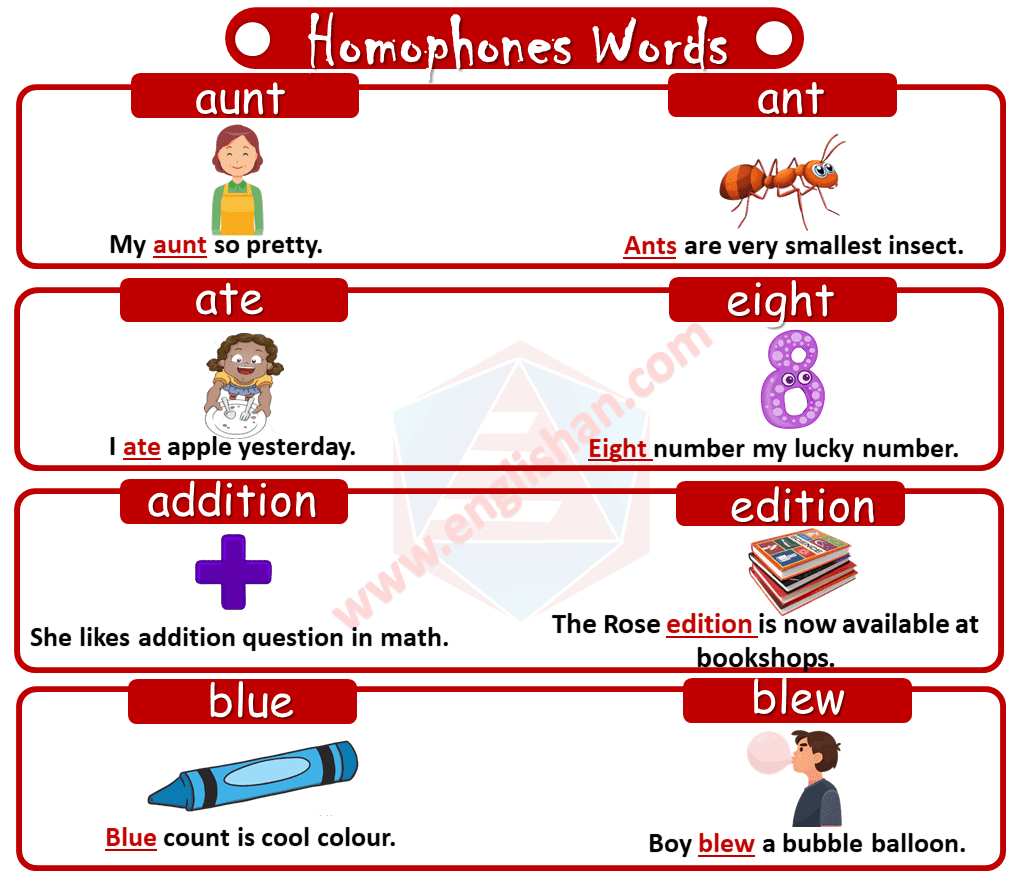
These pairs use familiar words, so they work well for early spelling practice and short sentence writing.
- Be / Bee
Be means to exist or stay in a state. A bee is a honey-making insect.
Be quiet when a bee flies near you. - No / Know
No means not any or not allowed. Know means to remember or understand.
I know the answer is no. - One / Won
One is a number. Won means became the winner.
One team won the match. - Blue / Blew
Blue is a color. Blew is the past tense of blow.
The wind blew the blue balloon away. - New / Knew
New means recent or not old. Knew means understood before now.
She knew the new song. - Sea / See
Sea means ocean water. See means to look.
I can see the sea from the window. - Tail / Tale
Tail is part of an animal. Tale means a story.
The tale was about a fox with a red tail. - Toe / Tow
A toe is part of the foot. Tow means to pull.
The truck will tow the car after I hurt my toe.
Homophones, Homonyms, and Homographs
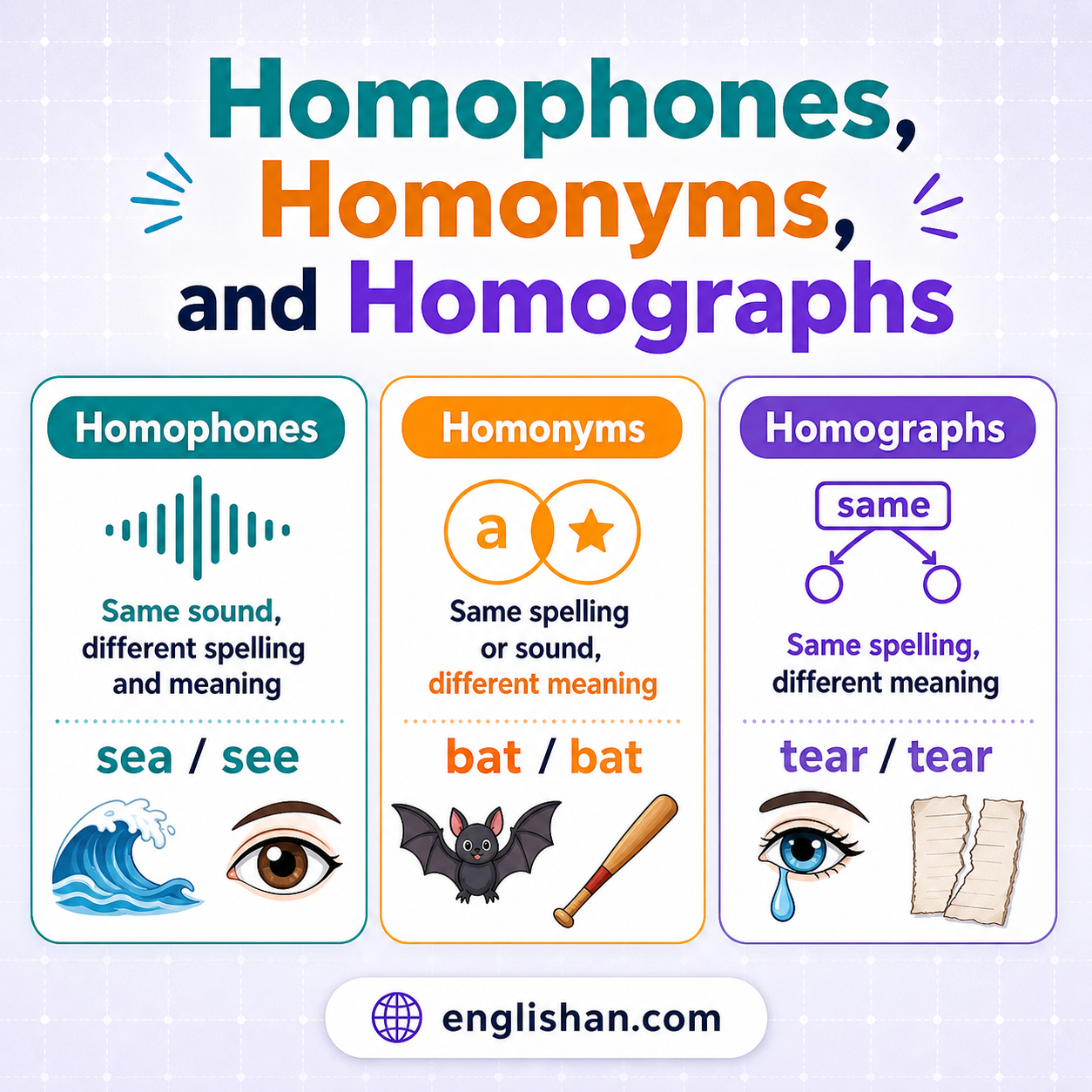
These three terms are related, but they do not mean exactly the same thing.
| Term | Meaning | Example |
|---|---|---|
| Homophones | Same sound, different meaning | sea / see |
| Homonyms | Same spelling or sound, different meaning | bat / bat |
| Homographs | Same spelling, different meaning or sound | lead / lead |
Homophones are the main focus here because they often create spelling mistakes. The sound may be right, but the written word must match the sentence.
How to Choose the Correct Homophone
The best way to choose the right homophone is to read the whole sentence, not just the word.
- Check the meaning first. If the sentence is about ocean water, use sea. If it is about looking, use see.
- Expand contractions. If you are fits, use you’re. If they are fits, use they’re.
- Look for ownership. Your, their, and its often show that something belongs to someone or something.
- Check the word’s job. Affect usually acts as a verb, while effect usually acts as a noun.
- Use a sentence test. Replace the word with its meaning and read the sentence again.
The sentence decides the spelling.
100 Homophones Examples
Here is a fast list of homophones for quick review.
- Ad / Add
- Ail / Ale
- Air / Heir
- Allowed / Aloud
- Ant / Aunt
- Ate / Eight
- Bare / Bear
- Be / Bee
- Beach / Beech
- Beat / Beet
- Blew / Blue
- Board / Bored
- Brake / Break
- Buy / By / Bye
- Cell / Sell
- Cent / Scent / Sent
- Cereal / Serial
- Cite / Sight / Site
- Coarse / Course
- Dear / Deer
- Die / Dye
- Doe / Dough
- Dual / Duel
- Eye / I
- Fair / Fare
- Feat / Feet
- Flew / Flu
- Flour / Flower
- For / Four / Fore
- Foul / Fowl
- Grate / Great
- Hair / Hare
- Hall / Haul
- Heal / Heel
- Hear / Here
- Hoarse / Horse
- Hole / Whole
- Hour / Our
- Idle / Idol
- In / Inn
- Its / It’s
- Knew / New
- Knight / Night
- Knot / Not
- Leak / Leek
- Led / Lead
- Lessen / Lesson
- Liar / Lyre
- Loan / Lone
- Made / Maid
- Mail / Male
- Meat / Meet
- Might / Mite
- Morning / Mourning
- None / Nun
- One / Won
- Pail / Pale
- Pair / Pear
- Passed / Past
- Pause / Paws
- Peace / Piece
- Peak / Peek / Pique
- Plain / Plane
- Principal / Principle
- Queue / Cue
- Rain / Reign / Rein
- Read / Red
- Right / Write / Rite
- Road / Rode
- Role / Roll
- Scene / Seen
- Seas / Sees / Seize
- Sole / Soul
- Son / Sun
- Stair / Stare
- Steal / Steel
- Tail / Tale
- Team / Teem
- Their / There / They’re
- To / Too / Two
- Toe / Tow
- Vain / Vein / Vane
- Waist / Waste
- Wait / Weight
- Ware / Wear / Where
- Way / Weigh
- Weak / Week
- Weather / Whether
- Which / Witch
- Wood / Would
- Yew / You / Ewe
- Yoke / Yolk
- Your / You’re
FAQs
Homophones examples are words that sound the same but have different meanings. Many also have different spellings, such as sea and see, right and write, and flower and flour.
Ten common homophones are sea/see, sun/son, to/too/two, right/write, hear/here, blue/blew, flour/flower, deer/dear, peace/piece, and knight/night.
Here are three homophones examples with sentences: I can hear you from here. The sun is bright, and my son is outside. Please write the right answer.
Yes. There, their, and they’re are homophones because they sound the same. There shows place, their shows possession, and they’re means they are.
Yes. To, too, and two are homophones. To shows direction or purpose, too means also or more than needed, and two is the number 2.
Homophones sound the same but have different meanings, such as sea and see. Homonyms share spelling or sound but have different meanings, such as bat for an animal and bat used in cricket or baseball.
Use the sentence meaning first. If the sentence means you are, write you’re. If it shows ownership, write your. The same test works for they’re/their, it’s/its, and many other pairs.
Homophones cause spelling mistakes because the words sound the same in speech. In writing, the spelling must match the meaning, so context becomes the main clue.
You May Also Like