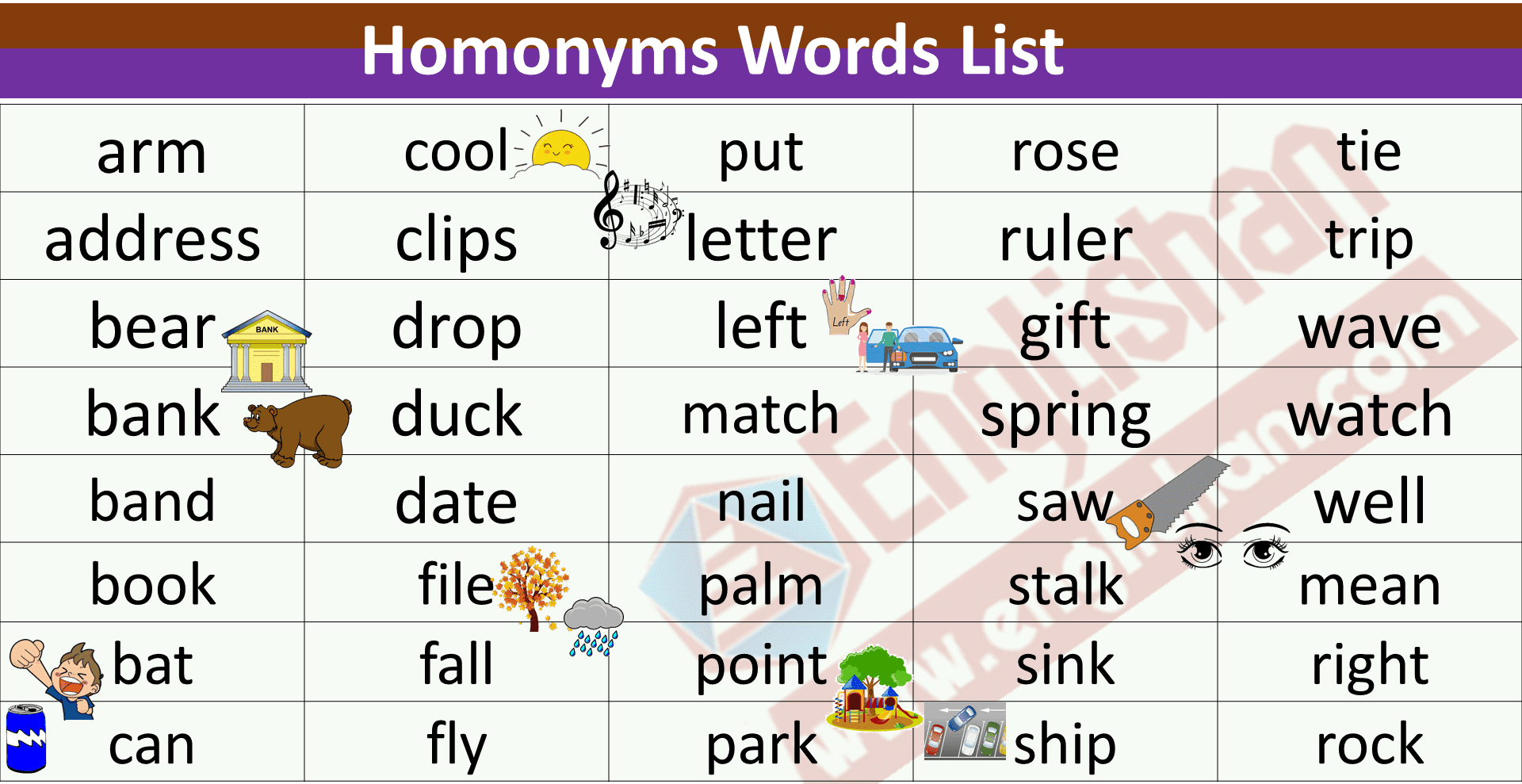
Words in English can sometimes look or sound the same but carry different meanings. These are homonyms, like “bat” as an animal and “bat” in sports, or “bark” for a tree and “bark” of a dog.
This post includes 100 homonyms in English with meanings to grow vocabulary and make language learning more effective.
What is a Homonym? (Definition and Meaning)
A homonym is a word that is either spelled the same or sounds the same as another word but has a different meaning.
- Example:
- Bat (a flying mammal)
- Bat (a piece of sports equipment)
Dictionary Definitions:
- Cambridge: “A word that is spelled or pronounced the same as another word but has a different meaning.”
- Oxford: “Each of two or more words having the same spelling or pronunciation but different meanings and origins.”
Homonyms include both homophones (same sound) and homographs (same spelling).
Types of Homonyms
Homographs as Homonyms (Same Spelling, Different Meaning)
Homographs share the same spelling but may have different meanings and sometimes different pronunciations.
- Lead (to guide) – She will lead the meeting.
- Lead (a metal) – The pipe is made of lead.
Homophones as Homonyms (Same Sound, Different Spelling)
Homophones sound the same but have different spellings and meanings.
- Bare (naked) – He walked on the bare floor.
- Bear (animal) – A bear is hibernating in the cave.
True Homonyms (Same Spelling and Sound, Different Meaning)
True homonyms are both spelled and pronounced the same but have unrelated meanings.
- Well (healthy) – She is feeling well now.
- Well (water source) – The farmer dug a well in his field.
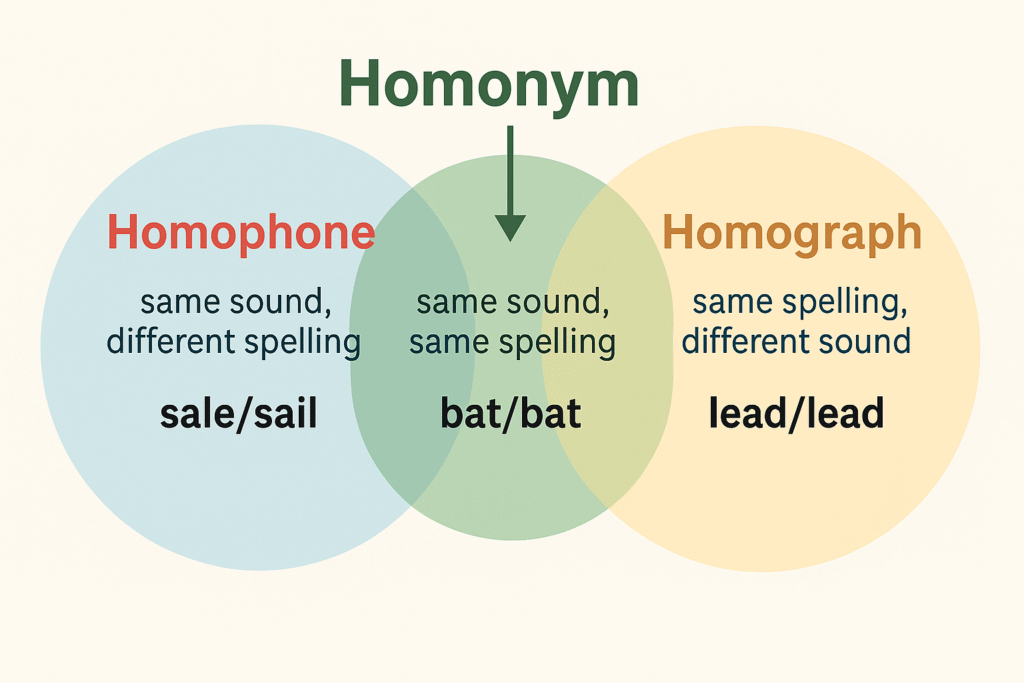
Homonyms vs Homophones vs Homographs
| Term | Same Spelling | Same Sound | Example |
|---|---|---|---|
| Homonym | Yes/No | Yes/No | Bat (animal/tool) |
| Homophone | No | Yes | Sun / Son |
| Homograph | Yes | No/Yes | Tear (cry/rip) |
- Homonyms can be either homophones or homographs.
- Homophones only share pronunciation.
- Homographs only share spelling.
List of Homonyms in English (with Meanings and Sentences)
Here is a list of common homonyms used in daily English:
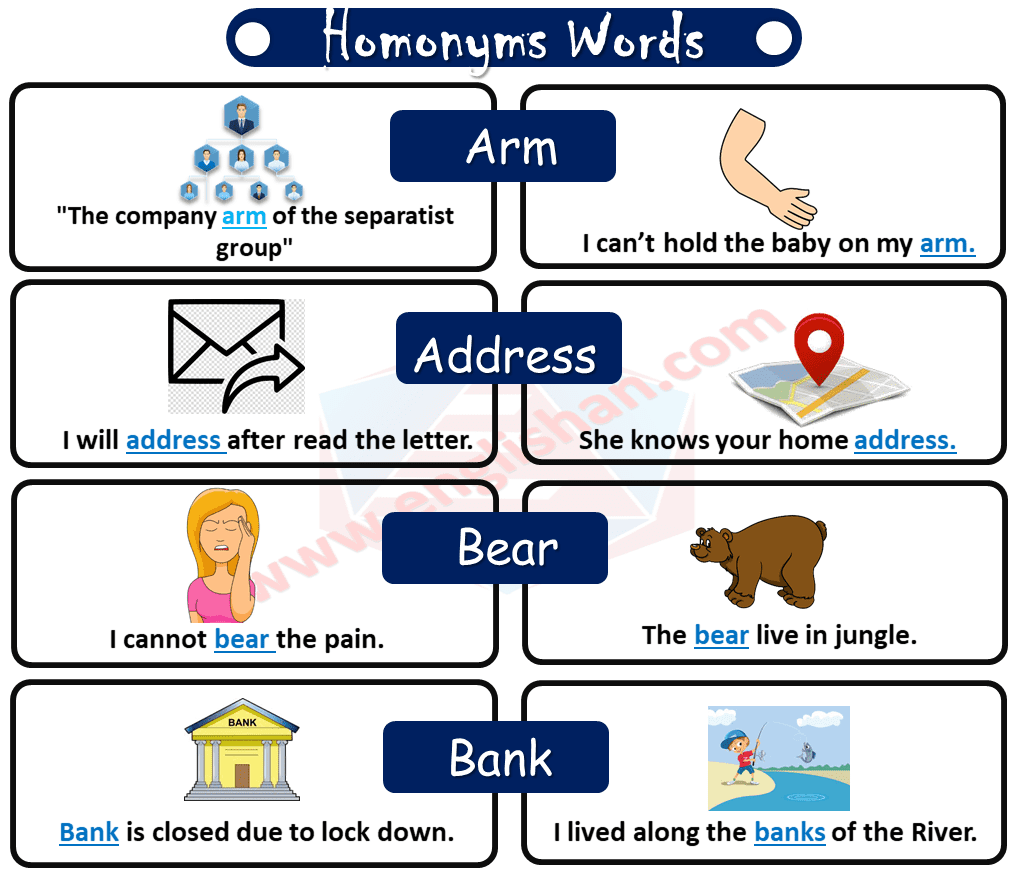
Arm (noun) – The upper limb of the body
Example: She injured her arm while playing.
Arm (noun) – A branch of an organization
Example: The charity’s educational arm supports schools.
Address (noun) – The details of a location
Example: What is your home address?
Address (verb) – To speak to or deal with something
Example: The manager will address the complaints tomorrow.
Bear (noun) – A large wild animal
Example: A bear was spotted near the forest.
Bear (verb) – To tolerate or endure
Example: I can’t bear this heat anymore.
Bank (noun) – A financial institution
Example: I deposited money in the bank.
Bank (noun) – The side of a river
Example: We sat on the river bank for a picnic.
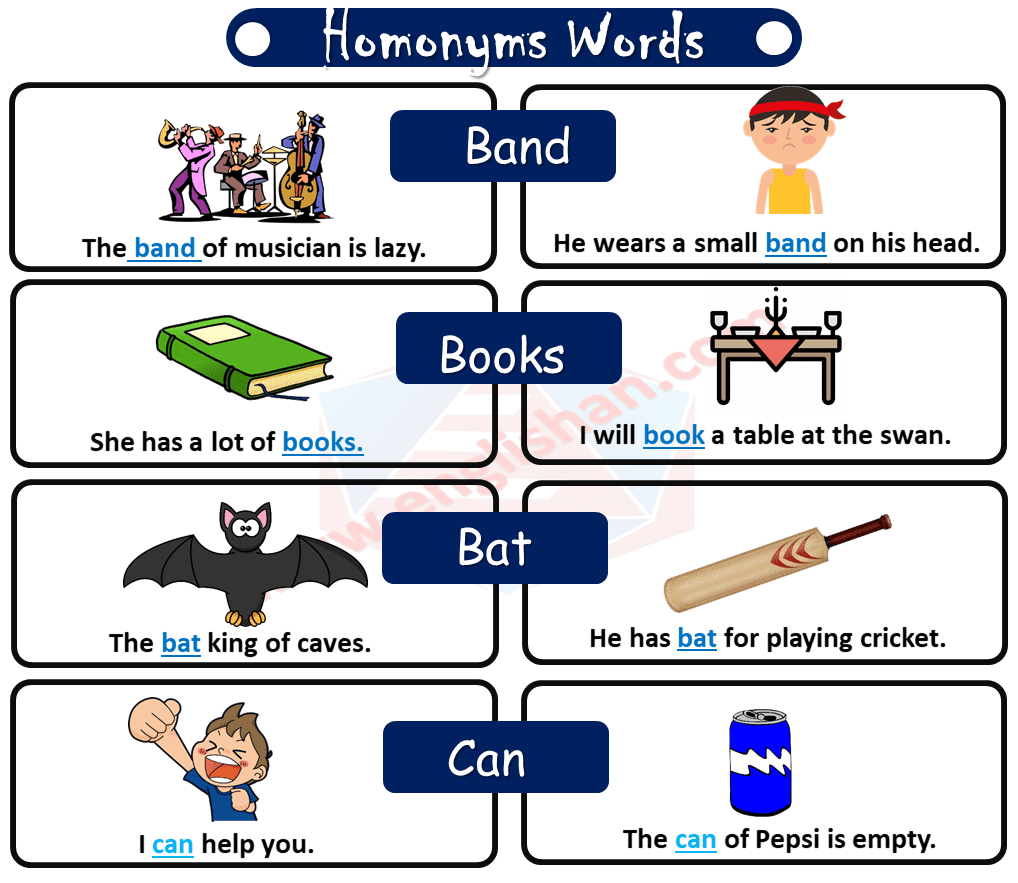
Band (noun) – A musical group
Example: The band performed live at the concert.
Band (noun) – A strip or ring of material
Example: She wore a silver band on her wrist.
Book (noun) – A set of written pages
Example: I borrowed a book from the library.
Book (verb) – To reserve something
Example: I will book a taxi for the evening.
Bat (noun) – A flying mammal
Example: A bat flew into the cave.
Bat (noun) – A wooden stick for hitting in sports
Example: He bought a new cricket bat.
Can (verb) – To be able to do something
Example: I can speak three languages.
Can (noun) – A container for liquids or food
Example: He opened a can of soda.
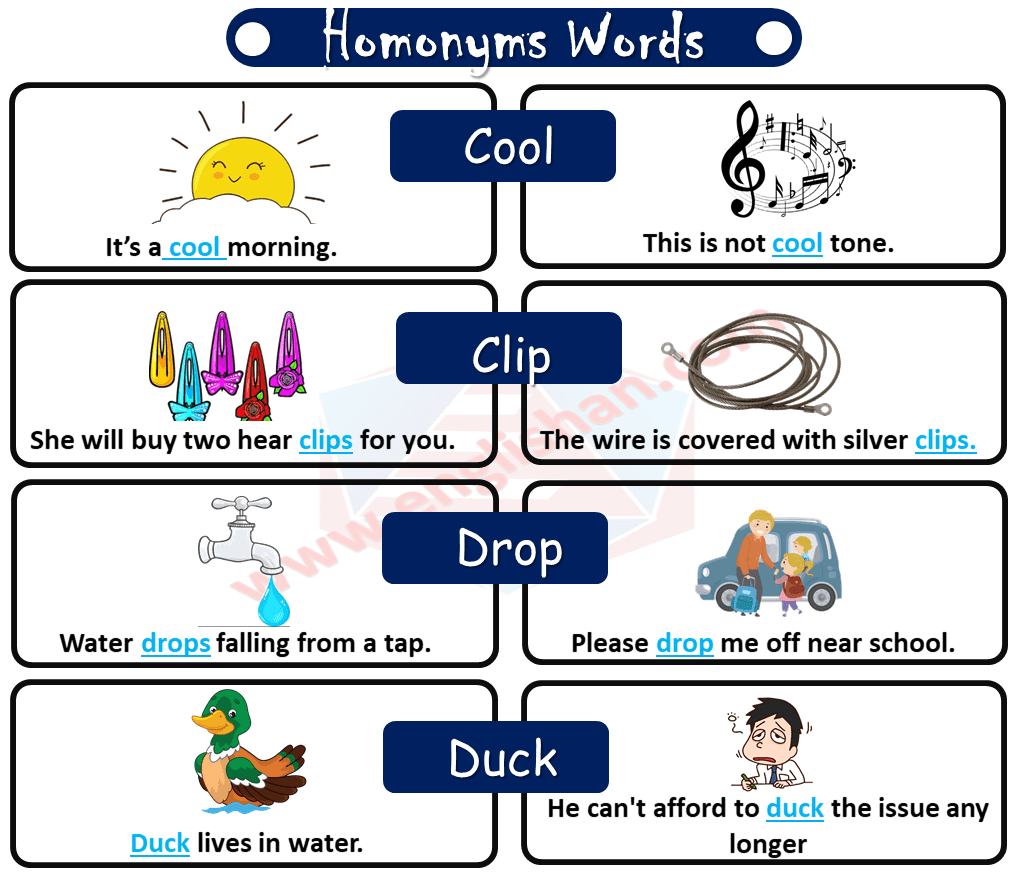
Cool (adjective) – Slightly cold
Example: The evening breeze is cool.
Cool (adjective) – Stylish or impressive
Example: That jacket looks really cool.
Clips (noun) – Small objects for holding things
Example: She bought hair clips from the store.
Clips (noun) – Short segments of video or audio
Example: I watched movie clips online.
Drop (noun) – A small amount of liquid
Example: A drop of water fell on my hand.
Drop (verb) – To let something fall
Example: Please don’t drop my phone.
Duck (noun) – A water bird
Example: A duck swam across the pond.
Duck (verb) – To lower quickly to avoid something
Example: Duck or you’ll hit your head on the beam.
Date (noun) – A day of the month or year
Example: Today’s date is August 22.
Date (noun) – A romantic meeting
Example: They went on a dinner date.
File (noun) – A collection of documents
Example: I saved the file on my computer.
File (verb) – To smooth or shape with a tool
Example: She filed her nails carefully.
Fall (verb) – To drop down from a height
Example: Leaves fall in autumn.
Fall (noun) – The season after summer
Example: We love the colors of fall.
Fly (noun) – A small insect
Example: A fly buzzed near the fruit.
Fly (verb) – To move through the air
Example: Birds fly across the sky.
Foot (noun) – The lower part of the leg
Example: My left foot is swollen.
Foot (noun) – A unit of measurement
Example: The room is ten foot wide.
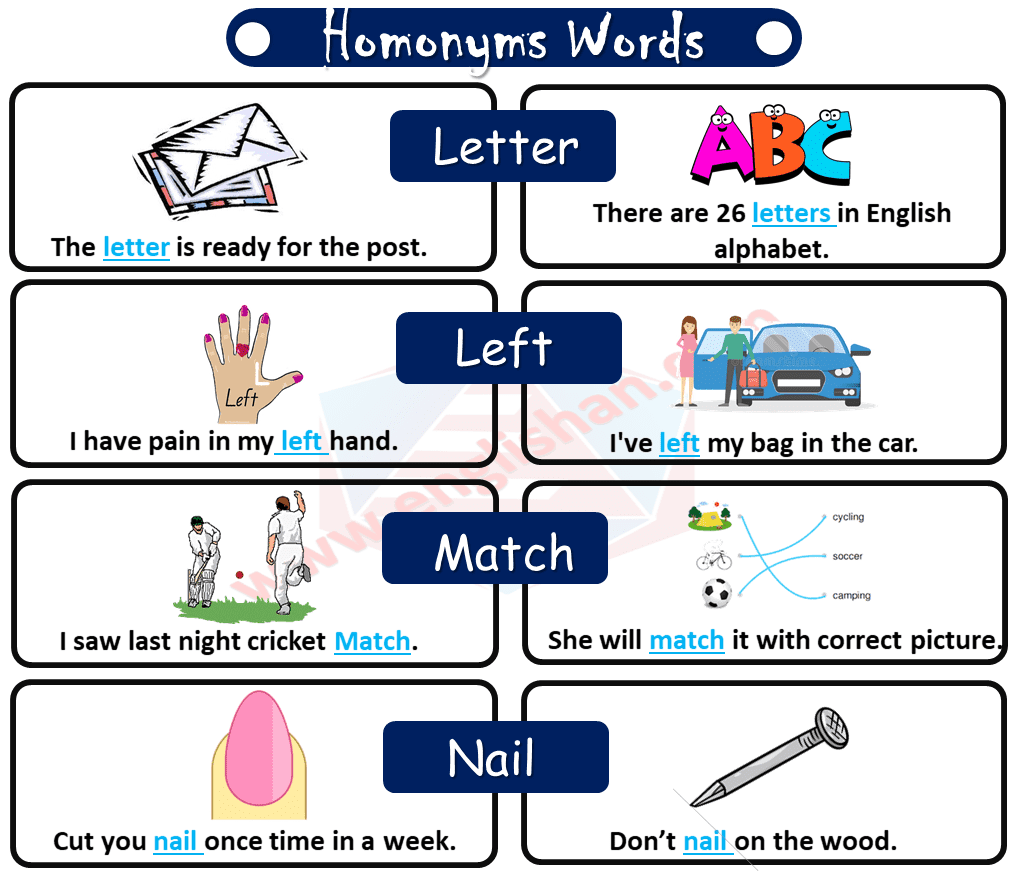
Letter (noun) – A character in the alphabet
Example: The letter “A” begins the word apple.
Letter (noun) – A written message
Example: She received a letter from her friend.
Left (adjective) – Situated on the side of the body
Example: He raised his left hand.
Left (verb) – Past tense of leave
Example: She left her keys on the table.
Match (noun) – A contest or game
Example: The match ended in a draw.
Match (noun) – A stick used to start a fire
Example: He lit a candle with a match.
Nail (noun) – A hard covering at the tip of fingers/toes
Example: She painted her nail red.
Nail (verb) – To fasten something with nails
Example: He nailed the picture to the wall.
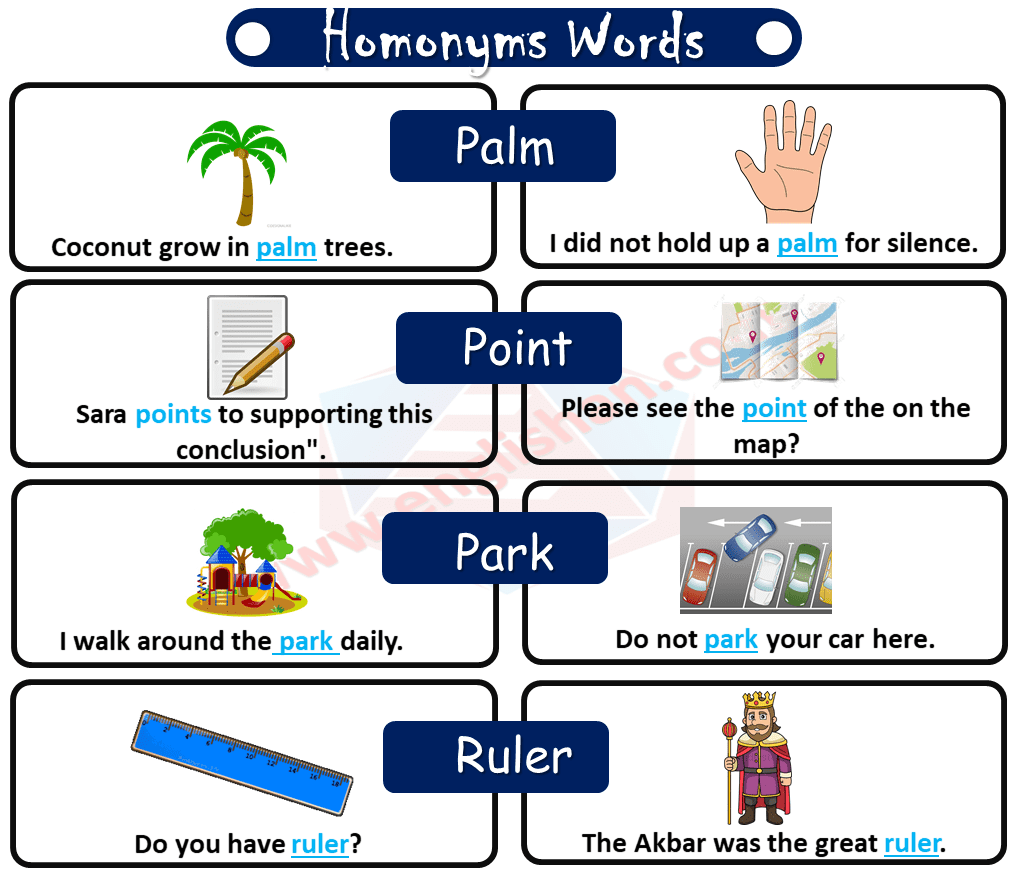
Palm (noun) – The inner surface of the hand
Example: He held the coin in his palm.
Palm (noun) – A tropical tree
Example: Coconuts grow on palm trees.
Point (noun) – A sharp end of something
Example: The knife has a sharp point.
Point (verb) – To indicate a direction
Example: She pointed at the board.
Park (noun) – A public recreational area
Example: We took the kids to the park.
Park (verb) – To leave a vehicle in a place
Example: Please park your car here.
Rose (noun) – A type of flower
Example: She received a bouquet of roses.
Rose (verb) – Past tense of rise
Example: The sun rose at six this morning.
Ruler (noun) – A measuring instrument
Example: Draw a straight line with the ruler.
Ruler (noun) – A person who governs
Example: The king was a just ruler.
Gift (noun) – A present
Example: He gave her a birthday gift.
Gift (verb) – To present something to someone
Example: They gifted the couple a painting.
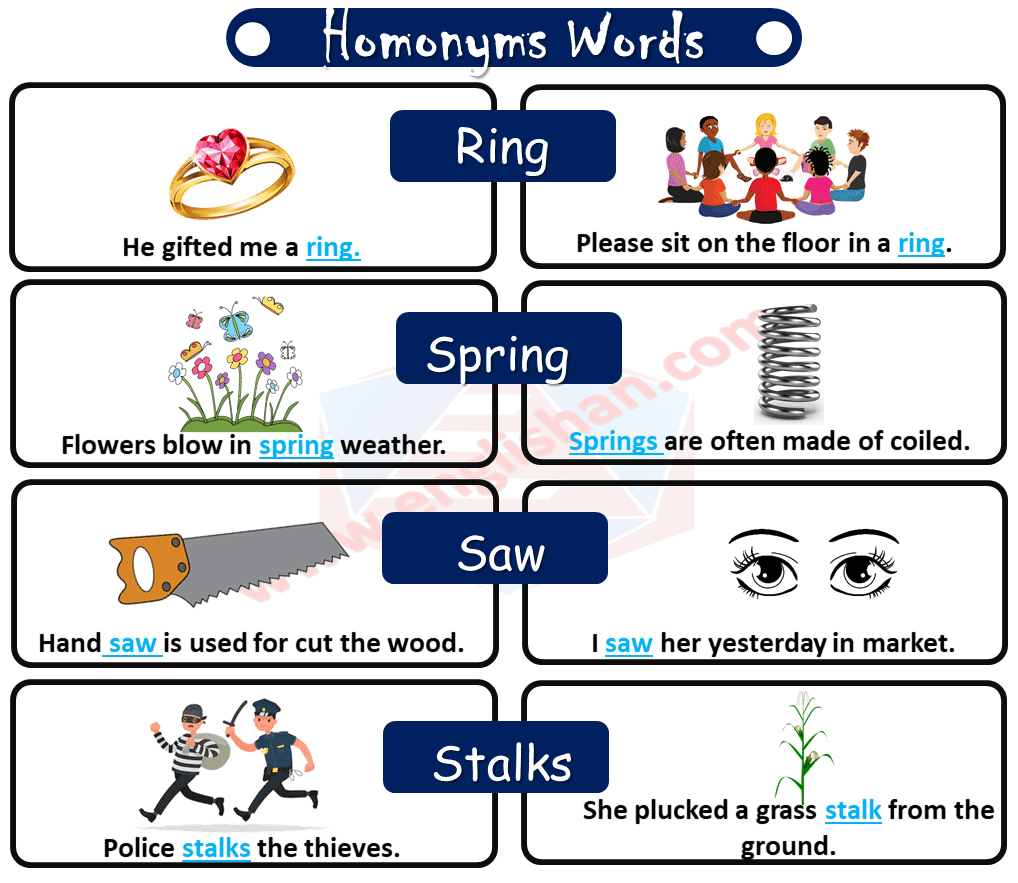
Spring (noun) – The season after winter
Example: Flowers bloom in spring.
Spring (verb) – To jump suddenly
Example: The cat sprang onto the table.
Saw (noun) – A tool for cutting wood
Example: He cut the plank with a saw.
Saw (verb) – Past tense of see
Example: I saw her at the station.
Stalk (noun) – A stem of a plant
Example: She picked a stalk of wheat.
Stalk (verb) – To follow secretly
Example: The tiger stalked its prey.
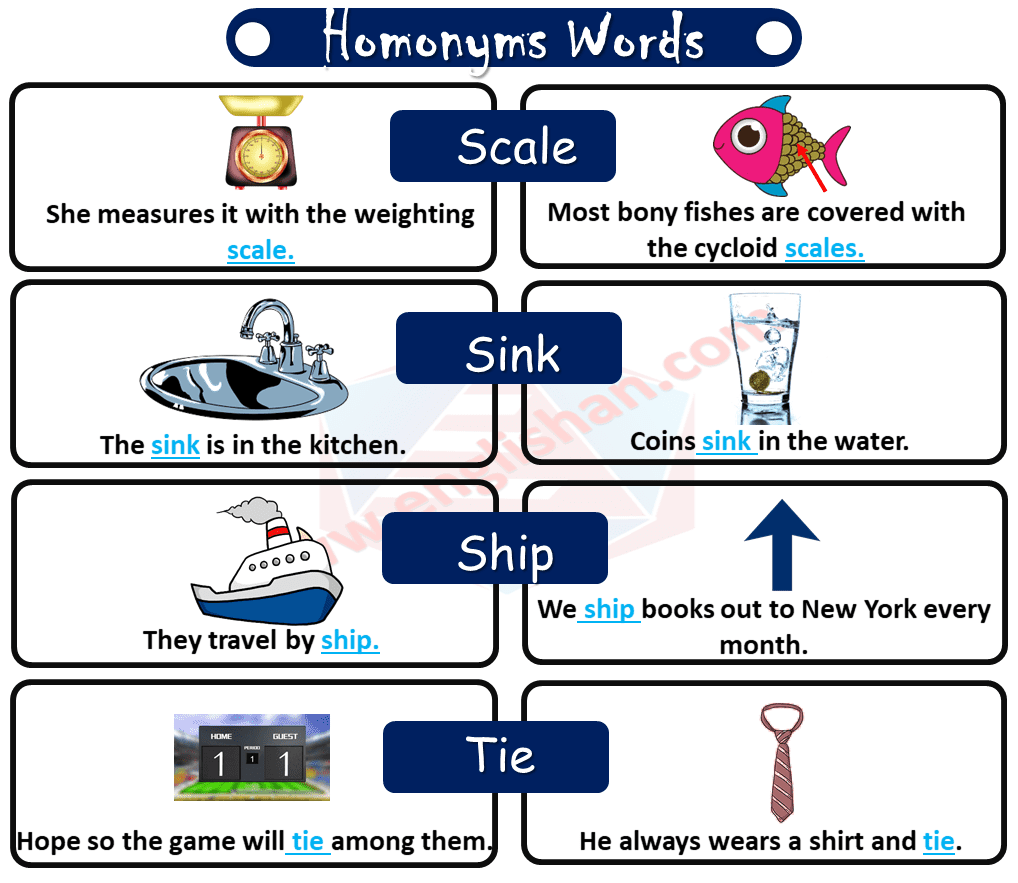
Scale (noun) – A device to measure weight
Example: The fish weighed 2 kg on the scale.
Scale (noun) – Protective covering on fish/reptiles
Example: The fish’s scales were shiny.
Sink (noun) – A basin for washing
Example: The sink is clogged.
Sink (verb) – To go below the surface
Example: The ship sank in the storm.
Ship (noun) – A large vessel for transport
Example: The ship sailed at dawn.
Ship (verb) – To send goods
Example: We ship products worldwide.
Tie (noun) – A piece of cloth worn around the neck
Example: He wore a blue tie.
Tie (verb) – To fasten with a cord or knot
Example: Tie your shoelaces properly.
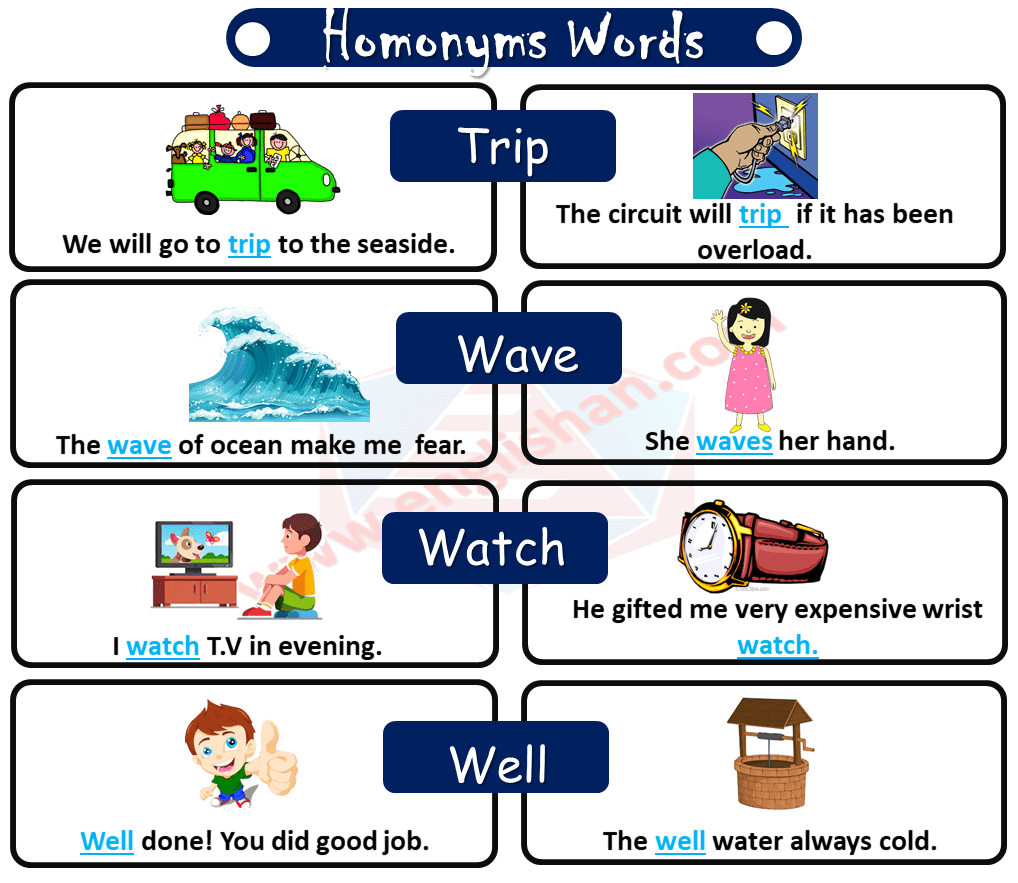
Trip (noun) – A journey
Example: We went on a trip to Paris.
Trip (verb) – To stumble or fall
Example: She tripped over the rug.
Wave (noun) – A moving ridge of water
Example: The wave crashed against the shore.
Wave (verb) – To greet by moving the hand
Example: He waved goodbye.
Watch (noun) – A small timepiece
Example: My watch stopped working.
Watch (verb) – To observe attentively
Example: Watch the road while driving.
Well (noun) – A deep hole for water
Example: The well provided drinking water.
Well (adjective) – In good health
Example: She is feeling well today.
Will (verb) – To express future action
Example: I will call you tomorrow.
Will (noun) – A legal document expressing wishes
Example: He left a will for his children.
Kind (adjective) – Being generous or considerate
Example: She is always kind to animals.
Kind (noun) – A type or variety
Example: This kind of flower blooms in spring.
Fair (adjective) – Just or impartial
Example: The decision was fair to all.
Fair (noun) – An event for entertainment or trade
Example: We visited the annual book fair.
Light (noun) – Visible illumination
Example: Turn on the light, please.
Light (adjective) – Not heavy in weight
Example: The bag is light enough to carry.
Current (noun) – A flow of water or electricity
Example: The river current is very strong.
Current (adjective) – Present or ongoing
Example: The current situation is challenging.
Park (noun) – A large green area for public use
Example: Kids are playing in the park.
Park (verb) – To stop and leave a vehicle
Example: Park the car in the garage.
Seal (noun) – A sea animal
Example: A seal rested on the rock.
Seal (verb) – To close tightly
Example: Please seal the envelope properly.
Spring (noun) – A source of water
Example: A natural spring flows near the village.
Spring (verb) – To leap or jump
Example: The athlete sprang across the finish line.
Rock (noun) – A solid mineral substance
Example: He threw a rock into the lake.
Rock (verb) – To move gently back and forth
Example: She rocked the baby to sleep.
Nail (noun) – A small metal fastener
Example: He hammered a nail into the wall.
Nail (verb) – To achieve something precisely
Example: She nailed the performance perfectly.
Right (adjective) – Correct or true
Example: You gave the right answer.
Right (noun) – A moral or legal entitlement
Example: Freedom of speech is a basic right.
Watch (noun) – A period of guard duty
Example: The soldier is on night watch.
Watch (verb) – To look at carefully
Example: Watch your steps on the stairs.
Sound (noun) – Noise or vibration
Example: I heard a strange sound outside.
Sound (adjective) – Healthy or in good condition
Example: The baby is sound asleep.
Tire (verb) – To become weary
Example: Long walks tire me quickly.
Tire (noun) – A rubber covering of a wheel
Example: The car’s front tire is flat.
Leaves (noun) – Plural of leaf
Example: Autumn leaves cover the ground.
Leaves (verb) – Goes away from a place
Example: She leaves for work at eight.
Date (noun) – A sweet fruit
Example: I ate a date with breakfast.
Date (verb) – To go out with someone
Example: They’ve been dating for years.
Pitcher (noun) – A container for liquids
Example: He poured water from the pitcher.
Pitcher (noun) – A baseball player who throws the ball
Example: The pitcher struck out the batter.
Pen (noun) – A writing instrument
Example: I lost my favorite pen.
Pen (noun) – An enclosure for animals
Example: The sheep are in the pen.
Fair (adjective) – Light in color
Example: She has fair skin.
Fair (noun) – A gathering for amusement
Example: We went to the funfair last weekend.
Can (verb) – To be able to
Example: I can finish this task today.
Can (noun) – A metal container
Example: He opened a can of beans.
Spring (noun) – A coil that returns to its shape
Example: The bed spring is broken.
Spring (verb) – To move suddenly forward
Example: The lion sprang at its prey.
Bark (noun) – The sound made by a dog
Example: The dog’s bark was loud.
Bark (noun) – The outer covering of a tree
Example: The tree’s bark is rough.
Well (adverb) – In a good manner
Example: She sings very well.
Well (noun) – A source of water
Example: They drew water from the well.
Lap (noun) – The front of the thighs when sitting
Example: The child sat on her mother’s lap.
Lap (verb) – To overtake in a race
Example: He lapped his competitor twice.
Jam (noun) – A sweet fruit spread
Example: I like toast with jam.
Jam (verb) – To get stuck or blocked
Example: My printer jammed again.
Mine (pronoun) – Belonging to me
Example: That book is mine.
Mine (noun) – A place where minerals are extracted
Example: The coal mine closed last year.
Row (noun) – A line of things
Example: We sat in the front row.
Row (verb) – To propel a boat with oars
Example: They rowed across the lake.
Saw (noun) – A cutting tool
Example: He sharpened the saw before using it.
Saw (verb) – Past tense of see
Example: I saw them at the station.
Park (noun) – A green open space
Example: We had a picnic in the park.
Park (verb) – To stop and leave a vehicle
Example: Park near the entrance.
Bowl (noun) – A round dish
Example: She served soup in a bowl.
Bowl (verb) – To roll a ball in a game
Example: He bowled a strike.
Bat (noun) – A nocturnal flying mammal
Example: A bat flew out of the cave.
Bat (verb) – To hit something
Example: He batted the ball far.
Match (noun) – Something equal to another
Example: They found a perfect match for her.
Match (noun) – A small stick for lighting a fire
Example: He lit the candle with a match.
Club (noun) – A group of people with shared interests
Example: She joined the debate club.
Club (noun) – A heavy stick used as a weapon
Example: The guard carried a club.
Light (verb) – To ignite
Example: Light the candle, please.
Light (noun) – Brightness or illumination
Example: The room was full of light.
Rock (verb) – To sway gently
Example: The boat rocked in the waves.
Rock (noun) – A genre of music
Example: He loves rock music.
Order (noun) – A request for goods or services
Example: I placed an order for shoes.
Order (verb) – To command or direct
Example: The teacher ordered silence.
Plane (noun) – An aircraft
Example: The plane landed on time.
Plane (noun) – A flat surface
Example: The carpenter smoothed the plane of wood.
Ring (noun) – A circular band
Example: He gave her a diamond ring.
Ring (verb) – To produce a sound
Example: The phone will ring soon.
Seal (noun) – A stamp used for authentication
Example: The letter had the official seal.
Seal (verb) – To close securely
Example: Seal the jar tightly.
Store (noun) – A place where goods are sold
Example: I bought it from the store.
Store (verb) – To keep for future use
Example: Store the documents safely.
Watch (noun) – A period of duty
Example: He kept watch at night.
Watch (verb) – To monitor carefully
Example: Watch the experiment closely.
Wave (noun) – A hand motion in greeting
Example: She gave me a friendly wave.
Wave (verb) – To move back and forth
Example: The flag waved in the wind.
Spring (noun) – The act of moving suddenly
Example: The cat made a sudden spring.
Spring (noun) – A natural flow of water
Example: The spring never runs dry.
List of 100 Homonyms
Address (n., v.) – Place where someone lives / To speak to someone
Band (n.) – A group of musicians / A flat strip or loop
Bat (n.) – A flying mammal / A piece of sports equipment
Match (n.) – A contest between teams / A small stick to produce fire
Mean (v., adj.) – To intend something / Unkind or cruel
Right (n., adj.) – A legal entitlement / Correct or true
Ring (n., v.) – A circular piece of jewelry / To make a sound
Rock (n., v.) – A solid mineral mass / To move gently back and forth
Rose (n., v.) – A flower / Past tense of ‘rise’
Spring (n., v.) – The season after winter / To leap or jump suddenly
Stalk (n., v.) – The main stem of a plant / To follow secretly
Well (n., adv.) – A source of water / In a good or satisfactory manner
Clip (n., v.) – A fastening device / To trim or cut
Date (n.) – A day of the month / A romantic meeting
Drop (n., v.) – A small amount of liquid / To let fall
Fly (n., v.) – A small insect / To move through the air
Letter (n.) – A written message / A character in the alphabet
Palm (n.) – Inner part of the hand / A tropical tree
Park (n., v.) – A recreational area / To place a vehicle
Point (n., v.) – A specific spot / To indicate with a finger
Ruler (n.) – A person who governs / A measuring instrument
Saw (n., v.) – A cutting tool / Past tense of see
Scale (n.) – A weighing device / A series of musical notes
Ship (n., v.) – A sea vessel / To transport goods
Sink (n., v.) – A basin for washing / To descend below a surface
Tie (n., v.) – A neckwear or fastening cord / To fasten together
Trip (n., v.) – A journey / To stumble or fall
Wave (n., v.) – A moving ridge of water / To move the hand in greeting
Cool (adj., v.) – Moderately cold / To make less hot
Duck (n., v.) – A waterbird / To lower quickly to avoid
Fall (n., v.) – The autumn season / To drop down
File (n., v.) – A folder for documents / To smooth a surface
Foot (n.) – Lower part of the leg / Unit of measure (12 inches)
Left (adj., v.) – Opposite of right side / Past tense of leave
Nail (n.) – A metal fastener / Horny covering on fingers or toes
Watch (n., v.) – A wrist timepiece / To observe attentively
Can (n., v.) – A metal container / To be able to
Fort (n.) – A strong military building
Fought (v.) – Past tense of fight
Foul (adj.) – Offensive or dirty
Fowl (n.) – Domestic bird
Groan (v.) – To make a low sound of pain
Grown (adj.) – Fully developed
Holy (adj.) – Sacred or religious
Wholly (adv.) – Entirely
Hour (n.) – 60 minutes of time
Our (pron.) – Belonging to us
I (pron.) – Referring to oneself
Eye (n.) – Organ of vision
Know (v.) – To be aware of
No (adv.) – Negative response
Links (n.) – Golf course
Lynx (n.) – Wild cat
Mail (n.) – Letters or parcels
Male (adj.) – Of the masculine sex
Meet (v.) – To come together
Meat (n.) – Animal flesh for food
Peace (n.) – Freedom from conflict
Piece (n.) – A portion of something
Right (adj., n.) – Morally correct / A legal claim
Write (v.) – To inscribe on a surface
Scene (n.) – Place of an incident
Seen (v.) – Past participle of see
Than (conj.) – Used in comparison
Then (adv.) – At that time / next
Weak (adj.) – Lacking strength
Week (n.) – Seven days
Ad (n.) – Advertisement
Add (v.) – To combine or put together
Ail (v.) – To trouble or afflict
Ale (n.) – A type of beer
Air (n.) – The invisible gaseous substance around us
Heir (n.) – A successor to property
All (det.) – Entire amount
Awl (n.) – A pointed tool for piercing
Allowed (v.) – Permitted
Aloud (adv.) – Spoken audibly
Alms (n.) – Charity to the poor
Arms (n.) – Upper limbs or weapons
Altar (n.) – Table in religious rituals
Alter (v.) – To change
Ant (n.) – A small insect
Aunt (n.) – Sister of a parent
Arc (n.) – Curved line or shape
Ark (n.) – Large boat from the Bible
Ate (v.) – Past tense of eat
Eight (num.) – Number after seven
Auger (n.) – Drilling tool
Augur (v.) – To foretell
Aural (adj.) – Relating to the ear
Oral (adj.) – Relating to the mouth
Baize (n.) – Green woolen cloth
Bays (n.) – Inlets of the sea
Bald (adj.) – Without hair
Bawled (v.) – Shouted loudly
Ball (n.) – Spherical object
Bawl (v.) – To cry loudly
Bare (adj.) – Uncovered
Bear (n., v.) – Large mammal / To carry
Baron (n.) – Nobleman
Barren (adj.) – Unable to produce
Be (v.) – To exist
Bee (n.) – Insect producing honey
Beach (n.) – Shore of a sea or ocean
Beech (n.) – A type of tree
Beat (v., n.) – To strike repeatedly / A rhythm
Beet (n.) – A root vegetable
Bell (n.) – A hollow object that rings
Belle (n.) – Beautiful woman
Berry (n.) – Small juicy fruit
Bury (v.) – To put in the ground
Birth (n.) – The act of being born
Berth (n.) – A ship’s docking place
Billed (v.) – Charged for services
Build (v.) – To construct
Bite (v., n.) – To cut with teeth / The act of biting
Byte (n.) – Unit of digital data
Blue (adj., n.) – Color between green and violet / Feeling sad
Blew (v.) – Past tense of blow
Board (n., v.) – A flat piece of wood / To get on a ship or plane
Bored (adj.) – Uninterested or tired
Bough (n.) – Main branch of a tree
Bow (n., v.) – Knot with loops / To bend forward
Brake (n., v.) – Device to stop a vehicle / To stop
Break (v., n.) – To separate into pieces / A pause
Bread (n.) – Baked food from flour
Bred (v.) – Past tense of breed
Buy (v.) – To purchase
By (prep.) – Near or through the agency of
Cell (n.) – Small room / Basic unit of life
Sell (v.) – To exchange for money
Cent (n.) – A unit of currency
Scent (n.) – A distinctive smell
Sent (v.) – Past tense of send
Cereal (n.) – Edible grain
Serial (adj., n.) – In a series / A sequence
Chews (v.) – Bites food to grind
Choose (v.) – To select
Chili (n.) – Spicy pepper
Chilly (adj.) – Uncomfortably cold
Chord (n.) – Combination of musical notes
Cord (n.) – String or rope
Coarse (adj.) – Rough in texture
Course (n.) – Path or direction / A series of lessons
Complement (n., v.) – Something that completes / To complete
Compliment (n., v.) – Praise / To express admiration
Counsel (n., v.) – Advice / To give advice
Council (n.) – An assembly of people
Crews (n.) – Groups working together
Cruise (n., v.) – A journey by ship / To travel smoothly
Dear (adj., n.) – Loved or valued / A beloved person
Deer (n.) – A hoofed grazing animal
Desert (n., v.) – Dry sandy area / To abandon
Dessert (n.) – Sweet dish after a meal
Die (v.) – To cease living
Dye (n., v.) – Coloring substance / To color
Fair (adj., n.) – Just or impartial / Public event
Fare (n.) – Fee for transport
Feat (n.) – Achievement requiring skill
Feet (n.) – Plural of foot
Fined (v.) – Penalized with money
Find (v.) – To discover
Flour (n.) – Powder from grinding grains
Flower (n.) – Bloom of a plant
Forth (adv.) – Forward in place or time
Fourth (adj., n.) – Next after the third
Gait (n.) – Way of walking
Gate (n.) – Entrance structure
Grate (n., v.) – Framework of metal bars / To shred into pieces
Great (adj.) – Large in amount or degree
Groan (v., n.) – Low sound of pain or protest / The act of groaning
Grown (adj., v.) – Mature / Past participle of grow
Hair (n.) – Strands growing from skin
Hare (n.) – Fast-running mammal
Hall (n.) – Large room for events
Haul (v.) – To pull or drag forcibly
Heal (v.) – To make healthy again
Heel (n.) – Back part of the foot
Hear (v.) – To perceive sound
Here (adv.) – In this place
Hole (n.) – Hollow place in a solid surface
Whole (adj., n.) – Entire / Complete amount
Idle (adj.) – Not active or working
Idol (n.) – Object of worship or admiration
Knot (n.) – Fastening made by tying string or rope
Not (adv.) – Expressing negation
Lead (v., n.) – To guide / Heavy metal element
Led (v.) – Past tense of lead
Loan (n., v.) – Something borrowed / To lend
Lone (adj.) – Solitary or alone
Made (v.) – Past tense of make
Maid (n.) – Female domestic worker
Mail (n., v.) – Postal items / To send by post
Male (adj., n.) – Belonging to the masculine sex / A male person or animal
Why Homonyms are Important in English
- Avoids Misunderstanding: Correctly using homonyms prevents confusion in communication.
- Improves Reading Comprehension: Helps you understand context in books, newspapers, and exams.
- Enhances Writing Skills: Adds variety and depth to your writing.
FAQs
A homonym is a word that has the same spelling and/or pronunciation as another word but has a different meaning.
For example:
Bat (an animal) and bat (used in sports)
Bark (the sound a dog makes) and bark (the outer layer of a tree)
Here are 6 simple homonym examples:
1. Bat
An animal (e.g., “The bat flew.”)
A sports tool (e.g., “He hit the ball with a bat.”)
2. Bark
The sound a dog makes (e.g., “The dog barks.”)
The outer layer of a tree (e.g., “The tree’s bark is rough.”)
3. Bow
To bend forward (e.g., “He gave a bow.”)
A type of knot (e.g., “She tied a bow.”)
4. Lead
To guide (e.g., “She will lead the team.”)
A type of metal (e.g., “The pipe is made of lead.”)
5. Tear
To rip (e.g., “Don’t tear the paper.”)
A drop of liquid from the eyes (e.g., “She wiped a tear.”)
6. Right
Correct (e.g., “You are right.”)
A direction (e.g., “Turn right.”)
Here are 12 examples of homophones:
1. Ate / Eight
2. Bare / Bear
3. Buy / By
4. Cell / Sell
5. Cents / Sense
6. Deer / Dear
7. Flew / Flu
8. Flower / Flour
9. Grate / Great
10. Hair / Hare
11. Heal / Heel
12. Hear / Here
Here are 12 different homophones:
1. Knot / Not
2. Know / No
3. Meat / Meet
4. Pair / Pear
5. Peace / Piece
6. Plain / Plane
7. Rain / Reign
8. Right / Write
9. Scene / Seen
10. Sea / See
11. Sole / Soul
12. Sun / Son
You May Also Like