What Is a Compound Predicate
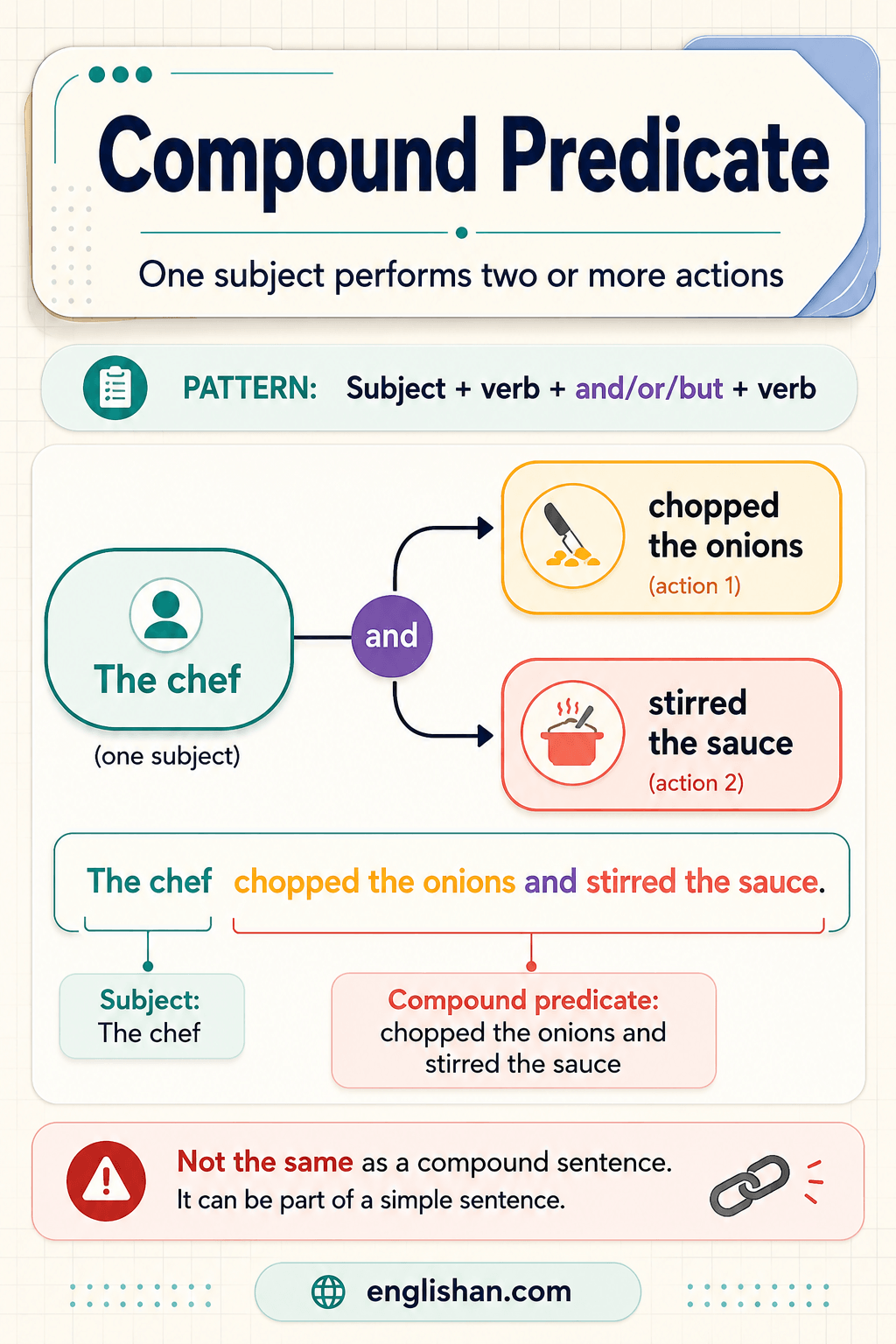
Every sentence has two parts: a subject and a predicate. The subject is who or what the sentence is about. The predicate is what the subject does or is. A compound predicate gives one subject two or more verbs or verb phrases, joined by a conjunction.
- The dog barked and chased the squirrel across the yard. (One subject, two verbs.)
- She planned the event, coordinated the vendors, and managed the guest list. (One subject, three verbs.)
- The engine sputtered but kept running. (One subject, two verbs joined by but.)
A compound predicate includes everything attached to those verbs: objects, modifiers, adverbs, and complements. In the first sentence, the full predicate is barked and chased the squirrel across the yard.
Caesar’s report shows the pattern at its tightest: Caesar came, saw, and conquered. One subject, three verbs, no repeated name.
Conjunctions That Join Compound Predicates
Coordinating conjunctions carry most compound predicates: and, but, or, nor, yet.
Correlative pairs join the verbs with equal force:
- The team not only finished ahead of schedule but also exceeded every quality benchmark.
- The system neither crashed nor lost any data during the outage.
- You will either submit the form online or mail it to the office.
How to Identify a Compound Predicate
Find the subject first, then check whether two or more verbs answer to it with no new subject introduced.
- Find the subject. Ask who or what the sentence is about.
- Locate the verbs. Name every action or state that follows.
- Confirm the shared subject. If one subject governs all the verbs and no second subject appears, the predicate is compound.
Test it on a sentence: Liam checked the schedule and sent a reminder email. The subject is Liam, the verbs are checked and sent, and both belong to Liam. One subject, two verbs, one compound predicate.
Modifiers hide the second verb more than anything else. A prepositional phrase between the two actions separates them, yet the predicate stays whole:
- The intern filed the paperwork in the afternoon and left before the meeting. (Verbs filed and left, split by in the afternoon.)
Imperatives work the same way with an unspoken subject. The you stays understood, shared by both verbs:
- Lock the door and set the alarm before you go. (Implied subject you; verbs lock and set.)
Compound Predicate vs Compound Sentence
Writers confuse these two more than any other pair in sentence structure, and the mix-up decides where the comma goes. One question settles it: does the second verb carry its own subject?
A compound predicate keeps one subject across several actions, and no comma precedes the conjunction. A compound sentence joins two independent clauses, each with its own subject and verb, and a comma precedes the conjunction.
| Compound predicate (no comma) | Compound sentence (comma) |
|---|---|
| He opened the email and forwarded it to the team. ✅ | He opened the email, and she forwarded it to the team. ✅ |
| The manager reviewed the data and approved the budget. ✅ | The manager reviewed the data, and the board approved the budget. ✅ |
| We tested the prototype and fixed the bugs. ✅ | We tested the prototype, and the QA team filed the report. ✅ |
The Remove-the-Subject Test
When a sentence leaves you unsure, delete the second subject and watch what happens.
She reviewed the contract, and she signed it that afternoon.
Drop the second she: She reviewed the contract and signed it that afternoon. The sentence holds, and the comma goes with the subject, because removing it turns a compound sentence into a compound predicate.
Now the reverse. She reviewed the contract, and her attorney flagged three issues. Drop her attorney, and the sentence breaks. Two different subjects need two clauses, which marks a compound sentence, so the comma stays. This one-move test settles the distinction faster than any grammar chart.
The Auxiliary and Modal Test
A shared helper verb that sits once before the first verb marks one clause. The same helper repeated beside a second subject marks two.
- Tess can read and write in three languages. ✅ (One modal governs both verbs: compound predicate, no comma.)
- Tess can read, and she can write in three languages. ✅ (The modal repeats beside a new subject: compound sentence, comma.)
When the helper appears once and no new subject follows it, the predicate is compound.
Compound Predicate vs Compound Subject
These structures differ, though a single sentence holds both, which is where the confusion starts.
A compound subject gives two or more subjects one shared verb: Tom and Sarah walked to the park.
A compound predicate gives one subject two or more verbs: Tom walked to the park and bought an ice cream.
Both land in one clause without commas: Tom and Sarah walked to the park and bought ice cream.
Comma Rules for Compound Predicates
Two Verbs Take No Comma
The default holds firm: no comma between two verbs in a compound predicate.
- She revised the manuscript and sent it to the publisher. ✅
- She revised the manuscript, and sent it to the publisher. ❌
That comma signals a second clause that never arrives, so it separates the subject from part of its own predicate.
- He locked the door and walked to the car. ✅
- The team analyzed the results and presented their findings. ✅
- We weighed the options but decided to wait. ✅
Three or More Verbs Take Commas in a Series
Once the compound predicate holds three or more verbs, commas separate them the way they separate any series. The serial (Oxford) comma before the final conjunction follows your chosen style.
- She drafted, revised, and submitted the report. ✅ (with Oxford comma)
- She drafted, revised and submitted the report. ✅ (without Oxford comma)
- Caesar came, saw, and conquered. ✅
When a Comma Belongs Between Two Verbs
The no-comma default is not absolute. The Chicago Manual of Style notes that a comma is not normally used between the parts of a compound predicate, and that word normally leaves room for editorial judgment in two situations.
A contrast that turns hard on but or yet earns a comma to sharpen the turn:
- The company posted record revenue, but laid off 200 employees.
- The software crashed, yet recovered without losing any data.
A first predicate long enough to strain the reader earns a comma for breath:
- The firm employs 25,000 people across 15 locations in four countries, and now stands on the edge of bankruptcy.
Dropping the comma reads the same in both. The comma serves style, not grammar. Hold to no comma in academic and formal writing; in editorial and creative prose, trust your ear.
Interrupting Phrases Within a Compound Predicate
When a nonessential phrase breaks into the compound predicate, commas wrap the interruption. Those commas belong to the phrase, never to the conjunction:
- He read the report and, after some deliberation, approved the funding. ✅
- She accepted the position and, to everyone’s surprise, resigned three weeks later. ✅
Strip the phrase, and the commas go: He read the report and approved the funding. The MLA Style Center draws the same line: no comma before the conjunction in a compound predicate, but commas around any phrase that intervenes within it.
Compound Predicates With Linking Verbs
Action verbs hold no monopoly on compound predicates. Linking verbs pair the same way, joining two descriptions of one subject:
- The soup smelled delicious and tasted even better. ✅ (Two linking verbs, two predicate adjectives.)
- The candidate sounded confident but seemed unprepared. ✅
- The results looked promising yet proved unreliable. ✅
The subject carries two states rather than two actions, and the punctuation holds to the same standard: no comma before the conjunction when one subject governs both verbs. A compound predicate built on linking verbs leans on predicate adjectives, each describing the subject after its verb.
Common Mistakes With Compound Predicates
Three errors surface again and again once writers start combining verbs.
Repeating the subject undoes the whole economy. A compound predicate names the subject once:
- My sister woke up early and my sister went for a walk. ❌
- My sister woke up early and went for a walk. ✅
Dropping a comma into a two-verb predicate creates a false stop:
- He signed the lease, and moved in the same day. ❌
- He signed the lease and moved in the same day. ✅
Breaking parallel form reads as a stumble. Both verbs need matching structure, whether two gerunds, two infinitives, or one shared tense:
- She enjoys hiking and to swim on weekends. ❌
- She enjoys hiking and swimming on weekends. ✅
Using Compound Predicates to Tighten Your Writing
Compound predicates cut subject repetition and fold related actions into one sentence, which ranks them among the strongest sentence-combining moves in prose.
Redundant: The stegosaurus was around 9 metres in length. The stegosaurus had 17 plates along its back. Tightened: The stegosaurus was around 9 metres in length and had 17 plates along its back.
Redundant: Josh will graduate college in two years. Josh will take a short break. Josh will enroll in a master’s program. Tightened: In two years, Josh will graduate college, take a short break, and enroll in a master’s program.
When Separate Sentences Work Better
Not every pair of actions belongs in one predicate. Split them when the two actions carry no logical link, when the predicate grows long enough to lose the subject, or when the second action deserves its own weight and folding it in drains the emphasis. Compound predicates serve concision; the moment merging costs rhythm or precision, two sentences win.
Comma Rules at a Glance
| Scenario | Comma? | Sentence |
|---|---|---|
| Two verbs, one subject | ❌ No | She wrote the draft and submitted it. |
| Three or more verbs, one subject | ✅ Series commas | She wrote, edited, and submitted the draft. |
| Long or complex first predicate | ✅ Optional, for breath | She wrote the entire draft over the weekend, and submitted it Monday. |
| Contrast on but or yet | ✅ Optional, for emphasis | The software crashed, but recovered without data loss. |
| Interrupting phrase inside the predicate | ✅ Around the phrase | He read the report and, after some thought, approved it. |
| Two subjects (compound sentence) | ✅ Before the conjunction | She wrote the draft, and he edited it. |
FAQ
A compound predicate has two or more verbs or verb phrases that share the same subject and are joined by a conjunction. Example: The dog ran across the yard and jumped over the fence. The subject (the dog) performs both actions.
Not when it has only two verbs. The default is no comma between two verbs sharing one subject. When the predicate contains three or more verbs, commas separate them as in any series. A comma between two verbs is acceptable only for emphasis on a contrast or for readability in a long sentence.
A compound predicate has one subject performing multiple actions: She cooked and cleaned. A compound sentence has two independent clauses, each with its own subject and verb: She cooked, and he cleaned. The compound sentence takes a comma before the conjunction. The compound predicate does not.
A compound subject has two or more subjects sharing one verb: Tom and Sarah walked to the park. A compound predicate has one subject performing two or more actions: Tom walked to the park and bought an ice cream. Both can appear in the same sentence: Tom and Sarah walked to the park and bought ice cream.
Yes. Correlative pairs like either…or, neither…nor, and not only…but also work in compound predicates. Example: The team not only finished the project ahead of schedule but also exceeded every quality benchmark.
You May Also Like
Compound Predicate Quiz
Compound Predicate
Which sentence has a compound predicate?
One subject, 'she', governs two verbs joined by 'and'.
one subject + two or more verbs
She sings and dances.
What makes this a compound predicate?
The dog barked and chased the cat.
'Barked' and 'chased' both belong to 'the dog'.
shared subject + multiple verbs
The dog barked and chased the cat.
Choose the correctly punctuated compound predicate.
Two verbs sharing a subject take no comma before 'and'.
no comma before 'and' joining two predicates
He opened the box and took out the gift.
Which is a compound predicate, not a compound sentence?
A single subject with two verbs stays one clause.
a compound predicate keeps one subject
Maria wrote the report and emailed it.
Choose the correctly punctuated series.
Three or more predicates form a series separated by commas.
three or more predicates form a comma series
He grabbed his coat, locked the door, and left.
Which sentence has NO compound predicate?
A single verb, 'listened', means there is no compound predicate.
a single verb is not a compound predicate
Students listened carefully.
Find the compound predicate.
The dog barked and chased the cat.
Two verbs sharing the single subject 'dog' form the compound predicate.
one subject + two or more verbs = compound predicate
The dog barked and chased the cat.
True or false?
A compound predicate needs two separate subjects.
A compound predicate keeps one subject and joins two or more verbs; two subjects would make a compound subject.
compound predicate = one subject, several verbs
She cooked and served the meal.
Which sentence has a compound predicate?
Pick the compound predicate.
One subject, 'She', governs two verbs — a compound predicate.
compound predicate joins verbs under one subject
She sings and dances on stage.
Type the past form of the verb in brackets to complete the compound predicate.
He opened the box and ___ (take) out the gift.
The second verb shares the subject 'He' and stays in the same past tense as 'opened'.
keep both verbs in the same tense
He opened the box and took out the gift.
True or false?
'The children laughed, and played in the park.' is punctuated correctly.
One subject with two verbs is a compound predicate and takes no comma before 'and': 'The children laughed and played in the park.'
no comma before 'and' in a compound predicate
The children laughed and played in the park.
Complete with a second verb.
Oliver locked the door and ___ the keys in his pocket.
A second past-tense verb under the subject 'Oliver' completes the compound predicate.
match the tense of both verbs in a compound predicate
Oliver locked the door and put the keys in his pocket.
Find the compound predicate.
The chef chopped the onions and stirred the sauce.
Two verbs share the single subject 'chef', forming the compound predicate.
one subject + two verbs = compound predicate
The chef chopped the onions and stirred the sauce.
True or false?
'She sang, and she danced' is a compound predicate.
The subject 'she' repeats, so this is two clauses joined into a compound sentence, not a compound predicate.
a compound predicate keeps one subject
She sang and danced.
Which sentence has a compound predicate?
Pick the compound predicate.
One subject, 'wind', governs two verbs.
compound predicate joins verbs under one subject
The wind howled and shook the trees.
Type the past form of the verb in brackets.
He grabbed his coat and ___ (rush) out.
The second verb shares the subject 'He' and stays in the past tense of 'grabbed'.
keep both verbs in the same tense
He grabbed his coat and rushed out.
Complete the three-verb predicate.
She stopped, looked, and ___ before crossing.
A third past-tense verb under the subject 'She' extends the compound predicate.
a compound predicate may hold three or more verbs
She stopped, looked, and listened before crossing.
True or false?
A compound predicate can contain three verbs sharing one subject.
One subject may govern three or more verbs joined by conjunctions.
one subject, several verbs
He washed, dried, and stacked the plates.
Choose the correct punctuation.
Two verbs, one subject.
No comma sits before 'and' when one subject governs two verbs.
no comma before 'and' in a compound predicate
Emma finished her lunch and washed the plate.
Complete the compound predicate.
The dog dug a hole and ___ the bone.
A second past-tense verb under 'dog' completes the compound predicate.
match the tense of both verbs
The dog dug a hole and buried the bone.
Turn on JavaScript for the interactive quiz. The full practice set is shown above.