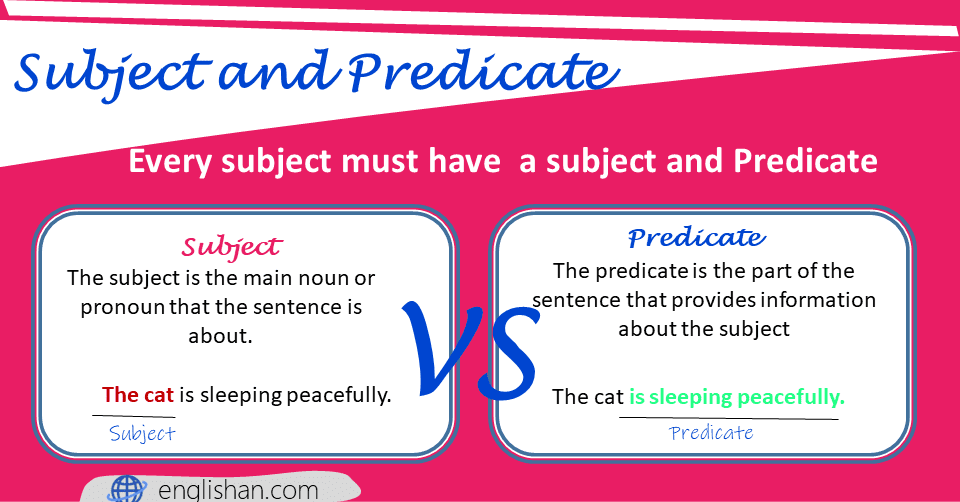
In every sentence, there are two main parts: the subject and the predicate. The subject tells us who or what the sentence is about, while the predicate explains what the subject is doing or describes it. This post helps learn how these parts work together to form meaningful sentences.
In English, every sentence consists of two main parts:
- Subject – Tells us who or what the sentence is about.
- Predicate – Explains what the subject does or what happens to it.
Examples:
- The dog barks. (Subject: The dog, Predicate: barks)
- Apples are tasty. (Subject: Apples, Predicate: are tasty)
By understanding subjects and predicates, you can write clearer and more effective sentences.
What is the Subject?
The subject is the main noun or pronoun that the sentence is about. It represents a person, thing, or idea performing an action or being described.
To identify the subject, ask:
“Who or what is the sentence about?”
Types of Subjects
Subjects can be simple, complete, or compound:
Simple Subject – The main noun or pronoun:
- The cat sleeps on the sofa.
Complete Subject – The simple subject + modifiers:
- The black and white cat sleeps on the sofa.
Compound Subject – Two or more subjects sharing the same predicate:
- John and Sarah went to the mall.
Examples
- Mary loves to play the piano.
- Dogs are loyal animals.
- The sun rises in the east.
- They went to the park together.
- My sister is a doctor.
In each sentence, the subject represents the who or what the sentence describes.
What is the Predicate?
The predicate is the part of the sentence that provides information about the subject. It includes:
- The verb
- Any other words or phrases describing the action or state of being
To identify the predicate, ask:
“What is happening or being said about the subject?”
Types of Predicates
Predicates can also be simple, complete, or compound:
Simple Predicate – The main verb or verb phrase:
- She sings beautifully.
Complete Predicate – The verb + additional details:
- She sings beautifully in the choir.
Compound Predicate – Two or more verbs sharing the same subject:
- She sings and plays the piano.
Examples
- Mary loves to play the piano.
- Dogs are loyal animals.
- The sun rises in the east.
- They went to the park together.
- My sister is a doctor.
The predicate highlights what happens to the subject in the sentence.
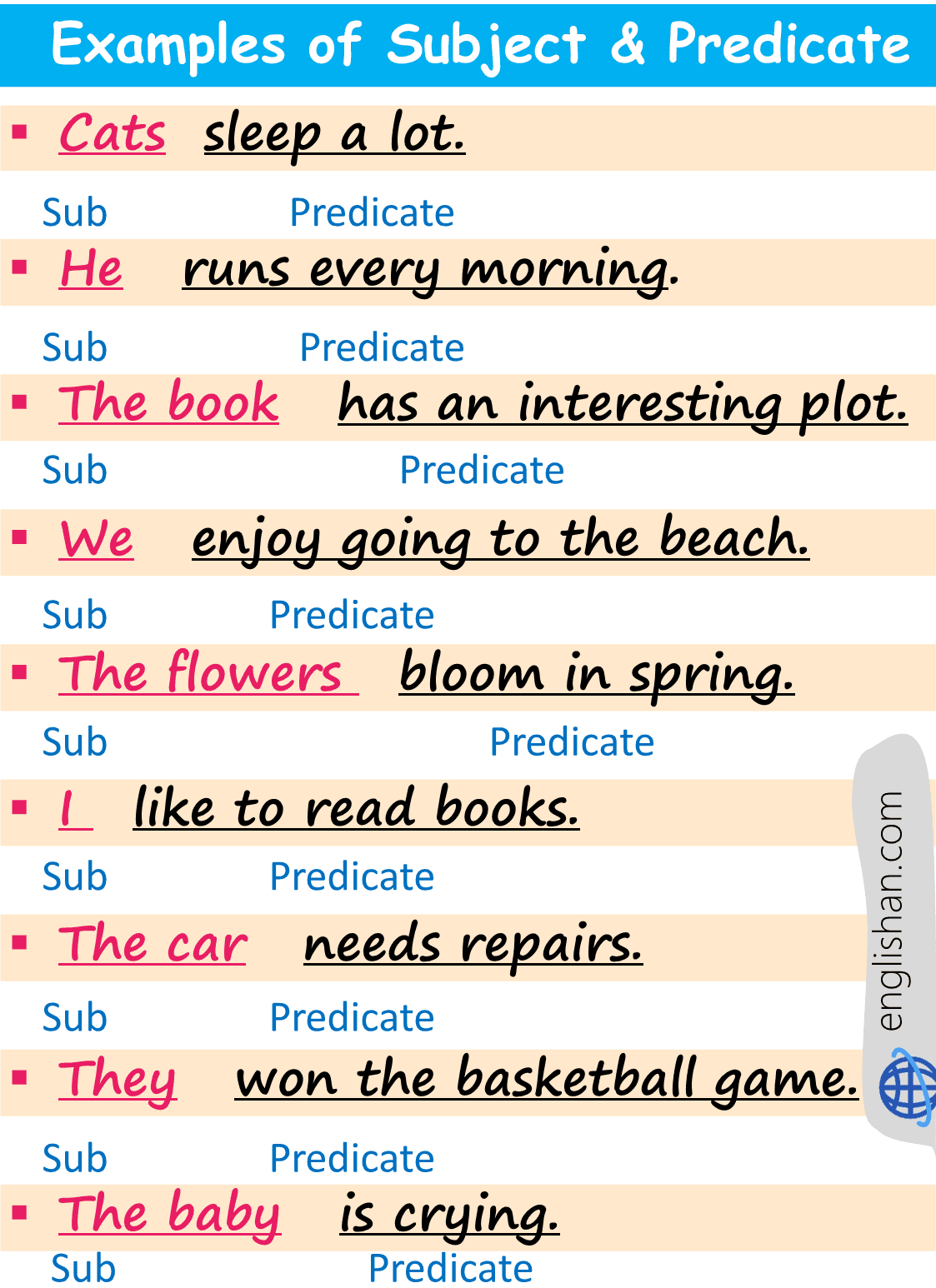
More Examples of Subjects and Predicates
Here are more example sentences to reinforce the concept:
| Sentence | Subject | Predicate |
|---|---|---|
| Cats sleep a lot. | Cats | sleep a lot. |
| He runs every morning. | He | runs every morning. |
| The book has an interesting plot. | The book | has an interesting plot. |
| We enjoy going to the beach. | We | enjoy going to the beach. |
| The flowers bloom in spring. | The flowers | bloom in spring. |
| She sings beautifully. | She | sings beautifully. |
| The students studied hard. | The students | studied hard. |
| I like to read books. | I | like to read books. |
| The car needs repairs. | The car | needs repairs. |
| They won the basketball game. | They | won the basketball game. |
| The baby is crying. | The baby | is crying. |
| My parents love to travel. | My parents | love to travel. |
| Heather baked a delicious cake. | Heather | baked a delicious cake. |
| The birds are chirping. | The birds | are chirping. |
| The movie starts at 8 PM. | The movie | starts at 8 PM. |
| We visited the museum yesterday. | We | visited the museum yesterday. |
| The dog barks loudly. | The dog | barks loudly. |
| The teacher explains the lesson. | The teacher | explains the lesson. |
| Sheila and Mark are best friends. | Sheila and Mark | are best friends. |
| The rain stopped abruptly. | The rain | stopped abruptly. |
FAQs
The subject and predicate are the two main parts of a sentence:
Every sentence has two parts:
1. Subject: Who or what the sentence is about.
2. Predicate: What the subject is doing or what happens.
Examples:
The cat (subject) is sleeping (predicate).
Tom (subject) plays football (predicate).
The flowers (subject) are blooming (predicate).
The subject is the “who or what,” and the predicate tells the action or description.
Here’s the simple rule for subject and predicate:
1. Every sentence needs a subject and a predicate.
2. The subject tells who or what the sentence is about.
3. The predicate tells what the subject is doing or what happens.
Example:
The dog (subject) runs fast (predicate).
Both parts are needed to make a complete sentence.
A predicate tells what the subject does or what happens to it. It usually includes the action word (verb) and other details about it.
Example:
The dog (subject) barks loudly (predicate).
Sara (subject) is reading a book (predicate).
The predicate shows the action or what is happening to the subject.
You May Also Like
Check Your Understanding by Solving the Worksheet Subject and Predicate in English
Subject and Predicate Quiz
Subject and Predicate
Find the subject.
The gardener planted roses.
'The gardener' is who the sentence is about, so it is the subject.
the subject names who or what the sentence is about
The gardener planted roses.
Find the predicate.
The gardener planted roses.
'Planted roses' tells what the subject did, so it is the predicate.
the predicate tells what the subject does or is
The gardener planted roses.
Find the simple subject.
The old wooden gate creaked loudly.
'Gate' is the core noun, so it is the simple subject.
the simple subject is the core noun
The old wooden gate creaked loudly.
Find the simple predicate.
The children were playing in the park.
'Were playing' is the verb phrase, so it is the simple predicate.
the simple predicate is the verb or verb phrase
The children were playing in the park.
Find the complete subject.
My best friend from school moved abroad.
The full group naming the subject is the complete subject.
the complete subject includes all modifiers
My best friend from school moved abroad.
Find the subject.
Across the field ran a frightened deer.
'A frightened deer' performs the action, so it is the subject.
the subject can follow the verb in inverted order
Across the field ran a frightened deer.
Find the complete predicate.
The tired travellers rested by the river.
'Rested by the river' tells what the subject did, so it is the complete predicate.
the complete predicate includes the verb and its modifiers
The tired travellers rested by the river.
Find the subject.
There are three cats on the wall.
'Three cats' is what the sentence is about, so it is the subject.
in 'there is/are', the subject follows the verb
There are three cats on the wall.
True or false?
Every clause has a subject and a predicate.
A clause states who or what, and what is said about them.
clause = subject + predicate
The bell rang.
Find the subject.
Running late, she skipped breakfast.
'She' performs the action of the main clause, so it is the subject.
the subject performs the main verb
Running late, she skipped breakfast.
Find the simple subject.
One of the boys has a bicycle.
'One' is the core noun of the subject, so it is the simple subject.
the simple subject is not inside a prepositional phrase
One of the boys has a bicycle.
Find the predicate.
The storm damaged several houses.
'Damaged several houses' tells what the storm did, so it is the predicate.
the predicate states what the subject did
The storm damaged several houses.
Type the simple subject.
In 'The bright morning sun warmed the room', the simple subject is ___ .
'Sun' is the core noun of the subject, so it is the simple subject.
the simple subject is the core noun
The bright morning sun warmed the room.
Find the compound subject.
Tom and Jerry chased each other.
Two subjects joined by 'and' form a compound subject.
a compound subject joins two subjects with 'and'
Tom and Jerry chased each other.
Find the subject.
Quietly, the cat crept forward.
'The cat' performs the action, so it is the subject.
the subject performs the action
Quietly, the cat crept forward.
Find the compound predicate.
She opened the window and looked outside.
Two verb groups joined by 'and' form a compound predicate.
a compound predicate joins two verb groups
She opened the window and looked outside.
Find the subject.
Do the students understand the lesson?
'The students' is who the question is about, so it is the subject.
the subject follows the auxiliary in a question
Do the students understand the lesson?
Find the simple predicate.
The letter on the desk has been opened.
'Has been opened' is the full verb phrase, so it is the simple predicate.
the simple predicate is the whole verb phrase
The letter on the desk has been opened.
True or false?
The predicate always contains the verb.
The predicate is built around the verb that states the action or being.
predicate = verb + its modifiers and objects
The dog barked loudly.
Find the complete subject.
A group of noisy children ran past.
The full group naming the subject is the complete subject.
the complete subject includes all its modifiers
A group of noisy children ran past.
Turn on JavaScript for the interactive quiz. The full practice set is shown above.