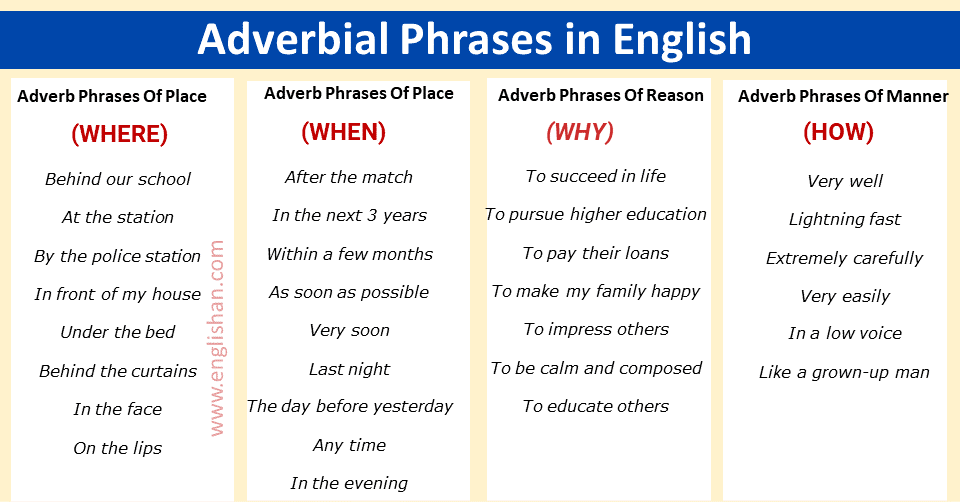
An adverbial phrase is a group of words that works like an adverb, telling you when, where, how, or why something happens. She left before dawn and he answered with real care both do the job a single adverb would do, using several words instead of one. What makes a phrase adverbial is not what it is built from but what it modifies, and that one point settles nearly every question that follows.
What An Adverbial Phrase Does
An adverbial phrase is a group of words that functions as an adverb, telling you when, where, how, or why something happens. It modifies a verb, an adjective, another adverb, or a whole clause. Unlike an adverbial clause, it has no subject and verb of its own.
Most often it modifies the verb. In She waited in the corridor, the phrase in the corridor tells you where the waiting happened, so it attaches to waited. The same phrase moved to a different sentence attaches to whatever verb it explains.
Adjectives and whole clauses take adverbial phrases too. An adverbial phrase modifies an adjective in The soup was hot beyond belief, where beyond belief intensifies hot. It modifies a whole clause in To be honest, the plan never had a chance, where the phrase comments on everything after it rather than on any single word.
Why the name is adverbial rather than adverb: the label describes a job, not a word class. In an hour is built from a preposition and a noun with no adverb in it, yet it answers when, so it counts. Most grammar guides use adverb phrase and adverbial phrase to mean the same thing. Stricter usage separates them, reserving adverb phrase for a phrase built out of adverbs, such as very quickly, and adverbial phrase for any phrase doing an adverb’s work. On a page like this the two are interchangeable, and the types of adverb behind them stay the same either way. That single job splits into eight different functions, and naming them is the fastest way into the topic.
Types Of Adverbial Phrases
Eight functions cover everything an adverbial phrase does. The first four appear in almost every sentence you write, so they get their own treatment, and the remaining four follow.
Adverbial Phrases Of Time
The rule: a time adverbial answers when, how long, or from when, and it attaches to the verb rather than to any noun near it.
| after lunch | before dawn | in the morning |
|---|---|---|
| last week | every Tuesday | during the storm |
| at half past six | since Friday | until midnight |
| by the end of the month | two hours ago | on Christmas Eve |
| throughout the winter | in a moment | the day before yesterday |
Adverbial Phrases Of Place
Place adverbials answer where or in what direction, and this is the type that needs the most care. The same phrase attaches to a noun in other sentences, which stops it being adverbial at all.
| in the garden | under the bridge | across the road |
|---|---|---|
| near the station | behind the shed | at the back of the hall |
| along the riverbank | outside the office | between the two buildings |
| on the top shelf | through the tunnel | beyond the hills |
| inside the cupboard | next to the window | all over the floor |
Adverbial Phrases Of Manner
Ask how the action was carried out and a manner adverbial answers. It substitutes directly for a single adverb of manner, which makes it the easiest type to form yourself.
| with great care | in a hurry | without a sound |
|---|---|---|
| like a professional | by hand | at full speed |
| in silence | with both hands | as fast as possible |
| in a friendly way | under protest | with a steady grip |
| at a crawl | in one go | without hesitation |
Adverbial Phrases Of Reason
Reason adverbials answer why by naming a cause that already exists. Keep them separate from purpose, which names a result you wanted instead, since the two look alike and behave differently.
| because of the rain | due to illness | on account of the strike |
|---|---|---|
| out of curiosity | for that reason | thanks to her advice |
| owing to the delay | from sheer exhaustion | in view of the cost |
| for fear of waking him | as a result of the merger | through carelessness |
| because of the noise | out of respect | on those grounds |
Four more functions complete the set, and each covers a relation the first four cannot express.
Purpose, answering what for: reason looks backward at a cause, purpose looks forward at an aim. He ran because of the noise explains what made him run. He ran to catch the bus explains what he wanted. Most purpose adverbials open with to, in order to, or so as to.
| to catch the train | in order to save time | so as not to wake her |
|---|---|---|
| for a better view | to avoid the traffic | in search of shelter |
| for the sake of clarity | to settle the argument | in preparation for the exam |
| so as to finish early | for extra practice | to keep warm |
| in hope of a reply | for safety | to make the point |
Frequency, answering how often: these count repetitions rather than fixing a moment, which is what separates them from time adverbials.
| every day | once a week | twice a month |
|---|---|---|
| three times a year | now and then | from time to time |
| on most weekends | several times an hour | all the time |
| once in a while | every other day | day after day |
| at regular intervals | hardly ever | more often than not |
Degree, answering how much: a degree adverbial measures the extent of an action or strengthens an adjective, and it is the one function that attaches to adjectives as readily as to verbs.
| to a great extent | almost completely | more than enough |
|---|---|---|
| hardly at all | quite a lot | beyond all measure |
| a great deal | very nearly | not in the slightest |
| by a wide margin | in full | only just |
| far too much | well beyond | at least a little |
Concession, answering despite what: these signal that the action happened against an obstacle, and they open a sentence more comfortably than any other type.
| in spite of the cost | despite the warning | for all his effort |
|---|---|---|
| regardless of the weather | even with the delay | notwithstanding the risk |
| despite everything | in spite of herself | for all that |
| against all odds | whatever the outcome | despite the odds |
| in the face of criticism | regardless of the result | for all the noise |
Examples Of Adverbials In Sentences
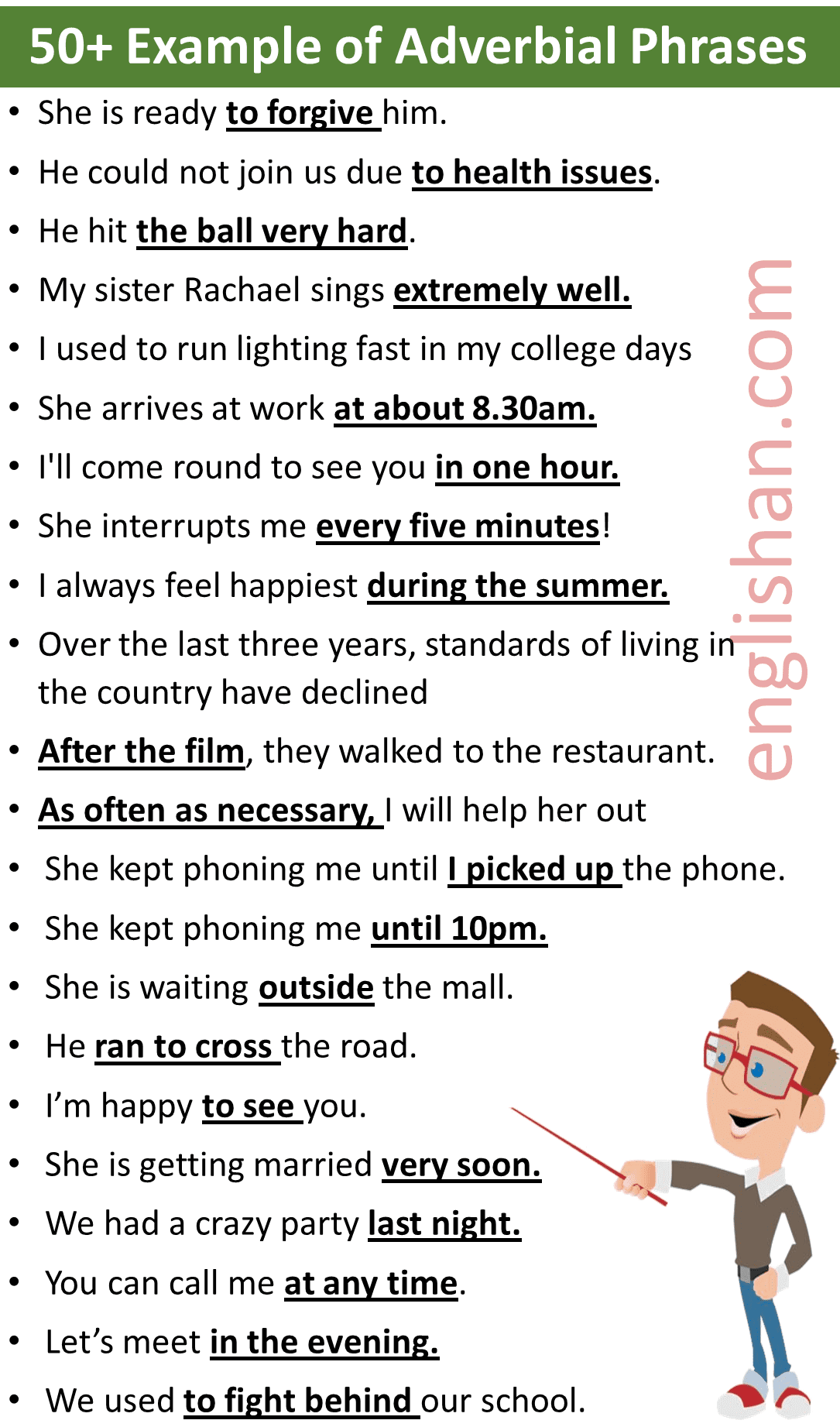
The four commonest functions are the ones you meet first, so each gets its own group of sentences.
Answering when:
- We set off before sunrise.
- She calls her mother every Sunday evening.
- The parcel arrived two days late.
- They finished the roof just after lunch.
- He has been coughing since the weekend.
- The shop closes at half past five.
- Our lease runs until the end of March.
- The kettle boiled in under a minute.
Answering where:
- The cat slept on the warm windowsill.
- She parked behind the old library.
- Water was leaking through the ceiling.
- The path runs along the riverbank.
- He found the receipt at the bottom of his bag.
- Smoke drifted across the valley.
- They camped beside a shallow stream.
- The keys had fallen between the seat cushions.
Answering how:
- She signed the form without hesitation.
- The surgeon worked with enormous care.
- He climbed the ladder one rung at a time.
- The children entered in single file.
- She answered in a friendly way.
- The engine started on the third attempt.
- They divided the bill down to the last penny.
- He read the letter out loud.
Answering why:
- The match was postponed because of the rain.
- She stayed home due to illness.
- He apologised out of genuine regret.
- They left early to avoid the traffic.
- The road was closed for emergency repairs.
- She saved every receipt in case of an audit.
Every bolded group does the same job in a different way: it answers a question about the verb beside it. What none of them shows is what those phrases are built from.
Prepositional And Infinitive Forms
Four forms cover the whole set, and recognising each structure is what lets you identify an adverbial phrase quickly.
| Form | What it is built from | Example |
|---|---|---|
| Prepositional phrase | A preposition plus a noun phrase | She waited in the corridor. |
| Infinitive phrase | To plus the base verb | He ran to catch the bus. |
| Adverb with an intensifier | An intensifier plus an adverb | She spoke very quietly. |
| Noun phrase used adverbially | A bare noun phrase, no preposition | They arrived last Tuesday. |
The fourth form is the one most readers miss, because nothing in its structure identifies it as adverbial. Last Tuesday, every morning, this way and three times are all noun phrases wearing no preposition, yet each answers when or how about the verb. Test them the same way you test any candidate: if the group answers one of the four questions and has no verb of its own, it is adverbial regardless of what it is made from. Single-word forms follow the same logic, which is why adverbs without -ly still count as adverbs, and the full adverbs list gives you the single-word versions these phrases replace.
Adverbial Phrase Vs Prepositional Phrase
The first of those four forms causes more confusion than the other three combined, and the reason is that the two labels describe different properties. A phrase is often both at once.
Prepositional describes what the phrase is made of. Adverbial describes what the phrase does. A prepositional phrase turns adverbial only when it modifies a verb, an adjective, or an adverb. When it modifies a noun instead, the very same phrase is adjectival.
Compare the same phrase in two functions:
- The man in the hat waved at us.
Here in the hat tells you which man, so it attaches to the noun man and works as an adjectival phrase. Nothing about the waving has been explained.
- He waved at us from the doorway.
Here from the doorway tells you where the waving happened, so it attaches to the verb waved and works as an adverbial phrase.
The check that decides it: ask what the phrase would leave behind if you deleted it. Lose a noun’s identity and the phrase was adjectival. Lose information about the action and it was adverbial. The same distinction governs adjectival phrases as a whole, and it applies no matter which of the types of prepositions opens the phrase.
A second distinction applies as widely and is easier to draw. Two points finish this one first. Not every adverbial phrase is prepositional, since infinitive phrases and bare noun phrases are adverbial with no preposition anywhere. And not every prepositional phrase is adverbial, as the man in the hat just showed. The two categories overlap heavily without either one containing the other.
Adverbial Phrase Vs Adverbial Clause
A single test separates a phrase from a clause.
| Adverbial phrase | Adverbial clause | |
|---|---|---|
| Subject and verb inside | No | Yes |
| When example | before the storm | before the storm arrived |
| Reason example | because of her warning | because she warned us |
| Manner example | with great care | as carefully as she could |
Look inside the group of words for something doing something. Before the storm names a thing and stops, so it is a phrase. Before the storm arrived gives the storm an action, which makes it a clause. Both answer when, both attach to the verb, and both are adverbials. Only one of them is a phrase.
Watch what is inside the group rather than how long it runs, because a long phrase stays a phrase and a short clause stays a clause. At the very back of the crowded lecture hall runs nine words with no verb inside it, so it remains a phrase. That subject test completes the method for identifying an adverbial phrase.
How To Identify An Adverbial Phrase
Locating one inside a long sentence defeats most readers, since the four forms share no common structure. Three checks resolve it, and every one of them has already been covered.
Step 1, find the verb: adverbial phrases point at verbs far more than anything else, so the verb tells you where to look.
Step 2, ask the eight questions: put when, where, how, why, what for, how often, how much, and despite what to the verb. Whichever one gets an answer, that answer is your candidate.
Step 3, run the subject test on the candidate: finding a subject with its own verb means you have a clause. Finding none confirms the phrase.
Run all three on this sentence:
- The team practiced on the frozen pitch until the light failed.
Step 1 gives you the verb practiced. Step 2 asks where and gets on the frozen pitch, then asks when and gets until the light failed. Step 3 separates them. On the frozen pitch has no verb inside it, so it is an adverbial phrase. Until the light failed has the subject light and the verb failed, which makes it an adverbial clause. One sentence, one phrase, one clause, and the third check is what distinguishes them. Once a phrase is confirmed, the next decision is its position.
Where Adverbials Go In A Sentence
Adverbial phrases move more freely than almost any other structure in English, and the position you choose changes the emphasis rather than the meaning.
End position, the default: She reviewed the contract with great care.
Front position, for emphasis or contrast: With great care, she reviewed the contract.
Mid position, between subject and verb: She, with great care, reviewed the contract.
End position reads as neutral, which is why most writing puts the adverbial there. Front position places the emphasis on the adverbial itself and suits a contrast with something stated earlier. Mid position interrupts the sentence, so it draws strong attention and loses its effect through repetition. Reserve it for cases where the interruption is the effect you want.
One rule overrides all three positions: keep the adverbial next to whatever it explains. Front position is the one that requires punctuation, and distance from the verb is what produces ambiguity.
Fronted Adverbials And Comma Rules
A fronted adverbial is an adverbial phrase moved to the start of the sentence, ahead of the subject. Teachers name it separately because it is a deliberate move, and it needs punctuation the end position does not.
The rule: a fronted adverbial takes a comma after it. The comma marks where the introduction stops and the main sentence starts, which is the whole reason it exists.
After a long day at the office she wanted only silence. ❌
After a long day at the office, she wanted only silence. ✅
In spite of the warnings the crew set out anyway. ❌
In spite of the warnings, the crew set out anyway. ✅
Short fronted adverbials of two or three words drop the comma without confusing anyone, since there is no long introduction to mark the end of. Last week she resigned and Last week, she resigned are both correct, and the shorter version reads faster.
The comma is required whenever omitting it forces a misreading. In After eating the family went for a walk, the missing comma gives the reader After eating the family, which reads as cannibalism until they go back and reparse it. Put the comma in and After eating, the family went for a walk reads correctly the first time. A comma corrects a misreading at the front of a sentence, though it does nothing for a phrase placed beside the wrong verb.
Misplaced Modifiers And Ambiguity
An adverbial phrase modifies whichever verb it is closest to, so a phrase in the wrong position modifies the wrong verb. English will not correct you, because the result is a grammatical sentence that means something you did not intend.
- She told him after the meeting she would resign.
Two readings compete here. The telling happened after the meeting, or the resigning will. Nothing in the sentence decides between them, so the reader picks one and half of them pick wrong.
- She told him after the meeting that she would resign.
- She told him that after the meeting she would resign.
Moving one word fixes the first reading, and moving the phrase fixes the second. Both versions say one thing only.
The check: read your sentence and ask which verb your adverbial phrase is nearest. If that is not the verb you meant it to explain, move the phrase until it is.
Adverbial Phrase Exercises
Four checks have run through this page: identify the phrase, tell adverbial from adjectival, separate phrase from clause, and punctuate the front position. Each set exercises one of them.
Find the adverbial phrase in each sentence and name the question it answers.
- The train pulled out before we reached the platform.
- He fixed the shelf with a borrowed drill.
- They meet twice a month.
- She stayed indoors because of the smoke.
- The dog waited beside the front door.
- He whispered so as not to wake the baby.
- The lecture ran on far too long.
- Despite the forecast, they sailed anyway.
Answers 1 to 4: before we reached the platform (when, and this one is a clause), with a borrowed drill (how), twice a month (how often), because of the smoke (why).
Answers 5 to 8: beside the front door (where), so as not to wake the baby (what for), far too long (how much), despite the forecast (despite what).
Decide whether each phrase is adverbial or adjectival.
- The woman with the red umbrella waved.
- He signed the form with a shaking hand.
- The house on the corner is for sale.
- She parked on the corner.
Answers: adjectival (which woman), adverbial (how he signed), adjectival (which house), adverbial (where she parked).
Decide whether each group of words is a phrase or a clause.
- after the concert
- after the concert finished
- because of his answer
- because he answered
Answers: phrase, clause, phrase, clause.
Add a comma where the sentence needs one.
- On the morning of the interview he overslept.
- Yesterday she resigned.
- In spite of everything the team qualified.
- Without a word of warning the power failed.
Answers: On the morning of the interview, he overslept. Yesterday she resigned (short enough to need no comma). In spite of everything, the team qualified. Without a word of warning, the power failed.
FAQs
No, though the two overlap heavily. Prepositional describes what a phrase is built from, while adverbial describes what it does, so a prepositional phrase is adverbial only when it modifies a verb, an adjective, or an adverb. In the man in the hat, the phrase modifies a noun, which makes it adjectival instead.
Most grammar guides define a phrase as two or more words, so a single adverb such as quickly is an adverb rather than an adverbial phrase. Some grammars take a wider view and count any word or group filling the adverbial slot, which makes quickly an adverbial. For schoolwork and exams, use the two-word definition unless your syllabus says otherwise.
An infinitive phrase such as to catch the bus has a verb form in it, and it is still a phrase. What a phrase never has is a subject paired with a finite verb. Because he answered has the subject he and the finite verb answered, which makes it a clause, while because of his answer has neither and stays a phrase.
A fronted adverbial takes a comma after it, and one in end position takes none. Short fronted adverbials of two or three words drop the comma safely, as in Last week she resigned. Use the comma whenever leaving it out makes the reader misread the opening words.
An adjective phrase modifies a noun and answers which one or what kind, while an adverbial phrase modifies a verb, adjective, or adverb and answers when, where, how, or why. The same string of words switches between the two depending on what it attaches to, which is why in the hat is adjectival after the man and adverbial after he waved.
Yes, and end position is the normal place for one. She reviewed the contract with great care puts the adverbial last and needs no comma. Move it to the front for emphasis and the comma becomes necessary.
You May Also Like