

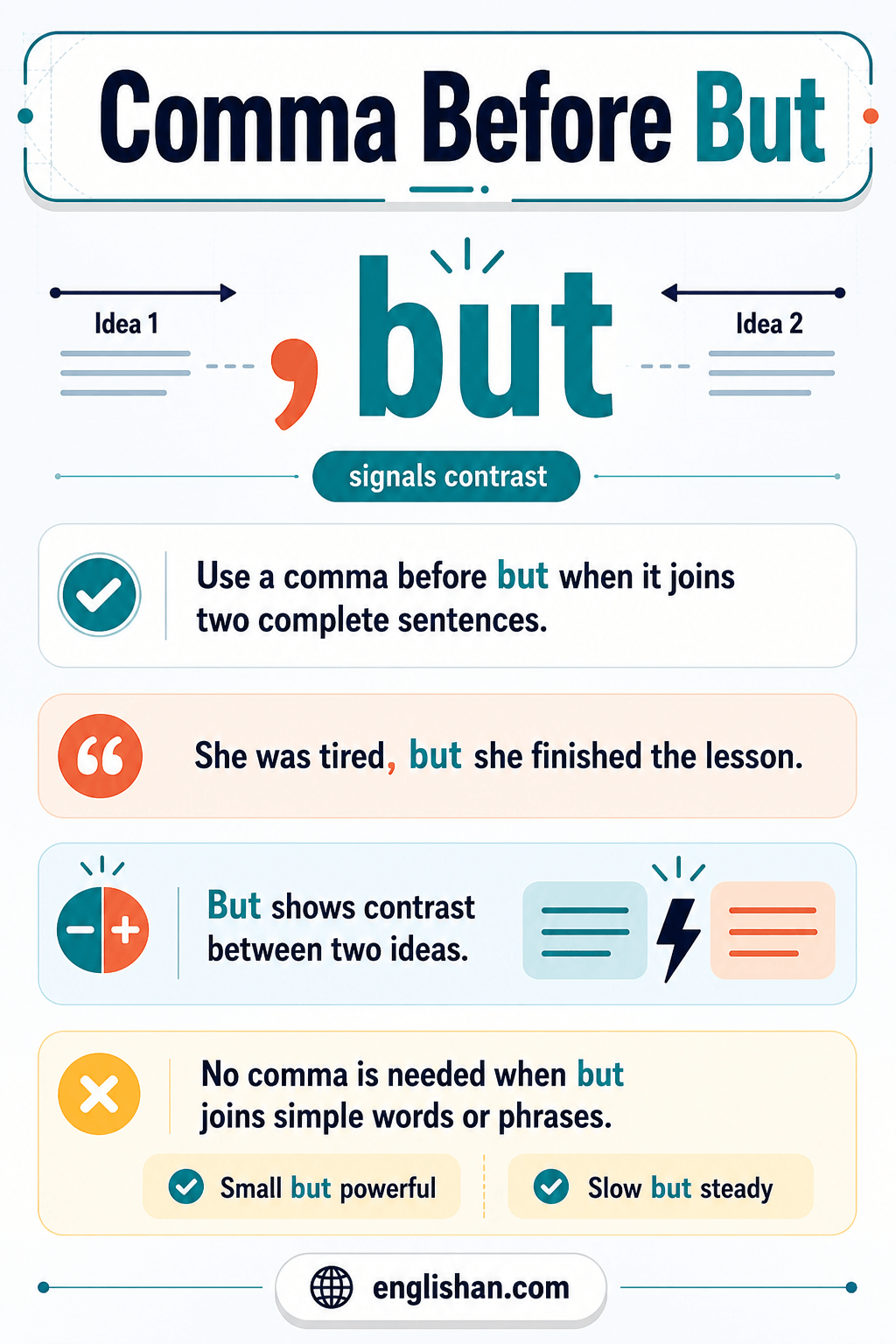
Quick answer: Place a comma before but when it joins two independent clauses — two groups of words that each work as a complete sentence. Skip the comma when the words after but cannot stand alone.
✅ I finished the draft, but the client wanted revisions. ❌ I finished the draft, but not the outline. ✅ I finished the draft but not the outline.
When to Use a Comma Before “But”
A comma before but signals that two complete thoughts are being joined into one sentence. Each side of but must have its own subject and its own verb — in other words, each side must qualify as an independent clause.
She studied for weeks, but she still failed the exam.
Test it: She studied for weeks is a full sentence. She still failed the exam is a full sentence. Two independent clauses joined by but always take a comma.
A few more examples:
- The restaurant was packed, but the service was fast.
- He promised to call, but he never did.
- I love the design, but the budget won’t cover it.
Every sentence above passes the same test — split it at but, and both halves survive on their own.
When to Skip the Comma Before “But”
Drop the comma when the words after but do not form a complete sentence. If the second half lacks its own subject or its own verb, it’s a dependent clause (or just a phrase), and no comma is needed.
The coffee was strong but smooth.
Smooth has no subject and no verb. It’s not an independent clause — it’s an adjective modifying coffee. No comma.
More examples without a comma:
- She was tired but determined.
- He looked everywhere but couldn’t find the keys.
- The hike was long but worth every step.
In each case, the words after but depend on the first half of the sentence to make sense.
The Subject-Removal Test — A Fast Editing Shortcut
Sometimes the line between “needs a comma” and “doesn’t” is blurry — especially when both halves seem complete. A quick editing trick borrowed from professional copy editors: remove the second subject and see if the sentence still works.
✅ He opened the door, but he didn’t walk in.
Remove the second he:
✅ He opened the door but didn’t walk in.
Both versions are grammatically correct. The first treats the two halves as independent clauses. The second merges them into a single clause with a compound predicate — one subject performing two actions. No comma needed.
This technique tightens prose and removes unnecessary punctuation at the same time. If you can cut the second subject and the sentence still reads naturally, the comma becomes optional.
Compound Predicate vs. Compound Sentence — The Most Common Mix-Up
Writers most often misplace the comma before but when they confuse a compound predicate with a compound sentence.
- Compound sentence (two subjects, two verbs → comma): Maya locked the door, but she forgot the windows.
- Compound predicate (one subject, two verbs → no comma): Maya locked the door but forgot the windows.
The difference is whether the second clause has its own subject. If but introduces a new subject-verb pair, use the comma. If the same subject carries both verbs, leave it out.
❌ He sat down, but said nothing. → One subject (he), two verbs. No comma needed. ✅ He sat down but said nothing.
❌ The team played well, but lost in overtime. → One subject (the team), two verbs. ✅ The team played well but lost in overtime.
✅ The team played well, but the crowd had already left. → Two subjects (the team, the crowd). Comma stays.
When to Use a Comma After “But”
A comma after but is rare. It only belongs there when but is immediately followed by an interrupter — a parenthetical word or phrase that adds emphasis, tone, or qualification without changing the sentence’s meaning.
But, of course, the deadline hadn’t changed.
Remove of course and the sentence still holds: But the deadline hadn’t changed. The commas fence off the interrupter, not but itself.
More interrupter examples:
- I agreed to help, but, honestly, I had no idea where to start.
- But, as you’d expect, the price went up.
- She accepted the offer, but, unsurprisingly, she had conditions.
If no interrupter follows but, no comma goes after it.
❌ But, I still think we should go. ✅ But I still think we should go.
Starting a Sentence With “But”
Despite what some grammar teachers insist, starting a sentence with but is widely accepted in modern writing — and has been for centuries. The AP Stylebook, the Chicago Manual of Style, and most usage guides treat it as standard.
No comma follows but at the start of a sentence unless an interrupter immediately follows it.
✅ But the results told a different story. ✅ But, ironically, the results told a different story. ❌ But, the results told a different story.
Comma With “Not Only… But Also”
The correlative pair not only… but also follows its own pattern. When it connects two phrases within a single clause, no comma is needed.
The software is not only fast but also reliable.
When not only… but also joins two independent clauses — each with its own subject and verb — a comma goes before but.
The software not only processes data quickly, but it also generates real-time reports.
If you can restructure the sentence to keep a single subject, the comma disappears:
The software not only processes data quickly but also generates real-time reports.
How Style Guides Handle the Comma Before “But”
Most style guides agree on the core rule: comma before but when it joins two independent clauses. Where they diverge is on short compound sentences.
- Chicago Manual of Style (18th ed.): Recommends the comma in nearly all compound sentences joined by a coordinating conjunction, regardless of length.
- AP Stylebook: Permits dropping the comma when both clauses are very short and closely related — I paint but she sculpts.
If you follow a specific style guide for your publication or assignment, defer to its recommendation. If you don’t, the safest default is to include the comma whenever both sides are independent clauses.
Quick-Reference Table
| Scenario | Comma? | Example |
|---|---|---|
| Two independent clauses joined by but | ✅ Yes | I called, but no one answered. |
| Independent clause + phrase or dependent clause | ❌ No | I called but got no answer. |
| Compound predicate (one subject, two verbs) | ❌ No | She read the email but didn’t reply. |
| Interrupter immediately after but | ✅ After | But, frankly, it was too late. |
| Not only… but also (single clause) | ❌ No | He’s not only smart but also kind. |
| Not only… but also (two independent clauses) | ✅ Yes | He not only studies hard, but he also works full-time. |
The Same Rule Applies to All Coordinating Conjunctions
But isn’t the only conjunction that follows this pattern. The same comma logic governs all seven coordinating conjunctions — remembered by the acronym FANBOYS: for, and, nor, but, or, yet, so.
- I ordered coffee, and she ordered tea. → Two independent clauses. Comma.
- I ordered coffee and a muffin. → One clause. No comma.
- He was exhausted, yet he kept running. → Two independent clauses. Comma.
- He was exhausted yet focused. → One clause. No comma.
Master the rule for but, and you’ve mastered it for all seven.
FAQ
No. A comma before but is required only when but connects two independent clauses — each with its own subject and verb. When but connects a clause and a phrase, or when a single subject carries both verbs, skip the comma.
No. Starting a sentence with but is grammatically correct and widely used in professional, academic, and journalistic writing. No comma is needed after but at the start of a sentence unless an interrupter (like however, of course, or frankly) immediately follows.
A compound predicate has one subject performing two or more actions: She sat down but said nothing. A compound sentence has two independent clauses, each with its own subject and verb: She sat down, but he remained standing. The comma goes in the compound sentence, not the compound predicate.
The core rule stays the same everywhere — comma before but when it joins independent clauses. The one point of variation: AP Stylebook allows dropping the comma in very short compound sentences, while the Chicago Manual of Style recommends keeping it regardless of sentence length.
You May Also Like