Quotation marks are one of those small punctuation marks that we often see in writing, but don’t always think much about. Yet, they play an important role in making our sentences clear and meaningful. We use quotation marks mainly to show someone’s exact words, highlight special terms, or sometimes to indicate titles.
In English grammar, understanding how and when to use quotation marks can really improve your writing. It helps you avoid confusion and makes your sentences easier for the reader to follow. In this article, we’ll go through the basic rules, common uses, and simple examples so you can use quotation marks confidently in your own writing.
What Are Quotation Marks?
Quotation marks are punctuation symbols used to set certain words apart from the rest of a sentence. They usually come in pairs like this: “ ”.
Their main job is to show that the enclosed words are special in some way—often because they are spoken words, a direct quote, or something being mentioned rather than used normally.
For example:
- She said, “I will come tomorrow.”
Here, the words inside the quotation marks are exactly what someone said.
Importance of Quotation Marks in Writing
Quotation marks are important because they make writing clearer and more accurate. Without them, it would be hard to tell:
- Who is speaking
- What words are exact quotes
- When a word is being mentioned rather than used normally
- Whether a title or phrase is being highlighted
They also help avoid confusion.
For example, compare:
- He said he is fine. (reported idea)
- He said, “I am fine.” (exact words)
Both are correct, but they are not the same. Quotation marks help separate your own words from someone else’s words.
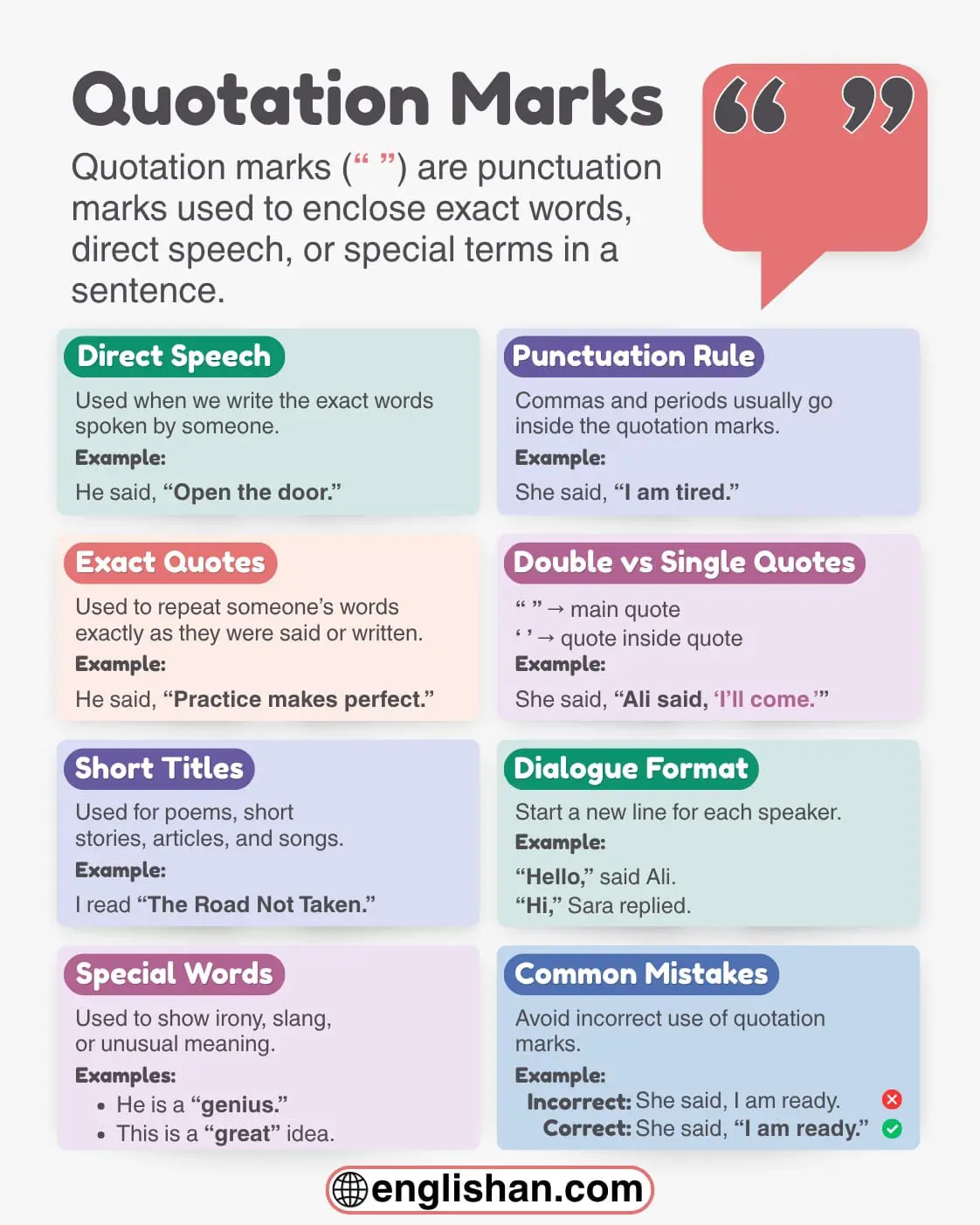
When to Use Quotation Marks
Quotation marks are used in several different situations. Each use has its own purpose, but all of them are about highlighting or separating specific words from the rest of the sentence.
Direct and Indirect Quotations
A direct quotation means you are repeating the exact words spoken or written by someone.
Example:
- The teacher said, “Always complete your homework on time.”
An indirect quotation means you are reporting the meaning, not the exact words. In this case, you do not use quotation marks.
Example:
- The teacher said that students should always complete their homework on time.
So, quotation marks are only needed when the exact wording is important.
Using Quotation Marks for Dialogue and Speech
Quotation marks are very common in conversations written in text, especially in stories, interviews, or everyday dialogue.
For Example:
- “Where are you going?” asked Ali.
- “I am going to the market,” she replied.
This makes it easy for the reader to understand who is speaking and what is being said. Without quotation marks, dialogue would become confusing and unclear.
Using Scare Quotes for Irony, Doubt, or Emphasis
Sometimes quotation marks are used to show that a word is being used in a doubtful, ironic, or unusual way. These are called scare quotes.
For Example:
- He is a “professional” chef.
This may suggest that the writer does not fully believe the person is truly professional. They are often used to show sarcasm or to question the meaning of a word.
Quotation Marks in Titles of Creative Works
Quotation marks are often used for titles of shorter creative works such as:
- Poems
- Short stories
- Articles
- Songs
- Chapters
Example:
- I really enjoyed the poem “The Road Not Taken.”
However, longer works like books or movies are often written in italics instead of quotation marks, depending on the style guide being used.
Quotation Marks for Discussing Words and Terms
Quotation marks are also used when we talk about a word itself, rather than using it in its meaning.
For Example:
- The word “fast” can have different meanings depending on context.
Here, we are not talking about something being fast—we are talking about the word “fast” itself.
Using Quotation Marks for Nicknames
When a person has a nickname, it is often placed in quotation marks between their first and last name.
For Example:
- Dwayne “The Rock” Johnson is a famous actor and wrestler.
This shows that “The Rock” is not part of his real name but a nickname.
Quotation Marks for Indicating Height (Inches and Feet)
Quotation marks are also used informally to show measurements of height in feet and inches.
For Example:
- 5’8” means 5 feet 8 inches.
Here:
- Single quote (’) = feet
- Double quote (”) = inches
This is commonly used in forms, sports, and quick references.
Single vs Double Quotation Marks
Quotation marks come in two main forms: single (‘ ’) and double (“ ”). At first glance, they may look like a small stylistic difference, but in actual writing, they follow specific conventions depending on the type of English you are using and the context of the sentence.
When to Use Double Quotation Marks
In most cases, especially in American English, double quotation marks are the standard choice.
They are mainly used for:
- Direct speech
- Exact quotations
- Titles of short works (like poems or articles)
- Emphasizing a word being used in a special way
Example:
- She said, “I will finish my work today.”
Here, the exact words spoken are enclosed in double quotation marks.
Another example:
- He called it a “simple” solution.
In this case, the word simple is being highlighted, possibly with a slight tone of doubt or emphasis. So, in general writing, double quotation marks are the default and most commonly used form.
When to Use Single Quotation Marks
Single quotation marks are not usually used on their own in American English. Instead, they are mainly used inside double quotation marks when you already have a quote within a quote.
For Example:
- She said, “My teacher told me, ‘You are improving every day.’”
Here’s what is happening:
- The outer quotation uses double quotes
- The inner quotation uses single quotes
This helps keep the structure clear and easy to follow. In British English, however, single quotation marks are more commonly used as the main style, and double quotation marks are used only for quotes inside quotes.
British vs American English Usage Differences
This is where things get a little different depending on where the English is used.
American English:
- Uses double quotation marks as the standard
- Uses single quotation marks inside double quotes
Example:
- He said, “I heard her say, ‘I’m coming soon.’”
British Englis:
- Uses single quotation marks as the standard
- Uses double quotation marks inside single quotes
Example:
- He said, ‘I heard her say, “I’m coming soon.”’
Important Rules for Using Quotation Marks
Quotation marks are not difficult once you understand how they behave in real sentences. The key is to follow a few clear rules and see how they work in everyday writing. Let’s go through them in a simple and conversational way.
Always Use Quotation Marks in Pairs
Quotation marks always come in two parts. One appears at the beginning of the quoted words and the other at the end. They work like a complete frame around the sentence.
For Example:
- She said, “I am ready to leave.”
- He replied, “I will call you later.”
If you only use one side, the sentence feels incomplete and confusing. The reader will not know where the quote starts or ends.
Placement of Punctuation Inside Quotation Marks
One important rule is how punctuation behaves with quotation marks. In most cases, punctuation such as commas and periods stays inside the quotation marks.
Commas with Quotation Marks
When you introduce speech, a comma is usually placed before or inside the quotation marks depending on the structure.
For Example:
- “I am coming home soon,” she said.
- He said, “I am coming home soon.”
The comma helps separate the speaker from the spoken words in a smooth and natural way.
Periods with Quotation Marks
When a quoted sentence ends the sentence, the period is placed inside the quotation marks.
For Example:
- She said, “It is a beautiful day.”
- He explained, “The work is complete.”
This keeps the quotation clean and complete inside its own structure.
Colons and Semicolons with Quotation Marks
olons and semicolons usually stay outside quotation marks unless they are part of the original sentence being quoted.
For Example:
- He gave one simple instruction: “Be on time.”
- She said, “I will try my best”; then she left the room.
These punctuation marks are more about connecting ideas in the main sentence, so they are kept outside.
Question Marks and Exclamation Marks in Quotes
This depends on the meaning of the sentence.
When the punctuation belongs to the quote, it stays inside:
- She asked, “Are you coming with us?”
- He shouted, “Stop right there!”
When it does not belong to the quote, it stays outside:
- Did he really say “I am leaving”?
- I cannot believe she said “it is over”!
Capitalization Rules in Quoted Sentences
If you are quoting a full sentence, the first word inside the quotation marks starts with a capital letter.
For Example:
- She said, “We will start the meeting now.”
- He replied, “This is not acceptable.”
However, if you are quoting just a word or a short phrase, you do not capitalize it unless it is a proper noun.
For Example:
- He called it “very expensive.”
- She described it as “a serious issue.”
Quoting Multiple Paragraphs
Sometimes a quotation is long and continues into more than one paragraph. In that case, you use opening quotation marks at the start of each paragraph, but you only close them at the very end.
For Example:
He wrote:
- “We have worked on this project for months. We have learned a lot along the way.
- “We are now ready to present our final results.”
This makes it clear that the entire passage belongs to the same quotation, even though it is split into paragraphs.
Using [sic] to Show Original Mistakes
Sometimes you copy someone’s exact words, even if there is a mistake in grammar or spelling. In that case, you use [sic] to show that the mistake was originally in the source.
For Example:
- He wrote, “They was [sic] very happy with the results.”
This tells the reader that the error is not yours. You are only copying the original text exactly as it was written.
Common Mistakes to Avoid with Quotation Marks
Quotation marks look simple, but small mistakes can easily change the meaning of a sentence or make writing feel messy. Let’s look at the most common mistakes people make so you can avoid them in your own writing.
Using quotation marks when they are not needed
A very common mistake is putting quotation marks around words just for decoration or emphasis. This can confuse the reader.
For Example:
- Incorrect: He was “very” tired.
- Correct: He was very tired.
Quotation marks should not be used just to stress a word. They are not emphasis tools.
Forgetting to close quotation marks
Sometimes people open a quote but forget to close it at the end. This makes the whole sentence unclear.
For Example:
- Incorrect: She said, “I will come tomorrow.
- Correct: She said, “I will come tomorrow.”
Always make sure the quote is properly closed.
Mixing up single and double quotation marks
Many learners use them randomly without understanding the rule.
For example:
- Incorrect: She said, ‘I am happy.”
- Correct: She said, “I am happy.”
Keep the style consistent. Use single quotes only inside double quotes (in American English).
Placing punctuation incorrectly
Another common mistake is putting commas or periods outside when they should be inside.
For example:
- Incorrect: She said, “I am ready”.
- Correct: She said, “I am ready.”
In most cases, punctuation stays inside the quotation marks.
Quoting without context
Sometimes people use quotes without making it clear who is speaking or why it is quoted. This can confuse the reader.
For example:
- Incorrect: “I will do it tomorrow.”
- Correct: He said, “I will do it tomorrow.”
FAQs about Quotation Marks
Double quotation marks are mostly used for normal quoting in American English. Single quotation marks are used inside another quote. In British English, the pattern is reversed.
In most cases, yes. Commas and periods usually go inside quotation marks in American English. However, colons and semicolons usually stay outside.
When you have a quotation inside another quotation, you use single quotation marks inside double quotation marks (in American English).
Example:
She said, “My teacher told me, ‘Keep practicing daily.’”
Yes, they can. Quotation marks show that words are being used in a special way, such as sarcasm, doubt, or direct speech. Without them, the meaning may change.
Example:
He is “honest.” (may suggest doubt)
He is honest. (clear statement)
No. American English and British English follow different rules. The main difference is whether single or double quotation marks are used first.
You May Also Like
- Commas Rules in English Grammar
- Punctuation Worksheets and Exercises with Answers i
- Write a Letter in English | Formal and Informal Letter Writing
- Direct and Indirect Speech in English Grammar with Examples
Quotation Marks Quiz
Quotation Marks
Which encloses direct speech?
Direct speech is enclosed in ___ .
Quotation marks surround the exact words spoken.
quotation marks enclose direct speech
She said, "Hello."
Punctuate the direct speech.
Choose the correct punctuation.
A comma introduces the quotation, capitalised inside the marks.
comma before the quote; capitalise inside
He said, "Wait here."
Quote within a quote.
Choose the correct nesting.
Single marks enclose a quote inside a double-marked quote.
single marks for a quote inside a quote
She said, "He told me 'go now' twice."
British punctuation placement.
In British style, where does the full stop go if it is not part of the quotation?
British style places the full stop outside unless it belongs to the quote.
British style: punctuation outside unless part of the quote
She called it a "triumph".
Punctuate the split quotation.
Choose the correct punctuation.
Commas separate the reporting clause from both quoted parts.
commas set off a mid-sentence reporting clause
"I agree," she said, "but not today."
Which needs quotation marks?
Choose the sentence needing quotation marks.
Direct speech quotes the exact words in quotation marks.
quotation marks enclose direct speech
She whispered, "Follow me."
Title of a short work.
Which correctly marks a short poem's title?
Quotation marks can enclose the title of a short work.
quotation marks can enclose short-work titles
We read "The Road Not Taken" aloud.
Capital inside the quote.
Choose the correct capitalisation.
The first word of a full quoted sentence is capitalised.
capitalise the first word of a quoted sentence
She said, "We should leave."
True or false?
Quotation marks show the exact words a person says.
Quotation marks enclose direct speech or a quotation.
quotation marks enclose exact words
"Stop," he said.
Question inside the quote.
Choose the correct punctuation.
The question mark belongs to the quoted question, inside the marks.
a quoted question keeps its mark inside
She asked, "Are you ready?"
Reporting clause first.
Choose the correct punctuation.
A comma introduces the quotation after the reporting clause.
comma introduces a quote after the reporting clause
Tom replied, "I understand."
Which is direct speech?
Choose the direct speech sentence.
The exact words appear in quotation marks, so it is direct speech.
direct speech uses quotation marks
"I'll be late," she warned.
Add the missing mark.
Punctuate: He said ___ Come in." (mark before the quote)
A comma introduces the quotation after the reporting clause.
comma before a quotation
He said, "Come in."
Nested quote punctuation.
Choose the correct nesting.
Single marks enclose the inner quote within the double-marked quote.
single marks nest inside double marks
"She said 'wait' and left," he recalled.
Which capitalisation is right?
Choose the correct sentence.
The first word of the quoted sentence is capitalised.
capitalise the first word of a quoted sentence
The sign read, "Do not enter."
British placement of a comma.
In British style, an unquoted comma after a quoted word goes ___ .
British style keeps the comma outside when it is not part of the quote.
British style: comma outside unless part of the quote
He described it as "unusual", then paused.
Which sentence quotes correctly?
Choose the correct sentence.
A comma ends the quote before the reporting clause.
a comma ends the quote before the reporting clause
"Come here," she called.
True or false?
A quote inside another quote uses single quotation marks.
Single marks nest a quotation inside a double-marked quotation.
single marks nest inside double marks
"He said 'yes'," she noted.
Punctuate the direct speech.
Choose the correct punctuation.
The exclamation mark belongs to the quoted warning, inside the marks.
a quoted exclamation keeps its mark inside
She shouted, "Watch out!"
Which nesting is correct?
Choose the correct sentence.
Single marks enclose the short title within the double-marked quote.
single marks nest inside double marks
The teacher said, "Read the poem 'If' tonight."
Turn on JavaScript for the interactive quiz. The full practice set is shown above.