Most punctuation marks are familiar from the first years of writing. Periods, commas, question marks, and exclamation marks show up in every sentence, and their rules become second nature over time. But the interrobang (‽) is different. It belongs to a smaller set of marks that solve a problem the standard ones cannot handle on their own.
The interrobang combines the question mark and the exclamation mark into a single glyph, built for sentences that ask a question and express surprise, disbelief, or excitement at the same time. The mark never became standard and still does not appear on any keyboard, but writers reach for its function constantly. Every You said what?! or Are you serious?! is an attempt to do what the interrobang was designed for.
Below, you’ll learn how the interrobang fits into modern writing, when the ?! combination is the right choice, when a single question mark works better, and how each option shapes emotional tone at the end of a sentence.
What Is An Interrobang?
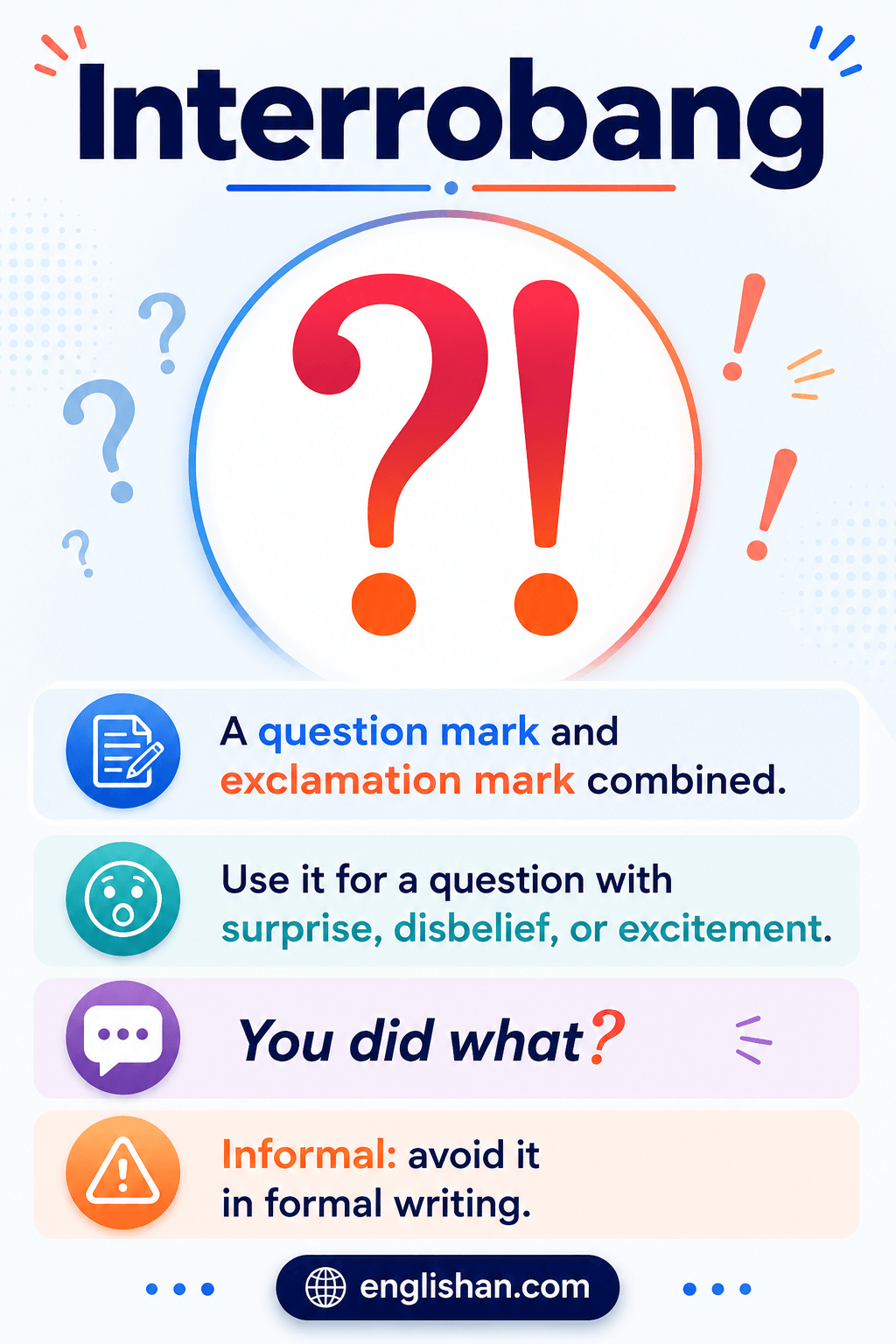
An interrobang (pronounced in-TEHR-eh-bang) is a nonstandard punctuation mark that combines the question mark (?) and the exclamation mark (!) into a single symbol: ‽. The mark signals that a sentence is both a question and an exclamation, expressing surprise, disbelief, or heightened emotion while still asking something.
The name itself reveals the mark’s construction. Interro comes from interrogation point, which is the technical term for the question mark. Bang is printers’ slang for the exclamation mark. The two halves of the name mirror the two halves of the glyph: a question mark and an exclamation mark superimposed on top of each other.
The interrobang is sometimes called an interabang or an exclamation question mark, though neither alternative name has gained wide traction. In everyday writing, the mark is far more commonly represented as ?! or !? than as the actual ‽ glyph, because no standard keyboard carries a dedicated key for it.
A Brief History Of The Interrobang
The interrobang was invented in 1962 by Martin K. Speckter, an American advertising executive. Speckter was frustrated by the way copywriters handled sentences that were simultaneously questions and exclamations. They would stack ?! or !? at the end of a headline, and Speckter considered this pairing an “ugly, jury-rigged construction” that deserved a proper typographic solution.
He proposed the new mark in an article for the trade magazine TYPEtalks, and the response was immediate. By the mid-1960s, several typographical societies had adopted the symbol, and the type designer Richard Isbell built the interrobang into his Americana typeface for the American Type Founders company in 1966. Two years later, Remington added an interrobang key to some of its typewriter models.
The mark’s momentum faded by the mid-1970s. As typewriters gave way to early computers, the interrobang was left off the standard keyboard layouts that would eventually become universal. Without a key, the glyph became increasingly invisible. Most writers returned to the improvised ?! combination, and the interrobang settled into its current status: recognized by linguists and typography enthusiasts, absent from mainstream publishing, and still waiting for a keyboard key that has never arrived.
When To Use An Interrobang
The interrobang belongs at the end of a sentence that genuinely functions as both a question and an exclamation. The sentence must be asking something, and it must carry strong emotion at the same time. When only one of those conditions is present, a single mark (either a question mark or an exclamation mark) does the job on its own.
Shocked Or Disbelieving Questions
The most natural home for the interrobang is a question driven by surprise or disbelief. The speaker is asking something, but the emotional charge behind the question is so strong that a plain question mark would not carry the full weight of the reaction.
- You spent three thousand dollars on a pair of shoes?!
- She quit her job without telling anyone?!
- He said that to the director’s face?!
In each sentence, the question is real (the speaker genuinely wants confirmation), and the emotion is real (the speaker is shocked). The interrobang, or the improvised ?!, captures both registers in a single beat at the end of the sentence.
Excited Or Enthusiastic Questions
Not every interrobang sentence carries negative emotion. Some express excitement, delight, or eager disbelief. The speaker is asking a question, but the question comes from a place of joy rather than shock.
- You got accepted into the program?!
- They’re giving us an extra week of vacation?!
- We actually won?!
The emotional register here is positive, but the structure is the same: a question with enough intensity that a plain question mark would flatten the reaction.
Rhetorical Questions With Emphatic Force
A rhetorical question asked with particular force or frustration can take an interrobang to underscore the intensity. The speaker is not expecting an answer, but the emotional weight of the question demands more than a standard question mark.
- How could you forget our anniversary?!
- Who does something like that?!
- What were you thinking?!
These sentences are rhetorical because the speaker already knows the answer (or the answer is implied). The interrobang adds a visual signal that the question is being delivered with emotional force, not neutral curiosity.
When A Single Mark Is Enough
Not every emotional question warrants an interrobang. When the question carries mild surprise, polite curiosity, or gentle emphasis, a standard question mark handles the tone without overstating it.
- You’re leaving already? (mild surprise, question mark is sufficient)
- Did she really say that? (curiosity, question mark is sufficient)
- How did you manage that? (impressed but calm, question mark is sufficient)
The interrobang earns its place only when the emotional intensity is strong enough that a single question mark would genuinely underrepresent the tone. Overusing it dilutes the effect, just as overusing exclamation marks makes every sentence feel the same.
Is ?! Or !? The Correct Order?
Both forms appear in published writing, but ?! is more widely accepted and more commonly used. The reasoning is structural: the sentence is fundamentally a question (it asks something), and the exclamation mark adds emotional emphasis on top of that question. Placing the question mark first reflects the sentence’s primary function, and the exclamation mark follows as the emotional modifier.
- You’re breaking up with me?! ✅ (question first, emotion second)
- You’re breaking up with me!? (less standard, but not incorrect)
Style guides that address the improvised form at all generally prefer ?!. In casual writing, either order communicates the same thing, but for consistency, ?! is the stronger default.
The Editorial Argument Against The Interrobang
Not every editor or style guide welcomes double punctuation. The counter-argument is straightforward: strong language should carry the emotional weight of a sentence, and punctuation should confirm that tone rather than create it.
A sentence like You spent three thousand dollars on a pair of shoes? already communicates shock through its content. The question mark is enough because the words do the heavy lifting. Adding the exclamation mark (?!) doubles the signal, and some editors consider that doubling unnecessary or even distracting.
This position appears in newsroom style guides, academic writing standards, and editorial advice from writers like Grammar Girl, who notes that letting language do the work produces cleaner prose. The argument is not that the interrobang is wrong, but that well-chosen words rarely require double punctuation to land.
The practical reality falls somewhere in the middle. In formal writing, academic papers, business reports, and journalism, double punctuation is almost universally avoided. In casual writing, dialogue, text messages, social media, and creative fiction, the ?! combination is widely understood and accepted. The audience and the context determine whether the interrobang strengthens the sentence or overloads it.
The Interrobang In Published Writing
The interrobang remains rare in professionally published text. Novels, newspapers, magazines, and academic journals almost never use the actual ‽ glyph, and most style guides (including the Chicago Manual of Style and the AP Stylebook) do not address it because they do not consider it part of standard punctuation.
The improvised ?! form appears more frequently, especially in dialogue-heavy fiction, comic books, graphic novels, and online writing. In these contexts, the double mark is treated as an informal convention rather than a formal punctuation rule.
One unexpected context where the interrobang has gained cultural visibility is as a symbol in personal expression. The ‽ glyph has been adopted as a tattoo and design motif, sometimes representing the idea of questioning with passion or living with both curiosity and intensity. This cultural usage has nothing to do with grammar, but it has kept the symbol visible in spaces where standard punctuation marks rarely appear.
How To Type An Interrobang
The ‽ glyph does not have a dedicated keyboard key, but it can be inserted through several methods depending on the platform.
| Method | How To Do It |
|---|---|
| Google Docs | Go to Insert, then Special Characters, and search for interrobang. |
| Unicode | Hold Alt, press +, type 203D, then release Alt. |
| macOS Character Palette | Press Ctrl + Cmd + Space, then search for interrobang in the search bar. |
| Copy and paste | Copy the symbol ‽ from any web page and paste it into your document. |
| Improvised form | Type ?! at the end of the sentence. This is the most common method. |
Most writers rely on the improvised ?! because it requires no special input and is universally understood. The actual ‽ glyph is a typographic curiosity that adds visual interest in design contexts but is not expected in standard writing.
Common Interrobang Mistakes
Using It In Formal Writing
The interrobang (and the improvised ?!) belongs to informal and creative contexts. Academic essays, business reports, legal documents, and professional correspondence rely on single punctuation marks and let the language carry emotional emphasis.
- The quarterly results exceeded all projections?! (formal context, inappropriate) ❌
- The quarterly results exceeded all projections. (professional tone, period) ✅
Overusing It
The interrobang works best as a rare, well-placed emphasis. When every other sentence ends in ?!, the mark loses its power and the writing starts to feel frantic rather than emphatic.
- You did what?! And then she said what?! And nobody stopped them?! ❌
- You did what?! Nobody stopped them? ✅
The corrected version reserves the interrobang for the sentence with the strongest emotional charge and lets a standard question mark handle the rest.
Using It Where A Single Mark Works
When the question carries mild surprise or ordinary curiosity, the interrobang overstates the tone. The reader expects intensity that the sentence does not deliver, and the double mark feels unearned.
- You’re going to the store?! (mild, question mark is enough) ❌
- You’re going to the store? ✅
Save the interrobang for sentences where the emotional intensity is genuinely high enough that a single question mark would leave something on the table.
Inconsistent Ordering
Switching between ?! and !? within the same piece of writing creates a visual inconsistency. Pick one form (preferably ?!) and apply it throughout.
Interrobang Examples Across Different Registers
| Emotional Register | Example |
|---|---|
| Shocked disbelief | She said that in the middle of the meeting?! |
| Excited surprise | You got the job?! |
| Frustrated rhetorical question | How many times do I have to explain this?! |
| Delighted disbelief | They named the baby after you?! |
| Angry question | You told them without asking me first?! |
| Astonished inquiry | The entire building sold out in one day?! |
| Dialogue | “You’re leaving the country tomorrow?!” she said, staring at him. |
Each sentence asks a genuine question and delivers it with strong emotion. The interrobang (or ?!) earns its place because neither a question mark alone nor an exclamation mark alone would capture the full tone.
Final Thought
The interrobang answers a real question about English punctuation: what do you do when a sentence asks and exclaims at the same time? Martin K. Speckter’s 1962 solution was elegant, merging two marks into one glyph that captured the exact tone writers were reaching for. The fact that the mark never became standard does not mean it failed. It means that most writers found a workaround (?!) that was close enough, and the keyboards of the world never caught up to the idea.
Whether you use the ‽ glyph, the ?! combination, or a carefully chosen question mark on its own, the underlying skill is the same: matching your punctuation to the emotional register of the sentence. When the words carry enough force on their own, a single mark is all you require. When the sentence genuinely asks and exclaims in the same breath, the interrobang, in whatever form you write it, is exactly the right tool.
FAQs
An interrobang (‽) is a nonstandard punctuation mark that merges the question mark and exclamation mark into one symbol. It signals that a sentence is both a question and an exclamation, expressing surprise, disbelief, or strong emotion while still asking something. The name combines interro (from “interrogation point,” the technical term for the question mark) and bang (printers’ slang for the exclamation mark).
Both forms communicate the same meaning, but ?! is more widely accepted. The question mark comes first because the sentence’s primary function is to ask a question, and the exclamation mark follows as the emotional modifier. For consistency, ?! is the stronger default.
No. Academic papers, business reports, legal documents, and professional correspondence rely on single punctuation marks. The interrobang and the improvised ?! belong to informal writing, creative fiction, dialogue, social media, and casual communication.
Functionally, yes. The ‽ glyph and the improvised ?! combination express the same meaning. The difference is visual: ‽ is a single merged symbol, while ?! uses two separate characters. Most writers use ?! because no standard keyboard carries a dedicated interrobang key.
When the question carries mild surprise, ordinary curiosity, or calm emphasis, a standard question mark handles the tone accurately. The interrobang earns its place only when the emotional intensity is strong enough that a single question mark would genuinely underrepresent the reaction.
Martin K. Speckter, an American advertising executive, invented the interrobang in 1962. He proposed the mark in an article for the trade magazine TYPEtalks as a replacement for the improvised ?! combination that copywriters were using in advertising headlines. The mark gained traction in the 1960s but faded from mainstream use by the mid-1970s.
You May Also Like