Punctuation in titles can often seem confusing, especially when deciding between quotation marks and italics. This confusion is common in academic and everyday writing, where incorrect formatting can make content appear inconsistent or unclear. However, a few simple rules can make title punctuation much easier to understand.
Clear and correct punctuation helps maintain consistency and improves the overall presentation of writing. In this article, we’ll learn the basic rules of punctuation in titles, along with simple examples and when to use quotation marks or italics.
What Is Punctuation in Titles?
Punctuation in titles refers to the correct use of quotation marks and italics when writing the names of different works in English. It helps distinguish between short and long works and keeps writing clear, consistent, and easy to understand. It is mainly used:
- To clearly identify titles within a sentence
- To show the type and length of a work
- To maintain consistency in academic and professional writing
Short works are written in quotation marks, while longer or complete works are written in italics. This rule is commonly followed in academic, professional, and general writing.
Example 1 (Short works – quotation marks): “The Road Not Taken” (poem), “Shape of You” (song), “The Lottery” (short story)
Example 2 (Long works – italics): Harry Potter and the Sorcerer’s Stone (book), Titanic (movie), The New York Times (newspaper)
In short, this rule helps keep titles properly organized in writing so that readers can quickly understand what type of work is being mentioned without confusion.
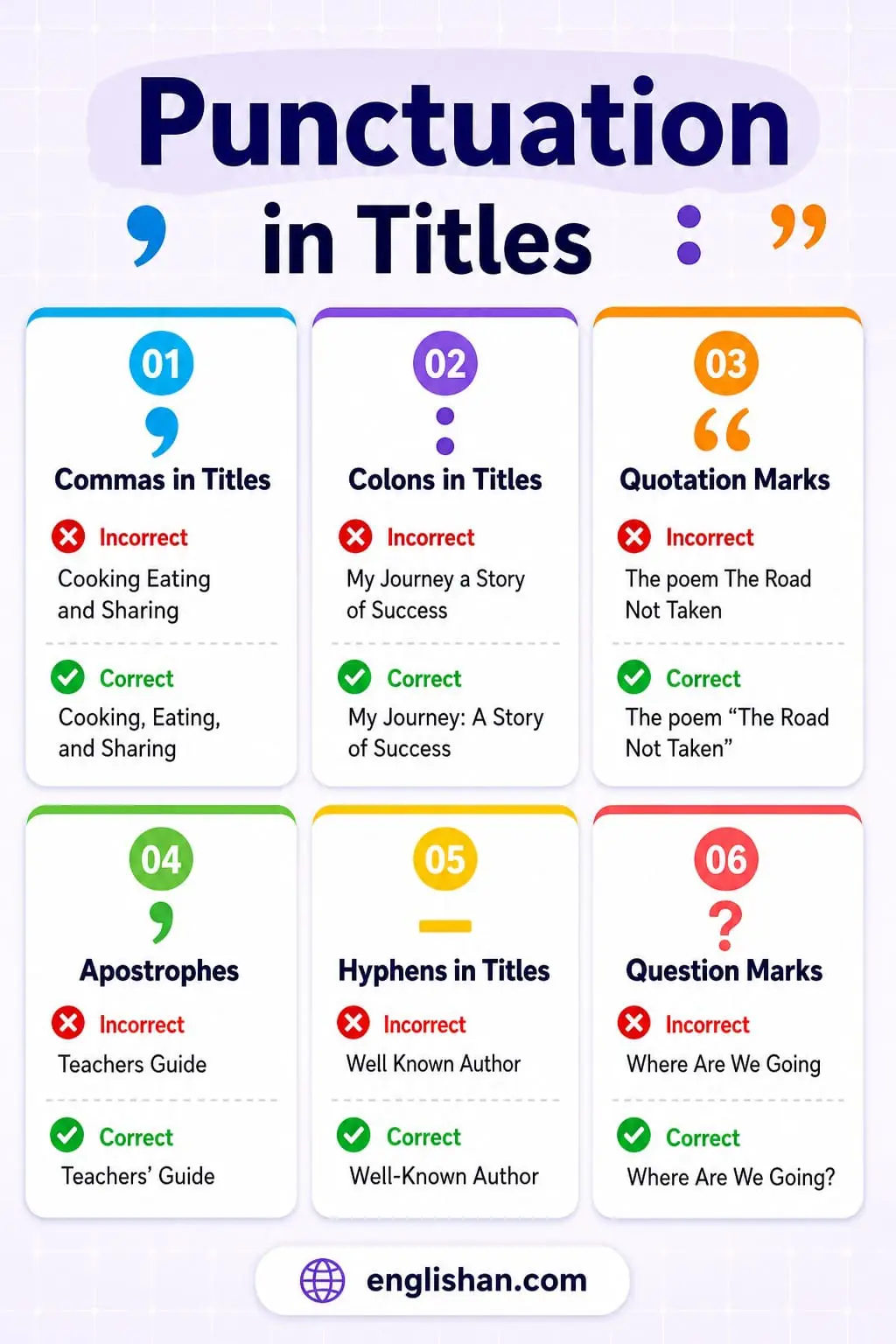
Main Rule: How Titles Are Punctuated
Not all titles are written the same way. The way you punctuate a title depends on one simple thing: is the work short or long?
Rule 1: Short Works Use Quotation Marks (” “)
Short works like poems, songs, articles, and blog posts go inside quotation marks. These are pieces that usually live inside something bigger, like a song inside an album or an article inside a magazine.
Example 1: “The Road Not Taken” (poem)
Example 2: “Bohemian Rhapsody” (song)
Example 3: “How to Write Better” (blog post)
So whenever you are referring to something short that is part of a bigger collection, just wrap the title in quotation marks and you are good to go.
Rule 2: Long Works Use Italics
Long works like books, movies, newspapers, and albums are written in italics. These are complete, standalone pieces that do not belong inside anything bigger. They stand on their own, so italics give them that extra weight and distinction.
Example 1: Harry Potter and the Sorcerer’s Stone (book)
Example 2: The New York Times (newspaper)
Example 3: Thriller (album)
So, it helps readers understand what kind of work is being referenced right away. Quotation marks say “This is a small piece.” Italics say “this is a big, complete work.” It is a tiny formatting habit that makes writing look clear and professional.
When to Use Quotation Marks in Titles
Quotation marks (“ ”) are used for short or minor works. These are pieces that usually exist as part of a larger collection rather than standing alone as a complete work.
This punctuation choice makes your writing clearer. It signals to the reader that the title refers to a specific section, piece, or segment inside a bigger source. For example, a single article belongs to a newspaper, and one episode belongs to a full TV series.
Works that use quotation marks
- Articles (journal, newspaper, blog)
- Essays
- Short stories
- Poems (non-epic)
- Songs
- Chapters (from books)
- TV episodes
- Podcast episodes
- Lectures
- Web pages
In simple terms, use quotation marks when the work is short and part of something larger. This small rule keeps your writing organized and easy to understand.
Examples of Punctuated Titles (Quotation Marks)
To understand how quotation marks are used in titles, it helps to look at real examples. These examples show how short works are written inside quotation marks because they are part of a larger collection or source. A brief explanation with each example will make the rule clearer and easier to remember.
Example 1: “The Road Not Taken”
It is a well-known poem by Robert Frost. It is a short literary work and is included in collections of poetry rather than being a full-length book on its own. That is why quotation marks are used.
Example 2: “A Good Man Is Hard to Find”
This is a short story by Flannery O’Connor. It is usually found in a collection of stories with the same title. Since it is one piece within a larger book, it is written in quotation marks.
Example 3: “How to Learn English Fast”
It can be a blog post or an online article. Articles are short written pieces that appear on websites or in publications, so quotation marks are the correct choice here.
Example 4: “Shape of You”
This is a popular song by Ed Sheeran. Songs are typically part of an album, which is a larger work, so the song title is placed in quotation marks.
Example 5: “The One Where They All Turn Thirty”
This is an episode from the TV show Friends. Since it is just one episode within a full series, quotation marks are used to show it is a smaller part of a bigger work.
Example 6: “Introduction to Grammar”
So, this could be the title of a chapter in an English textbook. Chapters are sections within a complete book, so they are written in quotation marks.
Example 7: “The Science of Happiness”
It might be a podcast episode or a lecture in a series. It represents one part of a larger set of content, which is why quotation marks are appropriate.
These examples help you see the pattern clearly. Whenever a title belongs to a smaller piece within a larger whole, quotation marks are used.
When to Use Italics in Titles
Italics are used for long or complete works. These are works that stand on their own and are not just a small part of something bigger. When you write a title in italics, it signals that the work is full-length and independent.
This style is commonly used in books, media, and formal writing. It helps readers quickly recognize that the title refers to a complete piece, such as a whole book, a full movie, or an entire series.
Works that use italics
- Books
- Movies
- TV series
- Newspapers
- Journals
- Albums
- Video games
- Plays
- Operas
- Reports
In simple terms, if the work is complete and can stand on its own, italics are the right choice. This makes your writing look more organized and easier to understand.
Examples of Punctuated Titles (Italics)
To understand how italics work in titles, it helps to look at real examples. These examples show how we use italics for long or complete works that stand on their own.
Example 1: Harry Potter and the Sorcerer’s Stone
This is a full-length novel by J.K. Rowling. Since it is a complete book and not just a part of a larger work, its title is written in italics.
Example 2: Titanic
This is a movie. Films are full, independent works, so their titles are always written in italics in formal writing.
Example 3: Friends
This is a TV series. Because it includes many episodes and forms a complete show, the series title is written in italics.
Example 4: The New York Times
This is a newspaper. Newspapers are complete publications that are issued regularly, so their names are italicized.
Example 5: Nature
This is a scientific journal. Journals are formal publications containing full research articles, so their titles are written in italics.
Example 6: Abbey Road
This is an album by The Beatles. Albums contain multiple songs and are treated as complete works, so they are italicized.
Example 7: The Legend of Zelda
This is a video game series. Since it is a full game title representing an entire product, it is written in italics.
Each of these examples shows a complete, independent work, which is why italics are used instead of quotation marks.
Single vs Double Quotation Marks in Titles
Single and double quotation marks are both used in titles, but their use depends on the writing context and style.
Single quotation marks (‘ ’) are not used as the main style for titles in American English. Instead, they are used when a title appears inside another title or quotation. This helps avoid repetition of double quotation marks and keeps the structure easier to read.
Example 1: Why ‘The Winds of Winter’ Matters
Example 2: Understanding ‘The Great Gatsby’ in Modern Context
Example 3: Review of ‘Shape of You’ by Ed Sheeran
Double quotation marks (“ ”) are commonly used in American English for titles of short works. These include poems, songs, short stories, articles, essays, and individual episodes. The purpose is to clearly mark the title as a smaller work within a sentence so it stands out without confusion.
Example 1: “The Road Not Taken” (poem)
Example 2: “Shape of You” (song)
Example 3: “The Lottery” (short story)
In short, double quotation marks are used for normal titles, while single quotation marks are only used when a title is placed inside another title.
How Different Style Guides Format Titles
Different style guides follow the same basic idea of using quotation marks for short works and italics for longer ones, but each has its own small preferences and formatting details.
APA Style
APA style keeps things structured but adds one important exception. While short works use quotation marks and long works use italics in the main text, titles appear without quotation marks or italics in the reference list, which keeps citations simple and uniform.
Example 1: “The Road Not Taken” (in-text)
Example 2: The Road Not Taken (reference list)
In short, APA focuses on clarity in citations by slightly adjusting how titles appear in reference lists.
MLA Style
MLA style is more straightforward and consistent. It applies the same general rule throughout without major exceptions, making it easier to follow in essays and academic writing.
Example 1: “Shape of You” (song)
Example 2: Harry Potter and the Sorcerer’s Stone (book)
In short, MLA keeps title formatting simple and uniform across all types of writing.
Chicago Style
Chicago style follows the same basic pattern but includes a few extra cases. Some works like fairy tales use quotation marks, while items such as maps and comic strips are written in italics depending on how they are published or presented.
Example 1: “Cinderella” (fairy tale)
Example 2: The New York Times Atlas (map collection)
Example 3: Peanuts (comic strip)
In short, the Chicago style allows a bit more flexibility depending on the type of work and its format.
Common Mistakes in Title Punctuation
When using title punctuation, errors usually happen because the rules for italics and quotation marks get mixed up or applied inconsistently. These mistakes can make writing look unclear or unprofessional. Below are the most common issues along with correct and incorrect examples.
Mixing italics and quotation marks together
A frequent mistake is using both styles for the same title. You should only use one formatting style depending on the type of work.
Incorrect: “Harry Potter and the Sorcerer’s Stone”
Correct: Harry Potter and the Sorcerer’s Stone
In short, avoid combining both styles because it creates unnecessary confusion and breaks standard formatting rules.
Using quotation marks for books or films
Long works like books, movies, and TV series should not be placed in quotation marks. They are complete works, so italics are required.
Incorrect: “Titanic”
Correct: Titanic
Simply put, full-length works always need italics to clearly show they are independent titles.
Inconsistent formatting in the same document
Sometimes different titles are formatted in different ways without a clear reason. This creates confusion and weakens consistency.
Incorrect: Harry Potter and “The Hobbit”
Correct: Harry Potter and The Hobbit
Overall, consistency is important because it keeps your writing organized and easy to follow.
Misusing single quotation marks instead of double
Single quotation marks are not used as the main style for titles in standard English writing. Double quotation marks are preferred for short works.
Incorrect: ‘The Road Not Taken’
Correct: “The Road Not Taken”
In general, always stick to standard double quotation marks to maintain proper writing conventions.
Practice Exercises: Punctuation in Titles (Quotation Marks vs Italics)
Below are some practice questions designed to help you understand how quotation marks and italics are used in titles. Try to apply the correct punctuation based on whether the work is short or long.
Exercise 1: Add the correct punctuation (quotation marks or italics)
She loved reading _____ the poem The Road Not Taken.
Exercise 2: Fix this sentence. Replace the incorrect punctuation
He enjoyed reading “Harry Potter and the Sorcerer’s Stone” in class.
Exercise 3: Choose the correct punctuation style (quotation marks or italics)
_____ Titanic is one of the most famous movies in history.
Exercise 4: Correct the sentence by applying proper title punctuation
I listened to “Shape of You” while studying last night.
Exercise 5: Fix the mistake in title formatting
The teacher assigned The Science of Happiness as a podcast episode to listen to.
Answer Key:
- She loved reading “The Road Not Taken.”
- He enjoyed reading Harry Potter and the Sorcerer’s Stone in class.
- Titanic is one of the most famous movies in history.
- I listened to “Shape of You” while studying last night.
- The teacher assigned “The Science of Happiness” as a podcast episode to listen to.
Final Thought on Punctuation in Titles
Punctuation in titles may look like a small detail, but it plays a big role in clear and professional writing. The basic idea is simple: use quotation marks for short works and italics for long or complete works. Once you understand this difference, most confusion disappears.
Good writing is not only about ideas, but also about presentation. Correct title formatting helps your reader instantly understand what type of work you are referring to, whether it is a poem, article, book, or movie. Consistency in using these rules also makes your writing look more polished and reliable.
In short, mastering title punctuation is a small step that significantly improves the overall quality and clarity of your writing.
FAQs: Punctuation in Titles
Punctuation in titles refers to the use of italics or quotation marks to show how a title should be written in English. It helps separate short works from long works and makes writing clearer and more organized.
Example: Harry Potter and the Sorcerer’s Stone (book in italics) vs “The Road Not Taken” (poem in quotation marks)
Quotation marks are used for short or minor works such as articles, poems, songs, short stories, chapters, and TV or podcast episodes. These are usually parts of a larger work.
Example: “Shape of You” (song) or “The Science of Happiness” (podcast episode)
Book titles are written in italics because books are complete and independent works. Quotation marks are not used for books in standard writing.
Example: To Kill a Mockingbird (correct) instead of “To Kill a Mockingbird” (incorrect)
In APA style, long works like books, journals, and movies are written in italics, while short works like articles, chapters, and web pages use quotation marks. The rule depends on whether the work is complete or part of a larger source.
Example: Nature (journal) and “How to Learn English Fast” (article)
No, mixing both styles in one title is incorrect. Each title should follow only one format based on its type.
Example: Incorrect: “Titanic”
Correct: Titanic
You May Also Like