The em dash (—) is a long dash used to add emphasis, show a break in thought, or add extra information to a sentence. It is the longest of the three dash marks in English, longer than a hyphen (-) and longer than an en dash (–).
The mark can replace commas, parentheses, or a colon depending on what effect you want. It makes a sentence feel less formal and more expressive. Too many em dashes in one piece of writing can feel broken or busy, so good writers use them carefully.
This guide explains the five main rules for using the em dash, shows the difference between the three dash marks, covers how to type it on any device, and ends with common mistakes and practice exercises. Each rule comes with three examples so you can see it in action.
What Is an Em Dash?
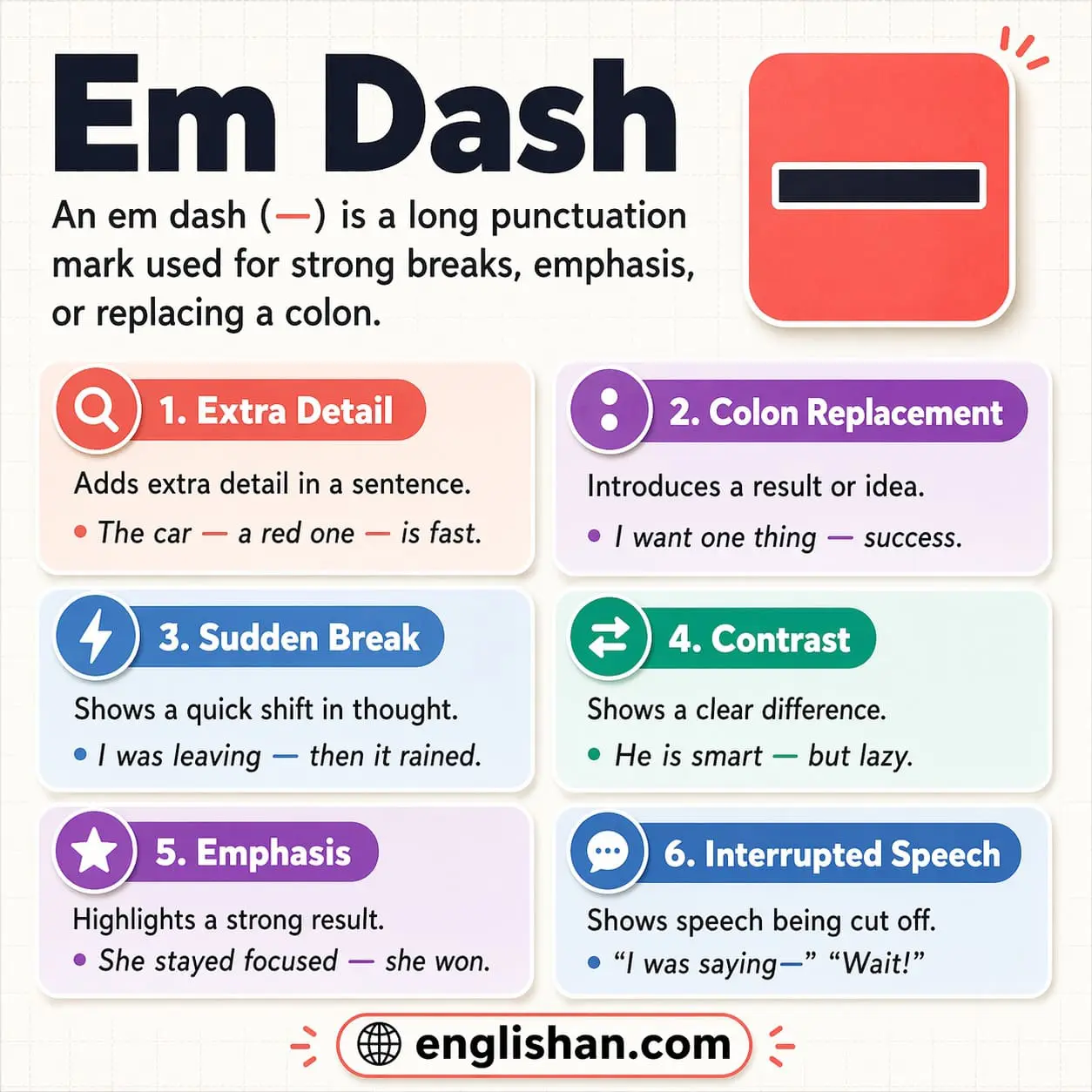
An em dash is a punctuation mark written as a long horizontal line. The symbol looks like this: —
The name comes from its width. In old printing, this mark was about the same width as the capital letter M. That is why it is called an em dash.
Writers use it to create a pause longer than a comma but softer than a full stop. It works when you want to:
- Add emphasis to part of your sentence
- Insert extra information in the middle
- Introduce a surprising or dramatic idea
- Show that someone was interrupted
Example 1: She finally made a decision—there was no turning back.
Example 2: My teacher—who has been teaching for 20 years—explained it clearly.
Example 3: I was going to call you—but then I got busy.
Em Dash vs En Dash vs Hyphen
Many English learners mix up the three dash marks. They look similar, but each one has a different job.
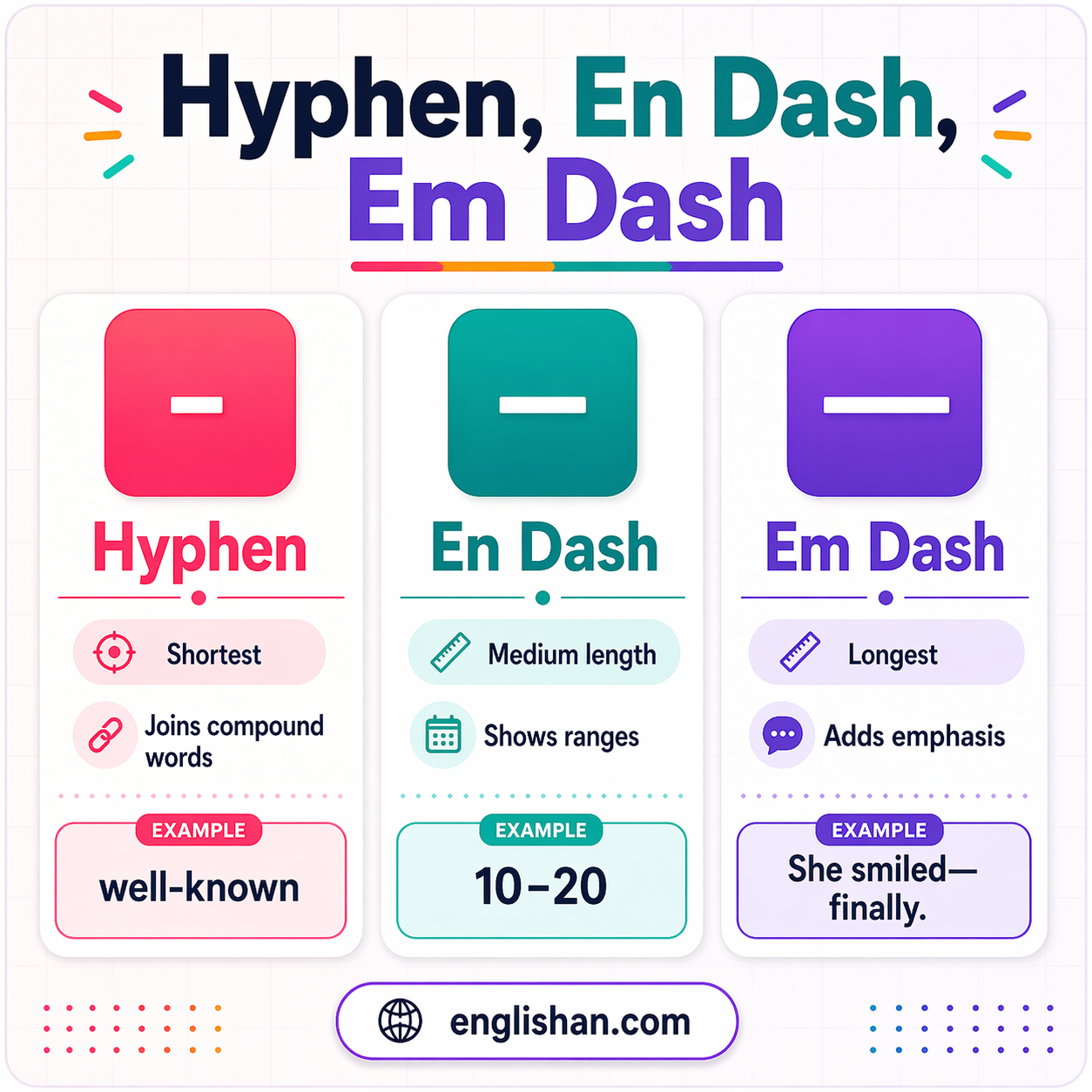
different jobs in English.
| Mark | Name | Length | Main Use | Example |
|---|---|---|---|---|
| – | Hyphen | Shortest | Joins two words together | well-known, mother-in-law |
| – | En dash | Medium | Shows a range of numbers or dates | 10–20, Monday–Friday |
| — | Em dash | Longest | Adds emphasis or extra information | She smiled—finally. |
The quick way to remember: use a hyphen for joining words, an en dash for ranges, and an em dash for emphasis or breaks in a sentence.
When to Use an Em Dash (5 Rules)
This mark is flexible. It can replace three different punctuation marks. Here are the five main rules with examples for each.
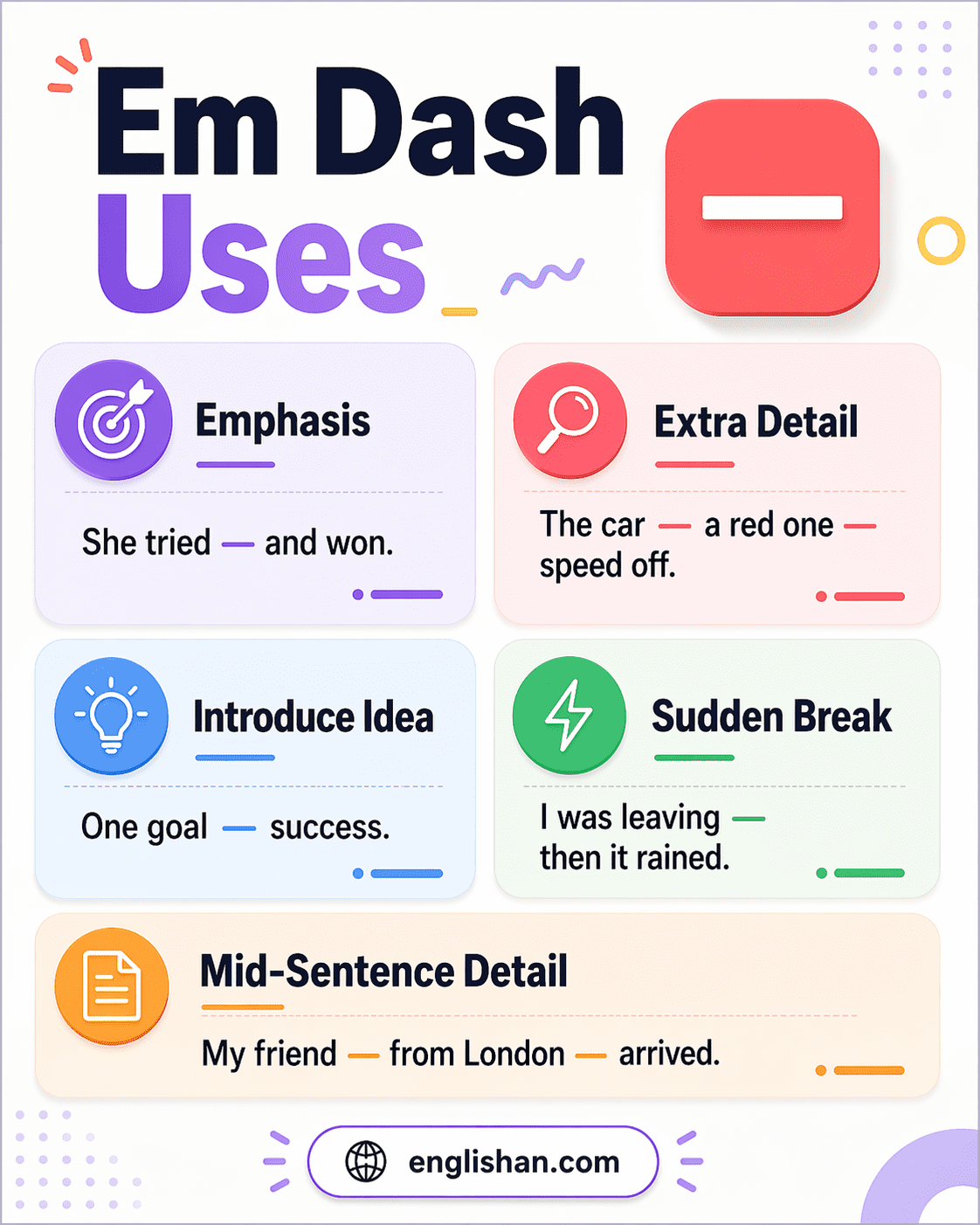
Rule 1: Use the Em Dash for Emphasis
Reach for an em dash when a comma feels too soft and you want part of your sentence to stand out. The dash pushes the final word forward and makes it land harder.
Example 1: She finally achieved what she wanted—success.
Example 2: He only cared about one thing—money.
Example 3: There was just one problem—he had no plan.
In short: if the last part of your sentence needs to feel dramatic or important, use a dash instead of a comma.
Rule 2: Use the Em Dash for Extra Information
Wrap two em dashes around extra information in the middle of a sentence. This works like parentheses but feels less formal. The extra information stays connected to the main sentence rather than sitting off to the side.
Example 1: My brother—who lives in Canada—is visiting us next week.
Example 2: The new restaurant—everyone is talking about it—opens this Friday.
Example 3: Our teacher—the kindest person I know—helped me after class.
Bottom line: if you could put the extra part in parentheses, use two dashes instead. They keep the extra part feeling part of the main sentence.
Rule 3: Use the Em Dash to Introduce or Explain
Swap the colon for an em dash when you want to introduce a list, an explanation, or a summary. This works like a colon but feels less formal. Use it when a colon would feel too stiff.
Example 1: He packed everything he needed—clothes, books, and food.
Example 2: There was only one option left—to start over.
Example 3: Three things matter in cooking—timing, heat, and practice.
In short: if you are about to explain or list something, a dash works as a casual colon.
Rule 4: Use the Em Dash for a Sudden Break
Mark a sudden break or interruption with an em dash. This comes up often in dialogue and in writing that reflects natural speech.
Example 1: I was going to call you—but then I got busy.
Example 2: She said, “I think we should—” but he cut her off.
Example 3: He wanted to help—too late, though.
Bottom line: if a sentence or a speaker is cut off mid-thought, use a dash to mark the cut-off.
Rule 5: Use the Em Dash for Details in the Middle
Slip a short idea, description, or list into the middle of your sentence using two em dashes. This is similar to rule 2, but here the extra part is often a list or several describing words.
Example 1: The manager—calm, focused, and confident—handled the problem perfectly.
Example 2: Her new car—red, fast, and shiny—was parked outside.
Example 3: The children—tired, hungry, and cold—finally made it home.
Remember: if you want to slide a list or a group of describing words into the middle of a sentence, use two dashes.
Em Dash Spacing: With or Without Spaces?
One small thing that confuses many learners is whether to leave a space before and after the em dash. Both styles are correct. The choice depends on the English style you are using.
American style (no spaces): The most common style in modern American English, used in books, articles, and websites. The dash sits directly against the words on both sides.
Example: She smiled—finally.
British style (with spaces): Some British writing and older print styles leave a space before and after. This looks slightly more open.
Example: She smiled — finally.
Which style should you use? If you are writing for a US audience, a blog, or a book, go with no spaces. If you are writing for a UK newspaper or an older British publisher, the spaced version may be preferred. When in doubt, check what your teacher, school, or workplace uses. Once you pick a style, use it everywhere. Do not mix both styles in the same document.
How to Type an Em Dash on Windows, Mac, and Mobile
The em dash is not on most keyboards, but every device has a quick way to type it. Need the symbol right now? Copy it here: —
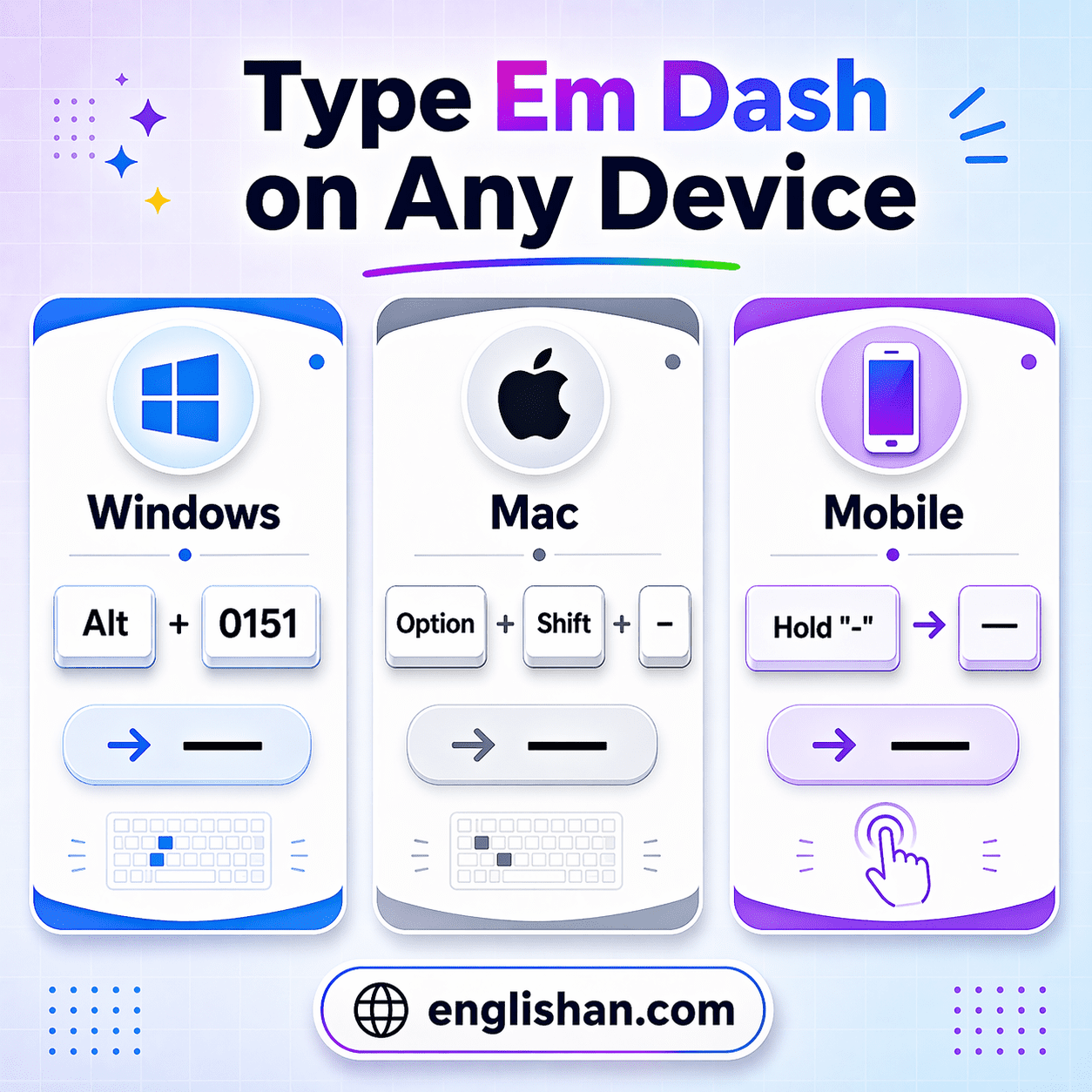
On Windows
Hold the Alt key and type 0151 on the numeric keypad. Release Alt and the dash appears.
Result: —
On Mac
Press Shift + Option + Hyphen (-) at the same time.
Result: —
On iPhone and iPad
Press and hold the hyphen key (–) on the on-screen keyboard. A small menu appears with extra options. Slide your finger to the em dash (—) and release.
On Android
Press and hold the hyphen key (–) on the on-screen keyboard. A menu pops up with three options: hyphen, en dash, and em dash. Tap the em dash.
In Microsoft Word and Google Docs
Type two hyphens (--) between two words with no spaces. Most word processors automatically change the two hyphens into a dash as you keep typing.
Example: decision--there becomes decision—there
This also works in many email apps and writing tools.
Common Mistakes with the Em Dash
Four mistakes show up more often than the rest. Watch for these in your own writing.
Using Too Many Em Dashes
Em dashes are strong. If you use them too often, your writing starts to feel broken and hard to read. One or two in a paragraph is usually enough.
Incorrect: I went to the market—bought fruits—met my friend—and came back home.
Correct: I went to the market, bought fruits, met my friend, and came back home.
Quick tip: if a sentence already has one dash, use commas for the rest.
Mixing Em Dashes with Other Punctuation
Do not combine em dashes with commas or parentheses in the same place. The sentence looks messy and confuses the reader.
Incorrect: My brother—who lives abroad, (in Canada)—is visiting us.
Correct: My brother—who lives abroad in Canada—is visiting us.
Remember: pick one pair of marks. Use either two dashes or two parentheses, not both.
Confusing Em Dash with Hyphen
Two hyphens (--) are not the same as an em dash (—). In formal writing, always use the real symbol.
Incorrect: She is my sister–she is very kind.
Correct: She is my sister—she is very kind.
In short: if your device does not have the mark, use the shortcut from the section above.
Inconsistent Spacing
Stick to one spacing style. Do not mix “no spaces” and “with spaces” in the same piece of writing.
Incorrect (mixed):
- She was happy — finally free.
- He laughed—loudly.
Correct (consistent):
- She was happy—finally free.
- He laughed—loudly.
Bottom line: check the style once, then keep it the same everywhere.
Em Dash Practice Exercises for English Learners
Try these five exercises to practise using what you have learned. Answers are at the bottom.
Exercise 1: Add an em dash to make the sentence stronger.
She had only one goal _____ to win the race.
Exercise 2: Fix this sentence. Remove unnecessary em dashes.
I woke up—got dressed—ate breakfast—and left for work.
Exercise 3: Combine the two sentences below into one sentence using two em dashes.
My sister is a doctor. She works in London.
Exercise 4: Choose the correct mark (hyphen, en dash, or em dash).
The meeting is on Monday _____ Friday next week.
Exercise 5: Fix the mistake.
He is my best friend–we have known each other since kindergarten.
Answer Key:
- She had only one goal—to win the race.
- I woke up, got dressed, ate breakfast, and left for work.
- My sister—who works in London—is a doctor.
- The meeting is on Monday–Friday next week. (en dash for a range of days)
- He is my best friend—we have known each other since kindergarten.
FAQs
An em dash (—) is used to add emphasis, insert extra information in the middle of a sentence, introduce a list or explanation, or show a sudden break in thought. It can replace commas, parentheses, or a colon depending on the effect you want.
A hyphen (-) is the shortest mark. It joins two words together, like in “well-known” or “mother-in-law.” An em dash (—) is the longest mark. It adds pauses, breaks, or emphasis to a sentence. A hyphen connects words. An em dash shapes the flow of a sentence.
Yes, but only when you want a stronger pause or more emphasis. Commas are still better for most pauses in everyday writing. Use em dashes only when the part you are adding really needs to stand out.
This depends on the style of writing. In American English, we usually write it without spaces (word—word), while in some British or traditional styles, spaces are added (word — word). Both are correct—the important thing is to stay consistent throughout your writing.
We should use them carefully. If we use too many em dashes, the writing can start to feel broken or less smooth. Instead of improving clarity, it can distract the reader. It’s best to use them only when they genuinely improve meaning or add emphasis.
No. Two hyphens (--) are not a real em dash (—), but most word processors and writing apps will change two hyphens into the correct mark automatically as you type. In formal writing, always use the real symbol.
Press and hold the hyphen key (–) on your phone’s keyboard. A small menu with extra options appears. Slide your finger to the em dash (—) and let go. This works on both iPhone and Android.
Use a dash when you want the extra information to feel more connected to the main sentence. Parentheses make the extra information feel separate and less important. Dashes keep it part of the flow.
You May Also Like