A hyphen is one of those small punctuation marks that often goes unnoticed, but it actually makes a big difference in writing. It is mainly used to connect words and avoid confusion, especially when forming compound words or describing something more clearly. For example, words like “well-known teacher” or “ten-year-old boy” become much easier to understand because of the hyphen. Without it, the meaning can sometimes feel unclear or even misleading.
In this article, we’ll explore the rules of using a hyphen simply and practically. You’ll see where it is commonly used, how it changes meaning, and what mistakes people usually make. By the end, you’ll feel more confident using hyphens in your own writing without second-guessing yourself.
What is a Hyphen?
A hyphen is a small punctuation mark (-) that is used to join words together so that their meaning becomes clearer. It helps connect parts of a word or two separate words to form a single idea, especially in compound words or descriptive phrases. Even though it looks simple, it plays an important role in making sentences easier to understand and more accurate.
For example, in words like “well-known author,” “part-time job,” or “ten-year-old child,” the hyphen connects the words to show that they work together as one unit. Without the hyphen, the meaning can become confusing or less clear. In short, a hyphen helps your writing stay neat, structured, and easy for the reader to follow.
Difference Between Hyphen and Dash
A hyphen (-) and a dash (– or —) may look similar, but they are used in different ways.
A hyphen is used to join words together and create compound terms. It works within words to make meaning clear and avoid confusion.
For Example:
- well-known author
- part-time job
- ten-year-old child
A dash, on the other hand, is used to show a break in thought, add extra information, or create emphasis in a sentence. It works at the sentence level and not inside words.
For Example:
- I finally got the result — after weeks of waiting.
- She was going to call him — but she changed her mind.
- Everything went wrong — except one thing.
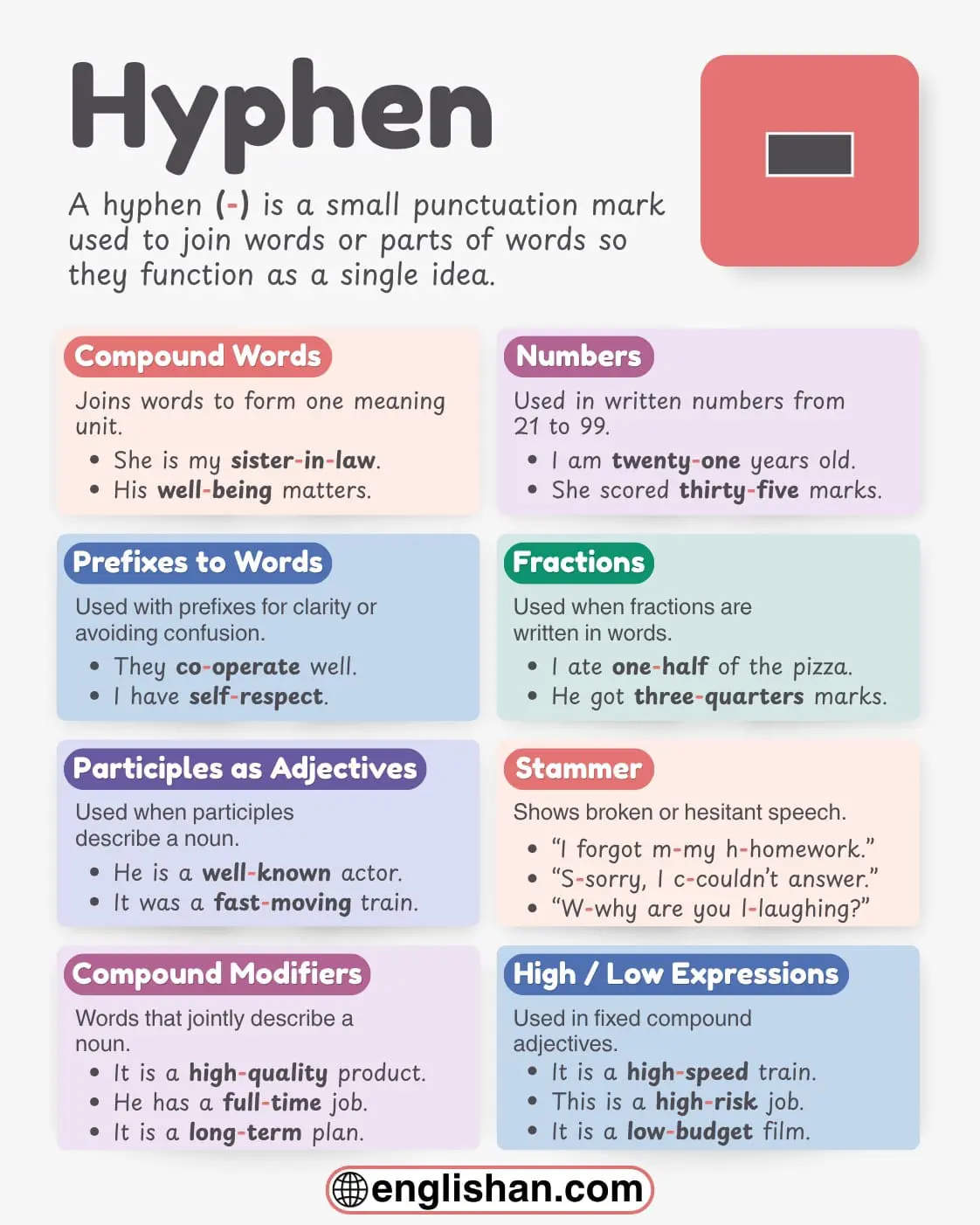
How to Use Hyphens Properly?
Hyphens may look like a tiny detail in writing, but they actually help a lot in making your sentences clear and easy to understand. They connect words in different situations so the meaning doesn’t get confusing. Let’s look at the main ways they are used in a simple and clear way.
Using Hyphens in Compound Modifiers
When two or more words come together to describe a noun, we often use a hyphen to show that they are working as one unit. This is especially helpful before a noun so the reader doesn’t misread the meaning.
For Examples:
- a well-known writer
- a full-time job
- a high-speed train
Using Hyphens in Compound Words
Some words are naturally formed by joining two words with a hyphen. These compound words have fixed meanings and are commonly used in everyday English.
For Examples:
- mother-in-law
- sister-in-law
- editor-in-chief
Using Hyphens in Numbers
Hyphens are also used when writing numbers between twenty-one and ninety-nine. They are also used in fractions when the number is acting like an adjective in a sentence.
For Example:
- twenty-one students
- sixty-five pages
- a two-thirds majority
Hyphens Used with Prefixes
Sometimes we use hyphens with prefixes to make the word clearer or to avoid confusion. This is often done when the base word starts with the same vowel or when the meaning might be misunderstood without a hyphen.
For Example:
- re-enter the building
- co-worker in the office
- ex-president of the company
Rules for Capital Letters in Hyphenated Words
Capital letters in hyphenated words can feel a bit confusing at first, but the rule is actually quite simple once you understand the pattern. It mainly depends on where the hyphenated word appears in a sentence and whether it is part of a title or a proper noun.
When a hyphenated word starts a sentence or is part of a title, the first word always begins with a capital letter. In titles, sometimes both parts of the hyphenated word are capitalized, especially if both words carry equal importance.
For Examples:
- Well-known facts are easy to remember.
- Part-Time Jobs Are Popular Among Students.
- Mother-in-Law is a common relationship term.
In normal sentences, only the first word of the sentence is capitalized unless the hyphenated word contains a proper noun. The words after the hyphen usually stay in lowercase unless they are names or special terms.
For Examples:
- She is a well-known artist.
- They visited a French-speaking country.
- We met the ex-President at the event.
Common Mistakes with Hyphens
Hyphens are often used incorrectly, not because they are difficult, but because people are unsure where exactly to place them. Let’s look at some common mistakes with correct and incorrect examples so it becomes clear.
Missing Hyphen in Compound Modifiers
People often forget to use a hyphen when two words describe a noun together.
For Example:
- ❌ Incorrect: a well known teacher
- ✔ Correct: a well-known teacher
- ❌ Incorrect: a full time job
- ✔ Correct: a full-time job
Using Hyphen When It’s Not Needed
Sometimes hyphens are added where they are not required.
For Example:
- ❌ Incorrect: He is a teacher-of English.
- ✔ Correct: He is a teacher of English.
- ❌ Incorrect: She is very well-known. (when not before a noun)
- ✔ Correct: She is very well known.
Confusing Hyphen with Dash
People often use a hyphen instead of a dash in sentences.
For Example:
- ❌ Incorrect: I was late – because of traffic.
- ✔ Correct: I was late — because of traffic.
Wrong Use in Numbers
Hyphens are sometimes missed or used incorrectly in numbers.
For Example:
- ❌ Incorrect: twenty one students
- ✔ Correct: twenty-one students
- ❌ Incorrect: sixty five pages
- ✔ Correct: sixty-five pages
Incorrect Prefix Usage
Some prefixes need hyphens, but they are often written as one word.
For Example:
- ❌ Incorrect: reenter the room
- ✔ Correct: re-enter the room
- ❌ Incorrect: coworker
- ✔ Correct: co-worker
Key Takeaway
As we learned, hyphens are small but very useful in making writing clear and easy to understand. They help connect words in compound forms especially when two or more words work together to describe something. You also see them in numbers, compound words and certain prefixes where clarity is needed.
The main thing to remember is balance. Use hyphens where they improve meaning but avoid adding them where they are not required. Once you understand the basic patterns, using hyphens correctly becomes simple and natural in everyday writing.
FAQs about Hyphen
A hyphen is used to join words together and make meaning clearer, especially in compound words and descriptions like “well-known” or “part-time.”
A hyphen (-) connects words, while a dash (–) is used to show a pause or break in a sentence or to add extra information.
You use a hyphen when two or more words act together as one idea, especially before a noun, like “a high-speed train” or “a full-time job.”
Yes, hyphens are used in numbers from twenty-one to ninety-nine and also in fractions used as adjectives, like “two-thirds majority.”
Not always. Hyphens are used with some prefixes to avoid confusion, like “re-enter” or “co-worker,” but many modern words are written without them.
You May Also Like
- Punctuation Worksheets and Exercises with Answers
- Quotation Marks in English Grammar
- Semicolon Use in English Grammar
- Commas in English Grammar
- Common Grammar Mistakes In Argumentative Writing