

The em dash and en dash may look very similar, but they have different roles in writing. These small punctuation marks are useful for adding clarity, connecting ideas, and improving the overall flow of a sentence. Using them correctly can make writing look more polished and easier to understand.
In this article, the differences between the em dash and en dash will be explained in a simple and clear way. It will cover when to use each one, share easy rules to follow, and include practical examples to help make their usage more natural in everyday writing.
What Is a Dash?
A dash is a punctuation mark used to add clarity, emphasis, or extra information within a sentence. It helps connect ideas or create a pause that is stronger than a comma but less formal than a full stop. Dashes are often used to make writing feel more natural and expressive, especially when adding details, interruptions, or explanations.
Types of Dashes
There are different types of dashes, mainly:
- Hyphen (-)
- En dash (–)
- Em dash (—)
While they may look similar, they are used in different situations. Understanding what a dash is and how it works can make writing clearer, smoother, and more engaging to read.
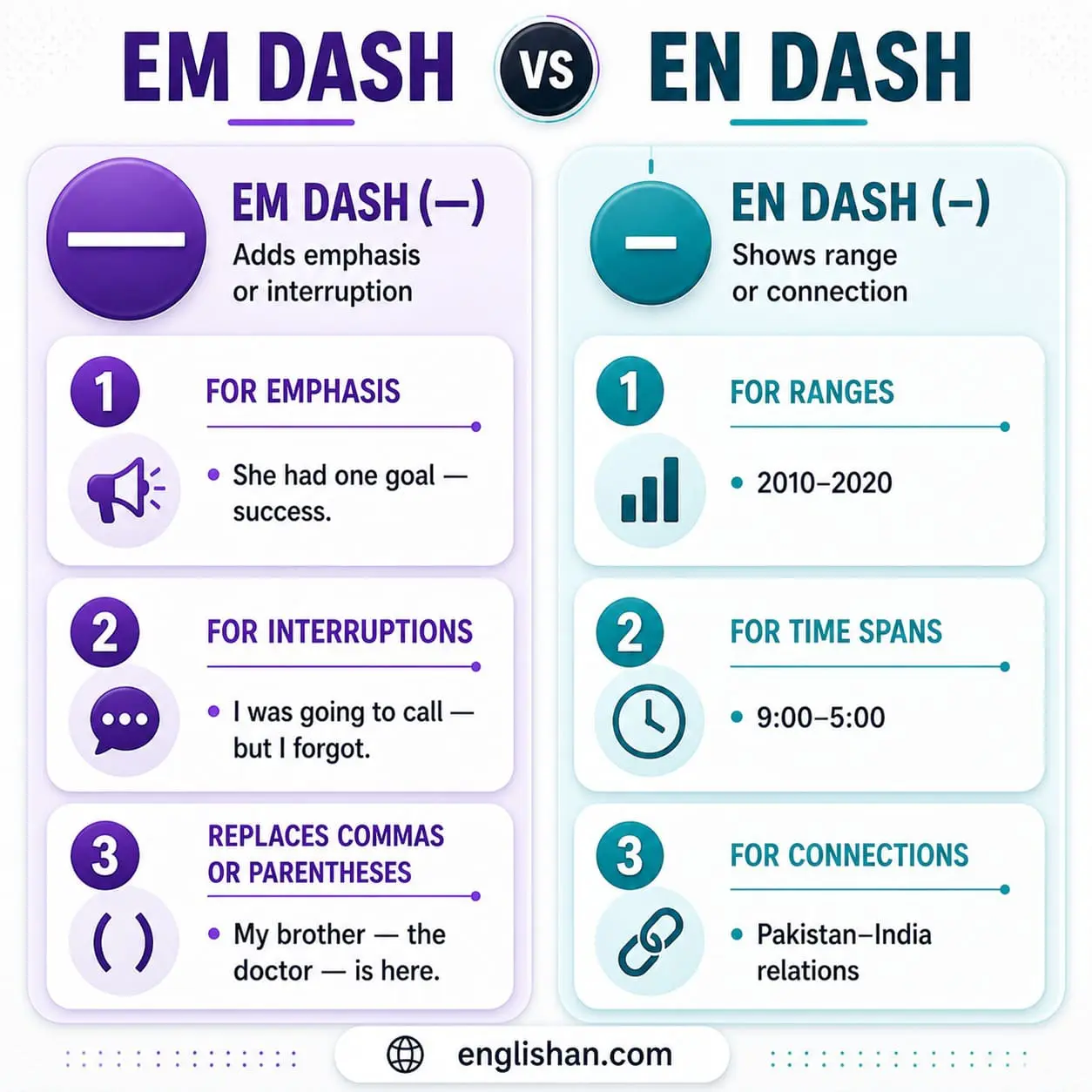
What Is an En Dash (–)?
An en dash (–) is a punctuation mark used to show ranges, connections, or relationships between ideas in a sentence. It is slightly longer than a hyphen and is commonly used in formal writing to make information clearer and more organized. Instead of using extra words like “to” or “and,” the en dash helps connect elements in a clean and simple way.
Example 1: The assignment covers pages 10–20.
Example 2: The office is open 9:00–5:00 on weekdays.
Example 3: The New York–London flight was delayed.
Overall, it helps present related information in a neat and easy-to-read form.
When to Use an En Dash
Understanding how punctuation shapes clarity in writing can make sentences easier to read and more precise. Among these punctuation marks, the en dash plays a small but important role in connecting information in a clean and structured way. Let’s understand how to use it.
Rule 1: To show number ranges
An en dash is used when numbers form a range, meaning everything between the two values is included. Instead of writing “to,” it keeps things shorter and more visually clean, especially in formal or academic writing.
Example 1: The assignment covers pages 10–20.
Example 2: The final score was 45–30.
Example 3: Read chapters 3–7 for better understanding.
It is simply a neat way to show that everything between two numbers is included.
Rule 2: To show time ranges
It is used to show the duration between a start and end time. This is especially common in schedules, timetables, and everyday planning, where clarity matters more than wording.
Example 1: The office is open 9:00–5:00 on weekdays.
Example 2: The meeting will run 2:00–4:30.
Example 3: The store operates 10:00–11:00 daily for maintenance.
Basically, it makes it easy to understand how long something lasts without extra explanation.
Rule 3: To show dates
An en dash connects years to show a full time period rather than a single point in time. It is widely used in history, research, and timelines to show continuity over years.
Example 1: The project ran from 1990–2000.
Example 2: She studied education trends from 2010–2020.
Example 3: The reform period lasted 2005–2015.
It helps present a complete stretch of time in a clean and simple way.
Rule 4: To show connections
It is used when two related names, places, or ideas are paired together. This is common in travel routes, partnerships, or situations where two things are closely linked and treated as one unit.
Example 1: The New York–London flight was delayed.
Example 2: The India–Pakistan match drew huge attention.
Example 3: A strong doctor–patient relationship improves care.
So, it naturally connects two things that are meant to be seen as related.
Rule 5: To show opposites
It links two contrasting ideas that are being compared or discussed together. This is often used in debates, discussions, or analytical writing where both sides need to be shown clearly.
Example 1: The liberal–conservative debate was intense.
Example 2: The north–south divide affects development patterns.
Example 3: The nature–nurture discussion is widely studied in psychology.
Simply, it brings two opposite ideas together so the difference between them is easy to see.
What Is an Em Dash?
An em dash is a punctuation mark that appears as a long horizontal line —. It is commonly used in writing to add emphasis, show interruption, or include extra information within a sentence.
The name “em dash” comes from its length, which was traditionally about the same width as the capital letter “M” in printing.
Example 1: I was about to leave—then I noticed the door was locked.
Example 2: Her plan—carefully prepared over months—finally worked.
Example 3: We were ready to start—but the power went out.
Overall, the em dash helps make writing more expressive by adding pauses and emphasis where needed, making sentences feel more natural and impactful.
When to Use an Em Dash
The em dash is a versatile punctuation mark that helps shape tone, rhythm, and clarity in writing. It is often used when a sentence needs extra emphasis, a smooth interruption, or a more expressive way of adding information. Let’s understand how to use it properly.
Rule 1: To replace commas (extra emphasis)
An em dash can be used instead of commas when extra information needs to stand out more clearly. It creates a stronger pause, which naturally draws attention to the added detail and makes it feel more important within the sentence.
Example 1: This book—written in the 19th century—is still widely read today.
Example 2: My brother—who lives in Dubai—visited us last week.
Example 3: The manager—a very experienced leader—handled the crisis well.
It works best when the added information is important enough that it deserves extra attention rather than blending in quietly.
Rule 2: To replace parentheses (stronger aside)
It can also take the place of parentheses when adding extra details that are closely related to the main idea. Instead of making the information feel separate, the em dash keeps it connected and easier to follow in the flow of the sentence.
Example 1: The final project—completed after months of effort—was submitted on time.
Example 2: The athlete—only 19 years old—won the championship.
Example 3: The report—based on recent data—was published yesterday.
It is especially useful when the writer wants side information to feel more natural and less detached from the main sentence.
Rule 3: To indicate interruption in thought
An em dash is often used when a sentence is cut off or changes direction suddenly, showing hesitation, interruption, or a shift in thinking. This makes the writing feel more realistic and conversational, similar to how people speak.
Example 1: I was about to call you—but my phone died.
Example 2: She wanted to explain—but no one was listening.
Example 3: We planned to go out—but the weather turned bad.
It helps capture moments where a thought is interrupted or changed mid-sentence.
Rule 4: To add a dramatic pause
It can also be used to create a pause before an important or surprising idea, building anticipation and making the final part of the sentence more impactful. This is often used in storytelling or expressive writing.
Example 1: He opened the letter—and couldn’t believe what it said.
Example 2: The lights went out—and everything became completely silent.
Example 3: I finally solved the puzzle—and realized it was much simpler than expected.
It is used when the goal is to slow the reader down for a moment and highlight what comes next.
En Dash vs Em Dash: Key Differences
The en dash and em dash are often confused because they look similar, but they serve very different purposes in writing. The en dash is mainly used to show relationships like ranges or connections, while the em dash is used to create emphasis, breaks, or interruptions in a sentence.
| Punctuation | Name | Length | Main Purpose | Example |
|---|---|---|---|---|
| – | En dash | Medium | Shows ranges or connections between related items | 10–20 pages, Monday–Friday |
| — | Em dash | Longest | Adds emphasis, interruption, or extra information | She was ready—until the phone rang |
In simple terms, the en dash is used when information needs to stay structured and factual, while the em dash is used when writing needs more expression, emphasis, or a noticeable pause.
How to Type En Dash and Em Dash?
Typing en dashes and em dashes is simple once the correct shortcuts are known. Different devices and tools provide quick ways to insert them without needing to copy-paste symbols.
On Windows
On Windows computers, dashes are typed using Alt codes with the numeric keypad.
- En dash (–): Alt + 0150
- Em dash (—): Alt + 0151
These shortcuts work when Num Lock is enabled and the numeric keypad is used.
On Mac
Mac systems use easy keyboard combinations for both dashes.
- En dash (–): Option + Hyphen (-)
- Em dash (—): Shift + Option + Hyphen (-)
These shortcuts allow quick typing without needing special codes.
In Microsoft Word and Google Docs
Word processors often make dash typing automatic or very simple.
- Typing two hyphens (–) usually converts into an em dash (—)
- Some versions also auto-format en dashes when writing ranges like 10-20
- Both tools also support insert menus or special character options for manual selection
This makes it easy to use the correct dash without memorizing complex shortcuts.
Common Mistakes to Avoid When Using Dashes
Using en dashes and em dashes correctly can make writing much clearer, but a few small mistakes are very common. Knowing them helps keep sentences clean and professional.
Using hyphen instead of en dash
A common issue is using a hyphen (-) where an en dash (–) is needed, especially in ranges or connections like numbers, dates, or places. This makes the writing look less standard in formal use.
Incorrect: 10-20 pages
Correct: 10–20 pages
It’s a small change, but it makes the range look properly formatted.
Overusing em dashes
Em dashes are useful for emphasis, but using too many in one piece of writing can make sentences feel broken or overdramatic. They work best when used only where emphasis or interruption is really needed.
Incorrect: I was tired—really tired—and I wanted to sleep—but I had work.
Correct: I was tired—really tired—and I wanted to sleep.
It keeps the writing balanced and easier to follow.
Incorrect spacing
Another mistake is adding spaces around dashes, which is not standard in most writing styles. Dashes are usually written directly next to the words without gaps.
Incorrect: The meeting is at 9:00 – 5:00
Correct: The meeting is at 9:00–5:00
This keeps the text clean and properly formatted.
Mixing styles
Sometimes different dashes are used randomly without following their specific roles. This can make writing confusing or inconsistent.
Incorrect: The New York – London flight runs 2010–2020 — it was very popular.
Correct: The New York–London flight ran 2010–2020—it was very popular.
Using each dash correctly helps the writing stay smooth and consistent.
Final Thought
Understanding the difference between en dashes and em dashes may seem like a small detail, but it plays a big role in making writing clear, professional, and easy to read. The en dash helps organize information by showing ranges and connections, while the em dash adds emphasis, breaks in thought, and a more natural flow of expression.
When used correctly, these punctuation marks improve both structure and style, helping sentences feel more precise and engaging. The key is consistency and choosing the right dash for the right purpose—fact-based clarity with en dashes and expressive impact with em dashes.
In short, mastering these two dashes is a simple but powerful step toward stronger, more polished writing.
Practice Exercises: Em Dash vs. En Dash
Exercise 1: Add the correct punctuation (em dash or en dash).
She finally understood the rule _____ it changed everything.
Exercise 2: Fix this sentence. Replace the incorrect punctuation.
He opened the door – he realized he forgot the keys.
Exercise 3: Combine the two sentences using an em dash.
The meeting was delayed. Everyone waited outside.
Exercise 4: Choose the correct mark (em dash or en dash).
The years _____ 2015 to 2020 were the most productive.
Exercise 5: Fix the mistake.
The Karachi-Islamabad flight – 9:00 AM – was delayed.
Answer Key:
- She finally understood the rule — it changed everything.
- He opened the door — he realized he forgot the keys.
- The meeting was delayed — everyone waited outside.
- The years 2015–2020 were the most productive.
- The Karachi–Islamabad flight 9:00 AM was delayed.
FAQs About En Dash vs Em Dash
An en dash (–) is mainly used to show ranges or connections, such as numbers, dates, or relationships (e.g., 10–20 pages). An em dash (—) is used to show a break in thought, add emphasis, or insert extra information (e.g., I was ready—until I wasn’t). In short, the en dash connects, while the em dash interrupts or emphasizes.
Use an en dash (–) instead of a hyphen when showing a range or connection between values. A hyphen is for joining words (like well-known), while an en dash is for spans and relationships, such as:
2000–2020
Pages 5–15
Delhi–Mumbai route
It depends on the style guide. In most formal writing systems like the Chicago Manual of Style, the em dash is written without spaces (e.g., word—word). However, in some journalism styles like the AP Stylebook, spaces are allowed (e.g., word — word). The key is consistency within the document.
The en dash (–) is correct for ranges. It is specifically used to show “from-to” relationships:
10–50 pages
1995–2005
Monday–Friday
A hyphen (-) is incorrect in formal writing for ranges.
Yes, in many formal writing standards, especially academic and professional styles, the en dash is preferred or required for ranges and connections. Using a hyphen instead is generally considered incorrect in those contexts. Style guides like the Chicago Manual of Style explicitly recommend en dashes for clarity and correctness.
You May Also Like