The question mark (?) tells the reader that a sentence is asking something, not stating it. Without that mark, Are you coming today reads as a flat statement. With it, the same words become a direct question. That single symbol changes the tone and purpose of an entire sentence.
In speech, your voice rises at the end of a question, and the listener recognizes the shift. The question mark does the same job on the page. It mirrors that rising inflection, letting the reader know the sentence expects an answer or a reaction rather than agreement.
Below, you’ll learn where the question mark belongs in direct questions, tag questions, rhetorical questions, and indirect questions. You’ll also see how it pairs with quotation marks and parentheses, and which common mistakes to avoid in your own writing.
What Is A Question Mark?
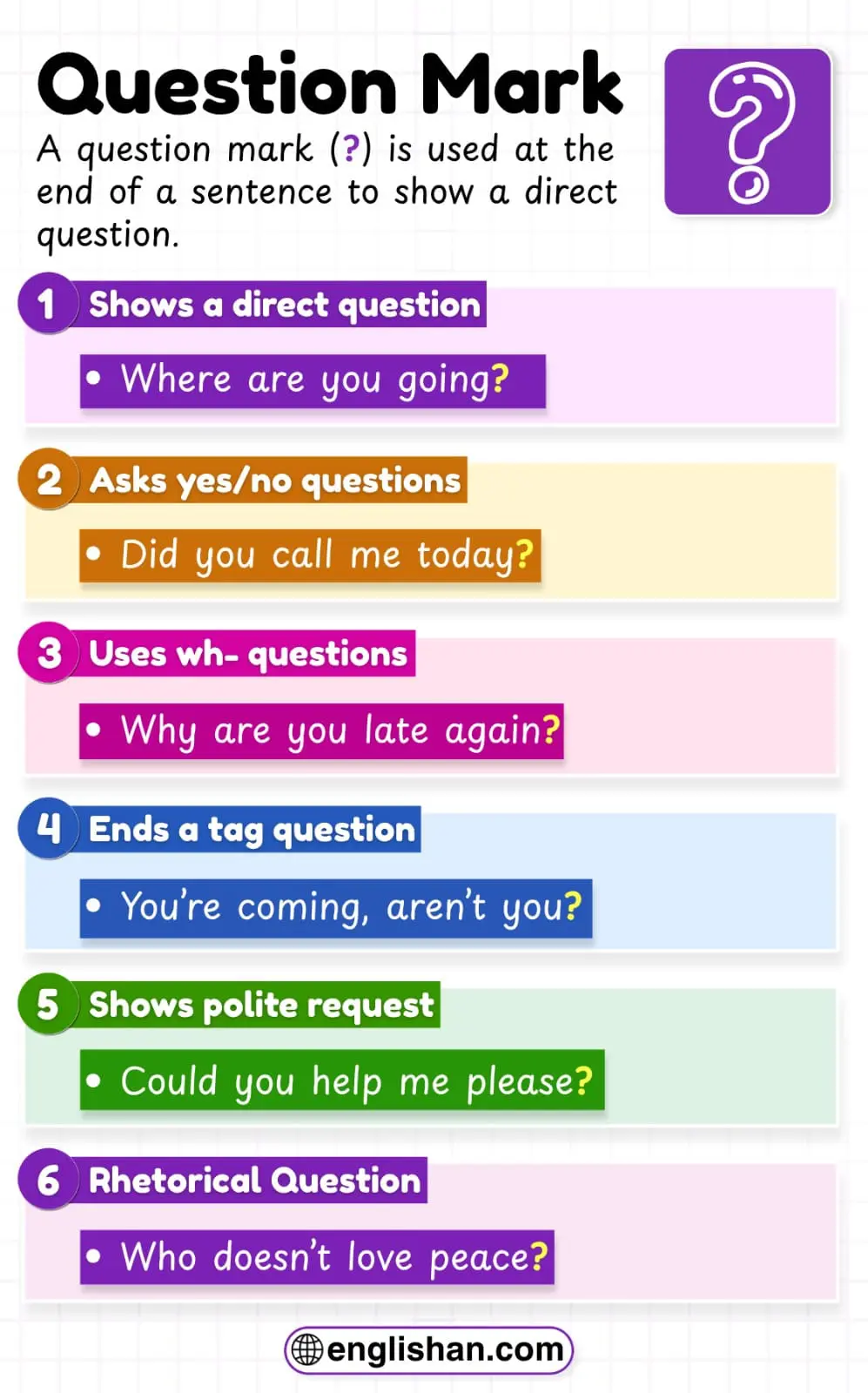
A question mark (?) is a punctuation mark placed at the end of a sentence to signal that the sentence is a question. It belongs to the same family as the period and the exclamation mark, all three are terminal punctuation marks that close a sentence. But while the period ends a neutral statement and the exclamation mark ends an emphatic one, the question mark tells the reader that the sentence is seeking information, confirmation, or a response.
The mark dates back to medieval Latin manuscripts, where scribes wrote the word quaestio (meaning “question”) at the end of interrogative sentences. Over time, quaestio was shortened to qo, then compressed into a symbol that eventually became the curved stroke and dot we recognize today.
In modern English, the question mark functions as both a grammatical signal and a tonal cue. It tells the reader what kind of sentence this is (a question, not a statement) and how to read it (with rising inflection rather than falling finality).
When To Use A Question Mark
Direct Questions
A direct question asks for information openly and expects a response. Whether the question starts with a question word (who, what, where, when, why, how), a helping verb (do, does, did, is, are, was, were, can, will), or an inverted subject-verb structure, the rule is the same: place a question mark at the end.
- Where are you going?
- Do you like coffee?
- What time does the train leave?
- Is she your sister?
- How does this work?
All of these are direct questions because they ask something outright and wait for an answer. Yes/no questions and WH-questions both fall under this same rule. The form of the question varies, but the punctuation stays the same: a question mark at the end of every direct question.
Tag Questions
A tag question is a short question attached to the end of a statement. The statement makes a claim, and the tag asks the listener to confirm or deny it. The question mark goes at the end of the full sentence, not after the statement portion.
- You are coming tonight, aren’t you?
- It is raining outside, isn’t it?
- She passed the exam, didn’t she?
- We should leave early, shouldn’t we?
The tag flips the verb form of the statement. A positive statement takes a negative tag (You are coming, aren’t you?), and a negative statement takes a positive tag (You aren’t coming, are you?). The question mark follows the tag because the entire sentence functions as a question, even though the first half is a statement.
Rhetorical Questions
A rhetorical question is asked to make a point rather than to receive an answer. The speaker already knows the answer, or the answer is so obvious that stating it would weaken the effect. Rhetorical questions still take a question mark in standard writing because their grammatical structure is interrogative.
- Who doesn’t want a better life?
- Isn’t it obvious?
- What’s the point of arguing?
The question mark stays because the sentence is structured as a question, even though no response is expected. In some literary and editorial contexts, writers occasionally drop the question mark from rhetorical questions that function more as exclamations or commands (What difference does it make. or How dare you.), but this is a stylistic choice rather than a standard grammar rule.
Questions In A Series
When multiple short questions follow in a row as part of the same thought, each question takes its own question mark, and the words after the first question start with a lowercase letter. The lowercase signals that the questions all belong to the same sentence.
- Do you want pizza? pasta? salad?
- Should we go today? tomorrow? next week?
- Who is responsible for this? the manager? the team lead? the intern?
Each item in the series is a separate question, but they all branch from the same opening sentence. The lowercase keeps the visual connection intact and tells the reader that these are follow-up questions, not independent sentences.
Embedded Questions
An embedded question is a direct question placed inside a larger sentence. The question itself keeps its question mark, and the sentence structure around it adjusts to accommodate it.
- The real question is, will they accept the offer?
- I keep wondering: where did she go?
- One thing still puzzles me: why didn’t anyone speak up?
The embedded question retains its question mark because it is still a genuine question being asked within the sentence. This is different from an indirect question, where the question is reported rather than asked directly. The distinction matters because indirect questions lose their question mark entirely, while embedded questions keep it.
When Not To Use A Question Mark
Indirect Questions
An indirect question reports what was asked without asking it directly. The sentence structure shifts from interrogative (question word order) to declarative (statement word order), and the question mark disappears because the sentence is no longer functioning as a question.
- Where are you going? (direct, question mark) ✅
- He asked where I was going. (indirect, period) ✅
- He asked where I was going? ❌
- What is your name? (direct, question mark) ✅
- She asked what my name was. (indirect, period) ✅
- She asked what my name was? ❌
The structural change is what removes the question mark. In the direct version, the question word (where, what) starts the sentence and the subject-verb order is inverted (are you going, not you are going). In the indirect version, the sentence reports the question as a statement, the word order returns to normal (I was going, not was I going), and the period replaces the question mark.
The test is consistent: read the sentence aloud. If your voice rises at the end because the sentence is actively asking something, the question mark belongs. If your voice falls because the sentence is reporting what someone else asked, a period is the correct mark.
Polite Requests In Question Form
Some sentences are shaped like questions but function as polite requests or instructions. When the speaker is not genuinely seeking a yes-or-no answer but rather issuing a courteous directive, the sentence takes a period instead of a question mark.
- Would you please forward the report to the finance team. ✅
- Could you kindly close the door on your way out. ✅
- Would all attendees please move to the main hall. ✅
These sentences use question-form words (would, could), but the speaker is not asking whether the listener is willing to do something. The speaker is telling the listener to do it politely. The period signals that the sentence is a directive wrapped in courteous language, not a genuine question.
This rule applies most often in formal, professional, and institutional writing. In casual conversation and informal writing, the same sentences would typically take a question mark because the tone feels more like an actual question.
Question Marks With Quotation Marks
Placement follows the source of the question. The question mark goes wherever the question lives, whether that is inside the quoted material or in the sentence surrounding it.
When the quoted words form the question, the question mark goes inside the closing quotation mark:
- She asked, “Are you coming today?”
- “What time does the meeting start?” he said.
The question belongs to the speaker’s words, so the mark stays inside the quote.
When the surrounding sentence is the question and the quoted words are not, the question mark goes outside the closing quotation mark:
- Did she actually say “I will handle it”?
- Are you sure he said “the project is finished”?
The quoted words are statements, not questions. The question belongs to the sentence wrapping around the quote, so the mark goes outside.
Never double up a question mark with a period. The question mark already serves as terminal punctuation, so adding a period after it is always incorrect.
- She asked, “Are you coming today?”. ❌
- She asked, “Are you coming today?” ✅
Question Marks With Parentheses
The same source-of-the-question logic applies to parentheses. The question mark follows whoever is doing the asking.
When the parenthetical content is a question, the question mark goes inside the parentheses:
- She finally arrived (wasn’t she supposed to be here an hour ago?).
- The report was approved (did anyone actually read it?).
When the main sentence is a question and the parenthetical content is not, the question mark goes at the end of the full sentence, outside the parentheses:
- Did she really say that (I’m not sure I believe it)?
- Are you going to the conference (the one in Istanbul)?
The parenthetical content adds extra information, but the question belongs to the main sentence, so the mark closes the full sentence rather than the parenthetical aside.
Capitalization After A Question Mark
A question mark ends a sentence, so the word that follows it starts with a capital letter, just as it would after a period.
- What are you doing? I’m waiting for you. ✅
- What are you doing? i’m waiting for you. ❌
The one exception is the questions-in-a-series pattern, where follow-up questions within the same sentence start with lowercase letters because they are extensions of the opening question, not independent sentences.
- Do you want tea? coffee? water? ✅
Question Marks With Abbreviations
When a question ends with an abbreviation that has its own period, the abbreviation period stays and the question mark follows immediately. No space goes between the period and the question mark.
- Weren’t we supposed to head toward Washington, D.C.? ✅
- Did she earn her Ph.D.? ✅
The period belongs to the abbreviation, and the question mark belongs to the sentence. Both marks serve different functions, so both remain.
The Interrobang
The interrobang is a combination of a question mark and an exclamation mark, used when a sentence expresses both surprise and inquiry at the same time. It can be written as ?! or !?, and a dedicated symbol (‽) exists, though it is rarely used in standard publishing.
- You ate the entire cake?!
- She said what?!
- Are you seriously telling me this now?!
The interrobang belongs to informal writing, dialogue, and creative contexts. In formal or academic writing, a single question mark is enough, and the surrounding words should carry the emotional weight rather than the punctuation.
Common Question Mark Mistakes
Placing A Question Mark After An Indirect Question
This is the most frequent question mark error. Indirect questions report what was asked without asking it directly, and they take a period because the sentence structure has shifted from interrogative to declarative.
- He asked where was I going? ❌
- He asked where I was going. ✅
- I wonder if she will come? ❌
- I wonder if she will come. ✅
The word order tells you which mark to use. If the subject comes before the verb (I was going), the sentence is a statement and takes a period. If the verb comes before the subject (was I going), the sentence is a question and takes a question mark.
Using A Question Mark After A Polite Request
Writers who recognize the question-form words (would, could, will) sometimes add a question mark out of habit, even when the sentence functions as a directive rather than a genuine inquiry.
- Would you please submit the form by Friday? (functions as a request, period is more appropriate in formal writing)
- Could all passengers please remain seated. ✅
This mistake is more about tone than grammar. In casual writing, the question mark is acceptable. In formal, professional, or institutional contexts, the period matches the sentence’s actual function more accurately.
Using Double Punctuation
A question mark replaces the period at the end of a sentence. Adding both creates a grammatical error.
- What are you doing?. ❌
- What are you doing? ✅
The same applies when a question mark appears inside quotation marks. The question mark already closes the sentence, so no additional period is required after the closing quotation mark.
Confusing Embedded Questions With Indirect Questions
An embedded question is a direct question placed inside a larger sentence, and it keeps its question mark. An indirect question reports a question as a statement, and it loses the question mark. Confusing the two produces either a missing mark or an unnecessary one.
- I keep asking myself: where did I leave my keys? (embedded, question mark stays) ✅
- I keep asking myself where I left my keys. (indirect, period) ✅
- I keep asking myself where I left my keys? (indirect treated as direct) ❌
The test is word order. If the embedded portion uses question word order (where did I leave), the question mark stays. If it uses statement word order (where I left), the sentence is indirect and the period closes it.
Question Mark Examples Across Different Contexts
| Context | Example |
|---|---|
| Direct question | What time does the flight leave? |
| Yes/no question | Did you finish the assignment? |
| WH-question | Why did she leave so early? |
| Tag question | You’re coming with us, aren’t you? |
| Rhetorical question | Who wouldn’t want that opportunity? |
| Questions in a series | Should we go Monday? Tuesday? Wednesday? |
| Embedded question | The real issue is, will the budget hold? |
| Indirect question (no mark) | She asked whether the budget would hold. |
| With quotation marks (inside) | He asked, “Where is the nearest station?” |
| With quotation marks (outside) | Did she really say “I’m not interested”? |
| With parentheses (inside) | The deadline passed (did anyone notice?). |
| Polite request (period) | Would you please take a seat. |
| Interrobang | You did what?! |
Final Thought
The question mark does one thing with remarkable consistency: it tells the reader that a sentence is asking rather than stating. That single function governs every rule, from direct questions to tag questions to rhetorical questions, and it explains every exception, from indirect questions losing the mark to polite requests taking a period instead.
The most reliable way to choose the right punctuation is to read the sentence aloud and listen to your own voice. If your inflection rises at the end because the sentence is genuinely asking something, the question mark belongs. If your voice falls because the sentence is reporting, requesting, or declaring, a period does the job. The mark mirrors the voice, and once that connection becomes instinct, question mark placement stops being a rule you follow and becomes a rhythm you feel.
FAQs
A question mark signals that a sentence is asking for information, confirmation, or a response. It goes at the end of direct questions, tag questions, and rhetorical questions. The mark mirrors the rising inflection of spoken English, telling the reader to process the sentence as an inquiry rather than a statement.
No. Indirect questions report what was asked without asking it directly, and they follow statement word order. She asked where I was going. takes a period because the sentence is a report, not a question. The direct version, Where are you going?, takes a question mark because it is actively asking.
It follows the source of the question. When the quoted words form the question, the mark goes inside the closing quotation mark: She asked, “Are you ready?” When the surrounding sentence is the question and the quoted words are not, the mark goes outside: Did she say “I’m ready”?
Yes. A question mark ends a sentence, so the next word starts with a capital letter, just as it would after a period. The only exception is the questions-in-a-series pattern (Do you want tea? coffee? water?), where the follow-up questions remain lowercase because they extend the opening sentence.
An embedded question is a direct question placed inside a larger sentence, and it keeps its question mark: I wonder: where did she go? An indirect question reports a question as a statement, with standard word order, and takes a period: I wonder where she went. The key difference is word order. Question word order (verb before subject) keeps the mark. Statement word order (subject before verb) removes it.
It depends on the context. In formal and professional writing, a polite request shaped like a question but functioning as a directive takes a period: Would you please forward the document. In casual or conversational writing, the question mark is acceptable because the tone feels closer to a genuine question.
An interrobang combines a question mark and an exclamation mark (?! or !?) to express surprise and inquiry in the same sentence: You did what?! It belongs to informal writing and dialogue. In formal contexts, a single question mark is sufficient, and the words themselves should carry the emotional weight.
You May Also Like