The colon (:) is a punctuation mark that helps make writing clearer and more structured. It is often used to connect ideas in a sentence, introduce a list, give an explanation, or highlight important information. Even though it looks simple, the colon plays an important role in guiding the reader and showing that something extra or related is coming next.
Once you understand how to use it, your writing becomes more organized and easier to follow. In this article, we’ll explore the basic rules of the colon, its common uses, and practical examples. This will help you use it confidently in your sentences and avoid common mistakes.
What is a Colon?
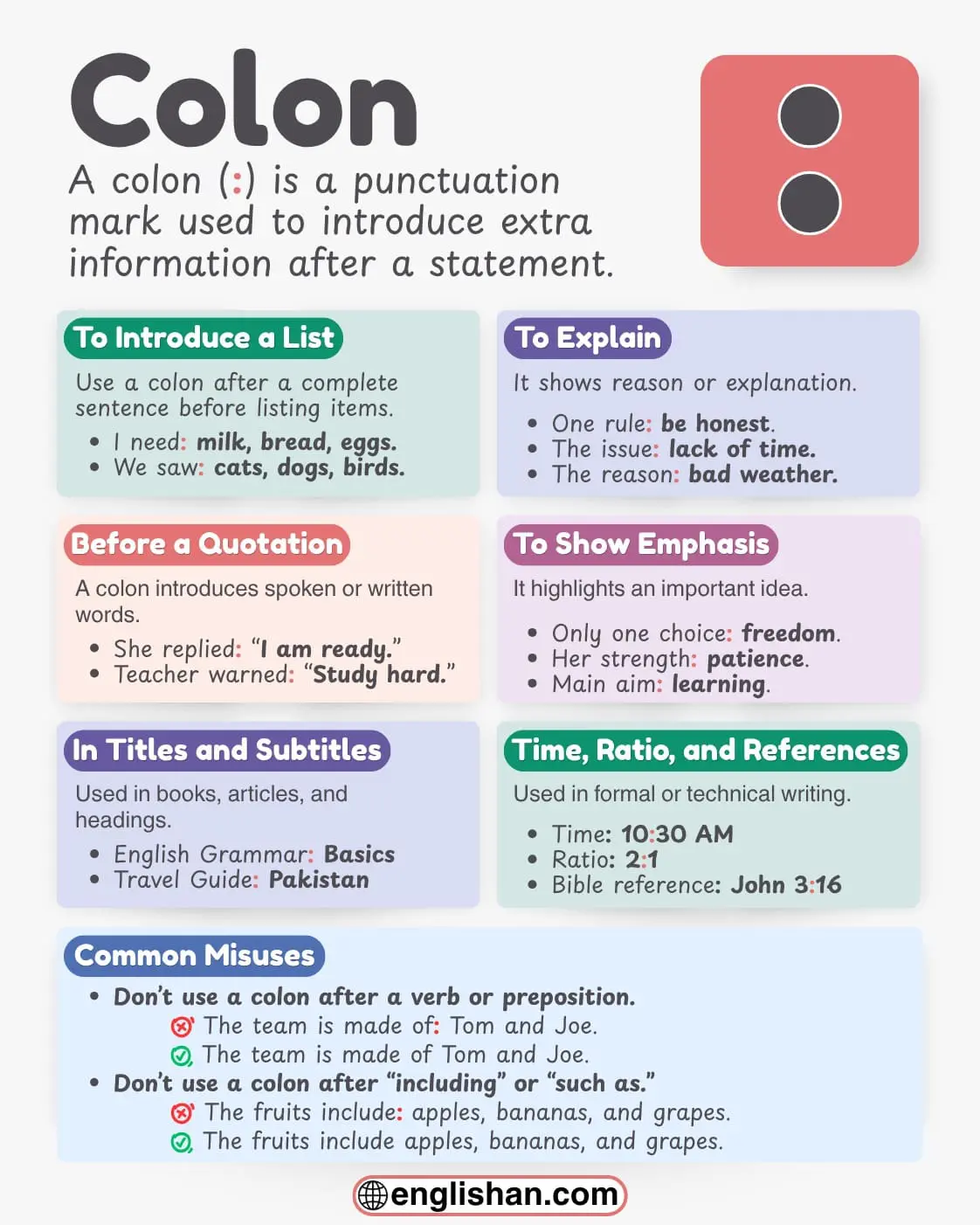
A colon (:) is a punctuation mark used in English to show that something extra is coming after it. It helps connect ideas in a clear way, especially when you want to explain something, introduce a list, or give more details about the first part of the sentence.
For Example:
- You only need one thing to succeed: hard work.
- We packed everything for the trip: clothes, snacks, and a first-aid kit.
When to Use a Colon?
You use a colon when the first part of your sentence is complete, but you want to add something that explains, supports, or gives more detail. It basically tells the reader, “I’m about to explain this further.” It creates a smooth link between an idea and its clarification, list, or example.
Colon for Explanation
A colon is very useful when you want to explain something more clearly. The first part introduces an idea, and the second part gives the meaning or reason behind it. It feels like you’re breaking down the thought for the reader.
For Example:
- He had one dream: to become a doctor.
Colon in Lists
We also use a colon before a list of items. It works like a signal that says, “here are the details.” The sentence before the colon introduces the idea, and the list completes it.
For Example:
- For the trip, we packed everything we needed: clothes, food, water, and a flashlight.
Colon with Noun Phrases
Sometimes a colon comes before a noun or noun phrase that adds extra meaning. It helps complete the idea in a simple and direct way.
For Example:
- She only wanted one thing for her birthday: a new phone.
Colon for Quotations
A colon is also used to introduce a quotation, especially when the quote explains or supports the idea before it. It makes the transition smooth and clear for the reader.
For Example:
- My father always reminds me of one thing: “Hard work never goes to waste.”
Capitalization After a Colon
After a colon, capitalization depends on how the second part of the sentence is written. If what comes after the colon is a complete sentence on its own, you can start it with a capital letter. But if it’s just a word, phrase, or list, then it usually stays in lowercase. The idea is to keep the sentence looking natural and grammatically balanced, not random or over-capitalized.
For Example:
- There was only one problem: He didn’t have enough time to finish the work.
- I have a simple plan for today: study, revise, and practice writing.
Colon vs Semicolon
A colon (:) and a semicolon (;) may look similar, but they are used in different ways. The main difference is how they connect ideas in a sentence.
A colon is used when you want to explain, introduce, or give details. It tells the reader that something important is coming next, like a list, explanation, or example.
For Example:
- She brought everything she needed: books, pens, and notebooks.
A semicolon, on the other hand, is used to connect two closely related complete sentences. Instead of using a full stop, it gently links the two ideas together.
For Example:
- I was very tired; I still finished my homework.
Common Colon Mistakes
Colons are simple, but many learners use them in the wrong place. The main issue is usually not understanding what kind of sentence should come before a colon. A colon should always follow a complete idea, not a word or incomplete structure. Let’s look at the most common mistakes in a clear way.
Using a colon after a verb or preposition
A colon should never come directly after a verb (like is, are, include) or a preposition (like to, in, at). This breaks the sentence structure because the first part is not complete.
For Example:
- Incorrect: The ingredients are: flour, sugar, and eggs.
- Correct: The ingredients are flour, sugar, and eggs.
Here, “are” already connects the sentence, so the colon is unnecessary.
Using a colon after “including” or “such as”
Words like including or such as already introduce examples, so adding a colon becomes repetitive and wrong.
For Example:
- Incorrect: I like fruits such as: apples, bananas, and mangoes.
- Correct: I like fruits such as apples, bananas, and mangoes.
The phrase “such as” already does the job of introducing examples.
Using a colon when the first part is not a complete sentence
A colon should only come after a full, complete idea. If the sentence before it feels unfinished, the colon is incorrect.
For Example:
- Incorrect: Because I was tired: I went to bed early.
- Correct: I was tired: I went to bed early.
The first sentence must stand complete before the colon.
Overusing colons unnecessarily
Sometimes writers use colons when a simple sentence or comma is enough. This makes writing look forced.
For Example:
- Incorrect: He said: hello to everyone.
- Correct: He said hello to everyone.
Colon Examples
- She had one goal: to become a teacher.
- I bought three things from the store: milk, bread, and eggs.
- He said something very powerful: “Never give up.”
- There is one reason I failed: I didn’t practice enough.
- The room had everything I needed: a bed, a desk, and a chair.
- We only need one thing now: patience.
- My teacher gave us clear instructions: complete the homework and revise the lesson.
- She packed everything for the trip: clothes, shoes, and snacks.
- He made a promise: he would return before sunset.
- There’s a simple rule in life: work hard and stay consistent.
Final Thought on the Colon
As we learned, the colon (:) is a small but very useful punctuation mark that helps make writing clear and meaningful. It connects ideas in a way that shows explanation, introduction, or emphasis. Whether you are adding a list, giving details, or introducing a quote, the colon helps guide the reader smoothly from one idea to the next.
In simple words, once you understand its proper use, your writing becomes more structured and easier to read. It may be a tiny mark, but it plays a powerful role in making your sentences more organized and professional.
Colon FAQs
A colon (:) is a punctuation mark used to introduce information that explains, supports, or adds detail to the first part of a sentence. It helps connect ideas in a clear and structured way. You’ll often see it used before lists, explanations, quotes, or examples.
Example:
She only needed one thing: confidence.
We use a colon when the first part of the sentence is complete and the second part gives extra information, such as a list, explanation, or emphasis.
Example:
I have three hobbies: reading, writing, and painting.
He had one dream: to become a pilot.
The main rule is that a colon should come after a complete sentence. It should introduce related information, not break grammar structure. It is commonly used for lists, explanations, quotations, and emphasis.
Example:
There was only one problem: he was not prepared.
A colon introduces information such as explanations or lists, while a semicolon connects two closely related complete sentences. In simple words, a colon explains, and a semicolon connects.
Examples:
Colon: She had one wish: peace.
Semicolon: She was tired; she still finished her work.
Common mistakes include using a colon after a verb or preposition, using it after words like “such as,” or using it when the first part of the sentence is not complete.
Incorrect: The items are: books and pens.
Correct: The items are books and pens.
You May Also Like