Quick answer: A comma before however is wrong when however joins two independent clauses. That error is called a comma splice. Use a semicolon or start a new sentence instead.
❌ I liked the hotel, however, the location was inconvenient. ✅ I liked the hotel; however, the location was inconvenient. ✅ I liked the hotel. However, the location was inconvenient.
A comma before however is correct when however appears as a parenthetical aside in the middle or at the end of a sentence.
✅ The results, however, were not what we expected. ✅ The results were not what we expected, however.
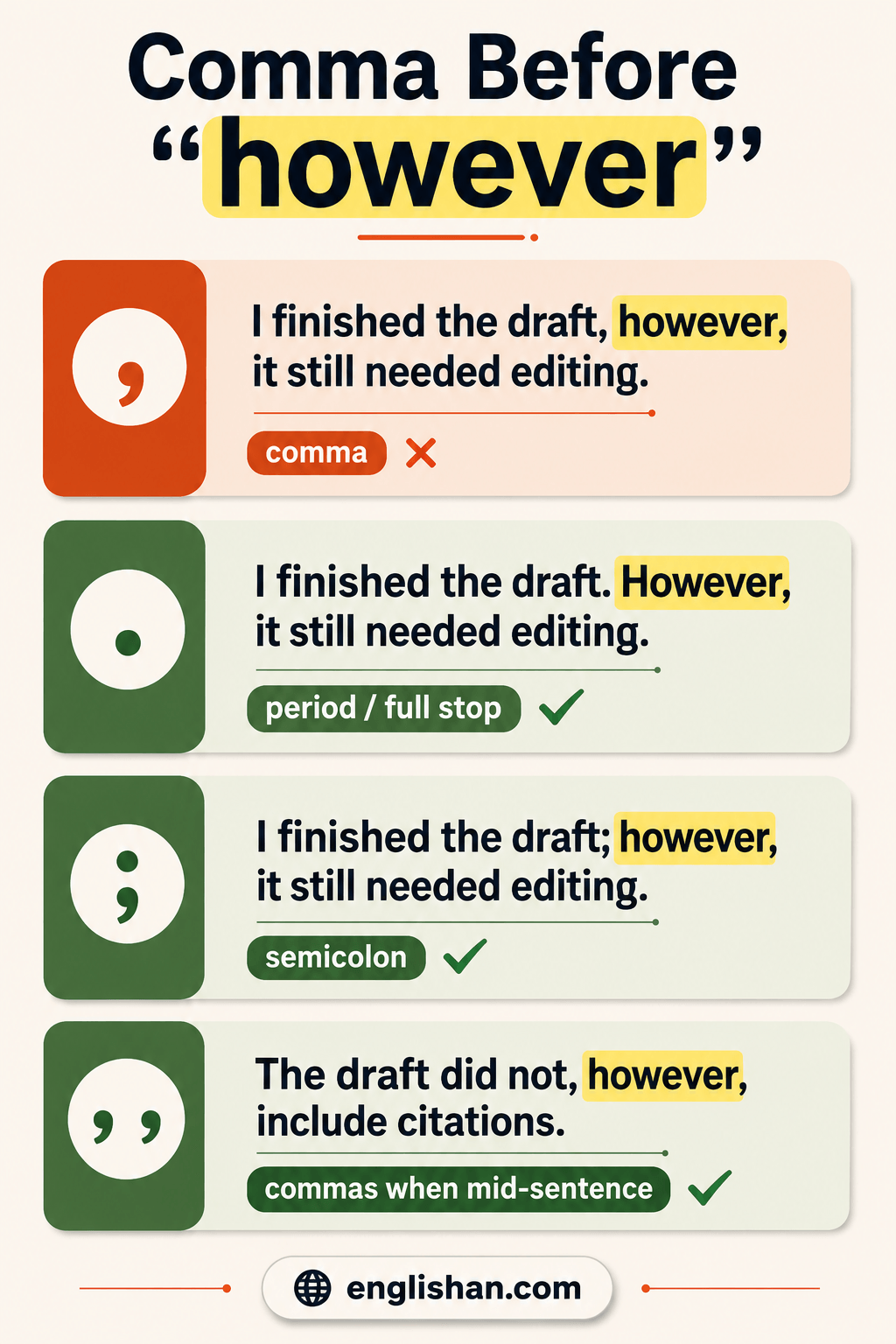
The Core Mistake: Comma + However = Comma Splice
The most common punctuation error with however is placing a comma before it when it bridges two complete sentences. That creates a comma splice, a specific grammatical error where two independent clauses are joined by nothing stronger than a comma.
❌ She studied all weekend, however, she still failed the exam.
Both sides of however are independent clauses. She studied all weekend is a complete sentence. She still failed the exam is a complete sentence. A comma is too weak to hold them together with however in between.
Two correct fixes exist.
Fix 1: Start a new sentence.
✅ She studied all weekend. However, she still failed the exam.
This is the stronger choice for most writing. It gives however its full weight as a transition between two distinct ideas.
Fix 2: Use a semicolon.
✅ She studied all weekend; however, she still failed the exam.
A semicolon works when the two ideas are closely related and you want a smoother transition within a single sentence. It signals that the second clause continues the thought rather than starting a new one.
When to Choose a Period vs. a Semicolon
Default to a period. It’s always correct, it keeps your sentences clean, and it avoids the risk of semicolon overuse. Reserve the semicolon for moments when the contrast between the two clauses is tight and immediate, and a full stop would feel like too hard a break.
If you find yourself using semicolons before however more than once or twice per page, switch to periods. Frequent semicolons become distracting and lose their smoothing effect.
Why Writers Make This Mistake: “However” vs. “But”
The comma splice with however is so common because writers treat however the same way they treat but. Both words signal contrast, and both connect two ideas. The difference is grammatical, and it changes the punctuation completely.
But is a coordinating conjunction. It joins two independent clauses with just a comma before it:
✅ I liked the hotel, but the location was inconvenient.
However is a conjunctive adverb. It cannot join two independent clauses with a comma. It needs a semicolon before it (or a period) and a comma after it:
✅ I liked the hotel; however, the location was inconvenient.
Side by side with the same content:
| Using “but” | Using “however” |
|---|---|
| I liked the hotel, but the location was inconvenient. ✅ | I liked the hotel, however, the location was inconvenient. ❌ |
| I liked the hotel; however, the location was inconvenient. ✅ | |
| I liked the hotel. However, the location was inconvenient. ✅ |
If you can replace however with but and a comma, go ahead and use but. If you want the more formal weight of however, change the punctuation to match.
When a Comma Before “However” Is Correct
A comma before however is appropriate in two situations: when however appears as a parenthetical in the middle of a sentence, and when it appears at the end of a sentence.
“However” as a Parenthetical (Mid-Sentence)
When however interrupts a single clause to add contrast, it functions as a parenthetical aside. Commas go before and after it, the same way they would around of course or on the other hand.
✅ The data, however, told a different story.
✅ She was, however, unwilling to compromise on the deadline.
✅ Trauma is a fact of life. It does not, however, have to be a life sentence. (Peter A. Levine)
In each case, however is not joining two independent clauses. It’s interrupting a single clause to inject a contrasting note. Remove however and the sentence still works: The data told a different story. That’s the test for a parenthetical: the sentence survives without it.
“However” at the End of a Sentence
When however appears at the end of a clause or sentence, a comma goes before it.
✅ The committee approved the budget. The timeline was unrealistic, however.
✅ She agreed to the terms. She wasn’t happy about them, however.
This position gives however an afterthought quality, as if the contrast is being added as a final note. It works best when you want to emphasize the main statement and let the contrast land softly at the end. In most writing, placing however at the start of the next sentence is a stronger choice, but the end-of-sentence position is grammatically correct and occasionally useful for rhythm.
“However” Meaning “No Matter How” (No Comma After)
However has a second meaning entirely separate from “nevertheless.” When however means “no matter how” or “to whatever extent,” it introduces a dependent clause and takes no comma after it.
✅ However difficult the project becomes, we will finish it on time.
✅ However long it takes, the investigation will be thorough.
✅ However difficult life may seem, there is always something you can do and succeed at. (Stephen Hawking)
Notice the pattern: however + adjective/adverb + clause, followed by a comma before the main clause. The comma here separates the introductory dependent clause from the independent clause that follows. It has nothing to do with however itself.
When the however clause comes at the end, no comma is needed if the clause is essential to the sentence’s meaning:
✅ We’ll finish the project however long it takes.
A comma before the however clause at the end is appropriate only when the clause adds nonessential information:
✅ She’ll finish the marathon, however painful the last miles become.
The test: if removing the however clause changes the core meaning of the sentence, skip the comma. If it adds a secondary detail, include one.
Comma After “However”: A Quick Rule
When however means “nevertheless” and starts a sentence or appears after a semicolon, a comma always follows it.
✅ However, the results were inconclusive.
✅ The sample size was large; however, the results were inconclusive.
When however means “no matter how,” no comma follows it. The next word is part of the same clause.
✅ However large the sample, the results remained inconclusive.
The distinction is straightforward: “nevertheless” gets a comma after. “No matter how” does not.
The Same Rule Applies to Other Conjunctive Adverbs
However is not the only word that triggers this comma splice mistake. The same punctuation rules govern all conjunctive adverbs, including therefore, furthermore, consequently, moreover, nevertheless, meanwhile, and as a result.
❌ The roads were flooded, therefore, we took a detour. ✅ The roads were flooded; therefore, we took a detour. ✅ The roads were flooded. Therefore, we took a detour.
❌ She finished early, furthermore, she helped her colleagues. ✅ She finished early. Furthermore, she helped her colleagues.
If you master the punctuation for however, you’ve mastered it for the entire category.
Quick-Reference Table
| Position / Usage | Correct Punctuation | Example |
|---|---|---|
| Joining two independent clauses | Semicolon before, comma after (or new sentence) | The plan failed; however, we learned from it. |
| Parenthetical, mid-sentence | Commas before and after | The plan, however, was worth attempting. |
| End of sentence | Comma before | The plan was worth attempting, however. |
| Start of sentence (meaning “nevertheless”) | Comma after | However, the plan was worth attempting. |
| Meaning “no matter how” (start of sentence) | Comma after the full clause, not after “however” | However risky the plan was, we went ahead. |
| Meaning “no matter how” (end of sentence) | No comma if essential; comma if nonessential | We’ll proceed however risky it is. |
FAQ
Only in specific positions. A comma before however is correct when however appears as a parenthetical in the middle of a sentence (The data, however, told a different story) or at the end of a sentence (The data told a different story, however). A comma before however joining two independent clauses is a comma splice and is always incorrect.
Both are correct when however bridges two independent clauses. A period is the safer default and works in all contexts. A semicolon creates a smoother transition and works best when the two ideas are tightly connected. If you’re unsure, use a period.
Both signal contrast, but they belong to different grammatical categories. But is a coordinating conjunction that joins two clauses with a comma before it: I tried, but I failed. However is a conjunctive adverb that requires a semicolon or period before it and a comma after it: I tried; however, I failed. Swapping the punctuation between them creates errors in both directions.
No. A comma follows however when it means “nevertheless” (However, the results were surprising). No comma follows however when it means “no matter how” or “to whatever extent” (However surprising the results were, we accepted them). The meaning determines the punctuation.
You May Also Like