Knowing when to put a comma before “and” depends on what and is doing in the sentence. Sometimes the comma belongs there, sometimes it breaks the sentence, and the difference comes down to the structure around and, not the word itself.
The rules change based on whether and is joining two full sentences, closing a list of three or more items, or connecting two words that share the same subject. Each structure follows its own comma rule, and mixing them up leads to comma splices, unnecessary pauses, or missing punctuation where the reader needs a break.
Since most comma-before-“and” mistakes come from applying one rule to all three structures, separating them makes the decision straightforward. Here, you’ll go through each structure with real sentence examples, correct and incorrect comma placement, and the specific situations where the Oxford comma matters.
When To Put A Comma Before “And”
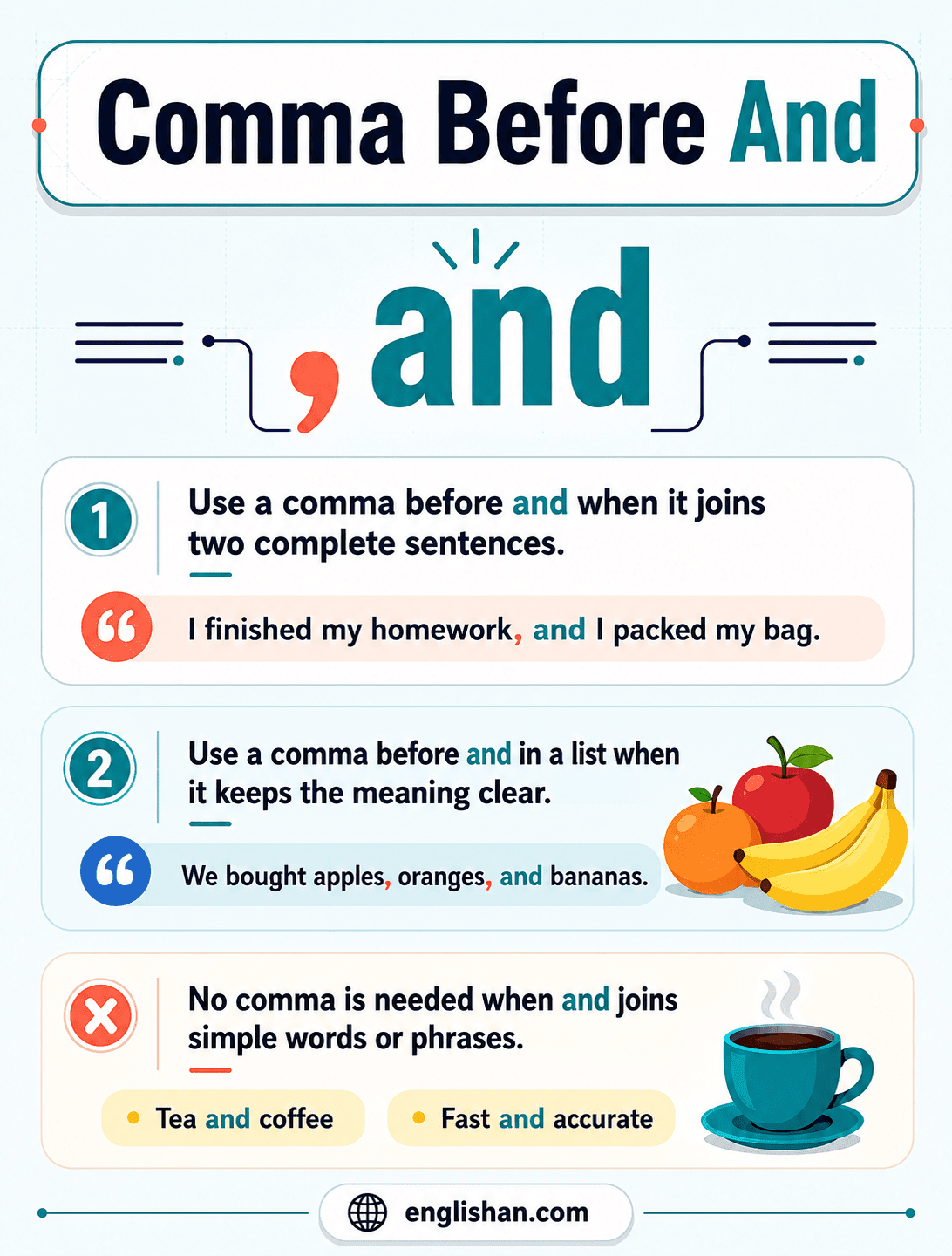
The comma earns its place before “and” in two situations, and both follow the same structural logic. In each case, what comes on either side of “and” carries enough grammatical independence to justify a pause between them.
Joining Two Independent Clauses
An independent clause is a group of words with its own subject and verb that works as a complete sentence on its own. When “and” connects two of these clauses into one sentence, a comma goes directly before “and” to mark the boundary between the two complete thoughts.
- The client approved the design, and the team began development the following week. ✅
- She studied for three hours, and she still felt unprepared for the exam. ✅
- Omar finished the report, and he submitted it before the deadline. ✅
Each example contains two independent clauses. The client approved the design is a complete sentence. The team began development the following week is also a complete sentence. The comma before “and” signals to the reader that a new clause with its own subject is about to begin.
This rule applies even when the subject of the second clause is a pronoun referring back to the first clause. She studied for three hours, and she still felt unprepared still requires the comma because both sides are independent clauses with their own subjects and verbs.
The short-clause exception: When both independent clauses are very short and closely related, the comma before “and” becomes optional. Some style guides, including the Chicago Manual of Style (CMOS 6.22), allow it to be dropped in these cases.
- She sang and he played guitar. (acceptable without comma)
- She sang, and he played guitar. (also correct)
Both versions work because the clauses are brief and the meaning is immediately clear. In longer or more complex sentences, the comma is always the safer choice.
The Oxford Comma (Before The Last Item In A List)
When “and” closes a list of three or more items, the comma that appears before it is called the Oxford comma, also known as the serial comma or the Harvard comma. This comma separates the second-to-last item from the final item in the list.
- The report analyzed costs, timelines, and staffing. (with Oxford comma)
- The report analyzed costs, timelines and staffing. (without Oxford comma)
Both versions are grammatically correct, and style guides disagree on which one to follow. But the Oxford comma exists for a reason, and that reason becomes visible the moment a list creates ambiguity without it.
The ambiguity problem: Without the Oxford comma, certain lists produce sentences that can be read in two completely different ways.
- I admire my parents, Taylor Swift and my dog. ❌ (reads as though Taylor Swift and the dog are the parents)
- I admire my parents, Taylor Swift, and my dog. ✅ (three separate items)
The missing comma before “and” turns Taylor Swift and my dog into an appositive that renames my parents. The Oxford comma eliminates that false reading by making each item in the list grammatically independent.
The Oakhurst Dairy case: The most famous real-world consequence of a missing Oxford comma is the 2014 lawsuit against Oakhurst Dairy in Maine. A state labor law exempted workers involved in “the canning, processing, preserving, freezing, drying, marketing, storing, packing for shipment or distribution” of certain products. Without a comma before “or distribution,” the court could not determine whether the law exempted distribution as a standalone activity or only “packing for distribution” as a single activity. The case was eventually settled for $5 million. A single missing comma changed the legal interpretation of the statute.
When the Oxford comma creates ambiguity: In rare cases, adding the Oxford comma introduces confusion rather than resolving it.
- I spoke with my mother, a doctor, and a lawyer. (Is “a doctor” the mother’s title, or a second person?)
This sentence is ambiguous with the Oxford comma because a doctor could be an appositive renaming my mother or a separate item in the list. The solution is not to remove the comma but to rephrase: I spoke with a doctor, a lawyer, and my mother. Restructuring the list removes the ambiguity entirely.
Style guide split: The Associated Press (AP) Stylebook advises omitting the Oxford comma unless it is necessary for clarity. The Chicago Manual of Style (CMOS), the Modern Language Association (MLA), and the American Psychological Association (APA) all recommend using it consistently. British English tends to omit it unless ambiguity would result. American English tends to favor it.
The strongest practical approach is consistency. Pick one convention and apply it throughout every document. Switching between using and omitting the Oxford comma within the same piece of writing looks like careless editing regardless of which convention you follow.
When Not To Put A Comma Before “And”
The comma disappears before “and” when the word connects elements that do not carry independent grammatical weight. Two items in a list, two verbs sharing one subject, and a dependent clause following “and” all drop the comma because no sentence boundary exists at that point.
Two Items In A List
When “and” joins only two items, no comma is used. The comma in a series exists to separate three or more elements, and with only two, “and” does the separating work on its own.
- She ordered coffee and a sandwich. ✅
- She ordered coffee, and a sandwich. ❌
- The walls were blue and white. ✅
- The walls were blue, and white. ❌
- Sam and Maria take excellent care of their dogs. ✅
- Sam, and Maria take excellent care of their dogs. ❌
This applies to compound subjects (two nouns), compound adjectives (two descriptors), compound objects (two things being acted on), and any other pairing connected by “and.” The comma enters only when a third item turns the pairing into a series.
Compound Predicates (Two Verbs, One Subject)
A compound predicate occurs when one subject performs two actions connected by “and.” Because both verbs belong to the same subject, no sentence boundary exists between them, and no comma is used.
- She opened the door and walked inside. ✅
- She opened the door, and walked inside. ❌
- The dog barked at the mailman and ran across the yard. ✅
- The dog barked at the mailman, and ran across the yard. ❌
The structural reasoning is what makes this rule stick. A comma before “and” between independent clauses marks a sentence boundary, the point where one complete thought ends and another begins. In a compound predicate, both verbs share the same subject, so there is no boundary to mark. Adding a comma falsely signals a new clause where none exists.
This rule holds even when the predicate is long. The committee reviewed the budget proposals from all three departments and approved the final allocation after two hours of debate has a long second predicate, but the subject (the committee) still governs both verbs. No comma before “and.”
Three or more verbs: When a compound predicate contains three or more verbs, they form a series, and the regular list comma rules apply.
- She opened the door, looked around, and walked inside. ✅
- She opened the door, looked around and walked inside. ✅ (without Oxford comma)
The creative writing exception: In fiction and long-form narrative, a comma before “and” in a compound predicate sometimes appears intentionally to create a rhythmic pause or give the reader a breath before the second action. The Chicago Manual of Style acknowledges this as a stylistic choice in creative contexts. In formal, expository, and academic writing, the comma stays out.
Dependent Clause After “And”
When the words following “and” do not form an independent clause, no comma is placed before “and.” A dependent clause or a verb phrase that shares the subject of the first clause does not qualify for the comma.
- He is talented and works extremely hard. ✅
- He is talented, and works extremely hard. ❌
Works extremely hard is not an independent clause because it has no subject of its own. It depends on he from the first clause. Without an independent clause on the other side of “and,” the comma has no structural reason to exist.
The test is the same one that governs the independent clause rule: take the words after “and” and ask whether they form a complete sentence on their own. Works extremely hard does not pass that test. He works extremely hard would. When both sides pass, the comma belongs. When only one side passes, it does not.
Comma After “And”
A comma after “and” is correct only when a parenthetical interrupter, a nonessential phrase set off by commas, immediately follows “and.” The comma after “and” is not a comma belonging to the conjunction itself. It is the opening comma of the parenthetical pair that sets off the interrupting phrase.
- I play the drums, and, occasionally, I play the guitar. ✅
- The finalists were excited and, as you can imagine, nervous. ✅
In the first example, occasionally is an interrupter set off by a pair of commas. In the second, as you can imagine is a parenthetical phrase. The commas around those phrases are doing their own work, independent of “and.”
Without an interrupter, no comma follows “and.”
- She picked up the phone and called her mother. ✅
- She picked up the phone and, called her mother. ❌
Starting a sentence with “and”: When “and” begins a sentence, no comma follows it unless a parenthetical interrupter comes next.
- And we never looked back. ✅
- And, we never looked back. ❌
- And, although we were exhausted, we never looked back. ✅ (although we were exhausted is a parenthetical interrupter)
Comma Before “And” Across Style Guides
The independent clause rule is universal across all major style guides. The Oxford comma is where they diverge.
| Style Guide | Oxford Comma | Independent Clause Comma |
|---|---|---|
| AP Stylebook | Omit unless clarity requires it | Required |
| Chicago Manual of Style (CMOS) | Required | Required (optional for very short clauses) |
| MLA | Required | Required |
| APA | Required | Required |
| British convention (general) | Omit unless clarity requires it | Required |
Consistency within a document matters more than which convention you follow. Every style guide agrees on one point: whichever approach you choose for the Oxford comma, apply it uniformly throughout the piece.
Common Mistakes With Comma Before “And”
Comma Before “And” In A Compound Predicate
When one subject performs two actions, no comma goes before “and.” This is one of the most frequent comma errors in English writing because the sentence can be long enough to feel like it contains two independent clauses, even when it does not.
- She reviewed the proposal, and approved it. ❌
- She reviewed the proposal and approved it. ✅
Both verbs (reviewed, approved) share the subject she. No sentence boundary exists, so no comma is used.
Missing Comma Before “And” Joining Two Independent Clauses
Omitting the comma when “and” joins two independent clauses can create a run-on sentence or a sentence that is harder to parse on first reading.
- The rain started at noon and the streets were flooded by evening. ❌
- The rain started at noon, and the streets were flooded by evening. ✅
Each side has its own subject and verb. The comma before “and” marks the structural break between them.
Inconsistent Oxford Comma Usage
Switching between including and omitting the Oxford comma within the same document creates an inconsistency that readers and editors notice. Pick one convention at the start and maintain it throughout.
Comma Between Only Two List Items
Two items connected by “and” do not take a comma. The comma in a list exists to separate three or more elements.
- I bought apples, and oranges. ❌
- I bought apples and oranges. ✅
Comma After “And” Without An Interrupter
A comma after “and” is correct only when a parenthetical phrase immediately follows. Without an interrupter, the comma is an error.
- He sat down and, started reading. ❌
- He sat down and started reading. ✅
Comma Before “And” Examples Across Different Rules
| Rule | Example | Comma Before “And”? |
|---|---|---|
| Two independent clauses | The meeting ended early, and everyone left. | Yes |
| Short independent clauses | She waved and he smiled. | Optional |
| Oxford comma (list of three) | We visited Paris, Rome, and Berlin. | Recommended |
| Two items in a list | We visited Paris and Rome. | No |
| Compound predicate | She sat down and opened her laptop. | No |
| Three verbs, one subject | He cooked, cleaned, and did the laundry. | Yes (list rule) |
| Dependent clause after “and” | He is creative and works very hard. | No |
| Comma after “and” with interrupter | She agreed, and, after some thought, signed the contract. | Yes (before); yes (after, parenthetical) |
Final Thought
The comma before “and” is not a single rule but a set of rules governed by what “and” is doing in the sentence. Between independent clauses, the comma marks a structural boundary. In a list of three or more items, the Oxford comma prevents ambiguity. Between two items or in a compound predicate, no comma belongs because no boundary exists.
The most reliable approach is to identify the structure first and let the punctuation follow. Check whether both sides of “and” are independent clauses. Check whether the sentence is a list of three or more items. Check whether both verbs share the same subject. Once the structure is clear, the comma decision answers itself. And whatever convention you choose for the Oxford comma, apply it consistently throughout the document. Consistency signals control, and control is what separates polished writing from uncertain punctuation.
FAQs
No. A comma before “and” is required only when “and” joins two independent clauses or when it precedes the last item in a list of three or more (the Oxford comma). When “and” connects two items, two adjectives, or two verbs sharing the same subject, no comma is used.
The Oxford comma (also called the serial comma) is the comma placed before “and” or “or” at the end of a list of three or more items: eggs, milk, and bread. It is recommended by CMOS, MLA, and APA, but omitted by AP style unless clarity requires it. Both approaches are grammatically correct, but the Oxford comma prevents ambiguity in complex lists.
No. Two items connected by “and” do not take a comma. Coffee and tea is correct. Coffee, and tea is not. The comma in a series applies only when three or more items are listed.
A compound predicate is a sentence structure where one subject performs two or more actions: She opened the door and walked inside. No comma goes before “and” because both verbs share the same subject and no sentence boundary exists. The comma between independent clauses marks a boundary that compound predicates do not have.
Only when a parenthetical interrupter follows “and.” The comma after “and” is the opening comma of the parenthetical pair, not a comma belonging to the conjunction: She agreed, and, after some thought, signed the contract. Without a parenthetical phrase, no comma follows “and.”
AP style omits the Oxford comma in most lists but recommends using it when omitting it would create ambiguity or confusion. The Chicago Manual of Style, MLA, and APA all recommend consistent use of the Oxford comma regardless of whether ambiguity is present.
In most cases, the meaning stays clear. But in some lists, the missing comma creates ambiguity by making the last two items read as an appositive that renames the item before them. The most famous example is the Oakhurst Dairy lawsuit in Maine, where a missing Oxford comma in a labor statute cost the company $5 million in a legal settlement because the court could not determine which activities the law exempted.
You May Also Like