A comma splice is a common writing mistake that happens when two complete sentences are joined together using only a comma. At first glance, it may not seem like a big issue, but it can make your writing feel unclear or grammatically weak. Many writers make this error when they try to connect ideas quickly in a single line.
This mistake is especially common in everyday writing, where sentences flow naturally in thought but don’t follow proper punctuation rules. The good part is that it’s easy to recognize and fix once you understand it. In this article, we’ll look at what a comma splice is, see simple examples, and learn how to correct it effectively.
What Is a Comma Splice?
A comma splice is a grammatical error that occurs when two independent sentences (complete ideas) are joined together using only a comma. Since both parts can stand alone as separate sentences, a comma alone is not enough to connect them properly.
❌ Incorrect: I love reading books, I don’t have much free time. (comma splice)
✔ Correct: I love reading books, but I don’t have much free time.
This is incorrect because two complete sentences are joined only with a comma. Adding a conjunction like “but” correctly connects the ideas and shows contrast. Another Example is:
❌ Incorrect: She finished her work early, she went for a walk. (comma splice)
✔ Correct: She finished her work early, and she went for a walk.
Here, the comma alone cannot join two independent sentences. Using “and” or separating them into two sentences fixes the structure.
In short, a comma splice is easy to fix once you notice it. Two complete sentences should not be joined with only a comma. We can correct it by separating the sentences or adding a suitable linking word.
How to Identify a Comma Splice
A comma splice occurs when two complete sentences are incorrectly joined with only a comma. To identify it, you need to understand clauses first. A clause is a group of words that contains a subject and a verb. When both parts of a sentence can stand alone as complete ideas, they are independent clauses. If these two independent clauses are connected only with a comma, it becomes a comma splice. Let’s break down how to identify it step by step.
- Read the sentence carefully and locate the comma.
- Split the sentence at the comma.
- Check each part separately. Ask yourself: can it stand alone as a complete sentence
- If both parts are complete sentences, check the connection.
- If there is only a comma and no conjunction or proper punctuation, it is a comma splice.
If all these points are true, the sentence contains a comma splice and needs correction.
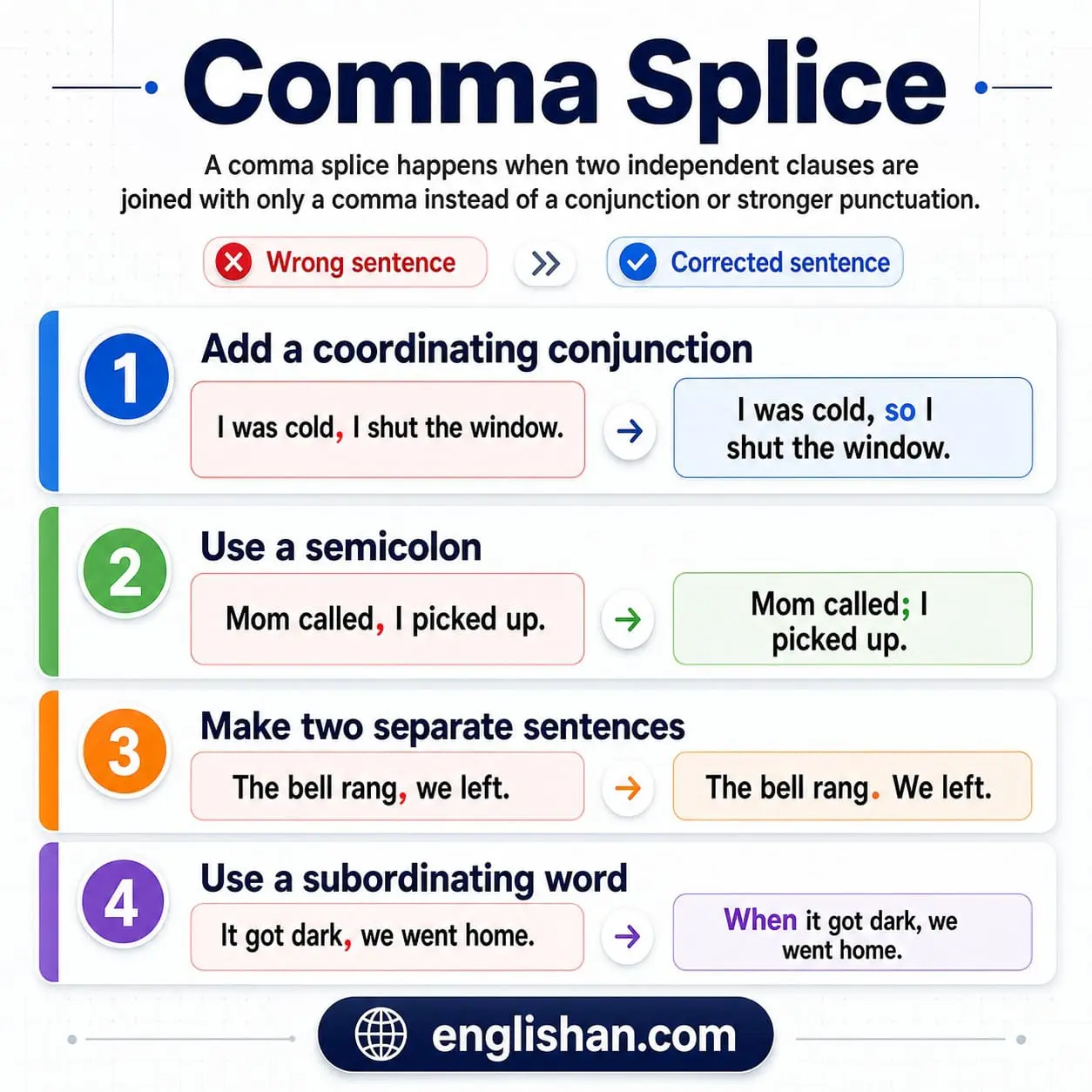
How to Fix a Comma Splice
A comma splice occurs when two complete sentences are joined only with a comma. It can be corrected by properly connecting the ideas or separating them to ensure grammatical accuracy and clarity.
Method 3: Use a Semicolon
A semicolon is used to join two closely related independent clauses without using a conjunction. It maintains a strong connection between ideas while ensuring correct punctuation.
❌ Incorrect: She was tired, she kept working.
✔ Correct: She was tired; she kept working.
This is correct because the semicolon properly connects two related complete thoughts without relying on a comma.
Method 2: Add a Coordinating Conjunction
One effective way to fix a comma splice is by adding a coordinating conjunction such as and, but, so, or. These words clearly connect two independent clauses and indicate the logical relationship between them, such as contrast, addition, or result.
❌ Incorrect: I wanted to go out, it was raining.
✔ Correct: I wanted to go out, but it was raining.
This correction works because the conjunction “but” properly links the contrasting ideas and removes the comma splice error.
Method 3: Make Separate Sentences
Another simple method is to separate the two independent clauses into distinct sentences. This approach improves clarity and avoids any punctuation confusion.
❌ Incorrect: He studied hard, he passed the exam.
✔Correct: He studied hard. He passed the exam.
So, a comma splice occurs when two complete sentences are joined only with a comma. It can easily be corrected by adding a suitable linking word, using proper punctuation like a semicolon, or separating the sentences. Understanding these simple fixes helps make writing clearer, more accurate, and easier to read.
Examples of Comma Splices (With Corrections)
Below are clear examples showing both incorrect and corrected versions. Each incorrect sentence contains a comma splice, where two complete sentences are joined only with a comma.
- ❌ Incorrect: I enjoy music, I listen to it every day.
- ✔ Correct: I enjoy music, and I listen to it every day.
This is a comma splice because two complete sentences are joined only with a comma. Adding “and” correctly connects both ideas.
- ❌ Incorrect: The sun was shining brightly, we went for a picnic.
- ✔ Correct: The sun was shining brightly, so we went for a picnic.
This is incorrect because the comma does not properly show the cause-and-effect relationship. “So” fixes the structure.
- ❌ Incorrect: She loves reading novels, she rarely has time for it.
- ✔ Correct: She loves reading novels, but she rarely has time for it.
This is a comma splice because both parts are independent sentences. “But” correctly shows contrast between the ideas.
- ❌ Incorrect: The teacher entered the class, the students became quiet.
- ✔ Correct: The teacher entered the class. The students became quiet.
This correction separates the two complete ideas into proper sentences, removing the comma splice.
- ❌ Incorrect: He finished his homework early, he decided to watch a movie.
- ✔ Correct: He finished his homework early, and he decided to watch a movie.
This is incorrect because only a comma is used between two complete sentences. Adding “and” makes the sentence grammatically correct.
Basically, a comma splice happens when two complete sentences are joined only with a comma. It can be fixed by adding a linking word, using a semicolon, or separating the sentences. These simple changes make writing clearer and more correct.
Are Comma Splices Ever Acceptable?
Comma splices are generally considered incorrect in formal writing, but there are a few situations where they may appear depending on context and style.
In Informal Writing
In informal writing such as messages, social media posts, or quick notes, comma splices are sometimes used. The focus here is more on natural flow and quick expression rather than strict grammar rules.
Example 1: I’m tired, I will sleep now.
Example 2: It is late, I am going home.
Example 3: I finished my work, I am relaxing now.
In informal situations, such sentences may be understood easily, but they are still not grammatically correct in standard writing.
In Creative Writing
In creative writing like stories or dialogue, comma splices can be used intentionally to create rhythm, emotion, or a natural speaking style. Writers may break rules slightly to achieve a specific effect.
Example 1: The wind was strong, the trees were shaking.
Example 2: She opened the door, silence greeted her.
Example 3: The night was dark, everything felt still.
These structures are used for stylistic impact, not formal correctness, and they help create mood or flow in writing.
In Formal Writing
In formal, academic, or professional writing, comma splices should be avoided. They are considered grammatical errors and can affect clarity and credibility.
❌Incorrect: The report is ready, it will be submitted today.
✔ Correct: The report is ready. It will be submitted today.
In formal contexts, correct punctuation is important to maintain clarity, accuracy, and professionalism in writing.
Common Mistakes to Avoid
Understanding comma splices also means avoiding some related writing mistakes that often cause confusion.
Confusing comma splice with run-on sentence
A comma splice and a run-on sentence are not the same. A comma splice uses only a comma to join two complete sentences, while a run-on sentence joins them with no punctuation at all.
Comma splice: I was late, I missed the bus.
Run-on sentence: I was late I missed the bus.
Both need correction, but the type of mistake is different. A comma splice has a comma, while a run-on has no proper punctuation.
Overusing commas
Using too many commas can make sentences confusing and hard to read. Sometimes writers add commas where they are not needed, which breaks the flow of ideas.
❌ Incorrect: She, went to the market, and bought, some fruits.
✔ Correct: She went to the market and bought some fruits.
Correct comma usage keeps writing clear and easy to follow without unnecessary pauses.
Wrong conjunction usage
Using the wrong conjunction can change the meaning of a sentence or make it unclear. The connecting word must match the relationship between the ideas.
❌ Incorrect: He was tired, or he kept working.
✔ Correct: He was tired, but he kept working.
Choosing the correct conjunction helps maintain the right meaning and improves sentence clarity.
Practice Exercises: Comma Splice
Complete the exercises below to test understanding of comma splices. The answers are provided at the bottom.
Exercise 1: Identify the comma splice
Find the sentence that contains a comma splice.
a) I went to the market, I bought some fruits.
b) I went to the market and bought some fruits.
c) I went to the market. I bought some fruits.
Exercise 2: Fix the sentence using a conjunction
Correct the comma splice by adding a suitable linking word.
I was very tired, I went to bed early.
Exercise 3: Fix the sentence using a full stop
Rewrite the sentence correctly by separating it into two sentences.
She finished her homework, she started watching TV.
Exercise 4: Fix the sentence using a semicolon
Correct the comma splice using a semicolon.
It was raining heavily, we stayed inside the house.
Exercise 5: Choose the correct option
Select the correctly written sentence.
a) He studied hard, he passed the exam.
b) He studied hard and he passed the exam.
c) He studied hard. He passed the exam.
Answer Key:
- a) I went to the market, I bought some fruits.
- I was very tired, so I went to bed early.
- She finished her homework. She started watching TV.
- It was raining heavily; we stayed inside the house.
- c) He studied hard. He passed the exam.
Conclusion
As well learned, a comma splice is a common grammar mistake that occurs when two complete sentences are joined only with a comma. It may seem minor, but it can reduce the clarity and correctness of writing.
The good part is that it is easy to fix once recognized. Using a proper conjunction, a semicolon, or separating the sentences can quickly correct the error. With a little practice, writing becomes clearer, more accurate, and more professional.
FAQs
A comma splice error happens when two complete sentences are joined together using only a comma. Since each part can stand alone as a full sentence, a comma alone is not enough to connect them correctly.
In formal, academic, and professional writing, a comma splice is considered incorrect. However, it may sometimes appear in informal writing or creative writing for style or effect, though it is still not grammatically standard.
A comma splice can be fixed in three simple ways: add a coordinating conjunction (and, but, so), use a semicolon, or separate the sentences into two full sentences. These methods make the writing clear and correct.
A comma splice uses a comma to incorrectly join two complete sentences, while a run-on sentence joins them without any punctuation at all. Both are grammatical errors, but the type of mistake is different.
You May Also Like