The semicolon (;) connects two complete sentences into one without a conjunction and without a full stop, while keeping both clauses independent. The result is a sentence that flows tighter than two separate statements but holds a longer pause than a comma would allow. That balance between connection and separation is what makes the semicolon distinct from every other mark in English punctuation.
Most writers avoid the semicolon because it feels uncertain. They default to periods or commas and end up with writing that either chops ideas apart or runs them together incorrectly. But once the logic clicks, the semicolon fits naturally into sentences where two related thoughts belong together but neither depends on the other.
Since the mark follows a small set of specific rules, it is easier to learn than most writers expect. Here, you’ll go through semicolon placement between independent clauses, correct pairing with conjunctive adverbs like however and therefore, usage in complex lists, and the common errors that lead to comma splices and sentence fragments.
What Is A Semicolon?
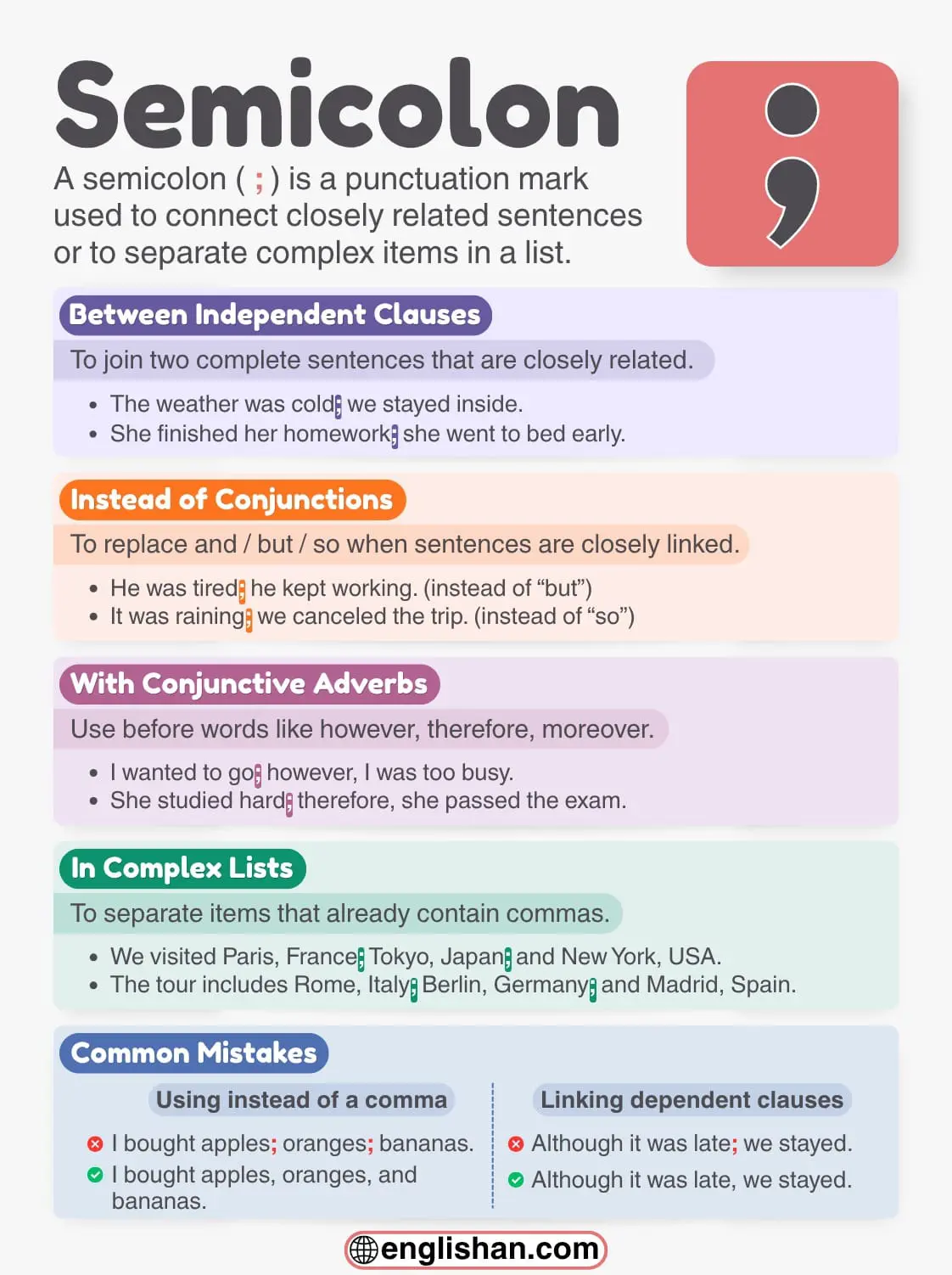
A semicolon (;) is a punctuation mark that connects two independent clauses within a single sentence. An independent clause is a group of words that forms a complete sentence on its own, with its own subject and verb. When two of these clauses share a strong logical relationship, the semicolon holds them together without needing a conjunction like and, but, or so.
- The rain started at noon; the streets were flooded by evening.
- She trained for six months; the marathon still pushed her to her limit.
In both sentences, each half works as a standalone statement. The semicolon signals that these ideas belong together because the second clause follows directly from the first.
The visual design of the mark reflects its function. A semicolon is a period stacked above a comma, and it behaves like a blend of both. It creates a pause stronger than a comma but softer than a period. That middle ground is what makes the semicolon valuable: it keeps related ideas in the same sentence while giving each clause enough space to breathe.
When Do Two Clauses Qualify For A Semicolon?
The phrase “closely related” appears in every semicolon definition, but it rarely gets explained. Two clauses qualify for a semicolon when one of these relationships exists between them:
- Cause and effect: He forgot his umbrella; he arrived at the office soaking wet.
- Contrast: The first half of the film was brilliant; the second half fell apart.
- Continuation: The garden was full of roses; their scent carried across the whole yard.
- Comparison: Her brother prefers fiction; she reads only nonfiction.
The test is straightforward. Read both clauses and ask whether the second one gains meaning from being placed next to the first. If removing either clause would leave the other feeling incomplete in context, the semicolon is the right choice. If the two statements could appear in completely different paragraphs without losing anything, a period works better.
How To Use A Semicolon
The semicolon follows a small set of rules, but each one has a specific structural logic behind it. Knowing why the rule exists makes it far easier to apply in real writing.
Joining Two Independent Clauses
This is the semicolon’s primary job. When two complete sentences share a direct relationship, the semicolon replaces the period and pulls them into one sentence.
- The flight was delayed by three hours; most passengers had already left the terminal.
- She finished the report ahead of schedule; her manager approved it the same afternoon.
- The café was crowded; we decided to try the new place across the street.
Each example follows the same structure: two independent clauses, no conjunction, and a logical link between the ideas. The semicolon tells the reader that these thoughts belong in the same breath.
This rule also replaces the comma + conjunction structure that most writers already know. These two sentences say the same thing:
- The café was crowded, so we decided to try the new place across the street.
- The café was crowded; we decided to try the new place across the street.
The semicolon version drops the conjunction and lets the reader infer the connection. This gives the sentence a slightly more formal, tighter rhythm.
Pairing With Conjunctive Adverbs
When a conjunctive adverb bridges two independent clauses, the semicolon goes before the adverb, and a comma follows it. Conjunctive adverbs are transitional words like however, therefore, moreover, nevertheless, meanwhile, furthermore, consequently, and otherwise.
- The data supported their theory; however, the sample size was too small to confirm it.
- She prepared extensively for the interview; therefore, she felt confident walking in.
- The budget was approved last week; meanwhile, the team had already started hiring.
Without the semicolon, these sentences would create a comma splice, which is one of the most common grammar errors in English. A comma splice happens when two independent clauses are joined by only a comma, without a conjunction strong enough to hold them together.
- ❌ The data supported their theory, however, the sample size was too small.
- ✅ The data supported their theory; however, the sample size was too small.
The semicolon fixes the splice by providing the structural weight that a comma alone cannot deliver. The comma after however is still required because it marks a brief pause before the second clause continues.
Not every sentence with however or therefore requires a semicolon. The semicolon is only necessary when the conjunctive adverb connects two independent clauses. When the adverb appears inside a single clause, commas are enough:
- The results, however, were inconclusive. (one clause, no semicolon)
- The results were promising; however, the timeline was unrealistic. (two clauses, semicolon required)
Separating Items In Complex Lists
When the items in a list already contain commas, semicolons step in as a higher-level separator. Without them, the reader cannot tell where one item ends and the next begins.
- ❌ The committee featured Dr. Hasan, a cardiologist, Fatima Noor, a public health researcher, and Ahmed Raza, a policy advisor.
- ✅ The committee featured Dr. Hasan, a cardiologist; Fatima Noor, a public health researcher; and Ahmed Raza, a policy advisor.
The commas inside each item (separating the name from the role) would blend with the commas between items, creating confusion. The semicolons draw a sharper boundary between each entry, and the list becomes immediately readable.
This rule applies to any list where internal commas exist, whether the items involve names and titles, cities and countries, dates and descriptions, or any other pairing.
- We visited Lahore, Pakistan; Istanbul, Turkey; and Barcelona, Spain.
- The timeline covered January 5, 2022; March 18, 2023; and September 2, 2024.
Semicolons Before Coordinating Conjunctions In Long Sentences
Normally, a semicolon does not pair with coordinating conjunctions (and, but, or, so, yet). A comma before the conjunction is the standard structure. But there is one exception: when the sentence is already dense with commas, a semicolon before the conjunction prevents the reader from losing track of the sentence’s main break.
- The proposal addressed staffing shortages, budget overruns, and scheduling conflicts; but the board, after reviewing all three areas, decided that more data was needed before any vote.
The semicolon before but marks the sentence’s central division. Without it, the reader would struggle to identify where the first clause ends and the second begins, because commas are already doing so much work inside each half.
This usage is less common and belongs in longer, more formal writing. In shorter sentences, a comma before but or and is always sufficient.
Semicolon Vs Comma Vs Colon Vs Period
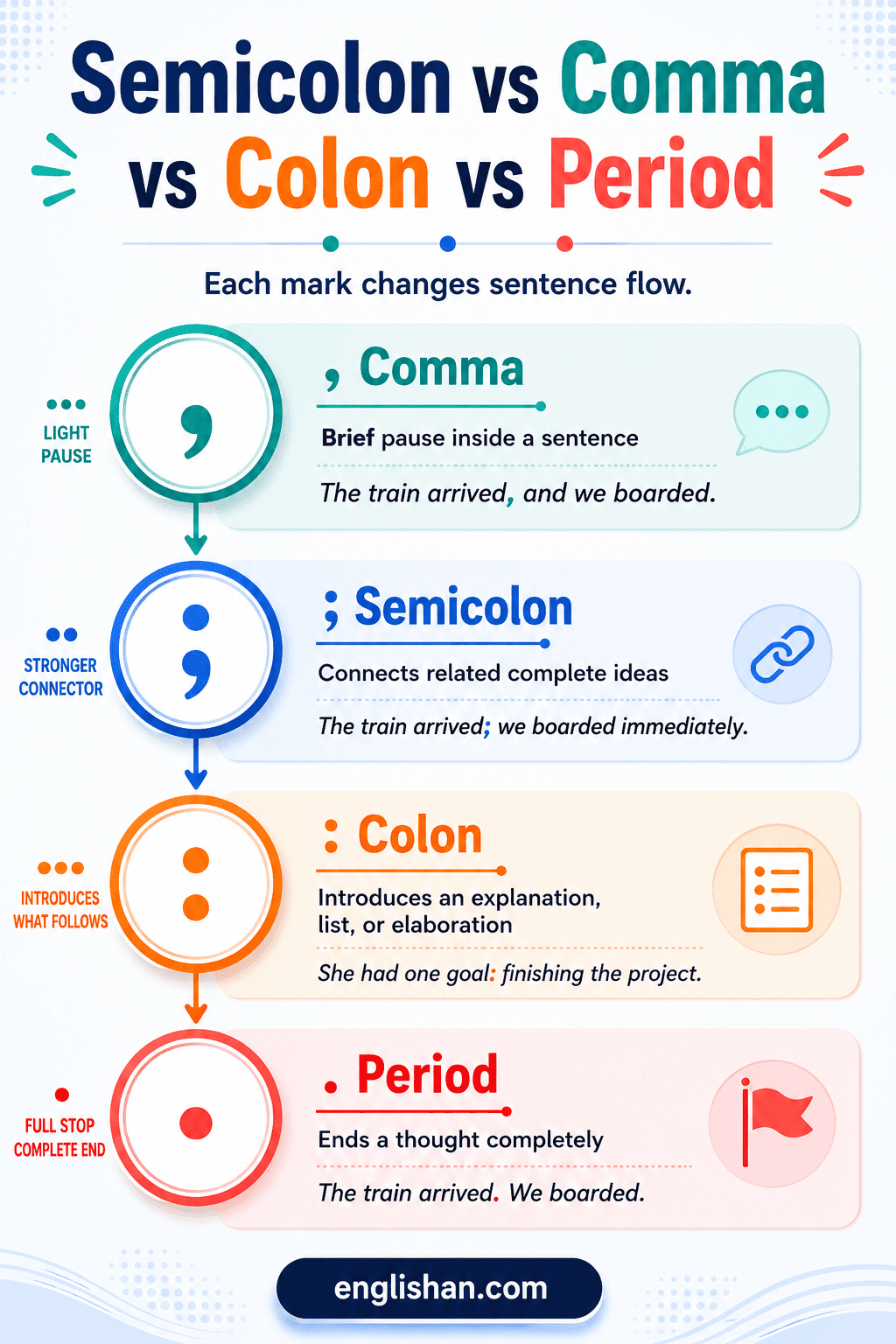
Each of these four marks ends or divides a sentence, but the effect on the reader is different every time. Choosing the right one depends on the relationship between the ideas and the strength of pause you want.
| Mark | Name | What It Does | Example |
|---|---|---|---|
| , | Comma | Pauses briefly inside a sentence | The train arrived, and we boarded. |
| ; | Semicolon | Connects two related independent clauses | The train arrived; we boarded immediately. |
| : | Colon | Introduces an explanation, list, or elaboration | She had one goal: finishing the project. |
| . | Period | Ends a sentence completely | The train arrived. We boarded. |
Semicolon Vs Period
Both the semicolon and the period separate independent clauses. The difference is the signal they send to the reader.
A period tells the reader that one idea has finished and a fresh one begins. The pause is complete, and the two sentences stand independently.
A semicolon tells the reader that the next idea follows directly from the one before it. The pause is shorter, and the connection between the clauses is deliberate.
- We finished our work. We went home. (two separate moments)
- We finished our work; we went home. (the second action follows from the first)
The period version treats each statement as its own event. The semicolon version tells the reader that going home was the direct result of finishing work. The difference is subtle, but in polished writing, that subtlety shapes how the reader processes the sentence.
Semicolon Vs Colon
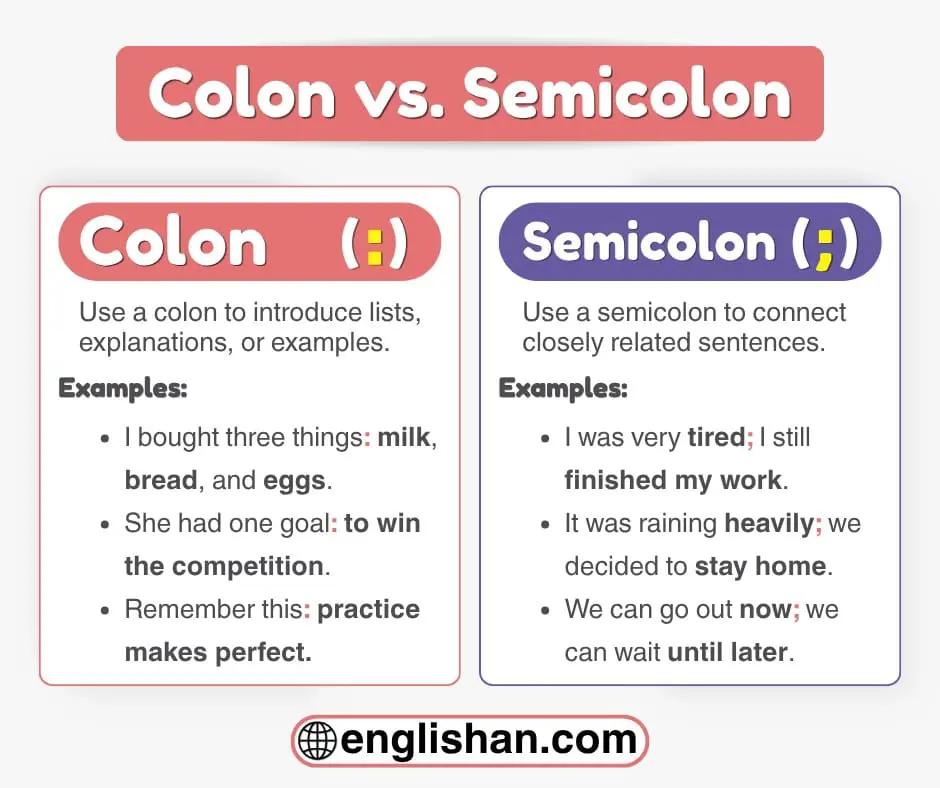
A colon points forward. It tells the reader that what comes next will explain, define, or expand on what came before. The first part sets up a promise, and the second part delivers it.
A semicolon connects sideways. Both clauses carry equal grammatical weight, and neither one explains the other. They are parallel, not hierarchical.
- She had one goal: finishing the race before sunset. (the colon introduces the goal)
- She trained every morning; the race was only two weeks away. (the semicolon connects two parallel facts)
One of the most common punctuation errors is using a semicolon where a colon belongs:
- ❌ He wanted one thing; success.
- ✅ He wanted one thing: success.
The word success is not an independent clause. It explains “one thing,” which makes the colon the correct mark. The semicolon requires a full clause on both sides.
Semicolon Vs Comma
A comma creates a brief pause, but it cannot connect two independent clauses on its own. When a writer uses a comma to join two complete sentences without a conjunction, the result is a comma splice, which is one of the most frequent grammar mistakes in English writing.
- ❌ The coffee was cold, I ordered another one. (comma splice)
- ✅ The coffee was cold; I ordered another one. (semicolon)
- ✅ The coffee was cold, so I ordered another one. (comma + conjunction)
The comma is too weak to hold two independent clauses together by itself. The semicolon has the structural strength to do it, which is exactly why it exists.
Capitalization After A Semicolon
The word after a semicolon does not start with a capital letter unless it is a proper noun. The semicolon connects two parts of the same sentence, so standard lowercase continues after the mark.
- ✅ We arrived early; the doors were still locked.
- ❌ We arrived early; The doors were still locked.
- ✅ The conference was held in Karachi; Lahore hosted the follow-up event.
In the third example, Lahore is capitalized because it is a proper noun, not because of the semicolon. The rule itself stays consistent: treat everything after the semicolon as a continuation of the same sentence.
Semicolons With Quotation Marks
The semicolon goes outside closing quotation marks. This is the opposite of how commas and periods behave in American English, and it catches many writers off guard.
- ✅ He described the project as “ambitious”; the investors were not convinced.
- ❌ He described the project as “ambitious;” the investors were not convinced.
The semicolon belongs to the larger sentence structure, not to the quoted word. Placing it inside the quotation marks would suggest that the quoted material itself contained the semicolon, which changes the meaning.
This rule applies in both American and British English. Unlike commas and periods, which American English places inside quotation marks by convention, semicolons always go outside.
Common Semicolon Mistakes
Using A Semicolon With A Dependent Clause
A semicolon requires independent clauses on both sides. A dependent clause, one that begins with words like although, because, when, if, or since, cannot stand alone as a sentence and does not qualify.
- ❌ Although she studied hard; she didn’t pass the exam.
- ✅ Although she studied hard, she didn’t pass the exam.
- ❌ We stayed inside; because it was raining.
- ✅ We stayed inside because it was raining.
The test is the same one used for independent clauses: take each side of the semicolon and ask whether it works as a complete sentence on its own. Although she studied hard fails that test, so a comma is the correct mark.
Using A Semicolon With A Coordinating Conjunction
In standard sentences, the semicolon replaces the conjunction. Using both together doubles the connection and creates an error.
- ❌ We went home; and we slept early.
- ✅ We went home, and we slept early.
- ✅ We went home; we slept early.
Choose one or the other. The only exception is the long-sentence rule discussed earlier, where the sentence is already heavy with commas and the semicolon before the conjunction prevents confusion.
Writing A Comma Splice Instead Of Using A Semicolon
A comma splice joins two independent clauses with only a comma. It is one of the most common errors in English writing, and the semicolon is one of the cleanest ways to fix it.
- ❌ She was exhausted, she kept working. (comma splice)
- ✅ She was exhausted; she kept working. (semicolon)
- ✅ She was exhausted, but she kept working. (comma + conjunction)
The comma alone does not have the grammatical authority to hold two independent clauses together. The semicolon does, and swapping in the correct mark eliminates the splice instantly.
Overusing Semicolons
Too many semicolons in a single paragraph make the writing feel heavy and overly formal. The mark works best when it appears once or twice in a passage, giving those moments a tighter connection than the surrounding sentences.
- ❌ The weather was warm; we went outside; the kids played in the garden; we stayed until dark.
- ✅ The weather was warm, so we went outside. The kids played in the garden; we stayed until dark.
The corrected version reserves the semicolon for the one connection that benefits from it and uses commas and periods for the rest. The result reads smoother and gives the semicolon more impact where it appears.
Semicolon Examples Across Different Uses
| Use | Example |
|---|---|
| Independent clauses | The library was quiet; she found a seat near the window. |
| Cause and effect | He skipped breakfast; his energy dropped by midmorning. |
| Contrast | The first draft was rough; the final version read beautifully. |
| With however | The evidence was strong; however, the jury remained divided. |
| With therefore | Demand increased sharply; therefore, prices followed. |
| With meanwhile | The team worked on the proposal; meanwhile, the client revised the brief. |
| Complex list (cities) | We traveled to Rome, Italy; Kyoto, Japan; and Lima, Peru. |
| Complex list (people) | The panel featured Sara, a journalist; Omar, an economist; and Leila, a historian. |
| Fixing a comma splice | She called twice, no one answered. → She called twice; no one answered. |
| Long sentence with conjunction | The report addressed cost, timeline, and staffing; but the committee, after a long debate, requested more data. |
Final Thought
The semicolon is a precision mark. It does not end a sentence like a period, and it does not pause inside one like a comma. It occupies the space between those two, connecting ideas that are independent in structure but linked in meaning.
The fastest way to build confidence with the semicolon is to start with the independent clause rule. Write two sentences that clearly relate to each other, remove the period, and place a semicolon between them. Once that feels natural, the conjunctive adverb rule and the complex list rule follow with very little effort. Every other semicolon situation is a variation of these three core uses.
FAQs
A semicolon connects two independent clauses that share a direct relationship, such as cause and effect, contrast, or continuation. It also separates items in complex lists where the items themselves contain commas. The mark creates a pause stronger than a comma but shorter than a period.
A comma splice happens when two complete sentences are joined with only a comma: She was late, she missed the train. The comma is not strong enough to hold two independent clauses together. Replacing it with a semicolon fixes the error instantly: She was late; she missed the train.
No. The word after a semicolon starts with a lowercase letter because the semicolon continues the same sentence. The only exception is proper nouns, which always take a capital letter regardless of their position.
A semicolon connects two independent clauses of equal weight. A colon introduces something: an explanation, a list, or an elaboration of what came before. He had one goal: winning. (colon) vs. He trained every day; the competition was fierce. (semicolon).
In standard sentences, no. The semicolon replaces the conjunction, so using both together is redundant. The one exception is long, comma-heavy sentences where a semicolon before the conjunction marks the sentence’s main structural break more clearly than a comma would.
No. Both sides of the semicolon must be independent clauses, meaning each one works as a complete sentence on its own. Although she tried; she failed is incorrect because although she tried is a dependent clause. The correct mark is a comma: Although she tried, she failed.
There is no strict limit, but restraint produces better writing. One or two semicolons per paragraph is usually enough. Stacking three or more in a single passage makes the rhythm feel heavy and can exhaust the reader. Reserve the semicolon for the connection that benefits most from it, and let commas and periods handle the rest.