

Punctuation can feel confusing sometimes, especially when two marks seem to do almost the same job. That’s exactly the case with the semicolon and the colon. Many people mix them up or avoid using them altogether because they’re not sure where each one fits. But once you understand their purpose, they actually become very useful for making your writing clearer and more polished.
In this article, we’ll explore the differences between a semicolon and a colon in a simple, easy-to-follow way. You’ll learn the basic rules, when to use each one, and see clear examples that make everything click. By the end, you’ll feel more confident using both in your everyday writing.
Colon vs. Semicolon: What’s the Difference?
A colon (:) and a semicolon (;) may look similar, but they serve different purposes in writing. Understanding the distinction is less about memorizing rules and more about recognizing how ideas connect within a sentence. Both marks help organize thoughts, but they do so in slightly different ways.
A colon (:) is used when you want to introduce or explain something that comes after it. It often leads into a list, an explanation, a quotation, or an example.
Example 1: She packed everything for the trip: clothes, books, and a camera.
Example 2: There is one thing I hate most about winter: the freezing mornings.
Example 3: He made a promise: he would never give up.
A semicolon (;), on the other hand, connects two closely related independent clauses. These are complete sentences that are linked in meaning, but instead of using a conjunction like “and” or “but,” the semicolon joins them in a smoother way.
Example 1: I wanted to go for a walk; it started raining heavily.
Example 2: She loves reading novels; her brother prefers watching movies.
Example 3: The meeting was long; however, it was very productive.
In simple terms, a colon introduces information, while a semicolon connects related ideas. If you’re adding details or explaining something, use a colon. If you’re joining two related sentences without a conjunction, a semicolon is the right choice.
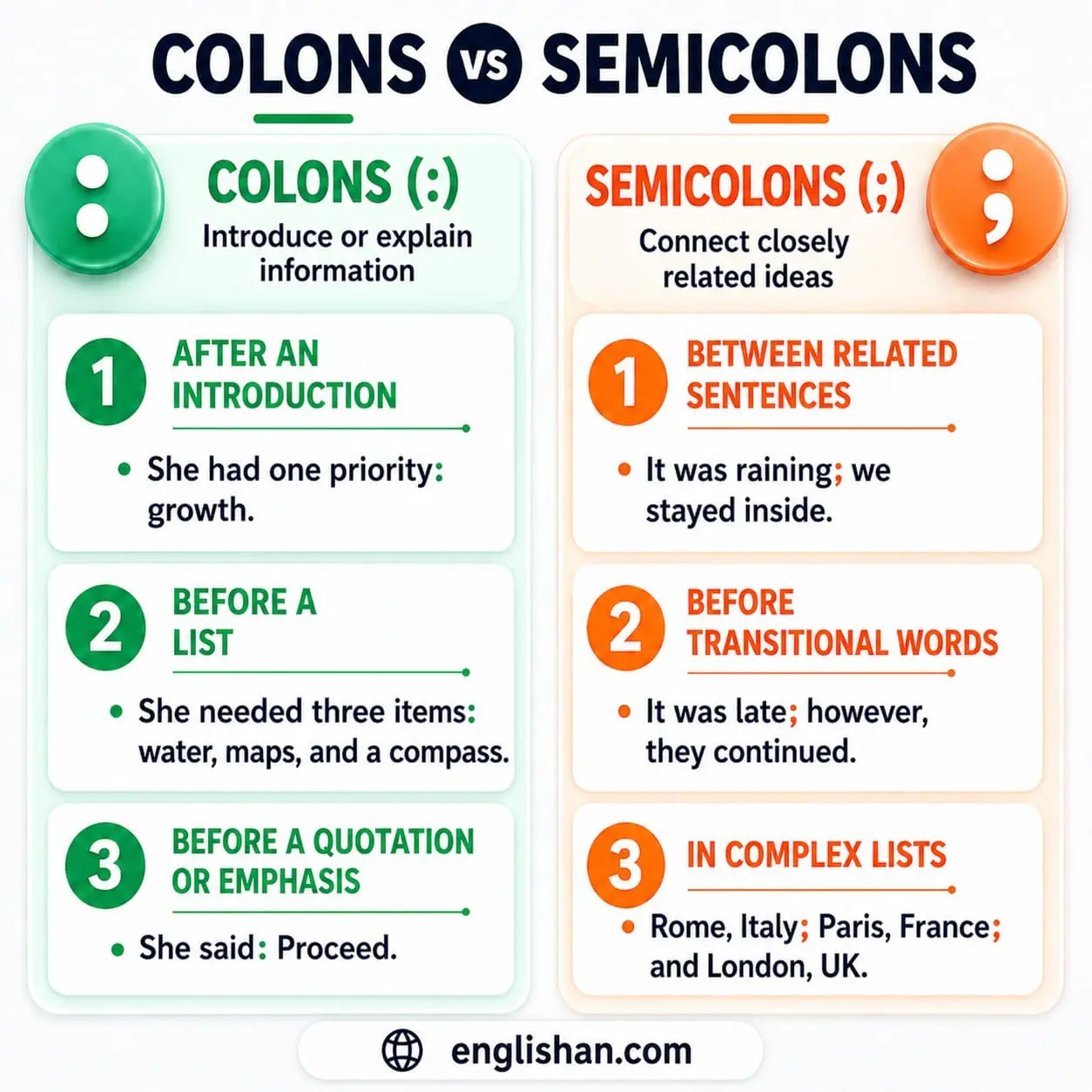
When to Use a Colon (:)
A colon is used to introduce, explain, or emphasize information that directly relates to the main clause. It signals that additional details are coming, usually in the form of a list, explanation, or key idea. The important rule is that the statement before the colon must be a complete sentence.
To Introduce a List
A colon is commonly used before listing items when the first part of the sentence is complete and sets up what follows.
Example: The student brought everything required for the exam: pens, pencils, erasers, and a ruler.
In this example, the first part forms a complete idea, and the colon introduces the items that complete the meaning.
To Introduce an Explanation or Clarification
A colon can also be used when the second part explains or expands the meaning of the first part. It helps connect a general idea with a specific explanation.
Example: Hard work leads to success: consistent effort creates long-term results.
Here, the second part explains the reason behind the first statement.
To Emphasize an Important Idea
A colon is effective when highlighting an important message or conclusion. It draws attention to what follows and gives it more impact.
Example: There is one important rule in learning: practice every day.
The statement after the colon carries the main emphasis of the sentence.
Capitalization After a Colon
Capitalization after a colon depends on the structure of what follows:
- If a complete sentence follows, capitalization is optional but often used in formal writing.
- If a list or phrase follows, lowercase is typically used.
Examples:
- Complete sentence: There was a clear reason for the delay: The weather conditions were severe.
- List: The requirements include: notebooks, folders, and pens.
When to Use a Semicolon (;)
A semicolon is used when two ideas are closely connected but could also stand as complete sentences on their own. Instead of separating them fully with a period, the semicolon creates a stronger, smoother link between the ideas. It sits between a comma and a full stop in strength, helping writing feel more connected and natural.
To Join Closely Related Independent Clauses
A semicolon is used when two complete sentences are closely related in meaning and do not need a full stop between them. It shows a clear connection between the ideas without breaking the flow completely.
Example: The weather was extremely cold; we decided to stay indoors.
Both parts could stand alone as separate sentences, but the semicolon connects them to show they are part of the same situation.
Before Conjunctive Adverbs (however, therefore, etc.)
A semicolon is also used before words like however, therefore, moreover, consequently, and similar linking words when they connect two independent clauses. These words act like bridges between ideas, and the semicolon supports that connection.
Example: The team worked hard for weeks; however, the results were not as expected.
Here, the semicolon connects the two ideas, and the conjunctive adverb shows contrast. Without the semicolon, the sentence would feel incomplete or incorrectly joined.
In Complex Lists
When items in a list already contain commas, semicolons are used to avoid confusion and keep the sentence clear. This helps the reader separate each item properly without mixing parts together.
Example: The meeting included participants from Lahore, Pakistan; Delhi, India; and Dubai, UAE.
Each item already has internal punctuation (city and country), so semicolons are used to clearly separate the groups.
Colon vs. Semicolon Before a List
When it comes to introducing a list, colon and semicolon do very different jobs, and mixing them up is one of the most common punctuation mistakes. The key difference is simple: a colon is used to introduce a list, while a semicolon is used inside a complex list to keep items clear and separated.
Use Colon Before a List
A colon is used when a complete sentence comes before the list. It acts as a signal that details or examples are about to follow. The structure feels natural because the first part introduces an idea, and the list completes it.
Example: The bakery offers several types of bread: white bread, brown bread, and whole grain bread.
Here, the sentence before the colon is complete. The colon simply introduces what is included in the category. A useful way to think about it is: the colon is saying “here are the details.”
Use Semicolon in a List
A semicolon is not normally used to introduce a simple list. Instead, it is used when the items in the list are long or already contain commas, which can make the sentence confusing if only commas are used.
Example: The tour includes visits to Paris, France; Rome, Italy; and Athens, Greece.
Each item already has a comma inside it (city and country), so semicolons are used to clearly separate the groups. In this case, the semicolon acts like a stronger separator, making sure each item stays distinct and readable.
Quick Tip to Remember the Difference
A quick and practical way to remember the difference is to focus on how each punctuation mark behaves in a sentence:
- Colon (:) → Think “introduce”
Used when the sentence is leading into something such as a list, explanation, or important idea. It feels like the sentence is pointing forward.- Example: She had one dream: to travel the world.
- Semicolon (;) → Think “connect”
Used to link two complete and closely related ideas. Both parts can stand alone, but they are kept together for smooth flow.- Example: She wanted to travel the world; she started saving money.
- Simple memory line:
A colon introduces what comes next, while a semicolon connects what already exists.
This small distinction is enough to make the correct choice in most sentences without confusion.
Common Mistakes to Avoid
Colon and semicolon are simple once understood, but a few common mistakes tend to create confusion. These usually happen when the structure of the sentence is not considered carefully.
Using a Colon After an Incomplete Sentence
One of the most frequent errors is placing a colon after a sentence that is not complete. A colon should only come after a full idea. If the sentence feels unfinished before the colon, it is not being used correctly.
Incorrect: She bought: apples, bananas, and oranges.
Correct: She bought the following items: apples, bananas, and oranges.
The corrected version works because the first part forms a complete thought before introducing the list.
Using a Semicolon Instead of a Comma
A semicolon is sometimes used where only a comma is needed. This usually happens when the sentence does not contain two complete ideas.
Incorrect: She likes tea; and coffee.
Correct: She likes tea and coffee.
A semicolon should only be used when both sides can stand as independent sentences.
Confusing Colon and Semicolon Before a List
Another common mistake is using a semicolon to introduce a simple list. A semicolon is not meant for that purpose.
Incorrect: He needs the following items; a pen, a notebook, and a bag.
Correct: He needs the following items: a pen, a notebook, and a bag.
A colon is the correct choice because it introduces the list.
Incorrect Capitalization After a Colon
Writers often get confused about whether to capitalize after a colon. While capitalization is sometimes flexible, using it randomly can make writing look inconsistent.
- Capitalize when a full sentence follows (especially in formal writing).
- Do not capitalize when introducing a list or phrase.
Consistency is more important than strict preference.
Practice Exercises: Colon vs. Semicolon
Complete the exercises below to test your understanding. The answers are listed at the bottom.
Exercise 1: Add the correct punctuation (colon or semicolon).
She had everything ready _____ her notes, her laptop, and her presentation slides.
Exercise 2: Fix this sentence. Replace the incorrect punctuation.
He was feeling tired: he decided to take a short break.
Exercise 3: Combine the two sentences using a semicolon.
The exam was difficult. Many students found it challenging.
Exercise 4: Choose the correct mark (colon or semicolon).
There is one important lesson _____ consistency leads to success.
Exercise 5: Fix the mistake.
The trip included visits to three cities: Lahore, Pakistan, Delhi, India, and Dubai, UAE.
Answer Key:
- She had everything ready: her notes, her laptop, and her presentation slides.
- He was feeling tired; he decided to take a short break.
- The exam was difficult; many students found it challenging.
- There is one important lesson: consistency leads to success.
- The trip included visits to three cities: Lahore, Pakistan; Delhi, India; and Dubai, UAE.
Final Thoughts
In the end, the difference between a colon and a semicolon comes down to how ideas are connected in your writing. A colon helps you move forward because it introduces, explains, or highlights what comes next. A semicolon works within the sentence because it connects ideas that are already complete but closely related.
Once you start noticing this pattern, choosing the right punctuation becomes much easier. You do not need to memorize complicated rules. Just ask yourself a simple question: are you introducing something new, or connecting two ideas? The answer will guide your choice.
With regular practice, both marks become useful tools instead of confusing symbols. They improve clarity and make your writing feel more natural, structured, and polished.
FAQs
The main difference lies in purpose. A colon is used to introduce or explain something that follows, such as a list or a key idea. A semicolon connects two complete and closely related sentences. In simple terms, a colon introduces, while a semicolon connects.
A colon is used when the sentence is leading into additional information. This could be a list, an explanation, or a conclusion. It is appropriate when the first part creates an expectation that is completed by what follows.
A semicolon generally does not replace a comma. Commas are used for simpler sentence structures, while semicolons are used for stronger separation between complete ideas. However, semicolons can replace commas in complex lists where clarity is needed.
Capitalization depends on what follows the colon. If a complete sentence comes after it, capitalization is often acceptable. If it introduces a list or phrase, lowercase is usually preferred. Consistency within the writing is important.
A semicolon is stronger than a comma but weaker than a full stop. It creates a clearer separation while still keeping related ideas within the same sentence. This makes writing smoother without breaking the flow completely.
A semicolon is not typically used to introduce a list. A colon is the correct choice for that purpose. Semicolons are only used within a list when the items are complex or already contain commas.
You May Also Like