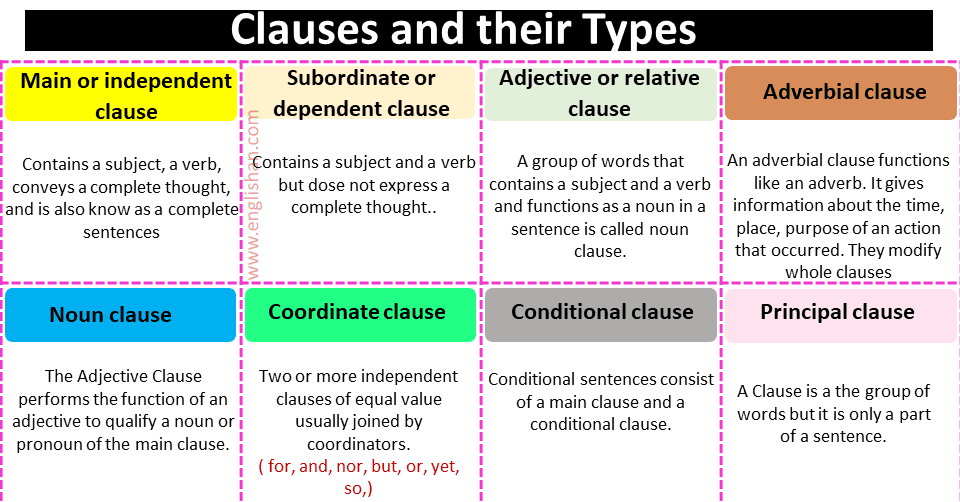
In English grammar, clauses and their types play a key role in sentence formation. A clause is a group of words that contains a subject and a verb. It can express a complete thought or provide additional information. Learning about the different types of clauses, such as independent and dependent clauses, is essential for improving sentence structure and overall communication skills.
What is a clause?
A clause is a combination of related words that contains its own subject and predicate. It may or may not make complete sense. it is usually a part of a large sentence (complex and compound sentence).
For example, she was eating an apple.
In this sentence “she was eating an apple” is a clause because it has the subject she and the verb were eating.
A clause may function as a noun, an adjective, or an adverb. And a clause is different from a phrase because, unlike phrases, a clause must contain a subject and a verb.
Clauses can be either independent or. dependent, but in a sentence that has an independent and a dependent clause, a comma is used to separate the two if the sentence starts with a dependent clause but if a sentence starts with an independent clause, no comma is required.
A clause can stand as a simple sentence, but it cannot always be considered a complete grammatical sentence. Therefore, sentences can consist of one, two, or more clauses.
For example,
- She speaks (One clause sentence)
- He failed because he was careless. (two clauses sentence)
- Although I was sick yesterday, I invited him to dinner and he arrived on time. (three clauses sentence)
Types of clauses
There are different types of clauses such as.
- Main or Independent Clauses
- Subordinate or Dependent Clauses
- Adjective or relative clause
- Adverbial clause
- Noun clause
- Coordinate clause
- Conditional clause
- Principal clause
Independent clause (main clause)
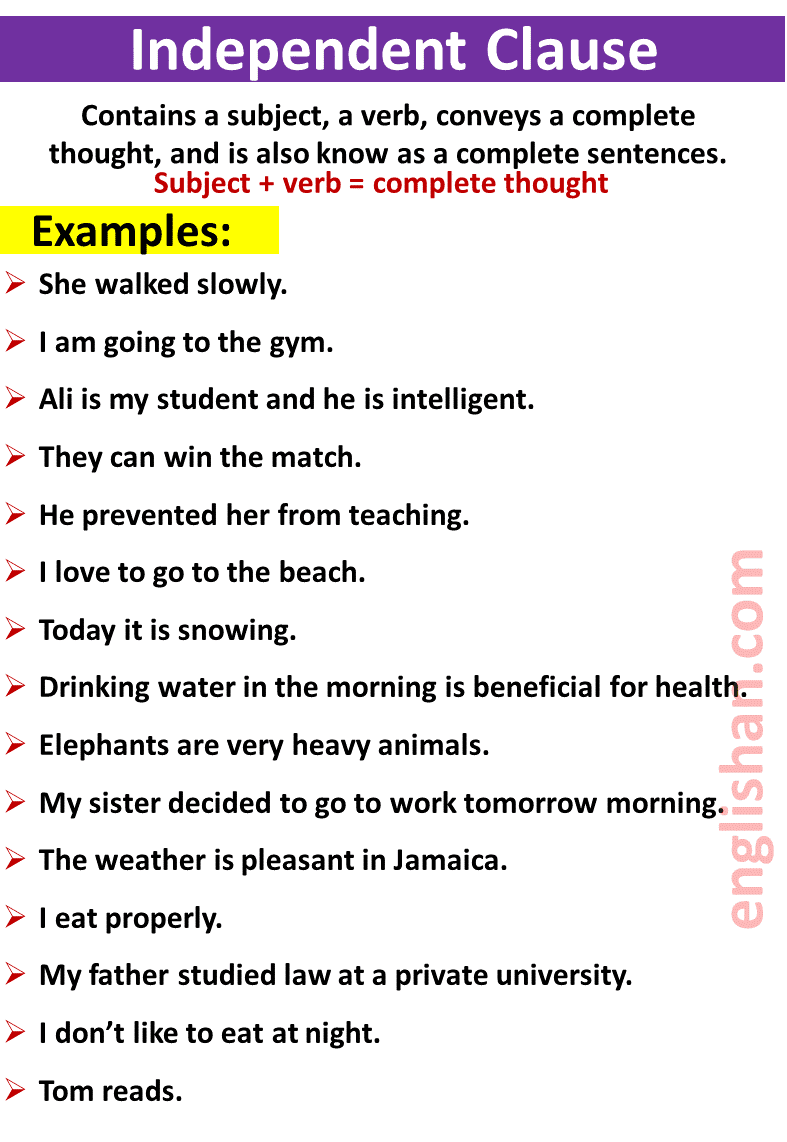
An independent clause can stand alone as a sentence and gives us complete thought. It remains meaningful even if its dependent clause is removed from the sentence. We can combine two independent clauses with a semicolon or with a comma and coordinators. The most used coordinators are often referred to as the FANBOYS ( for, and, nor, but, or, yet so). Every independent clause follows this pattern.
Subject + verb = complete thought
For example,
- She walked
- I am going to the gym.
- Ali is my student and he is
- They can win the match.
- He prevented her from teaching.
- I am preparing for the exam so I will not attend the party.
All these clauses consist of a subject and a verb, and each clause expresses a complete idea.
Dependent clause (subordinate clause)
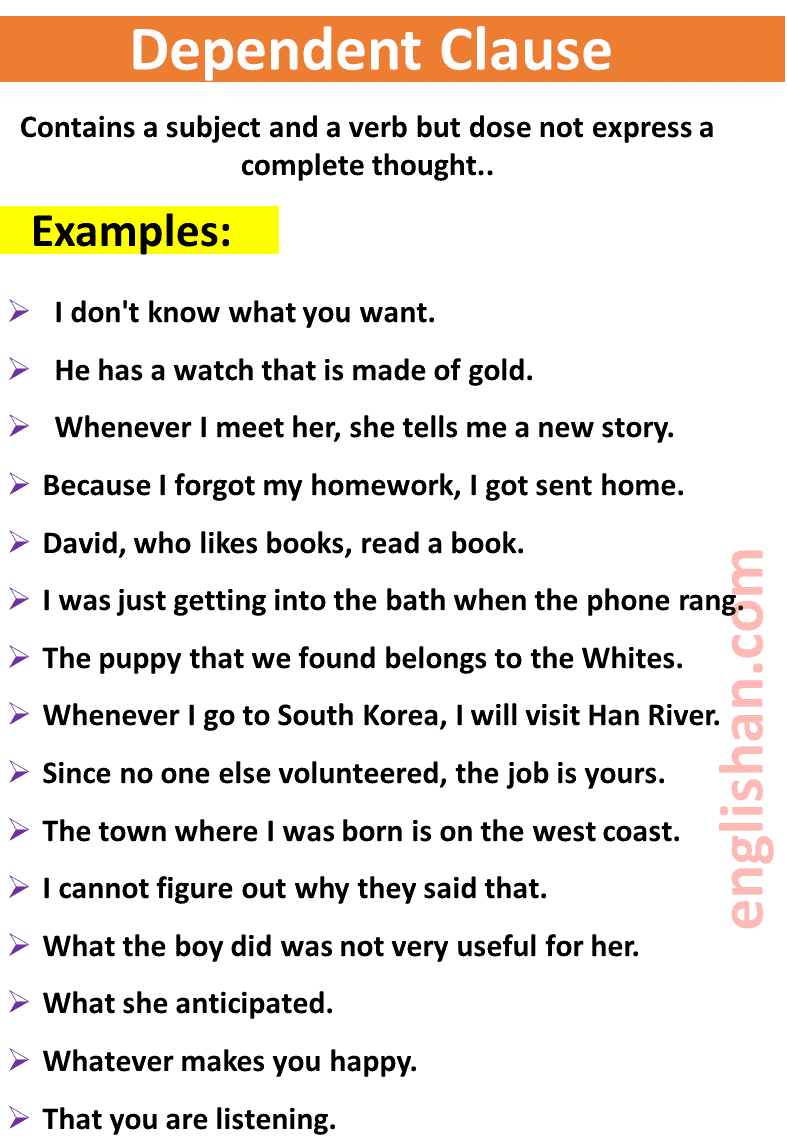
A dependent cannot stand alone as a complete sentence. It cannot convey a complete thought. It becomes meaningful when it is attached to the main clause. A dependent clause may contain a subject and a verb, but it cannot make complete sense.
For example,
- I don’t know what you want.
- He has a watch that is made of gold.
- Whenever I meet her, she tells me a new story.
Dependent clauses are further divided into three types, noun, adjective, and adverb clauses.
Noun clauses
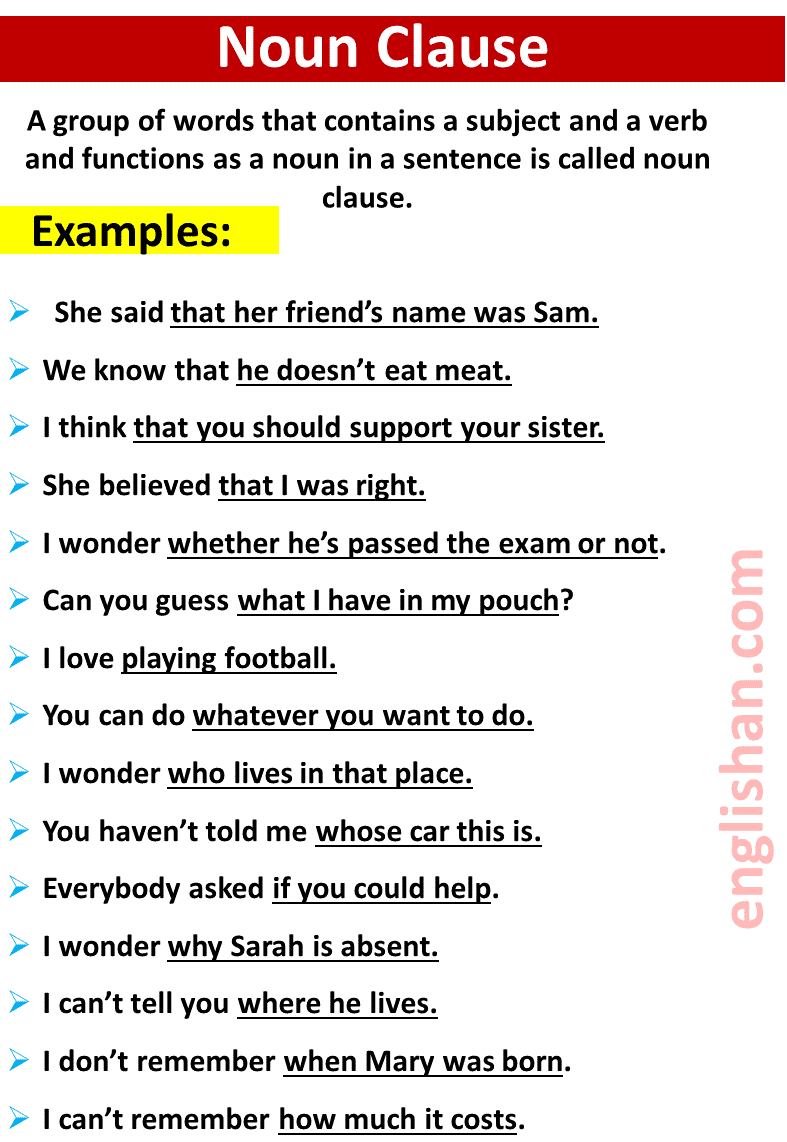
A group of words that contains a subject and a verb and functions as a noun in a sentence is called noun clause. However, it can’t make complete sense.
For example,
- Can you guess what I have in my pouch?
- I love playing football.
- You can do whatever you want to do.
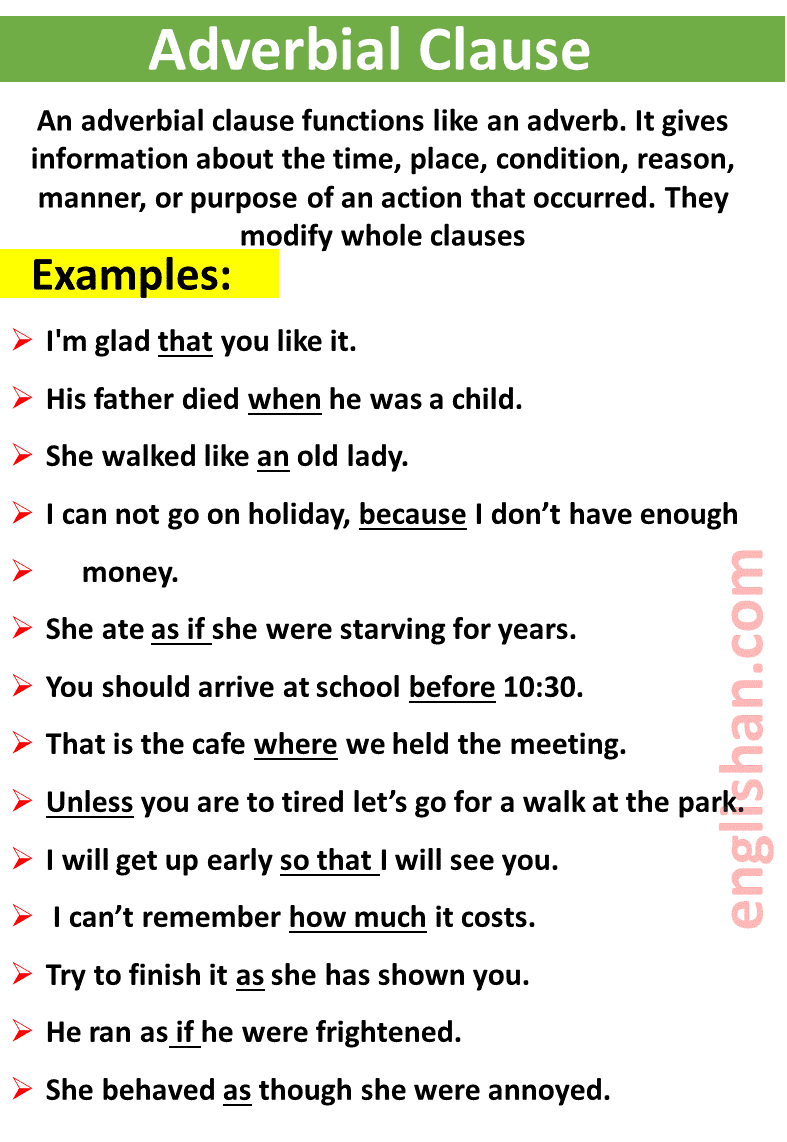
Adverbial clauses
A dependent clause functions as an adverb in a sentence is called an adverbial clause. and It gives us additional information about the verb, an adjective, or another adverb by answering questions like when, why, how, where, etc. However, it can’t make complete sense.
For example,
- I’m glad that you like it.
- His father died when he was a child.
- She walked like an old lady.
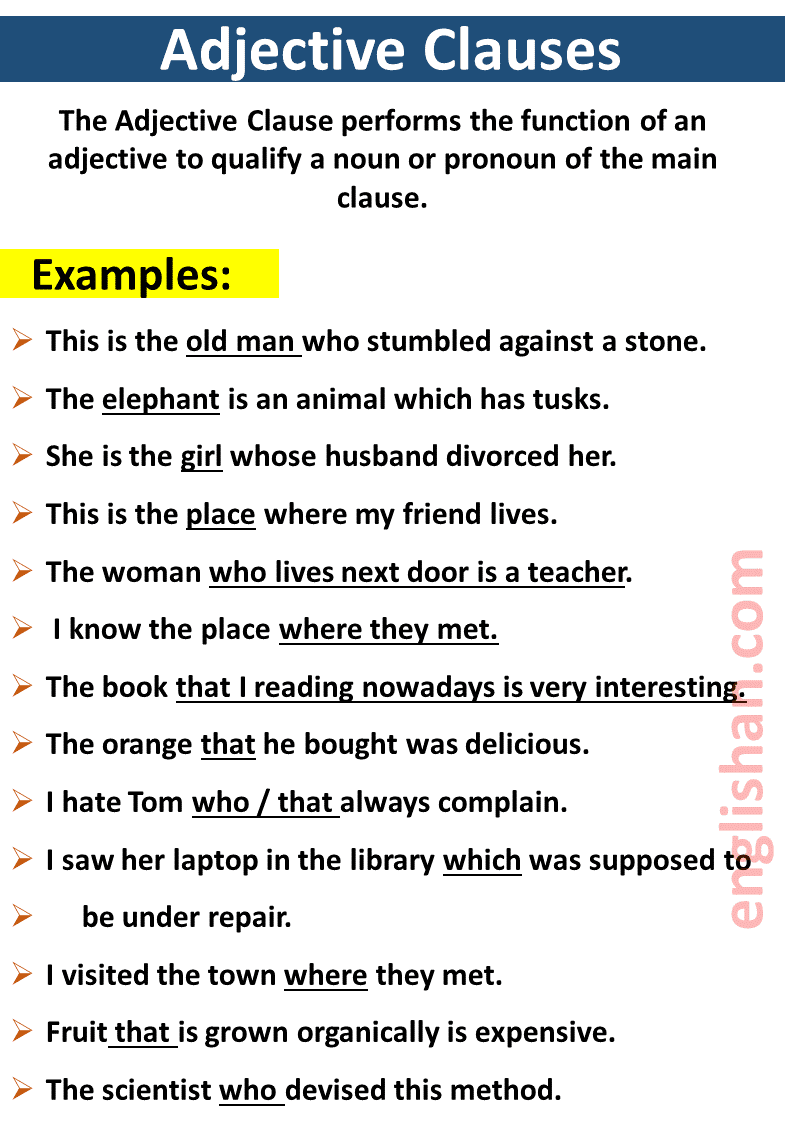
Adjective clauses
A group of words that contains a subject and verb and act as an adjective in a sentence is called adjective clause. However, it can’t make complete sense. Adjective clauses are also called relative clauses. These clauses gives us additional information about the noun in a sentence.
For example,
- The woman who lives next door is a teacher.
- I know the place where they met.
- The book that I reading nowadays is very interesting.
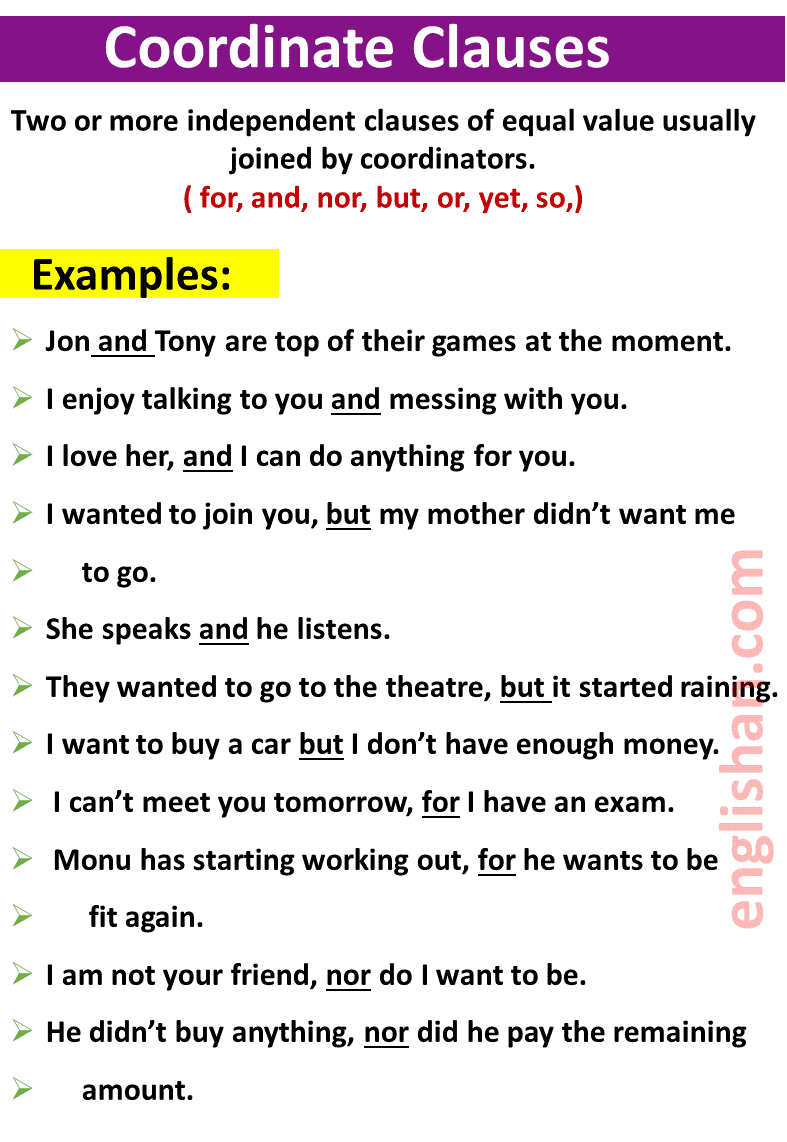
Coordinate clause
Two or more independent clauses of equal value usually joined by coordinators ( for, and, nor, but, or, yet, so,), and when we combine two independent clauses with coordinating conjunctions we get compound sentences.
For example,
- She speaks and he listens.
- They wanted to go to the theatre, but it started raining.
- I want to buy a car but I don’t have enough money.
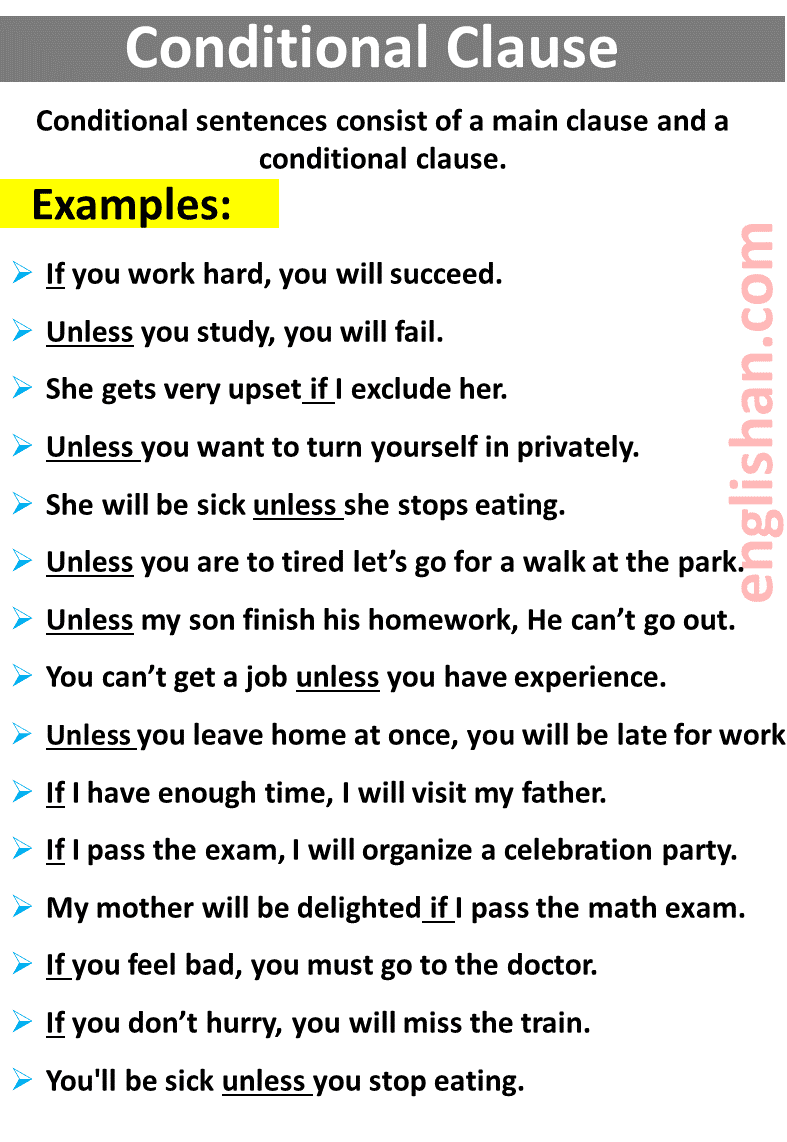
Conditional clauses
The conditional clause usually starts with if and unless (only if, even if, whether, or not) and they cannot stand alone without an independent clause. These clauses state the condition which is required to exist for something to happen.
For example,
- If you work hard, you will succeed.
- Unless you study, you will fail.
- She gets very upset if I exclude her.
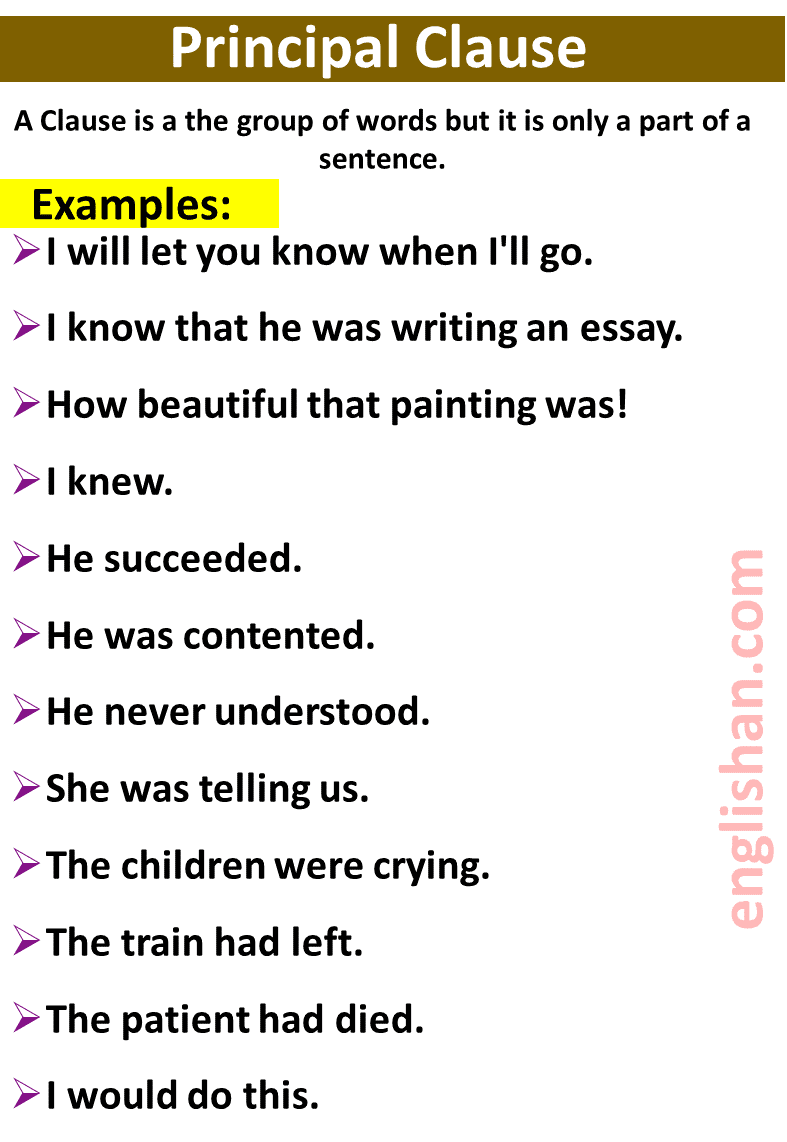
Principal clauses
A principal clause is an independent clause that can exist without a dependent clause. It has a subject and a verb but it doesn’t give complete thought without the principal part of the sentence. Principal clauses are further divided into four types, declarative, interrogative, imperative, and exclamative clauses.
For example,
- I will let you know when I’ll go.
- I know that he was writing an essay.
- How beautiful that painting was!
FAQs
A clause is a group of words with a subject and a verb.
Types of Clauses:
1. Independent Clause: A complete thought that can stand alone as a sentence.
Example: She loves ice cream.
2. Dependent Clause: Incomplete on its own, needs an independent clause.
Example: Because she loves ice cream (needs more to make sense).
There are also types of dependent clauses:
Adjective Clause: Describes a noun. Example: The book that she read was good.
Adverb Clause: Describes a verb, adjective, or adverb. Example: She ran quickly because it was late.
Noun Clause: Acts as a noun. Example: What she said surprised me.
In short, independent clauses are complete, and dependent clauses need more to make sense.
Here are 5 examples of main clauses (also called independent clauses), each expressing a complete thought:
1. She is reading a book.
2. They went to the park.
3. I like to play soccer.
4. He studied for the exam.
5. The sun is shining brightly.
Here are the 4 types of clauses:
1. Independent Clause: A complete sentence.
Example: She smiled.
2. Dependent Clause: Needs more to make sense.
Example: Because she smiled.
3. Adjective Clause: Describes a noun.
Example: The book that you gave me is interesting.
4. Adverb Clause: Describes a verb, adjective, or adverb.
Example: She ran quickly because it was late.
Independent clauses can stand alone, and the others need extra information.
Here are 10 examples of clauses:
1. She went to the store. (Independent Clause)
2. Because he was late. (Dependent Clause)
3. I love ice cream. (Independent Clause)
4. Although it was raining. (Dependent Clause)
5. The dog that is barking. (Adjective Clause)
Read More