


In English grammar, a main clause is a group of words with a subject and a verb that expresses a complete thought. A main clause can be a full sentence on its own, which makes it very important in writing. Learning about main clauses helps you understand how sentences work and makes your writing clear.
Main clauses are key to writing and speaking because they let us communicate complete ideas. They are the building blocks of sentences, making understanding and sharing thoughts easier. Let’s take a closer look at the main clauses and how they work in English.
What Is a Main Clause?
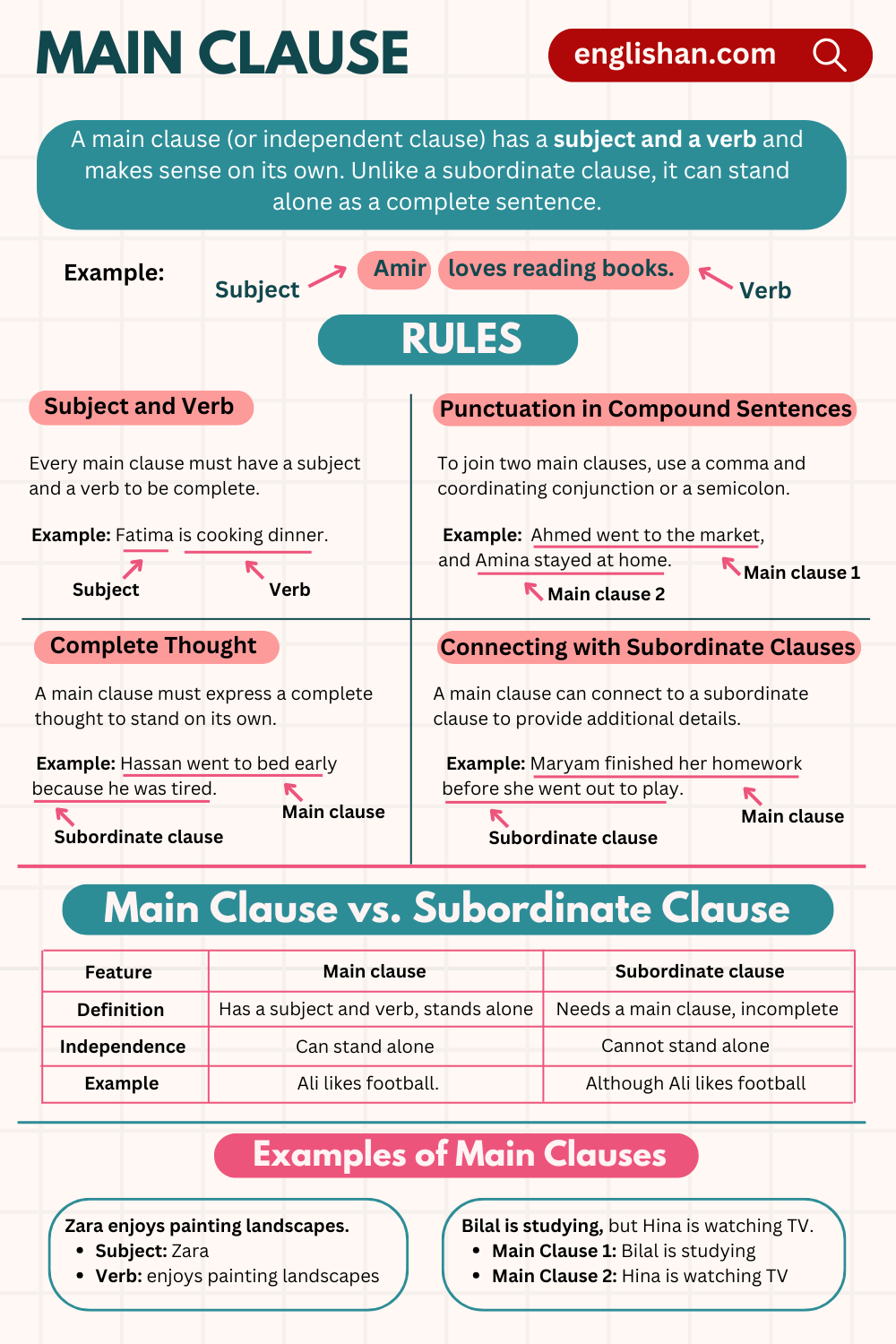
A main clause (also called an independent clause) is a group of words with both a subject and a verb. It expresses a complete idea and makes sense on its own. This is different from a subordinate (or dependent) clause, which needs a main clause to make sense.
For example:
- Amir loves reading books.
In this sentence, “Amir” is the subject, and “loves reading books” is the verb part. This main clause makes a complete statement and can be a full sentence by itself.
Main clauses make up simple sentences. They can also be combined to form compound or complex sentences.
How to Use a Main Clause in a Sentence
Using main clauses correctly is important for making sure your sentences are complete and make sense. Here are some simple rules to help you use main clauses:
- Subject and Verb Requirement: Every main clause must have a subject and a verb. Without these, the clause cannot stand alone.
- Fatima is cooking dinner.
- Punctuation in Compound Sentences: When combining two main clauses, use a comma and a coordinating conjunction (for, and, nor, but, or, yet, so) or a semicolon.
- Ahmed went to the market, and Amina stayed at home.
- Express a Complete Thought: A main clause should always express a complete thought that makes sense by itself. Avoid fragments that are missing important parts.
- Incorrect: ❌ Because Hassan was tired. (This is not complete)
- Correct: ✅ Hassan went to bed early because he was tired.
- Connecting with Subordinate Clauses: A main clause can be connected to one or more subordinate clauses for extra information, but the main clause should be able to stand alone.
- Maryam finished her homework before she went out to play.
Difference between a Main Clause and a Subordinate Clause
It is important to understand the difference between main and subordinate clauses to use them correctly.
| Feature | Main Clause | Subordinate Clause |
|---|---|---|
| Definition | Has a subject and verb and expresses a complete thought. It can stand alone. | Has a subject and verb but does not express a complete thought. It depends on a main clause. |
| Independence | Can stand alone as a complete sentence. | Cannot stand alone, needs a main clause. |
| Example | Ali likes football. | Although Ali likes football |
| Usage | Forms simple, compound, or complex sentences. | Adds extra information to a main clause. |
To make sense, a subordinate clause must be attached to a main clause:
- Ali likes football although it’s raining outside.
Here, “Ali likes football” is the main clause, while “although it’s raining outside” is a subordinate clause that adds more information.
Examples of Main Clauses
Here are some examples of main clauses to help you understand better:
- Zara enjoys painting landscapes.
Zara is the subject, and “enjoys painting landscapes” is the verb part. This is a complete sentence and stands on its own. - Bilal is studying, but Hina is watching TV.
This sentence has two main clauses joined by the word but. Both “Bilal is studying”” and “”Hina is watching TV” can stand alone as complete sentences. - Sarah cooked dinner, and Usman cleaned the dishes.
In this example, “Sarah cooked dinner” and “Usman cleaned the dishes” are both main clauses joined with “and” to make a compound sentence.
FAQs
A main clause is a group of words that has a subject and a verb and expresses a complete thought. It can be a sentence by itself, unlike subordinate clauses which need a main clause.
To find a main clause, look for a subject and a verb that express a complete idea. If it makes sense on its own, it is a main clause.
Yes, a sentence can have more than one main clause. These are called compound sentences, and they are joined by words like “and,” “but,” or “so.”
A main clause can be a complete sentence by itself, but a subordinate clause cannot. Subordinate clauses need to be attached to a main clause for meaning.
Here are some examples of main clause: “Sara loves to play basketball.” This is a main clause because it has a subject (Sara) and a verb (loves) and expresses a complete thought.
You May Also Like
Main Clause Quiz
Main Clause
Which is a main clause?
It holds a subject and verb and states a complete thought.
a main clause stands alone as a full sentence
The rain stopped.
Which part is the main clause?
She smiled because she was happy.
It carries the complete idea and can stand alone.
the main clause carries the complete idea
She smiled.
Which sentence contains two main clauses?
Two independent clauses join with a comma and 'and'.
two main clauses joined by a coordinating conjunction
I cooked dinner, and he washed up.
Which is NOT a main clause?
'Although' makes the clause dependent and incomplete.
a subordinating word makes a clause dependent
He tried hard.
Which joins two main clauses correctly?
A semicolon links two independent clauses.
two main clauses need a semicolon or a conjunction
The sky darkened; rain began to fall.
Which main clause is complete?
The subject 'bridge' pairs with the verb 'collapsed'.
a main clause needs a subject and a finite verb
The old bridge over the river collapsed.
Which group of words is a main clause?
Choose the independent clause.
It carries a subject and verb and stands alone as a complete thought.
a main clause stands alone with subject + verb
We stayed home.
True or false?
A main clause can stand alone as a full sentence.
A main clause holds a subject, a verb, and a complete thought, so it stands alone.
main clause = independent, complete thought
She finished the race.
Find the main clause.
Although she was tired, she finished the race.
This half stands alone as a complete thought — the main clause.
the independent half is the main clause
She finished the race.
Which sentence is a single main clause?
Pick the independent clause.
One subject and verb express a complete thought with no dependent part.
main clause needs no other clause to complete it
The train arrived on time.
Add a main clause to finish the sentence.
When the rain stopped, ___ .
A main clause supplies the independent, complete thought that the 'when' clause depends on.
pair a subordinate clause with a main clause
When the rain stopped, we went outside.
True or false?
'After the movie ended' is a main clause.
'After' opens a subordinate clause; on its own it is a fragment, not a main clause.
subordinators cannot begin a main clause
The movie ended.
Which group of words is a main clause?
Choose the independent clause.
It carries a subject and verb and stands alone as a full thought.
a main clause stands alone with subject + verb
The lights went out.
True or false?
Every complete sentence holds at least one main clause.
A complete sentence needs an independent clause to carry its core thought.
a sentence needs a main clause
Birds sing.
Find the main clause.
If you finish early, call me.
'Call me' stands alone as a command with an understood subject.
the independent half is the main clause
Call me.
Which sentence is a single main clause?
Pick the independent clause.
One subject and verb express a full thought with no dependent part.
a main clause needs no other clause to complete it
Rain fell all night.
Add a main clause to finish the sentence.
Whenever I feel tired, ___ .
A main clause supplies the independent thought the 'whenever' clause depends on.
pair a subordinate clause with a main clause
Whenever I feel tired, I take a walk.
True or false?
'Although he tried hard' is a main clause.
'Although' opens a subordinate clause; on its own it is a fragment.
subordinators cannot begin a main clause
He tried hard.
Find the main clause.
She smiled because she had won.
'She smiled' stands alone as a full thought.
the independent half is the main clause
She smiled.
Which group of words can stand alone?
Choose the independent clause.
It holds a subject and verb and forms a full thought.
a main clause stands alone
We celebrated.
Turn on JavaScript for the interactive quiz. The full practice set is shown above.