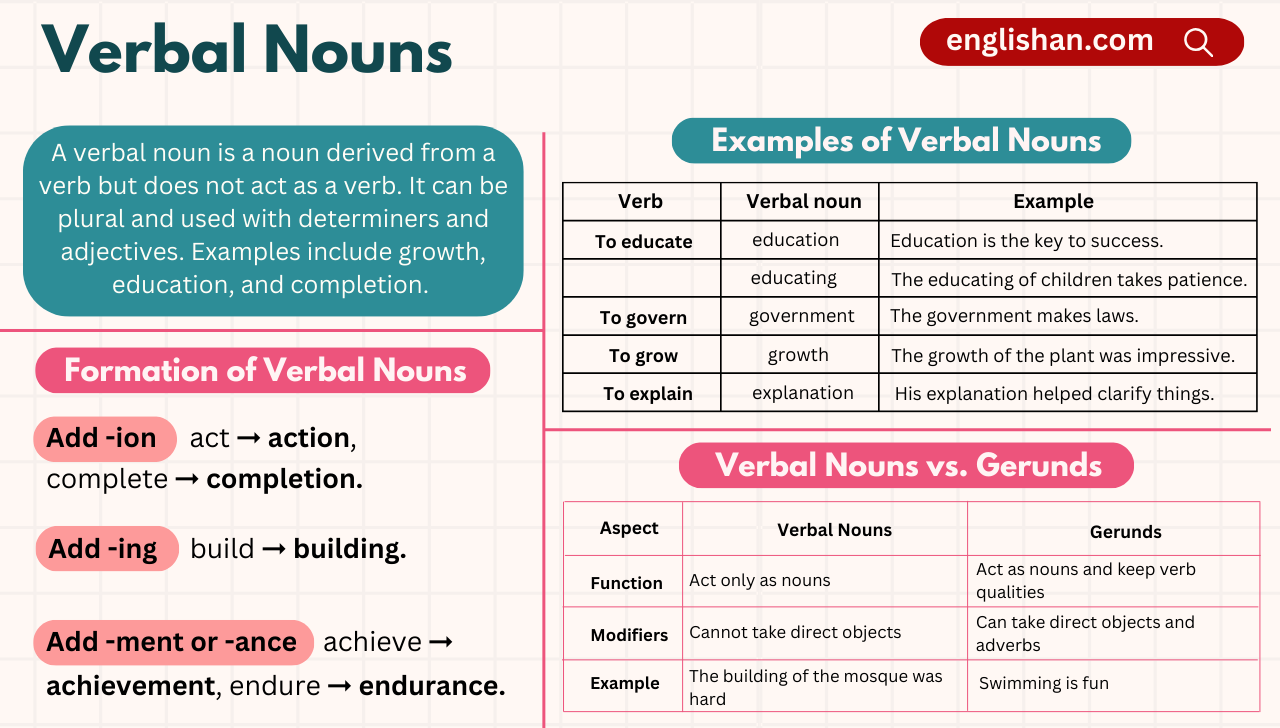
A verbal noun is a noun formed from a verb that behaves as a full noun and shows no verb-like grammatical behavior. It accepts an adjective, allows a plural, and takes a prepositional phrase after it, but never accepts an adverb and never takes a direct object. That is the defining rule. The word comes from a verb, then leaves every trace of verb behavior behind.
Two properties separate a verbal noun from its confusable neighbor, the gerund. When the word takes an adjective and is followed by a prepositional phrase (a careful reading of the report), you have a verbal noun. When it takes an adverb and is followed by a direct object (carefully reading the report), you have a gerund. Every rule further down builds on that split.
What Is a Verbal Noun?
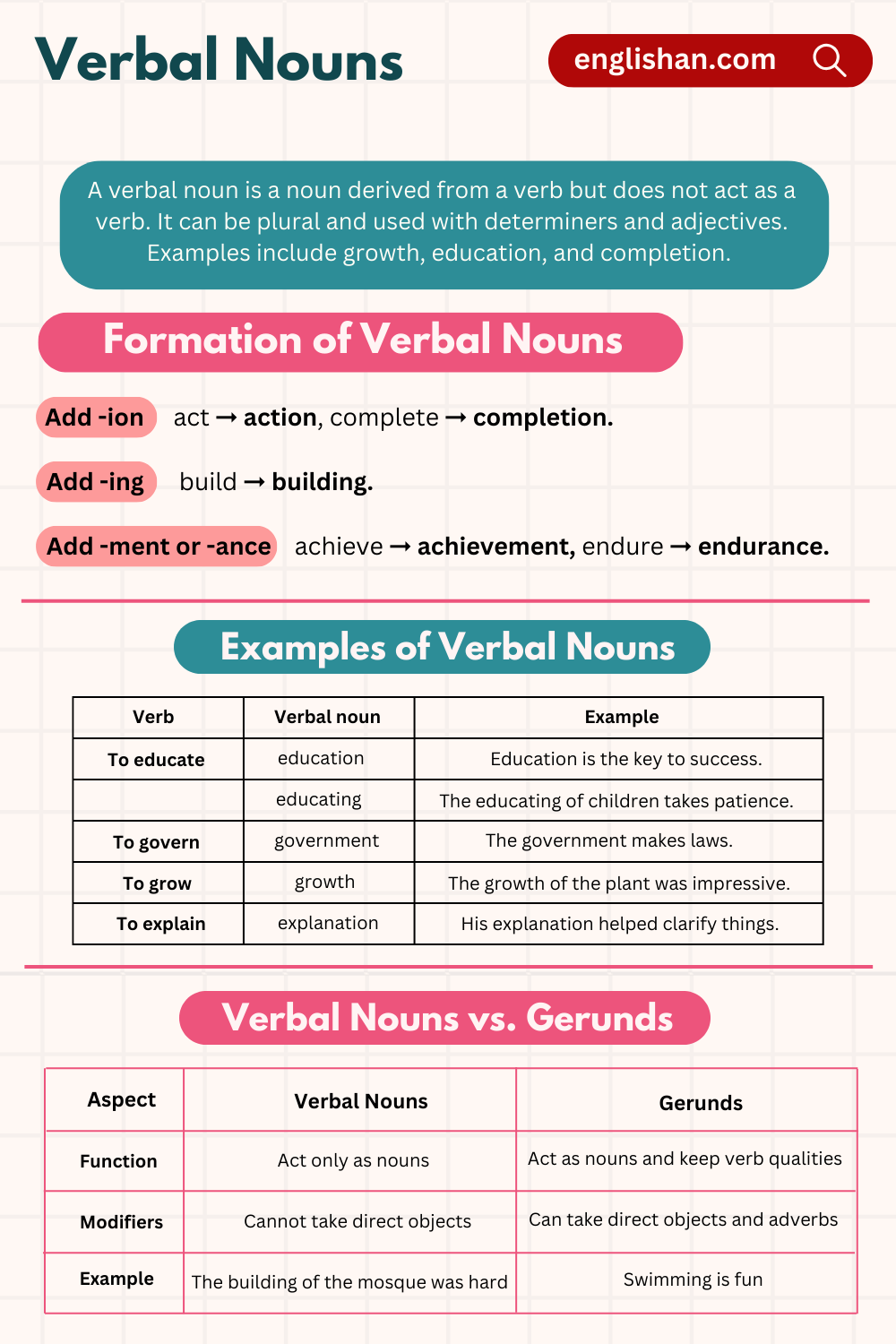
A verbal noun is a noun formed from a verb that no longer behaves like a verb. In the sentence The building of the mosque took years, the word building is a verbal noun. It names the process as a noun, accepts the determiner the, and is followed by the prepositional phrase of the mosque. Replace building with construction and the sentence still holds together. That swap test is one of the fastest ways to check whether a word has become fully nominal.
Two properties give the word away every time.
- It accepts a determiner and an adjective: the slow building, a careful reading, my recent decision.
- It is followed by a prepositional phrase, most commonly of + noun: the arrival of the guests, the killing of the tyrant, the writing of the book.
Anything that also accepts an adverb, takes a direct object, or refuses a plural is a gerund, not a verbal noun.
How Verbal Nouns Are Formed
Verbal nouns arrive in English through several derivational routes. The recurring suffixes fall into a fixed set; conversion (using the verb form as a noun with no change at all) rounds it out. Each row pairs a verb with its verbal noun and one working sentence.
| Suffix | Verb → Verbal noun | Sentence |
|---|---|---|
| -ion | Discuss → discussion | The discussion of the budget ran late. |
| -ation | Explore → exploration | The exploration of the caves took three weeks. |
| -ment | Move → movement | The movement of the goods across the border was tracked. |
| -sion | Decide → decision | Her decision on the safety question surprised the panel. |
| -al | Arrive → arrival | Concorde’s noisy arrival caught everyone’s attention. |
| -ence | Prefer → preference | His preference for early meetings shaped the office culture. |
| -ance | Accept → acceptance | Their acceptance of the offer settled the negotiation. |
| -ure | Depart → departure | The departure of the last train left me stranded. |
| -ing | Build → building | Historian John Robert Seeley wrote of “the building of the New Jerusalem.” |
| Conversion | Run → a run, cook → the cook | The cook served the room; a morning run cleared his head. |
Conversion is the one route that does not change the shape of the word. Verbs like run, cook, and love function as verbal nouns with no suffix at all. The verbal noun and its source verb look identical, and only the surrounding grammar reveals which form is present.
The Two Tests: How to Spot a Verbal Noun
Two behavioral tests settle every verbal-noun-versus-gerund case in under five seconds.
Test 1: Adjective or adverb? A verbal noun accepts an adjective (a slow building, a careful reading). A gerund accepts an adverb (slowly building, carefully reading). Put both modifier types in front of the word; the one that reads naturally tells you the form.
- A slow building of trust is worth the wait. (verbal noun; adjective slow)
- Slowly building trust takes patience. (gerund; adverb slowly)
Test 2: Prepositional phrase or direct object? A verbal noun is followed by a prepositional phrase, most commonly of + noun. A gerund is followed by a direct object with no preposition.
- The killing of the tyrant shocked the region. (verbal noun; of the tyrant is a prepositional phrase)
- Killing the tyrant shocked the region. (gerund; the tyrant is a direct object)
Both tests point the same way. When one gives an ambiguous answer, run the other. If either test fires the gerund signal, the word is a gerund.
Verbal Nouns in Real Sentences
Historian John Robert Seeley wrote: “No man saw the building of the New Jerusalem.” The word building here is a verbal noun. Test 1 fires: the slow building is grammatical, the slowly building is not. Test 2 fires: of the New Jerusalem is a prepositional phrase, not a direct object.
A second worked demonstration: The slow arrival of the guests kept the host waiting at the door. The verbal noun arrival takes the adjective slow and is followed by the prepositional phrase of the guests. English rejects both the slowly arrival (adverb modifier) and the arrival the guests (direct object). Both tests fire cleanly.
Three more working sentences from ordinary editorial writing:
- The signing of the treaty ended the conflict.
- Her reading of the manuscript uncovered two errors.
- The movement of capital across borders drives modern finance.
In each case, the verbal noun accepts the definite article, allows an adjective (swift signing, close reading, steady movement), and is followed by a prepositional phrase.
Verbal Nouns vs Gerunds
Both come from a verb; both function as a noun in a sentence. Their behavior splits along five lines.
| Feature | Verbal noun | Gerund |
|---|---|---|
| Modifier | Adjective (a careful reading) | Adverb (carefully reading) |
| Follower | Prepositional phrase (of the report) | Direct object (the report) |
| Plural form | Accepted (buildings, readings) | Not accepted |
| Determiner | Accepted (the, a, my) | Rarely accepted |
| Ending | Various (-ion, -ment, -al, -ing, conversion) | Always -ing |
Three paired sentences show the split at work.
- A bad drawing of a dog is not acceptable for the project. (verbal noun; bad is an adjective, of a dog is a prepositional phrase)
- Badly drawing a dog is not acceptable for the project. (gerund; badly is an adverb, a dog is a direct object)
- The loud singing woke the neighbors. (verbal noun)
- Singing loudly woke the neighbors. (gerund)
- Her writing on tax reform influenced two governments. (verbal noun)
- Writing quickly, she finished before dawn. (participle, not a gerund; the sentence shows how the -ing ending crosses categories)
When the word ends in -ing, the sentence around it decides which form is present. The modifier and the follower are the deciding signals.
Process vs Product: The Real Distinction
The sharpest single distinction on this rule is this: a gerund names the process or the act of doing something; a verbal noun names the result or the product of that act. The distinction holds even when the two words look identical.
- Translating poetry is difficult. (gerund; the act of translation as an ongoing activity)
- Her translation of Rimbaud is excellent. (verbal noun; the finished work she produced)
- Arriving by plane during a storm is a nerve-wracking experience. (gerund; the ongoing action)
- The plane’s arrival was delayed by fog. (verbal noun; the completed event)
- Building a case takes months. (gerund; the process of assembling)
- The building at the corner of Fifth and Main is a landmark. (verbal noun; the physical result)
Reading a sentence for what the noun refers to (an act in progress or a finished product) resolves most identical-form cases without any grammar analysis. When the referent has physical form, a completion date, or a named producer, the word is almost certainly a verbal noun.
The Four-Way Spectrum: Deverbal Noun, Verbal Noun, Gerund, Participle
Four verb-derived forms exist in English, ranked on a spectrum from most nominal to most verbal. Each position has its own behavior and its own limits.
Deverbal noun (most nominal). A regular noun that came from a verb long ago and no longer shows any verbal trace. A building, the discovery, my decision, the love. It accepts every noun behavior and none of the verb ones.
Verbal noun. Behaves as a full noun, accepts adjectives and prepositional phrases, allows a plural where the sense fits, and stays close in meaning to the verb it came from. The building of the mosque, the killing of the tyrant, a slow reading of the report.
Gerund. A noun that retains some verb behavior. It fills a noun slot but still takes an adverb and a direct object. Killing tyrants is dangerous, reading quickly saves time.
Present participle (most verbal). Not a noun at all. Works as an adjective (the running water, the fallen leaves) or as part of a verb phrase (she is running).
The scale reads left to right on the nominal-to-verbal axis. A verbal noun falls closer to the noun end; a gerund falls closer to the verb end. Naming the position before writing the sentence prevents most learner mistakes.
When to Use Verbal Nouns (and When Not to)
Verbal nouns add precision to formal prose and drain energy from editorial prose when overused. Both effects are real, and the choice depends on register.
In academic and legal writing, a verbal noun packages an action into a single grammatical unit that later clauses reference without ambiguity. The decision of the court affected every subsequent case names the ruling as an object other clauses act on. Rewriting it as When the court decided, every subsequent case was affected loses the anchoring noun the surrounding prose needs.
In editorial and journalistic prose, the same construction weakens sentences. The technical name for this move is nominalization: turning a verb into a noun and losing the verb’s action force. Heavy verbal-noun use produces stiff, boring prose because the reader loses the verb’s energy. Compare:
- Nominalized: The implementation of the policy resulted in a reduction of complaints.
- De-nominalized: After the company implemented the policy, complaints dropped.
The second sentence has two live verbs (implemented, dropped) and one live subject (the company). The first sentence has none of those and reads twice as heavy for half the substance.
A working rule of thumb. Use a verbal noun where the sentence needs a stable object for other clauses to reference. Rewrite it into an active verb where the sentence needs momentum. Both moves are correct English; the register decides.
Common Mistakes with Verbal Nouns
Five errors show up repeatedly in learner writing. Each has a fast fix.
1. Attaching a direct object to a verbal noun.
- The reading the book was pleasant. ❌
- The reading of the book was pleasant. ✅ (verbal noun with prepositional phrase)
- Reading the book was pleasant. ✅ (gerund with direct object)
2. Modifying a verbal noun with an adverb.
- The quickly reading of the report impressed the panel. ❌
- The quick reading of the report impressed the panel. ✅
3. Refusing a plural when the sense allows it.
- Her writing on tax reform influenced two governments. (singular reference)
- Her writings on tax reform influenced two governments. (plural, when several written works exist)
4. Mixing up identical -ing forms.
- The building took years. (ambiguous: the act of constructing, or the completed edifice?)
- The building of the mosque took years. (verbal noun, unambiguous)
- The building was completed in 2020. (deverbal noun, unambiguous)
The prepositional phrase or the surrounding sentence resolves the ambiguity every time.
5. Choosing a verbal noun where a live verb reads stronger.
- The completion of the project was achieved by the team last week. ❌ (heavy nominalization)
- The team completed the project last week. ✅ (live verb, active subject)
Quick Reference
| Feature | Verbal noun | Gerund |
|---|---|---|
| Origin | A verb | A verb |
| Function | Full noun | Noun with verb-like traits |
| Modifier accepted | Adjective (careful reading) | Adverb (carefully reading) |
| Follower accepted | Prepositional phrase (of the report) | Direct object (the report) |
| Plural | Yes (buildings, readings) | No |
| Determiner | Yes (the, a, my) | Rare |
| Ending | -ion, -ment, -al, -ence, -ance, -ure, -ing, conversion | Always -ing |
| Names | The product or event | The act or process |
FAQs
A verbal noun is a noun derived from a verb that behaves as a full noun with no verb-like grammatical behavior. It accepts adjectives and prepositional phrases, allows plurals where the sense fits, and never takes a direct object. The building of the mosque took years uses building as a verbal noun.
A verbal noun is modified by an adjective and followed by a prepositional phrase (a careful reading of the report). A gerund is modified by an adverb and takes a direct object (carefully reading the report). Both derive from verbs, but the gerund keeps verb-like behavior and the verbal noun does not.
No. Verbal nouns take many endings: -ion (discussion), -ation (exploration), -ment (movement), -sion (decision), -al (arrival), -ence (preference), -ance (acceptance), -ure (departure), and -ing (building). Some verbs form verbal nouns by conversion, with no suffix change at all (a run, the cook).
Run two behavioral tests. Put an adjective and an adverb in front of the word; the modifier that reads naturally reveals the form. Then look at what follows: a prepositional phrase (of + noun) signals a verbal noun; a direct object signals a gerund.
Not quite. Every verbal noun is a nominalization, but not every nominalization is called a verbal noun. Editors use nominalization for any noun formed from a verb or adjective when a live verb would read stronger. Wordrake and Emma Darwin both warn writers against heavy nominalization in editorial prose.
The recurring set is -ion, -ation, -ment, -sion, -al, -ence, -ance, -ure, and -ing, drawn from Cambridge Dictionary and standard morphology references. Conversion (using the verb form as a noun with no suffix) rounds out the routes.
Yes. Where the sense allows countable use, the verbal noun takes a regular plural: buildings, readings, writings, arrivals, decisions, achievements. A gerund does not pluralize, and that behavior is one of the fastest ways to tell the two apart.
A deverbal noun is a noun that came from a verb but retains no verb-like behavior at all, placing it further from the verb end of the spectrum than the verbal noun. Building (the physical structure), discovery, decision, and love (the noun) are deverbal nouns. Grammarians rank the four verb-derived forms as deverbal noun, verbal noun, gerund, and present participle on the nominal-to-verbal scale.
You May Also Like
Verbal Nouns Quiz
Verbal Nouns
Name the part of speech.
In 'The building is tall', 'building' is a ___.
'Building' names a thing and takes 'the', so it works as a noun.
a verbal noun names the action or result and works as a noun
The building is tall.
Which is a verbal noun formed with a suffix?
'Move' plus -ment forms the verbal noun 'movement'.
suffixes like -ment and -tion form verbal nouns
move -> movement
Choose the verbal-noun use.
An article and adjective mark 'painting' as a noun.
a verbal noun accepts articles and adjectives
The careful painting took hours.
How does 'Reading' work here?
The reading of the will took place.
'The reading of' signals full noun behaviour.
with 'the' and 'of', an -ing word behaves as a verbal noun
The reading of the will took place.
Choose the verbal-noun sentence.
'The singing of' takes an article and 'of', so it is a verbal noun.
articles and 'of' signal a verbal noun over a gerund
The singing of the choir was lovely.
Form the verbal noun.
The verbal noun from 'arrive' is ___.
'Arrive' plus -al forms the verbal noun 'arrival'.
some verbs form verbal nouns with -al
arrive -> arrival
Name the part of speech at work.
In 'Swimming is fun', 'Swimming' works as a ___.
'Swimming' names an action but stands as the subject, so it works as a noun.
an -ing form used as a noun is a verbal noun
Swimming is fun.
Form the verbal noun.
The verbal noun of 'arrive' is ___.
'Arrival' names the act of arriving as a thing.
many verbs form a noun: arrive/arrival
The arrival of the train was late.
Name the part of speech at work.
In 'I enjoy reading', 'reading' works as a ___.
'Reading' is the object of 'enjoy', so it works as a noun.
a gerund names an action and works as a noun
I enjoy reading.
Type the verbal noun of the word in brackets.
Their ___ (decide) surprised everyone.
'Decision' is the noun formed from the verb 'decide'.
decide/decision
Their decision surprised everyone.
True or false?
A verbal noun names an action but works as a noun.
A verbal noun carries the sense of an action while filling a noun's role.
verbal nouns name actions as things
Painting relaxes her.
Form the verbal noun.
The verbal noun of 'move' is ___.
'Movement' names the act of moving as a thing.
move/movement
The movement of the crowd was slow.
Name the part of speech at work.
In 'Running is healthy', 'Running' works as a ___.
'Running' names an activity and stands as the subject, so it works as a noun.
an -ing form used as a noun is a verbal noun
Running is healthy.
Form the verbal noun.
The verbal noun of 'depart' is ___.
'Departure' names the act of departing as a thing.
depart/departure
The departure was delayed.
Name the part of speech at work.
In 'She loves painting', 'painting' works as a ___.
'Painting' is the object of 'loves', so it works as a noun.
a gerund names an action and works as a noun
She loves painting.
Type the verbal noun of the word in brackets.
Their ___ (discover) changed the field.
'Discovery' is the noun formed from the verb 'discover'.
discover/discovery
Their discovery changed the field.
Form the verbal noun.
The verbal noun of 'choose' is ___.
'Choice' names the act of choosing as a thing.
choose/choice
The choice was hers.
True or false?
In 'The building is tall', 'building' works as a noun.
'Building' names a thing here and takes the subject role, so it works as a noun.
an -ing word can settle into a plain noun
The building is tall.
Form the verbal noun.
The verbal noun of 'know' is ___.
'Knowledge' names what is known as a thing.
know/knowledge
Her knowledge of history runs deep.
Name the part of speech at work.
In 'Smoking is banned here', 'Smoking' works as a ___.
'Smoking' names an activity and stands as the subject, so it works as a noun.
an -ing form used as a subject is a verbal noun
Smoking is banned here.
Turn on JavaScript for the interactive quiz. The full practice set is shown above.